Page 167 of 280
FOR PLEASANT DRIVING
6–27
Handling of cassette tapesEH02B-Ad
CAUTION
To maintain the cassette tape player
in good condition, observe the follow-
ing precautions.
(1) Do not use cassette tapes longer
than C-90, otherwise sound qual-
ity and tape durability will be
greatly diminished.
(2) Keep the cassette tape in its case
to protect it from tape looseness
and dust when it is not used.
(3) Keep the cassette tape away from
direct sunlight, heat and magnet-
ic fields such as the radio
speakers.
(4) Before inserting the cassette,
make sure that the label is ad-
hered securely to the cassette.
(5) A loose tape should be corrected
before use.
CAUTION
(6) Do not oil any part of the player
and do not insert any object other
than tape cassettes into the slot,
or the tape player may be dam-
aged. Also, avoid inserting your
fingers into the slot. There is a
danger of being burned by the hot
internal parts.
H12F004a
Handling of compact discsEH12E-Ah
(1) This CD player allows use of only the
compact discs with the mark shown in
the illustration above.
(Playback of CD–R discs may cause
problems. CD–RW discs cannot be
played.)
The use of heart-shaped, octagonal, or
any other non-circular discs will result in
the CD player being damaged.
(2) When the temperature suddenly rises,
i.e. immediately after the heater is
turned on in cold weather, dew con-
densation on the disc or in the player
might occur resulting in failure of oper-
ation. In such a case, allow some time
before use.
(3) When the CD player is subjected to viol-
ent vibration as during off-road driving,
detracking may result.
Page 190 of 280
FOR PLEASANT DRIVING
6–50
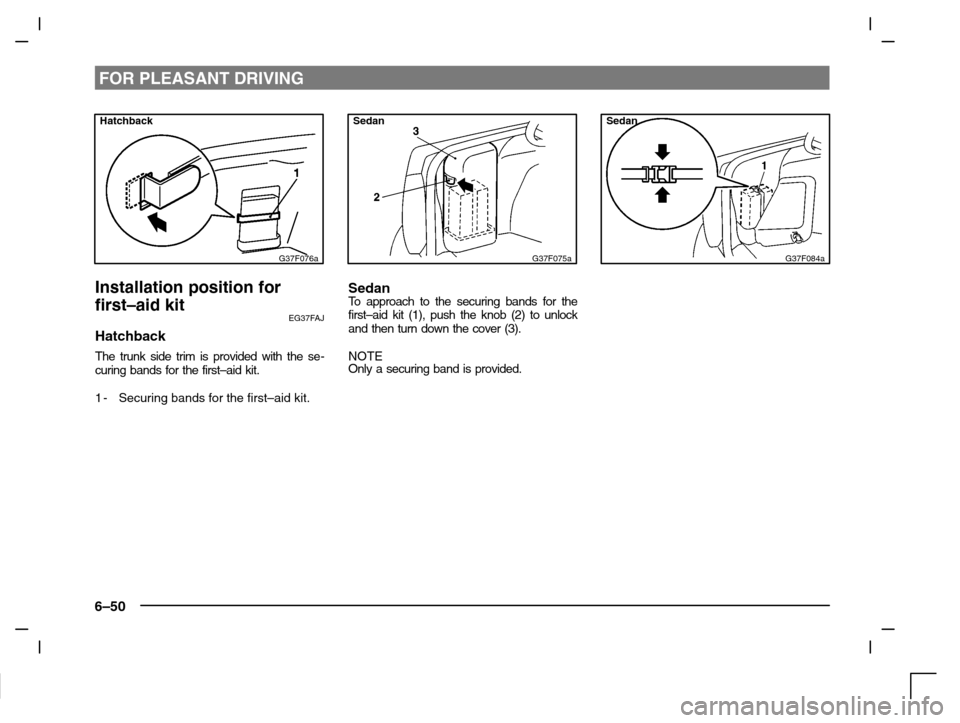
Hatchback
G37F076a
Installation position for
first–aid kit
EG37FAJ
Hatchback
The trunk side trim is provided with the se-
curing bands for the first–aid kit.
1-Securing bands for the first–aid kit.
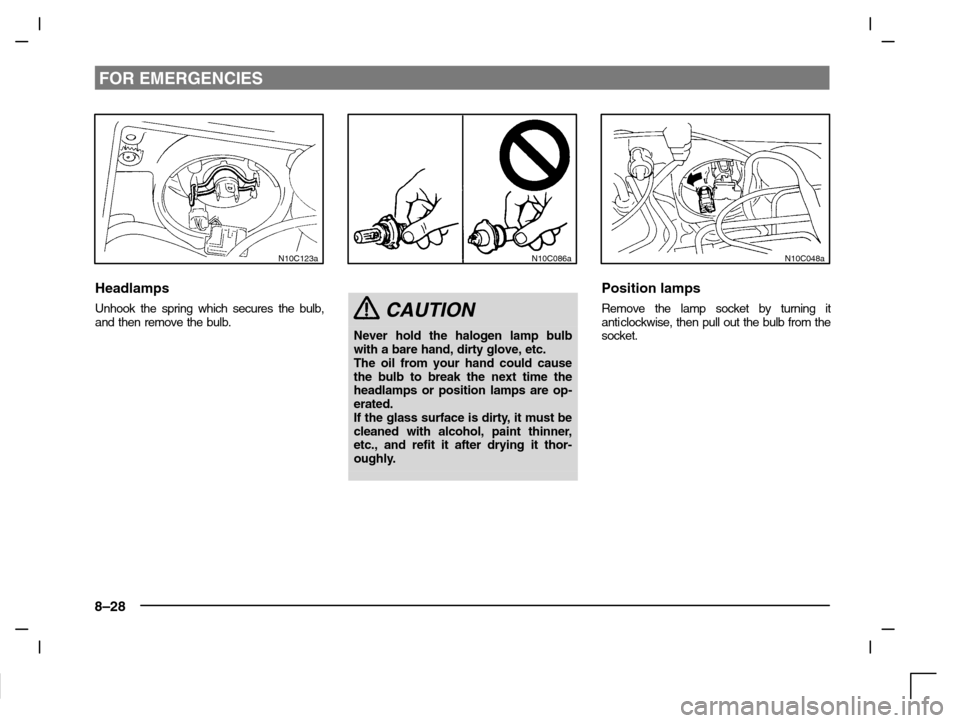
Sedan
G37F075a
SedanTo approach to the securing bands for the
first–aid kit (1), push the knob (2) to unlock
and then turn down the cover (3).
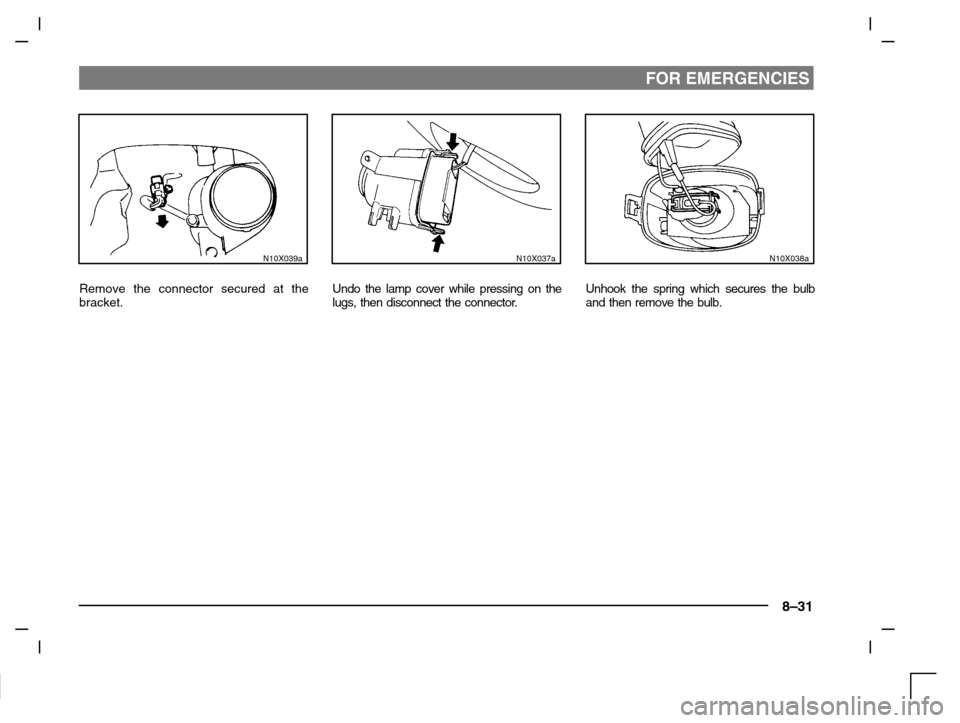
NOTE
Only a securing band is provided.
Sedan
G37F084a
Page 204 of 280

FOR EMERGENCIES
8–4
N21C026a
JackEN21C - Ba
1-To remove
Turn the shaft end so that the jack re-
tracts and detach it from fixing bracket
(A).
2-To store
Turn the shaft end by hand to expand
the jack until it is secured firmly in posi-
tion.
Jacking up the vehicleEN22ALEb
1. Park the vehicle on a level and stable
ground.
2. Activate the hazard flashers and turn
the ignition key to the “LOCK” position.
3. Set the parking brake firmly, move the
gearshift lever (manual transmission)
to the 1st position or move the selector
lever (automatic transmission) to the
“P” (PARK) position.
N22A220a
4. Apply a chock or block (A) at the tyre
diagonally opposite the tyre (B) to be
changed.
CAUTION
Be sure to apply a chock to the rel-
evant tyre when jacking up the ve-
hicle. If the vehicle moves while
jacked up, the jack could slip out of
position, leading to an accident.
NOTE
(1)The chock shown in the illustration is
not supplied with the vehicle. It is rec-
ommended one be obtained and car-
ried for use if required.
(2) If a chock is not available, use a stone
or any other object that is large enough
to hold the wheel in position.
Page 207 of 280

FOR EMERGENCIES
8–7
The spare wheel is stored beneath the floor
board of the luggage compartment; to re-
move it, using the wheel nut wrench, remove
the bolt securing the spare wheel, and take
out the spare wheel.Compact spare wheel*
The compact spare tyre is designed to save
space in the luggage compartment and its
lighter weight makes it easier to use if a flat
tyre occurs.
CAUTION
(1) The pressure should be period-
ically checked and maintained at
the specified pressure while the
tyre is stowed.
Driving with an insufficient tyre
pressure can lead to an accident.
If you have no choice but to drive
with an insufficient tyre pressure,
keep your speed down and inflate
the tyre to the correct pressure as
soon as possible. (Refer to “Tyre
inflation pressure” on page
9–12.)
(2) The compact spare wheel is for
temporary use only and should
be removed as soon as the orig-
inal wheel can be repaired or re-
placed.
Flange nuts are used for some
type of aluminium wheel. These
wheel nuts can be used temporar-
ily on the compact spare wheel.
CAUTION
(3) The vehicle must not be driven at
speeds in excess of 80 km/h while
using the compact spare wheel.
(4) The compact spare tyre is not so
good as the standard spare tyre
in controllability and stability.
When the compact spare tyre is
used, avoid quick starts, sudden
braking and sharp steering.
(5) Avoid driving through automatic
vehicle washers and over ob-
stacles that could possibly dam-
age the vehicle’s undercarriage.
Because the compact spare
wheel is smaller than the original
wheel, the ground clearance is
slightly reduced.
(6) The compact spare wheel is spe-
cifically designed for your vehicle
and it should not be used on any
other vehicle.
Page 209 of 280
FOR EMERGENCIES
8–9
N23B083a
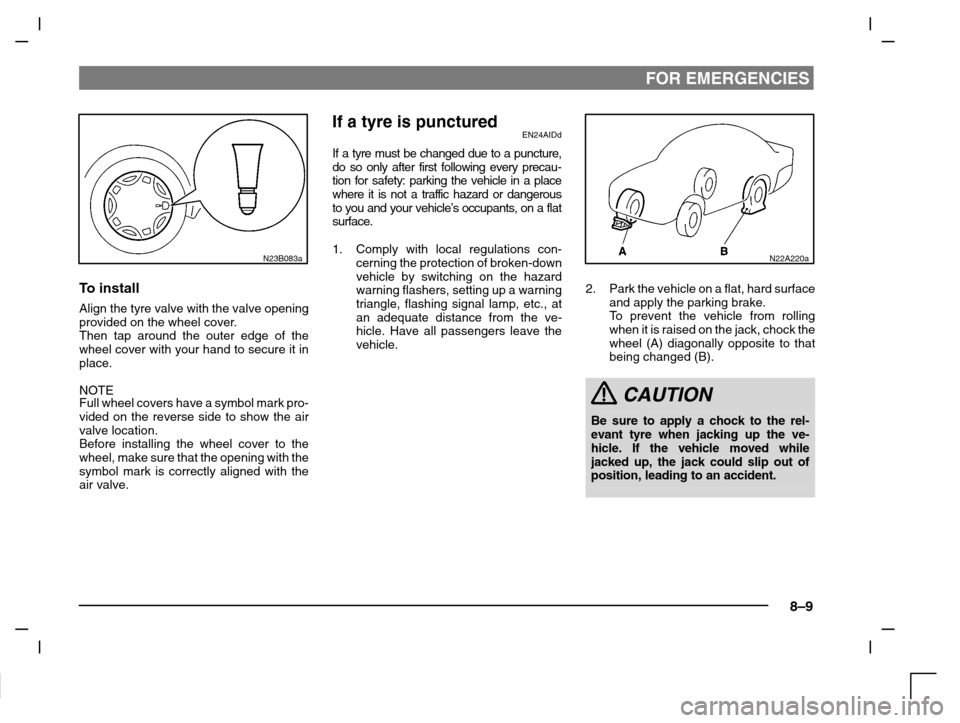
To install
Align the tyre valve with the valve opening
provided on the wheel cover.
Then tap around the outer edge of the
wheel cover with your hand to secure it in
place.
NOTE
Full wheel covers have a symbol mark pro-
vided on the reverse side to show the air
valve location.
Before installing the wheel cover to the
wheel, make sure that the opening with the
symbol mark is correctly aligned with the
air valve.
If a tyre is puncturedEN24AIDd
If a tyre must be changed due to a puncture,
do so only after first following every precau-
tion for safety: parking the vehicle in a place
where it is not a traffic hazard or dangerous
to you and your vehicle’s occupants, on a flat
surface.
1. Comply with local regulations con-
cerning the protection of broken-down
vehicle by switching on the hazard
warning flashers, setting up a warning
triangle, flashing signal lamp, etc., at
an adequate distance from the ve-
hicle. Have all passengers leave the
vehicle.
N22A220a
2. Park the vehicle on a flat, hard surface
and apply the parking brake.
To prevent the vehicle from rolling
when it is raised on the jack, chock the
wheel (A) diagonally opposite to that
being changed (B).
CAUTION
Be sure to apply a chock to the rel-
evant tyre when jacking up the ve-
hicle. If the vehicle moved while
jacked up, the jack could slip out of
position, leading to an accident.
Page 215 of 280

FOR EMERGENCIES
8–15
Towing the vehicle by a tow truck
CAUTION
(1) This vehicle cannot be towed by
a tow truck using Type A equip-
ment to prevent the bumper from
deformation. If this vehicle is
towed, use Type B, Type C, Type
D or Type E equipment.
(2) In case the vehicle with automatic
transmission must be towed far-
ther than 30 km, transport the ve-
hicle with all wheels off the
ground (Type B or C) or with front
wheels off the ground (Type D).
(3) If the transmission is not operat-
ing, transport the vehicle with all
wheels off the ground (Type B or
C).
Towing with front wheels off the
ground (Type D)
Release the parking brake. Place the gear-
shift lever (manual transmission) or the se-
lector lever (automatic transmission) in the
“N” (NEUTRAL) position.
Towing with rear wheels off the
ground (Type E)
Place the gearshift lever (manual trans-
mission) or the selector lever (automatic
transmission) in the “N” (NEUTRAL) posi-
tion.
Turn the ignition key to the “ACC” position
and secure the steering wheel in a straight-
ahead position with a rope, etc.
Never place the ignition key in the “LOCK”
position. It is dangerous as the steering
wheel may lock.
Engine overheatingEN26A - Ub
If the water temperature gauge indication re-
mains in the overheating zone for a long
time, the engine may be overheating. If this
occurs, take the following corrective
measures :
1. Stop the vehicle in a safe place.
Page 228 of 280
FOR EMERGENCIES
8–28
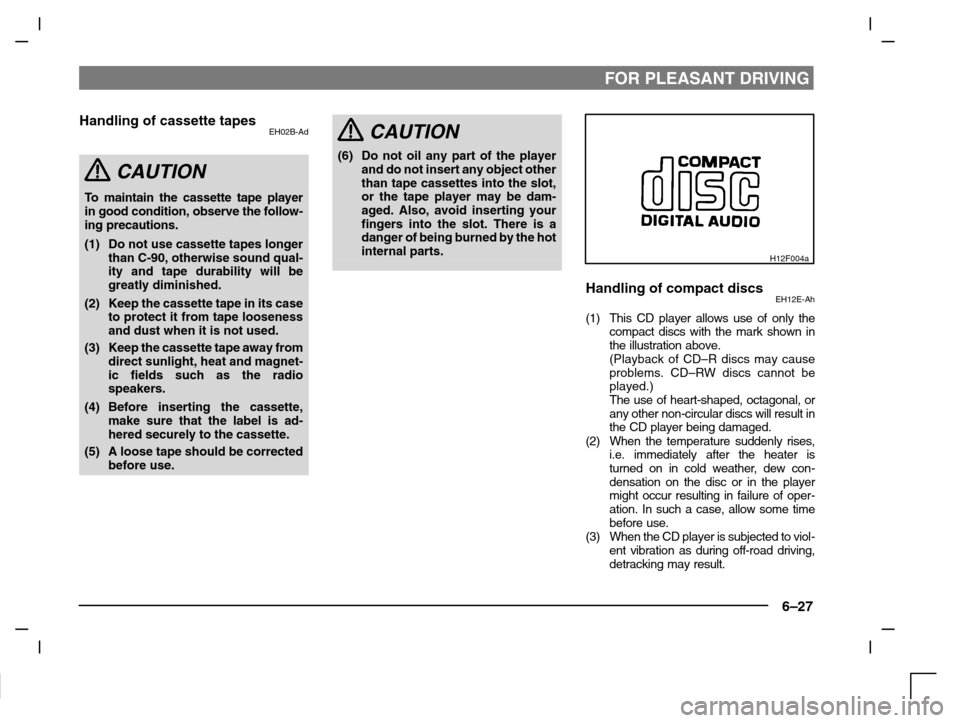
N10C123a
Headlamps
Unhook the spring which secures the bulb,
and then remove the bulb.
N10C086a
CAUTION
Never hold the halogen lamp bulb
with a bare hand, dirty glove, etc.
The oil from your hand could cause
the bulb to break the next time the
headlamps or position lamps are op-
erated.
If the glass surface is dirty, it must be
cleaned with alcohol, paint thinner,
etc., and refit it after drying it thor-
oughly.
N10C048a
Position lamps
Remove the lamp socket by turning it
anti clockwise, then pull out the bulb from the
socket.
Page 231 of 280
FOR EMERGENCIES
8–31
N10X039a
Remove the connector secured at the
bracket.
N10X037a
Undo the lamp cover while pressing on the
lugs, then disconnect the connector.
N10X038a
Unhook the spring which secures the bulb
and then remove the bulb.