Page 241 of 280

MAINTENANCE
9–3
Petrol-powered vehicles (1600, 1800 models)
M03A027a
This check must be carried out with the ve-
hicle on a flat level surface with the engine at
normal operating temperature, but NOT run-
ning. If the engine has been running, wait for
a few minutes to allow the engine oil to return
to the oil pan to ensure an accurate
measurement.
Remove the dipstick and wipe it with a clean
cloth, re - insert the dipstick as far as it will go.
Remove the dipstick and check the oil level.
This should always be within the range as
indicated.
If the oil level is below the specified limit, re-
move the filler cap and add oil. Then recheck
the level. When satisfied that the level is cor-
rect, refit the oil filler cap making sure that it
is securely fitted.
Diesel-powered vehicle
M03A090a
Use only the recommended oils with an API
or ACEA classification as specified in this
manual.
NOTE
(1)Engine oil consumption is greatly in-
fluenced by payload, engine speed,
etc. It may reach 1.0 lit./1,000 km de-
pending on style of driving.
(2) The engine oil will deteriorate rapidly if
the vehicle is subjected to severe condi-
tions (for example, repeated operation
on rough roads, in mountainous re-
gions, on roads with many uphill and
downhill gradients, or over short dis-
tances). Consequently, the oil will re-
quire earlier replacement.
(3) For handling of used engine oils, refer to
page
1–11.
Petrol-powered vehicles
M03B037a
Selection of engine oil
(petrol-powered vehicle)
EM03B-Of
(1) Select engine oil of the proper SAE vis-
cosity number according to the atmos-
pheric temperature.
For 0W-30, 5W-30, 0W-40 and 5W-40
viscosity grade, use only ACEA A3
classification.
(2) Use engine oil conforming to the follow-
ing classification:
�ACEA classification:
“For service A1, A2 or A3”
�API classification:
“FOR SERVICE SG” or higher
NOTE
Use of additives is not recommended since
they may reduce the effectiveness of addi-
tives already included in the engine oil. It
may result in failure of the mechanical as-
sembly.
Page 246 of 280
MAINTENANCE
9–8
WARNING
(1) Keep sparks, cigarettes, and
flames away from the battery be-
cause the battery could explode.
(2) The battery electrolyte is extremely
caustic. Do not allow it to come in
contact with your eyes, skin, cloth-
ing, or the painted surfaces of the
vehicle. Spilled electrolyte should
be flushed immediately with ample
amounts of water.
Irritation to eyes or skin from con-
tact with electrolyte requires im-
mediate medical attention.
(3) Ventilate when charging or using
the battery in an enclosed space.
CAUTION
(1) Never disconnect the battery with
the ignition switch in the “ON”
position; doing so could damage
the vehicle’s electrical compo-
nents.
(2) Never short - circuit the battery;
doing so could cause it to over-
heat and damage it.
CAUTION
(3) Always wear protective eye
goggles when working near the
battery.
(4) If the battery is to be
quick -charged, first disconnect
the battery cables.
(5) In order to prevent a short circuit,
be sure to disconnect the nega-
tive (–) terminal first.
(6) Keep it out of the reach of
children.
NOTE
(1) Keep the terminals clean. After the bat-
tery is connected, apply terminal protec-
tion grease. To clean the terminals, use
lukewarm water.
(2) Check to see if the battery is securely in-
stalled and cannot be moved during
travel. Also check each terminal for
tightness.
(3) When the vehicle is to be left unused for
a long period of time, remove the battery
and store it in a place where the battery
fluid will not freeze. The battery should
be stored only in a fully charged condi-
tion.
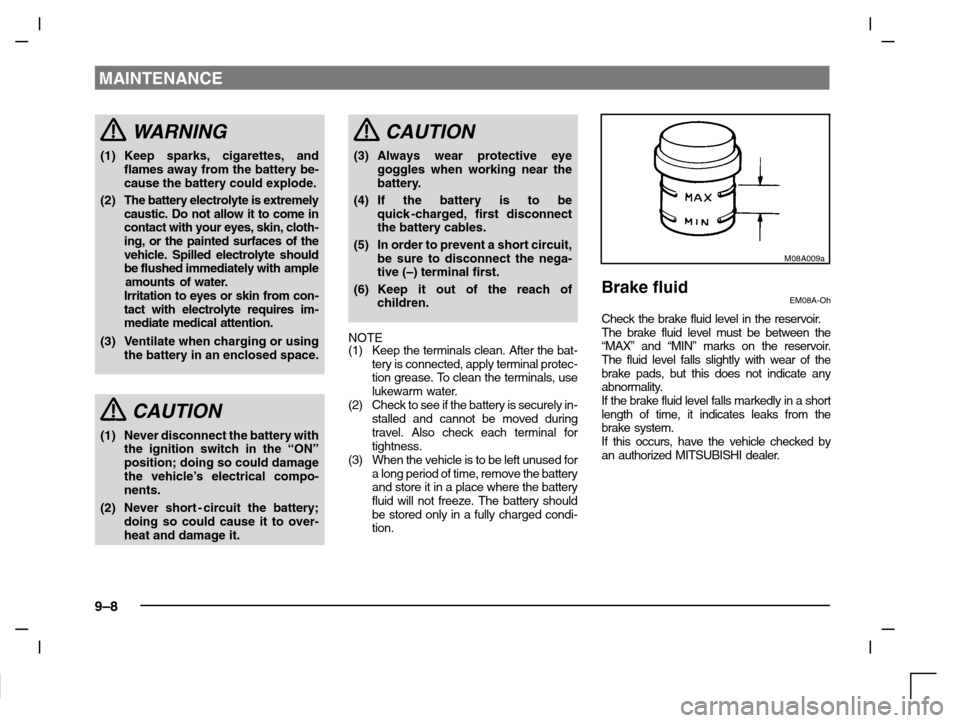
M08A009a
Brake fluidEM08A-Oh
Check the brake fluid level in the reservoir.
The brake fluid level must be between the
“MAX” and “MIN” marks on the reservoir.
The fluid level falls slightly with wear of the
brake pads, but this does not indicate any
abnormality.
If the brake fluid level falls markedly in a short
length of time, it indicates leaks from the
brake system.
If this occurs, have the vehicle checked by
an authorized MITSUBISHI dealer.
Page 254 of 280

MAINTENANCE
9–16
CAUTION
(8) Do not install a tyre chain on an
emergency wheel which is com-
pact in size. If one of the front
wheels is punctured, replace it
with one of the rear wheels and in-
stall the compact spare wheel in
that place before fitting a tyre
chain.
(9) An aluminium wheel can be dam-
aged by a tyre chain while driving.
When fitting a tyre chain on an
aluminium wheel, take care that
any part of the chain and fitting
cannot be brought into contact
with the disc wheel.
(10) On vehicles with wheel covers,
remove the wheel covers before
installing a tyre chain, otherwise
they may be damaged by the tyre
chain. (Refer to page 8–8)
(11) When installing or removing a
tyre chain, take care that hands
and other parts of your body are
not injured by the sharp edges of
the vehicle body.
(12) Install the chains only on the front
tyres and tighten them as tightly
as possible with the ends secure-
ly fastened.
NOTE
The laws and regulations concerning the
use of tyre chains vary. Find out and follow
the laws and regulations in driving area. In
most countries, it is prohibited by the law to
use tyre chains on roads without snow.
Fuel, engine coolant, oil and
exhaust gas leakage
EM14A-Bd
Look under the body of your vehicle to check
for fuel, engine coolant, oil and exhaust gas
leaks.
WARNING
If you see a suspicious fuel leak or if
you smell fuel, do not operate the ve-
hicle; call your authorized MITSUBI-
SHI dealer for assistance.
Exterior and interior lamp
operation
EM35A-Ad
Operate the combination lamp switch to
check that all lamps are functioning properly.
If the lamps do not illuminate, the probable
cause is a blown fuse or defective lamp bulb.
Check the fuses first. If there is no blown
fuse, check the lamp bulbs.
For information regarding the inspection and
replacement of the fuses and the lamp
bulbs, refer to the section entitled “For
emergencies”.
If the fuses and bulbs are all OK, take the ve-
hicle to an authorized MITSUBISHI dealer
for inspection and repair.
Meter, gauge and indication/
warning lamp operation
Run the engine to check the operation of all
meters, gauges, and indication/warning
lamps.
If there is anything wrong, take the vehicle to
an authorized MITSUBISHI dealer for in-
spection.
Page 257 of 280

MAINTENANCE
9–19
L05A002a
3. Attach retainers (C) to a new wiper
blade.
4. Insert the wiper blade into the arm,
starting with the opposite end of the
blade from the stopper. Make sure the
hook (B) is fitted correctly in the
grooves in the blade.
NOTE
If retainers (C) are not supplied with the
new wiper blade, use the retainers from the
old blade.
L05A003a
5. Push the wiper blade until the hook (B)
engages securely with the stopper
(A).
Ventilation slotsEL06A-A
The ventilation slots in front of the wind-
screen should be brushed clear after a
heavy snowfall so that the operation of the
heating and ventilation systems will not be
impaired.
WeatherstrippingEL10A-Aa
To prevent freezing of the weatherstripping
on the doors, bonnet, etc., they should be
treated with silicone grease.
Additional equipment
(For regions where snow is
encountered)
EL14A-Ac
It is a good idea to carry a shovel or a
short - handled spade in the vehicle during
the winter so that you can clear away snow
if you get stranded. A small hand - brush for
sweeping snow off the vehicle and a plastic
scraper for the windscreen, side and rear
window are also useful.
Page:
< prev 1-8 9-16 17-24