Page 449 of 1111

Z05962
B02027
Turn
B02028
Move
B01995
Type A
A
Type BB
AB
Z05963
CORRECT WRONG WRONG CH±2
± CHARGING (2JZ±GE)CHARGING SYSTEM
1604 Author�: Date�:
2000 LEXUS GS300/GS400 (RM718U)
5. INSPECT DRIVE BELT
HINT:
A belt tensioner is used, so checking the belt tension is not nec-
essary.
(a) Visually check the drive belt for excessive wear, frayed
cords, etc.
If necessary, replace the drive belt.
HINT:
�Cracks on the rib side of a drive belt are considered ac-
ceptable. If the drive belt has chunks missing from the
ribs, it should be replaced.
�The drive belt tension can be released by turning the belt
tensioner clockwise.
(b) Check the belt tensioner operation.
�Check that the belt tensioner moves downward
when the drive belt is pressed down at the points in-
dicated in the illustration with approx. 98 N (10 kgf,
22.0 lbf) of force.
�Check the alignment of the belt tensioner pulley to
make sure the drive belt will not slip off the pulley.
If necessary, replace the belt tensioner.
�Check that the arrow mark on the belt tensioner falls
within area A of the scale.
If it is outside area A, replace the drive belt.
HINT:
�When a new belt is installed, it should lie within area B. If
not, the drive belt is not correct.
�After installing a drive belt, check that it fits properly in the
ribbed grooves.
�Check by hand to confirm that the belt has not slipped out
of the groove on the bottom of the pulley.
6. VISUALLY CHECK GENERATOR WIRING AND
LISTEN FOR ABNORMAL NOISES
(a) Check that the wiring is in good condition.
(b) Check that there is no abnormal noise from the generator
while the engine is running.
Page 450 of 1111

Z03473
Ammeter
Battery
VoltmeterGenerator Disconnect Wire
from Terminal B
B01656
Terminal F
± CHARGING (2JZ±GE)CHARGING SYSTEM
CH±3
1605 Author�: Date�:
2000 LEXUS GS300/GS400 (RM718U)
7. CHECK CHARGE WARNING LIGHT CIRCUIT
(a) Warm up the engine and then turn it off.
(b) Turn off all accessories.
(c) Turn the ignition switch ºONº. Check that the charge warn-
ing light is lit.
(d) Start the engine. Check that the light goes off.
If the light does not go off as specified, troubleshoot the charge
light circuit.
8. INSPECT CHARGING CIRCUIT WITHOUT LOAD
HINT:
If a battery/generator tester is available, connect the tester to
the charging circuit as per manufacturer's instructions.
(a) If a tester is not available, connect a voltmeter and amme-
ter to the charging circuit as follows:
�Disconnect the wire from terminal B of the genera-
tor, and connect it to the negative (±) probe of the
ammeter.
�Connect the positive (+) probe of the ammeter to
terminal B of the generator.
�Connect the positive (+) probe of the voltmeter to
terminal B of the generator.
�Ground the negative (±) probe of the voltmeter.
(b) Check the charging circuit as follows:
With the engine running from idling to 2,000 rpm, check
the reading on the ammeter and voltmeter.
Standard amperage: 10 A or less
Standard voltage: 13.2 ± 14.8 V
If the voltmeter reading is more than standard voltage, replace
the voltage regulator.
If the voltmeter reading is less than standard voltage, check the
voltage regulator and generator as follows:
�With terminal F grounded, start the engine and
check the voltmeter reading of terminal B.
�If the voltmeter reading is more than standard volt-
age, replace the voltage regulator.
�If the voltmeter reading is less than standard volt-
age, check the generator.
9. INSPECT CHARGING CIRCUIT WITH LOAD
(a) With the engine running at 2,000 rpm, turn on the high
beam headlights and place the heater blower switch at
ºHIº.
(b) Check the reading on the ammeter.
Standard amperage: 30 A or more
If the ammeter reading is less than the standard amperage, re-
pair the generator.
HINT:
If the battery is fully charged, the indication will sometimes be
less than standard amperage.
Page 464 of 1111
CO09W±03
± COOLING (2JZ±GE)COOLANT
CO±1
1539 Author�: Date�:
2000 LEXUS GS300/GS400 (RM718U)
COOLANT
INSPECTION
1. CHECK ENGINE COOLANT LEVEL AT RESERVOIR
The engine coolant level should be between the ºLOWº and ºFULLº lines, when the engine is cold.
If low, check for leaks and add ºToyota Long Life Coolantº or equivalent up to the ºFULLº line.
2. CHECK ENGINE COOLANT QUALITY
There should not be any excessive deposits of rust or scale around the radiator cap or radiator filler hole,
and the coolant should be free from oil.
If excessively dirty, replace the coolant.
Page 468 of 1111
CO0A5±01
P 1111 7
ProtrusionJiggle Valve
± COOLING (2JZ±GE)THERMOSTAT
CO±13
1551 Author�: Date�:
2000 LEXUS GS300/GS400 (RM718U)
INSTALLATION
1. PLACE THERMOSTAT IN WATER INLET
(a) Install a new gasket to the thermostat.
(b) Align the jiggle valve of the thermostat with the protrusion
of the water inlet.
2. INSTALL WATER INLET
Install the water inlet with the 2 nuts.
Torque: 9.0 N´m (90 kgf´cm, 80 in.´lbf)
3. FILL WITH ENGINE COOLANT
4. START ENGINE AND CHECK FOR COOLANT LEAKS
Page 470 of 1111
CO0A7±01
CO1242
Radiator Cap Tester
Radiator Cap
30° or More
B01882
Radiator Cap Tester
± COOLING (2JZ±GE)RADIATOR
CO±15
1553 Author�: Date�:
2000 LEXUS GS300/GS400 (RM718U)
ON±VEHICLE INSPECTION
1. REMOVE RADIATOR CAP
Remove the radiator cap from the radiator.
CAUTION:
To avoid the danger of being burned, do not remove the ra-
diator cap while the engine and radiator are still hot, as fluid
and steam can be blown out under pressure.
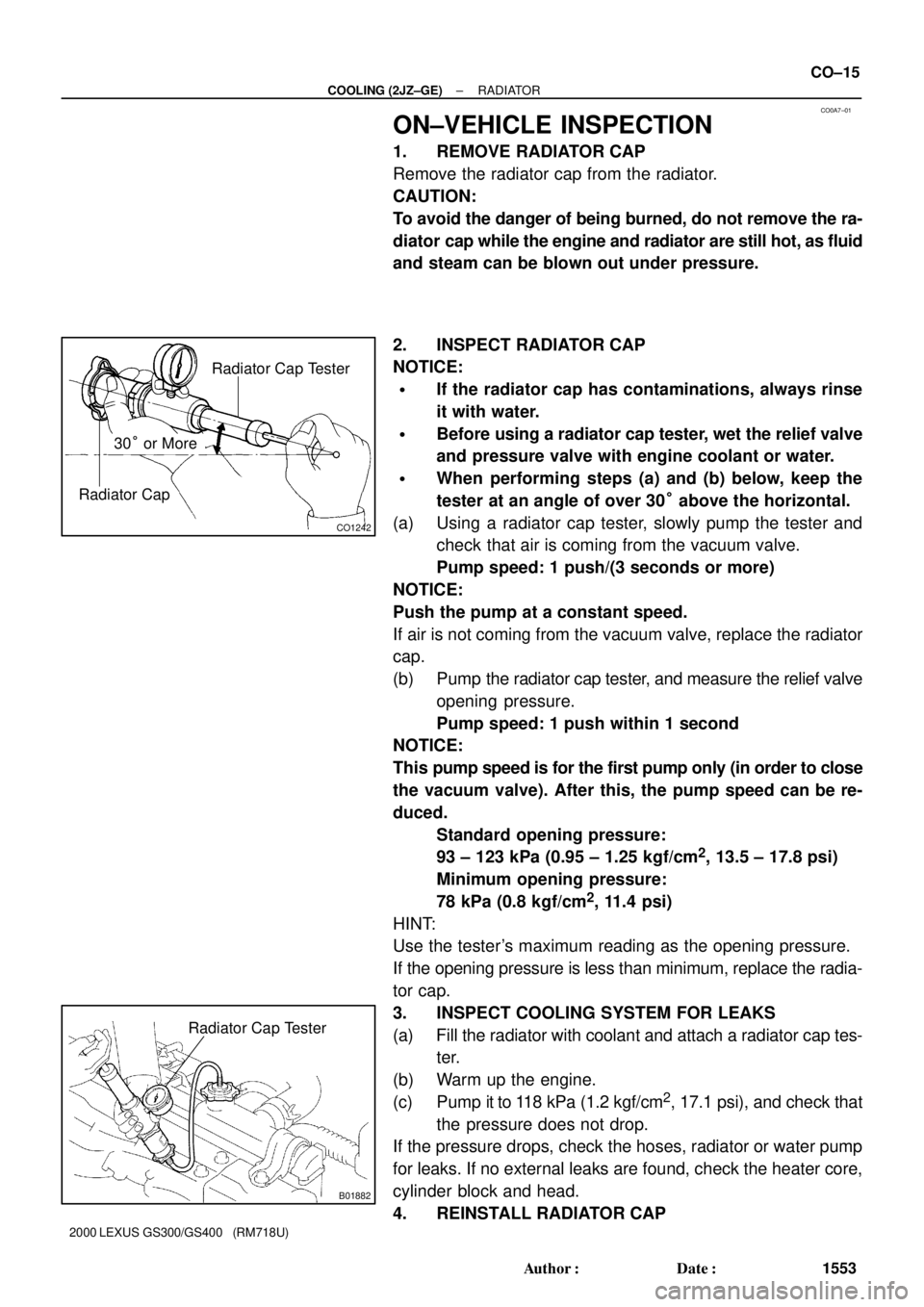
2. INSPECT RADIATOR CAP
NOTICE:
�If the radiator cap has contaminations, always rinse
it with water.
�Before using a radiator cap tester, wet the relief valve
and pressure valve with engine coolant or water.
�When performing steps (a) and (b) below, keep the
tester at an angle of over 30° above the horizontal.
(a) Using a radiator cap tester, slowly pump the tester and
check that air is coming from the vacuum valve.
Pump speed: 1 push/(3 seconds or more)
NOTICE:
Push the pump at a constant speed.
If air is not coming from the vacuum valve, replace the radiator
cap.
(b) Pump the radiator cap tester, and measure the relief valve
opening pressure.
Pump speed: 1 push within 1 second
NOTICE:
This pump speed is for the first pump only (in order to close
the vacuum valve). After this, the pump speed can be re-
duced.
Standard opening pressure:
93 ± 123 kPa (0.95 ± 1.25 kgf/cm
2, 13.5 ± 17.8 psi)
Minimum opening pressure:
78 kPa (0.8 kgf/cm
2, 11.4 psi)
HINT:
Use the tester's maximum reading as the opening pressure.
If the opening pressure is less than minimum, replace the radia-
tor cap.
3. INSPECT COOLING SYSTEM FOR LEAKS
(a) Fill the radiator with coolant and attach a radiator cap tes-
ter.
(b) Warm up the engine.
(c) Pump it to 118 kPa (1.2 kgf/cm
2, 17.1 psi), and check that
the pressure does not drop.
If the pressure drops, check the hoses, radiator or water pump
for leaks. If no external leaks are found, check the heater core,
cylinder block and head.
4. REINSTALL RADIATOR CAP
Page 475 of 1111
CO09X±03
Z07402
Drain Plug
Drain Plug
B01611
Drain Plug
Rubber
HoseConnect
CO±2
± COOLING (2JZ±GE)COOLANT
1540 Author�: Date�:
2000 LEXUS GS300/GS400 (RM718U)
REPLACEMENT
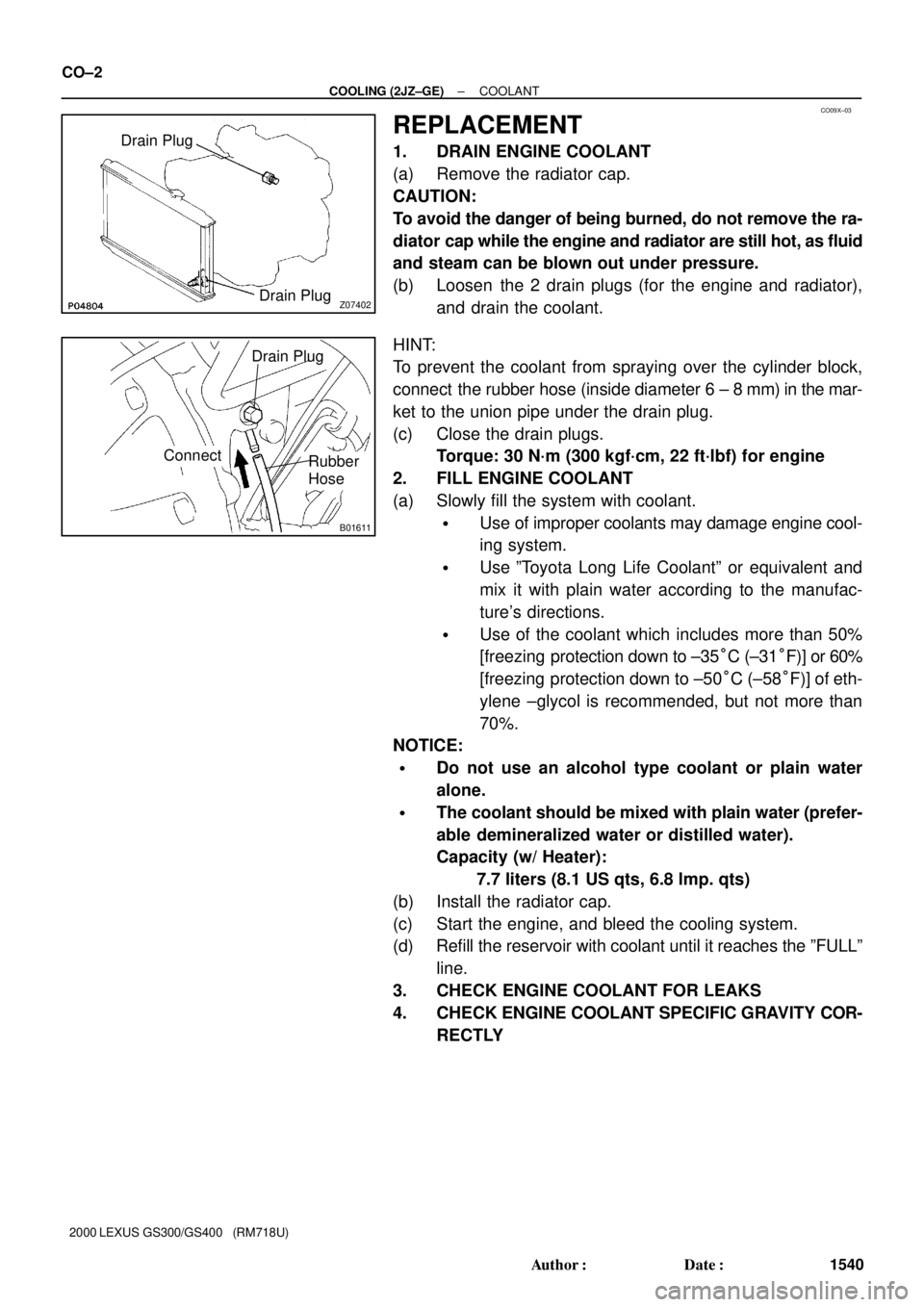
1. DRAIN ENGINE COOLANT
(a) Remove the radiator cap.
CAUTION:
To avoid the danger of being burned, do not remove the ra-
diator cap while the engine and radiator are still hot, as fluid
and steam can be blown out under pressure.
(b) Loosen the 2 drain plugs (for the engine and radiator),
and drain the coolant.
HINT:
To prevent the coolant from spraying over the cylinder block,
connect the rubber hose (inside diameter 6 ± 8 mm) in the mar-
ket to the union pipe under the drain plug.
(c) Close the drain plugs.
Torque: 30 N´m (300 kgf´cm, 22 ft´lbf) for engine
2. FILL ENGINE COOLANT
(a) Slowly fill the system with coolant.
�Use of improper coolants may damage engine cool-
ing system.
�Use ºToyota Long Life Coolantº or equivalent and
mix it with plain water according to the manufac-
ture's directions.
�Use of the coolant which includes more than 50%
[freezing protection down to ±35°C (±31°F)] or 60%
[freezing protection down to ±50°C (±58°F)] of eth-
ylene ±glycol is recommended, but not more than
70%.
NOTICE:
�Do not use an alcohol type coolant or plain water
alone.
�The coolant should be mixed with plain water (prefer-
able demineralized water or distilled water).
Capacity (w/ Heater):
7.7 liters (8.1 US qts, 6.8 lmp. qts)
(b) Install the radiator cap.
(c) Start the engine, and bleed the cooling system.
(d) Refill the reservoir with coolant until it reaches the ºFULLº
line.
3. CHECK ENGINE COOLANT FOR LEAKS
4. CHECK ENGINE COOLANT SPECIFIC GRAVITY COR-
RECTLY
Page 479 of 1111

CO0AC±01
B01881
± COOLING (2JZ±GE)RADIATOR
CO±23
1561 Author�: Date�:
2000 LEXUS GS300/GS400 (RM718U)
INSTALLATION
1. INSTALL ELECTRIC COOLING FAN TO RADIATOR
(a) Install the electric cooling fan with the 6 bolts.
Torque: 5.0 N´m (50 kgf´cm, 44 in.´lbf)
(b) Connect the radiator reservoir hose to the radiator.
2. INSTALL RADIATOR AND ELECTRIC COOLING FAN
ASSEMBLY
(a) Install the 2 lower radiator supports to the radiator.
(b) Attach the 2 lower radiator supports on the radiator to the
body bracket.
(c) Install the radiator and electric cooling fan assembly with
the 2 upper radiator supports and 2 nuts.
Torque: 13.5 N´m (135 kgf´cm, 10 ft´lbf)
(d) Connect these parts:
�Upper radiator hose to radiator
�Lower radiator hose to radiator
�ECM outlet duct to ECM box
�Wire for electric cooling fan to clamp on electric
cooling fan
�2 electric cooling fan connectors
�ECT switch connector for electric cooling fan
�2 oil cooler hoses for A/T to radiator
3. INSTALL AIR CLEANER AND MAF METER AS-
SEMBLY
4. INSTALL AIR CLEANER INLET
5. FILL WITH ENGINE COOLANT
6. START ENGINE AND CHECK FOR ENGINE COOLANT
AND A/T FLUID LEAKS
7. INSTALL ENGINE UNDER COVER
Page 480 of 1111
B01900
CO0AD±03
B00922
ECT
Switch
Connector
B02072
B02073
Ammeter
Battery(+)
(±)
CO±24
± COOLING (2JZ±GE)ELECTRIC COOLING FAN
1562 Author�: Date�:
2000 LEXUS GS300/GS400 (RM718U)
ELECTRIC COOLING FAN
ON±VEHICLE INSPECTION
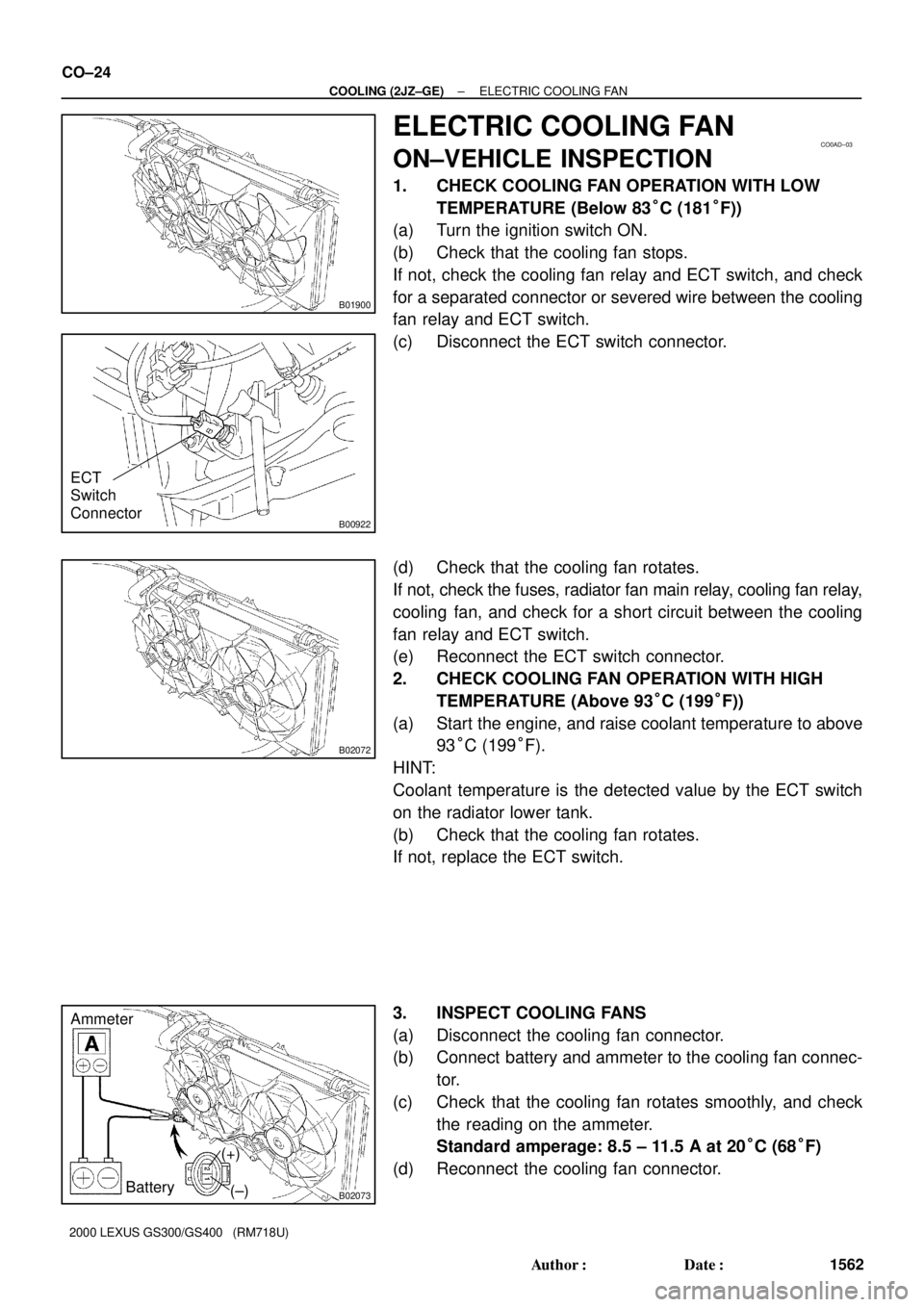
1. CHECK COOLING FAN OPERATION WITH LOW
TEMPERATURE (Below 83°C (181°F))
(a) Turn the ignition switch ON.
(b) Check that the cooling fan stops.
If not, check the cooling fan relay and ECT switch, and check
for a separated connector or severed wire between the cooling
fan relay and ECT switch.
(c) Disconnect the ECT switch connector.
(d) Check that the cooling fan rotates.
If not, check the fuses, radiator fan main relay, cooling fan relay,
cooling fan, and check for a short circuit between the cooling
fan relay and ECT switch.
(e) Reconnect the ECT switch connector.
2. CHECK COOLING FAN OPERATION WITH HIGH
TEMPERATURE (Above 93°C (199°F))
(a) Start the engine, and raise coolant temperature to above
93°C (199°F).
HINT:
Coolant temperature is the detected value by the ECT switch
on the radiator lower tank.
(b) Check that the cooling fan rotates.
If not, replace the ECT switch.
3. INSPECT COOLING FANS
(a) Disconnect the cooling fan connector.
(b) Connect battery and ammeter to the cooling fan connec-
tor.
(c) Check that the cooling fan rotates smoothly, and check
the reading on the ammeter.
Standard amperage: 8.5 ± 11.5 A at 20°C (68°F)
(d) Reconnect the cooling fan connector.