2000 HONDA PASSPORT service
[x] Cancel search: servicePage 168 of 267
Whee
l Replacemen t
Consideration s
Damaged wheels must be
replaced. For example, replace
wheels if they are bent, cracked or
heavily rusted, or if wheel nuts
often become loose. Also replace
wheels that leak air (except some
aluminum wheels that can be
repaired). See your Honda dealer.
Do not use bent wheels that have
been straightened, and do not use
tubes in leaking wheels designed
for tubeless tires. Such wheels
may have structural damage and
could fail without warning.
Maximum loads, maximum
inflation pressures, wheel
identification codes, and wheel
sizes are stamped on each wheel.
Service-tested and approved
wheels are available from your
Honda dealer.
When obtaining wheels for any
reason from any other source, the
replacement wheels should be
equal in load capacity, inflation
pressure capacity, diameter, width, offset and mounting configuration
to those originally installed on
your vehicle. A wheel of the
wrong size or type may adversely
affect load carrying capacity, wheel
and bearing life, brake cooling,
speedometer/odometer calibration,
stopping ability, headlight aim,
bumper height, vehicle ground clearance, and tire or tire chain
clearance to the body and chassis.
Replacement with used wheels is
not advised: They may have been subjected to harsh treatment or very high mileage and could fail
without warning.
Installing wheels and/or tires that
have a higher load carrying limit
than those that originally came on
your vehicle does not increase the
GAWR or GVWR of the vehicle.
Driving Tip s
Page 171 of 267
Three-Wa
y Catalyti c Converte r
The three-way catalytic converter is an emissions control device
added to the exhaust system to
reduce exhaust gas pollutants. The
converter contains a ceramic material coated with noble metal
catalysts. To prevent contamination
of the catalysts, unleaded gasoline must be used. Unleaded gasoline
also reduces combustion chamber
deposits and exhaust system
corrosion.
The three-way catalytic converter requires the use of unleaded
gasoline. Use of leaded gasolinewill cause the converter to lose its
effectiveness.
T o Hel p Preven t Damag e
1. Keep your engine properly maintained. Engine
malfunctions involving the electrical, electronic fuel
injection or ignition systems
may result in unusually high
converter and exhaust system
temperatures. Do not keep
driving your vehicle if you
detect engine misfire,
noticeable loss of performance, or other unusual operating
conditions. Have it serviced
promptly. A properly
maintained engine willminimize malfunctions that
could damage the converter. It
will also help provide good
emissions control and fuel economy. (See theMaintenance Schedule on page
200 for information on inspecting and maintaining the
engine, exhaust system and
other components.) 2. Do not push or tow your
vehicle to start it. This could
damage the converter.
3. Do not park your vehicle over high grass, dry leaves or othercombustible materials. The
catalytic converter gets very
hot and could set fire to these materials.
Drivin g Tip s
Page 178 of 267
Follow the recommendations in
this manual and ask your Honda
dealer for further details before
you tow a trailer with your
Passport.
Towing a trailer affects vehicle
maintenance requirements due
to the additional load. More
frequent maintenance intervals
will be required to assure
continued satisfaction with
your vehicle. Consult yourHonda dealer for recommended
maintenance and service.
The gross trailer weight (trailer weight plus cargo load) must
never exceed 4,500 Ib.
Additional equipment will be
required, depending on the specific model/load combination.
See "Trailer Hitches" in this
section.
Exceeding the weight limit will
cause damage to your vehicle and
possibly result in personal injury. The Gross Vehicle Weight
Rating (GVWR) is the
combined weight of the
unloaded vehicle, passengers,
cargo, trailer hitch, trailer
tongue load, and optional
equipment. This value is indicated on the F.M.V.S.S.
Certification Label on the
driver's doorjamb. The Gross Combined Weight
Rating (GCWR) equals the combined weight of your
vehicle (including passengers
and cargo) plus the total trailer
load. The following limits
apply.
2WD: 8,700 Ib
4WD: 8,950 Ib
The Gross Axle Weight Rating
(GAWR) is also indicated on
the Certification Label. The
load on either the front or rear
axle resulting from distribution
of the gross vehicle weight on both axles must not exceed the
values listed. Remember to
account for additional
equipment and tongue load.
Driving Tip s
Page 181 of 267
There are no provisions in your
vehicle to tap into its hydraulic
braking system. Any attempt toattach the trailer's brakes to your
vehicle's hydraulic braking system, no matter how successfulit may seem, will lower braking
effectiveness and create a
potential hazard.
Equipmen t Chec k
Before operating your vehicle,
check all safety equipment to
ensure safe operation. Be sure
your vehicle is properly serviced
to avoid mechanical failure.
Check that your vehicle remains
level when the loaded or unloadedtrailer is hitched. Do not drive if
the rear end of your vehicle is abnormally higher or lower.
Check for proper tongue weight,
overload, improper weight
distribution, worn suspension, or
other possible causes.
Make sure the trailer load is
properly positione
d and secured
so its does not shift around whil
e
driving.
Chec k
if your rearview mirrors
comply with federal, state and
local regulations. If not, confirm
the proper mirrors required for
towing and have them installed.
Perform an equipment check of
all braking, lighting and safety
equipment to ensure they are working properly.
Your safety depends on proper
operation and installation of
equipment. Never operate a
vehicle with faulty equipment.
Limite
d Sli p Differentia l
Standard on 4WD models
The limited slip differential is
designed to improve traction by limiting wheelspin. If one rear
wheel begins to spin on a slipperysurface, the limited slip
differential will automatically
transmit driving force to the other
rear wheel.
Drivin g Tip s
Page 187 of 267
8. Turn the jack handle
clockwise with a slow, smooth
motion to raise the vehicle sothe inflated spare tire will
clear the surface.
9. Remove the wheel nuts and the wheel.
10. Install the wheel and replace the whee
l nuts with the
cone-shaped end toward the
wheel, then hand-tighten each
nut. The wheel must be seated on the hub.
11.
Lower the vehicle by turning
the jac
k handle counter-
clockwise, then fully tighten the wheel nuts in a crisscrosssequence by turning the
wrench clockwise. Have the
wheel nut torque checked at
the nearest automotive service
facility.
87 lb-ft ( 118 N.m)
12.
Stow the jacking tools and flat
tire i
n their proper locations.
Too
l Location s
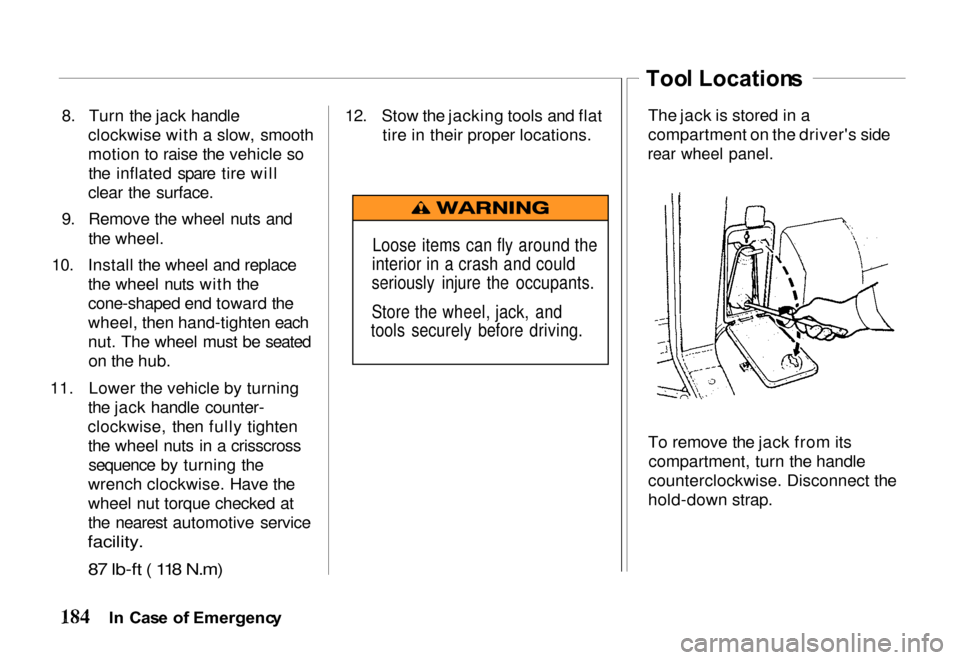
The jack is stored in a
compartment on the driver's side
rear wheel panel.
To remove the jack from itscompartment, turn the handle
counterclockwise. Disconnect the
hold-down strap.
I n Cas e o f Emergenc y
Loose items can fly around the
interior in a crash and could
seriously injure the occupants.
Store the wheel, jack, and
tools securely before driving.
Page 194 of 267

Car
e an d Maintenanc e
This section explains why it is important to keep your vehicle
well maintained and to follow
basic maintenance safety
precautions.
This section also includes Maintenance Schedules for
normal driving and severe driving
conditions, a Maintenance
Record, and instructions for simple maintenance tasks you
may want to take care of yourself.
If you have the skills and tools
required to perform more complex
maintenance tasks on your Honda,
you may want to purchase the Service Manual. See page 249 for
information on how to obtain a
copy, or see your Honda dealer. Service Station Information . 193
Fuel Fill Cap .......... 193Fuel Recommendation ... 194
Fuel Tank Capacity ..... 194
Engine Oil Recommendation ...... 194
Windshield Washer ..... 194
Tire Inflation Pressures .. 194 Battery ............... 194
Hood Release .......... 195
Engine Oil Dipstick ..... 196
Fuel Requirements ........ 196 Oxygenated Fuels ...... 196
Maintenance Safety ....... 197 Important Safety
Precautions .......... 198
Maintenance Schedule ..... 199
Required Maintenance Record 202
Owner Safety Checks ...... 204
Engine Oil and Filter ...... 207 Proper Quality Oil ...... 207 Change Interval ........ 207
Oil
Change ........... 208
Oil Filter Installation . 208
Oil Viscosity .......... 209
Oil Level Check ....... 209
Engine Oil Additives ... 210
Air Cleaner Filter ........ 210
Manual Transmission Fluid 211
Automatic Transmission Fluid .................. 212
Front (4WD) and Rear Axles ............. 212
Engine Cooling System ... 213
Other Required Maintenance 215 Brake Master Cylinder . . 215
Shift-on-the-Fly System
. 216
Front Whee
l Bearings ... 216
Hood Latch and Hinges . 217
Air Conditioning ....... 217 Body Lubrication ...... 217
Car e an d Maintenanc e
Page 200 of 267
standards, some areas of the United
States and Canada use oxygenated
fuels to help reduce emissions.
If you use an oxygenated fuel, be sure it is unleaded and meets the
minimum octane rating requirement.
Before using an oxygenated fuel,
try to confirm the fuel's contents. Some states/provinces require this
information to be posted on the
pump.
The following are the EPA-approved
percentages of oxygenates:
ETHANOL (ethyl or grain alcohol). You may use gasoline containing up
to 10% ethanol by volume. Gasoline
containing ethanol may be marketed under the name "Gasohol."
MTBE (Methyl Tertiary Butyl
Ether). You may use gasoline
containing up to 15% MTBE by
volume. METHANOL (methyl or wood
alcohol). Your vehicle was not
designed to use fuel that contains
methanol. Methanol can corrode
metal parts in the fuel system, and also damage plastic and rubber
components. This damage woul d not
be covere
d by your warranties.
If you notice any undesirable
operating symptoms, try another service station or switch to another
brand of gasoline.
Fuel system damage or performance
problems resulting from the use of an oxygenated fuel containing
more than the percentages of oxygenates given above are not
covered under warranty. Regularly maintaining your
vehicle is the best way to protect
your investment. Proper maintenance is essential to yoursafety and the safety of your
passengers. It will also reward you with more economical,
trouble-free driving and help
reduce air pollution.
Car e an d Maintenanc e
Maintenanc
e Safet y
Improperly maintaining this
vehicle or failing to correct a problem before driving can
cause a crash in which you
can be seriously hurt or killed.
Always follow the inspection
and maintenance recommendations and
schedules in this owner's
manual.
Page 201 of 267
This section includes instructions
for simple maintenance tasks,
such as checking and adding oil.
Any service items not detailed in
this section should be performed
by a Honda technician or other qualified mechanic.
Some of the most important safety
precautions are given below. However, we cannot warn you of
every conceivable hazard that can arise in performing maintenance.
Only you can decide whether or
not you should perform a given
task.
Importan
t Safet y Precaution s
Before you begin any
maintenance, make sure your
vehicle is parked on level ground and that the parking brake is on.
Also, be sure the engine is off.
This will help to eliminate several
potential hazards:
Carbo
n monoxid e poisonin g
fro m engin e exhaust . Be sure
there is adequate ventilation
whenever you operate the engine.
Burn
s fro m ho t parts . Let the
engine and exhaust system cool
before touching any parts.
Injur y fro m movin g parts . D o
not run the engine unless instructed to do so.
Read the instructions before you
begin, and make sure you have
the tools and skills required.
To reduce the possibility of fire or
explosion, be careful when
working around gasoline or
batteries. Use a commercially
available degreaser or parts
cleaner, not gasoline, to clean
parts. Keep cigarettes, sparks, and
flames away from the battery and
all fuel-related parts.
You should wear eye protection
and protective clothing when
working near the battery or when
using compressed air.
Car e an d Maintenanc e
Failure t
o properly follow
maintenance instructions and
precautions can cause you to
be seriously hurt or killed.
Always follow the procedures and precautions in this owner's
manual.