Page 202 of 267
Maintenanc
e Schedul e
The Maintenance Schedule specifies how often you should
have your vehicle serviced and what things need attention. It is
essential that you have your vehicle serviced as scheduled to
retain its high level of safety, dependability, and emission
control performance.
The services and time or distanceintervals shown in the
maintenance schedule assume you will use your vehicle as normal
transportation. You should: Avoid exceeding your vehicle's
load limit. This puts excess
stress on the engine, brakes, and
many other parts of your vehicle.
The load limit is shown on the label on the driver's doorjamb. Operate your vehicle on
reasonable roads within the
legal speed limit. Drive your vehicle regularly over
a distance of several miles
(kilometers).
Always use unleaded gasoline
with the proper octane rating
(see page 196).
Your authorized Honda dealer
knows your vehicle best and can
provide competent, efficient service. However, service at a
dealer is not mandatory to keep
your warranties in effect.
Maintenance may be done by any
qualified service facility or person
who is skilled in this type of automotive service. Keep all the
receipts as proof of completion, and have the person who does the
work fill out the Maintenance Record. Check your warranty
booklet for more information.
We recommend the use of Genuine Honda parts and fluids
whenever you have maintenance
done. These are manufactured to
the same high-quality standards as
the original components, so you
can be confident of their
performance and durability.
U.S . Vehicles :
Maintenance , replacemen t o r repai r
o f emissio n contro l device s an d
system s ma y b e don e b y an y
automotiv e repai r establishmen t o r
individua l usin g part s tha t ar e
"certified " t o EP A standards .
Car e an d Maintenanc e
Page 203 of 267
Maintenanc
e Schedul e
Check oil and coolant level, at each fuel stop. Under severe driving conditions, service these items more often.
* 1 Using SAE 10W-40 oil, or any viscosity other than those recommended, may reduce engine life and affect the warranty.
* 2 This service is recommended only.
Inspec
t monthly :
— These fluids: brake, clutch, PIS, battery, ATF, windshield washer
— Tire pressure
Car e an d Maintenanc e
R — Replace L — Lube I — Inspect After inspection, clean, adjust, repair or replace if necessary.
Page 204 of 267
R — Replace L — Lube I — Inspect After inspection, clean, adjust, repair or replace if necessary.
Check oi
l and coolant level at each fuel stop.
Under severe driving conditions, service these items more often. These conditions are: Service for severe driving conditions
Repeated short trips in cold weather Frequent idling and/or frequent low-speed operation Change engine oil and filter - Every 3,750 miles (6,000 km) Driving in dusty areas Towing a trailer or 3 months
Change rear axle oil - Every 15,000 miles (24,000 km)
Care an d Maintenanc e
Page 207 of 267

Owne
r Safet y Check s
Promptly take any safety
problems to your Honda dealer for service advice.
Parkin g brak e — Park on a fairly
steep hill and hold the vehicle
with the parking brake only. This
checks its holding ability.
Starte r safet y switc h (automati c
transmission ) — Check the safety
switch by trying to start the
engine in each gear. The starter should work only with the shift
lever in the "P" (Park) or "N" (Neutral) position.
Starte r safet y switc h (manua l
transmission ) — To check the
safety switch, place the shift lever
in "Neutral," push the clutch
pedal halfway and try to start the engine. The starter should not
work. The starter should work only when the clutch pedal is fully
depressed.
Transmissio n shif t indicato r
(automati c transmission ) —
Check that the indicator points to
the gear chosen.
Steerin g — Be alert for any
changes in steering action. An inspection or service is needed
when the steering wheel is harder
to turn or has too much free play,
or if there are unusual sounds when turning or parking.
Whee l alignment , balanc e an d
tire s — Uneven or abnormal tire
wear, or pulling to the right or left
on a straight and level road may show the need for a wheel
alignment. A vibration of the
steering wheel or seat at normal
highway speeds means wheel balancing is needed. Check tire
pressures (including the spare) at
least monthly and whenever the
vehicle is serviced (see page 159).
Brake s — Watch for the
"BRAKE" light coming on. Other signs of possible brake trouble are
such things as repeated pulling to
one side when braking, unusual sounds when braking or between
brake applications, or increased
brake pedal travel. If you note one
of these conditions, have the system checked at once and
repaired if needed.
Car e an d Maintenanc e
Page 211 of 267
Change the oil and oil filter every
3,750 miles (6,000 kilometers) or
every three months if you drive under one or more of these
"severe driving" conditions: Driving in dusty areas
Towing a trailer
Frequent idling or idling for
long periods Frequent short trips (4 miles [6
kilometers] or less) in cold or
freezing weather, where the
engine does not thoroughly
warm up. Change the oil and oil filter as
soon as possible after driving in
a dust storm.
Oi
l Chang e
Changing the oil and filter requires
special tools and access from underneath the vehicle. The vehicle
should be raised on a service station-type hydraulic lift for this
service. Unless you have the
knowledge and proper equipment,
you should have this maintenance
done by a skilled mechanic.
1. Warm up the engine. This makes the oil drain faster and
more thoroughly.
2. Remove the oil filler cap.
3. Remove the drain plug and drain oil fully.
4. Install the drain plug, with a new gasket, and tighten it.
5. Fill the engine with the proper amount of new oil (see
"Specifications"). Oil Filter Installation
1. Remove the old oil filter with the filter wrench.
2. Apply a light coat of engine oil to the oil filter gasket.
3. Hand-tighten the filter until the gasket contacts the sealing
face.
4. Using the filter wrench, tighten the filter one full turn.
5. Run the engine and inspect for
leaks.
6. Shut off the engine. After a couple of minutes, check the
oil level. If necessary, add oilto bring it to the FULL mark.
An improperly installed oil filter can result in severe engine
damage.
Car e an d Maintenanc e
NOTIC
E
Page 212 of 267
Oi
l Viscosit y
Engine oil viscosity (thickness) has an effect on fuel economy. Lower
viscosity engine oils can provideincreased fuel economy; however,
higher temperature weather
conditions require higher viscosity
engine oils for satisfactory lubrication. To get the best fuel
economy with your vehicle, you should use a fuel-saving engine oil
of the proper viscosity. These oils
can be found in service stations and other retail stores. They are
identified by words such as
"Energy Saving," "Conserves
Gasoline," "Gas Saving,"
"Gasoline Saving," "Friction
Reducing," "Improved Gasoline Mileage" or "Fuel Saving."
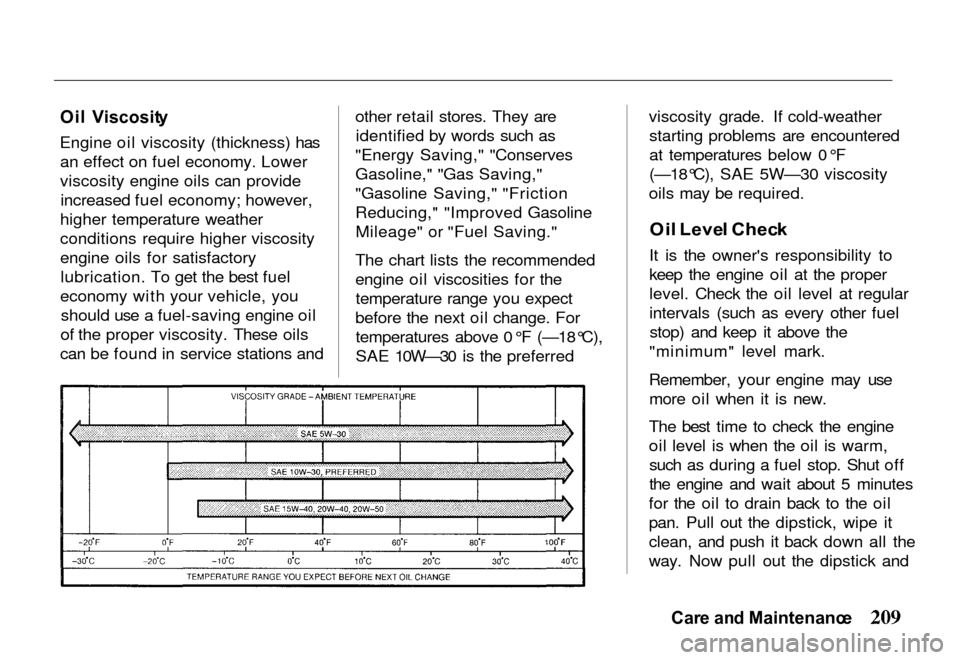
The chart lists the recommended
engine oil viscosities for the temperature range you expect
before the next oil change. For temperatures above 0°F (—18°C),
SAE 10W—30 is the preferred viscosity grade. If cold-weather
starting problems are encountered
at temperatures below 0°F
(—18°C), SAE 5W—30 viscosity
oils may be required.
Oi l Leve l Chec k
It is the owner's responsibility to
keep the engine oil at the proper
level. Check the oil level at regular
intervals (such as every other fuel stop) and keep it above the
"minimum" level mark.
Remember, your engine may use more oil when it is new.
The best time to check the engine
oil level is when the oil is warm, such as during a fuel stop. Shut off
the engine and wait about 5 minutes
for the oil to drain back to the oil
pan. Pull out the dipstick, wipe it
clean, and push it back down all the
way. Now pull out the dipstick and
Car e an d Maintenanc e
Page 217 of 267

You usually do not need to remove
the radiator cap to check the engine
coolant level.
Addin g Engin e Coolan t
To add engine coolant, remove the cap on the radiator reserve tank
and fill the tank up to the
maximum level mark. Add a
50/50 mixture of water and a good
quality ethylene glycol antifreeze. If you need to add engine coolant
frequently, see your Honda dealer
for a cooling system check.
If the proper quality antifreezeis used, there is no need to add
extra inhibitors or additives. They may be harmful to the proper
operation of the system.
Coolin g Syste m Servic e
The cooling system should be serviced at the intervals specified in the Maintenance Schedule as
follows:
Wash the radiator cap and filler
neck with clean water.
Check the engine coolant level
in the radiator and have it tested
for freeze protection. Add
ethylene glycol antifreeze, if
needed, to maintain freeze
protection at —33°F (—36°C).
Have the cooling system and
radiator cap tested for a pressure capacity of 15 psi (105
kPa). If a replacement cap is
needed, use a cap specified for
your model. Tighten all radiator and heater
hose clamps and inspect all
hoses. Replace the hoses if they
are swollen, "checked," or
otherwise worn. Carefully tighten the hose clamps at the
radiator. Overtightening could bend or collapse the radiator
fittings. Clean the front of the radiator
core and air conditioning
condenser.
It is the owner's responsibility to: Maintain the cooling system
freeze protection at —33°F
Car e an d Maintenanc e
Removing the radiator cap
while the engine is hot can
cause the coolant to spray out, seriously scalding you.
Always let the engine andradiator cool down beforeremoving the radiator cap.
Page 231 of 267
Vehicl
e Identificatio n
Vehicl e Identificatio n
Numbe r (VIN )
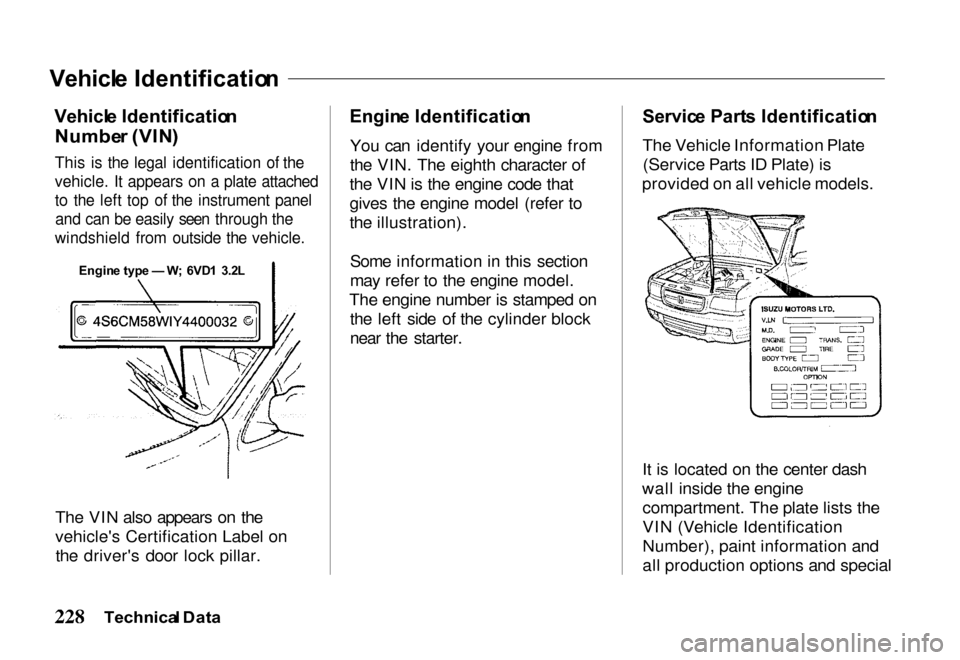
This is the legal identification of the
vehicle. It appears on a plate attached
to the left top of the instrument panel
and can be easily seen through the
windshield from outside the vehicle.
The VIN also appears on the
vehicle's Certification Label onthe driver's door lock pillar.
Engin
e Identificatio n
You can identify your engine from
the VIN. The eighth character of
the VIN is the engine code that
gives the engine model (refer to
the illustration).
Some information in this section
may refer to the engine model.
The engine number is stamped on the left side of the cylinder block
near the starter.
Servic
e Part s Identificatio n
The Vehicle Information Plate (Service Parts ID Plate) is
provided on all vehicle models.
It is located on the center dash
wall inside the engine compartment. The plate lists the
VIN (Vehicle Identification
Number), paint information and
all production options and special
Technica l Dat a
Engin
e typ e — W; 6VD 1 3.2 L

