Page 222 of 352
Towin
g a Traile r
Gros s Vehicl e Weigh t Ratin g
(GVWR) :
The total weight of the vehicle, all occupants, all cargo, and the
tongue load must not exceed: 5,565 Ibs (2,525 kg)
Gros s Axl e Weigh t Ratin g
(GAWR) :
The total weight of the vehicle, all occupants, all cargo, and the
tongue load must not exceed:
2,775 Ibs (1,260 kg)
on the front axle
2,840 Ibs (1,290 kg)
on the rear axle
Gros
s Combine d Weigh t Ratin g
(GCWR) :
The total weight of the vehicle, all occupants and cargo, and the
trailer and everything in or on it,
must not exceed:
8,160 Ibs (3,700 kg)
with transmission fluid cooler
6,660 Ibs (3,025 kg)
without transmission fluid cooler
Checkin
g Load s
The best way to confirm that vehicle and trailer weights are within limits
is to have them checked at a public
scale.
Using a suitable scale or a special
tongue load gauge, check the tongue
load the first time you set up a
towing combination (a fully-loaded
vehicle and trailer), then recheck the tongue load whenever the conditions
change.
Driving
Exceeding load limits or
improperly loading your vehicle
and trailer can cause a crash in
which you can be seriously
injured or killed.
Check the loading of your
vehicle and trailer carefully before starting to drive.
Page 223 of 352
Towing a Traile r
Towin g Equipmen t an d
Accessorie s
Towing can require a variety of equipment, depending on the size of
your trailer, how it will be used, and how much load you are towing.
Discuss your needs with your trailer
sales or rental agency, and follow the
guidelines in the rest of this section.
Also make sure that all equipment is properly installed and that it meets
federal, state, province, and local
regulations.
Hitches
Any hitch used on your vehicle mustbe properly bolted to the underbody, using the six threaded holes
provided. A hitch designed especially
for your Odyssey can be obtained
from your Honda dealer.
Weight Distributing Hitch
If the total trailer weight is more
than 2,000 Ibs (900 kg), you must
also use a weight distributing hitch.
This device transfers weight from the vehicle's rear wheels to the front
wheels, and to the trailer's wheels. Carefully follow the hitch maker's
instructions for proper installation
and adjustment.
Safety Chain
Always use a safety chain. Make sure that it is secured to both the
trailer and hitch, and that it crosses under the tongue so it can catch the
trailer if it becomes unhitched. Leave enough slack to allow the
trailer to turn corners easily, but do not let the chain drag on the ground.
Sway Control
If the total trailer weight exceeds
2,000 Ibs (900 kg), you should install
a sway control device to minimize swaying that can occur in crosswinds
and in normal and emergency
driving maneuvers. Your trailer
maker can tell you what kind of sway
control you need and how to install it.
Transmission Fluid Cooler
If the total trailer weight is more
than 2,000 Ibs (900 kg), you must also have a transmission fluid cooler
installed. This device will help
prevent transmission overheating,
which could cause serious damage.
A transmission fluid cooler designed for your Odyssey can be obtained
from your Honda dealer.
Drivin g
Page 249 of 352
Cooling Syste m
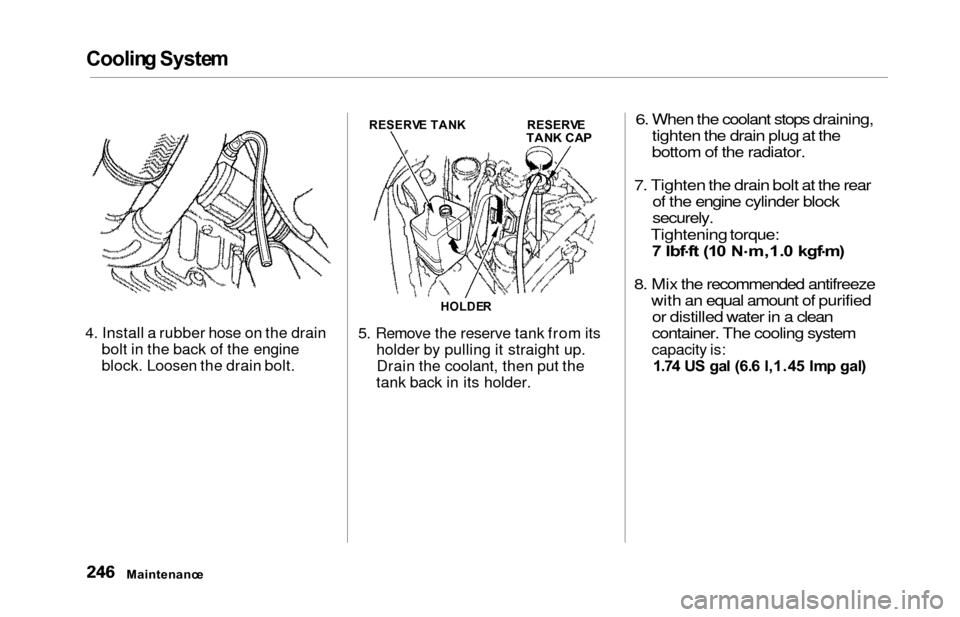
4. Install a rubber hose on the drain
bolt in the back of the engine
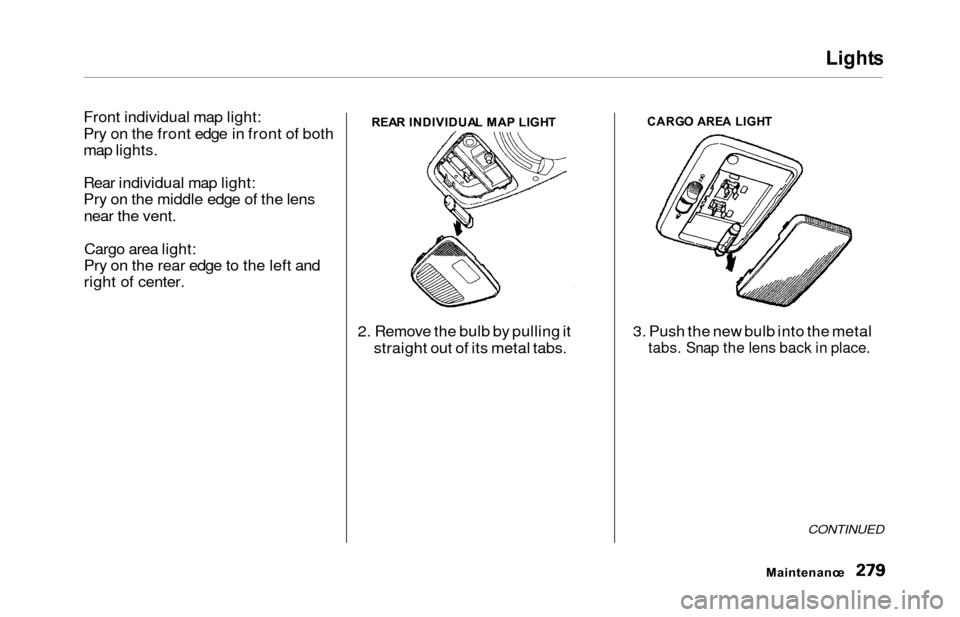
block. Loosen the drain bolt. 5. Remove the reserve tank from its
holder by pulling it straight up.Drain the coolant, then put the
tank back in its holder.
6. When the coolant stops draining, tighten the drain plug at the
bottom of the radiator.
7. Tighten the drain bolt at the rear of the engine cylinder block
securely.
Tightening torque:
7 lbf .
f t (1 0 N .
m,1. 0 kgf .
m )
8. Mix the recommended antifreeze
with an equal amount of purifiedor distilled water in a clean
container. The cooling system
capacity is:
1.7 4 U S ga l (6. 6 l,1.4 5 Im p gal )
Maintenanc e
RESERVE TAN KRESERV ETANK CA P
HOLDE R
Page 251 of 352
Windshield Washer s
Check the level in the windshield
washer reservoir at least monthly during normal usage. In bad weather,
when you use the washers often, check the level every time you stop
for fuel. This reservoir supplies the
windshield and rear window washers.
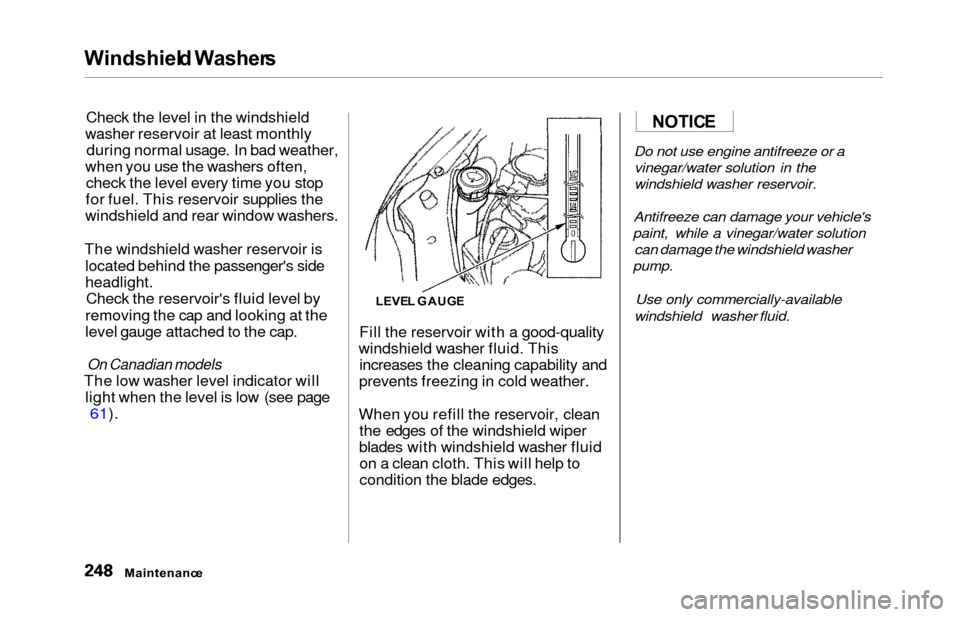
The windshield washer reservoir is located behind the passenger's side
headlight.Check the reservoir's fluid level by
removing the cap and looking at the
level gauge attached to the cap.
On Canadian models
The low washer level indicator will light when the level is low (see page
61).
Fill the reservoir with a good-quality
windshield washer fluid. This increases the cleaning capability and
prevents freezing in cold weather.
When you refill the reservoir, clean the edges of the windshield wiper
blades with windshield washer fluid on a clean cloth. This will help to
condition the blade edges.
Do not use engine antifreeze or a
vinegar/water solution in the
windshield washer reservoir.
Antifreeze can damage your vehicle's
paint, while a vinegar/water solution
can damage the windshield washer
pump.
Use only commercially-available
windshield washer fluid.
Maintenanc e
LEVEL GAUG E
NOTICE
Page 270 of 352
Tires
When shopping for replacement
tires, you may find that some tires
are "directional." This means they
are designed to rotate only in one direction. If you use directional tires,
they should be rotated only front-to-
back. Replacin
g Tire s an d Wheel s
The tires that came with your
vehicle were selected to match the performance capabilities of the
vehicle while providing the best combination of handling, ride
comfort, and long life. You should
replace them with radial tires of thesame size, load range, speed rating,
and maximum cold tire pressure
rating (as shown on the tire's sidewall). Mixing radial and bias-ply
tires on your vehicle can reduce its
braking ability, traction, and steering
accuracy.It is best to replace all four tires at
the same time. If that is not possible or necessary, then replace the two
front tires or the two rear tires as a pair. Replacing just one tire can
seriously affect your vehicle's han-
dling.
CONTINUED
Maintenanc e
Installing improper tires on your
vehicle can affect handling and stability. This can cause a crashin which you can be seriously
hurt or killed.
Always use the size and type of
tires recommended in this
owner's manual.
Page 282 of 352
Lights
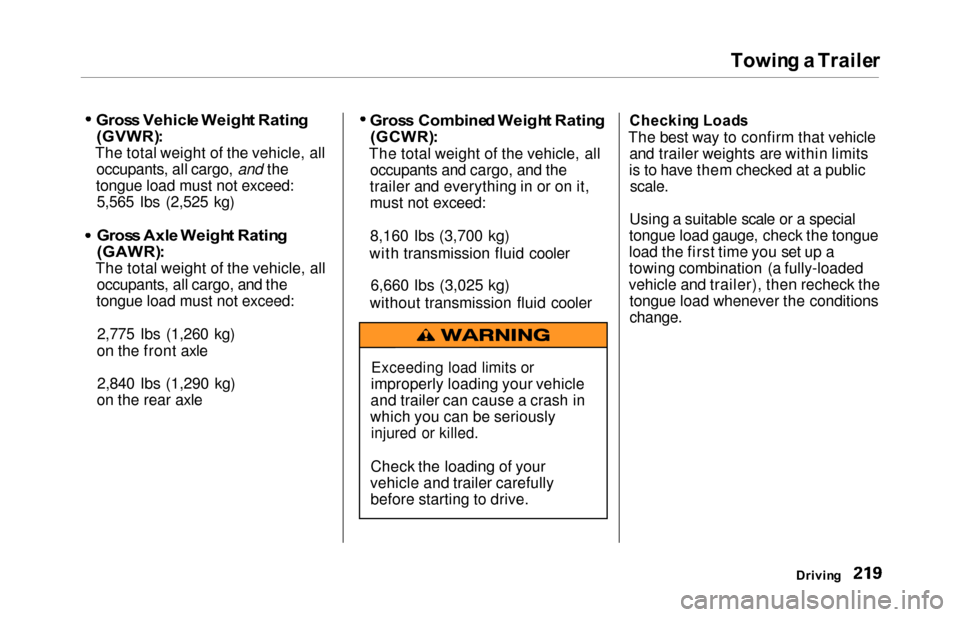
Front individual map light:
Pry on the front edge in front of both
map lights.
Rear individual map light:
Pry on the middle edge of the lens
near the vent.
Cargo area light:
Pry on the rear edge to the left and
right of center.REA R INDIVIDUA L MA P LIGH T
2. Remove the bulb by pulling it
straight out of its metal tabs.
CARG O ARE A LIGH T
3. Push the new bulb into the metal
tabs. Snap the lens back in place.
CONTINUED
Maintenanc e
Page 284 of 352
Storing You r Vehicl e
If you need to park your vehicle for
an extended period (more than one
month), there are several things you
should do to prepare it for storage.
Proper preparation helps prevent
deterioration and makes it easier to
get your vehicle back on the road. If
possible, store your vehicle indoors.
Fill the fuel tank.Change the engine oil and filter
(see page 241).
Wash and dry the exterior
completely.
Clean the interior. Make sure the
carpeting, floor mats, etc. are
completely dry.
Leave the parking brake off. Put
the transmission in Park.
Block the rear wheels.
If the vehicle is to be stored for a
longer period, it should be
supported on jackstands so the
tires are off the ground. Leave one window open slightly (if
the vehicle is being stored
indoors).
Disconnect the battery.
Support the front and rear wiper
blade arms with a folded towel or rag so they do not touch the
windshield.
To minimize sticking, apply a silicone spray lubricant to all door
and tailgate seals. Also, apply a
vehicle body wax to the painted surfaces that mate with the door
and tailgate seals.
Cover the vehicle with a
"breathable" cover, one made
from a porous material such as cotton. Nonporous materials, such
as plastic sheeting, trap moisture,
which can damage the paint.
If possible, run the engine for a
while periodically (preferably once a month).
If you store your vehicle for 12
months or longer, have your Honda
dealer perform the inspections called
for in the 24 months/30,000 miles (48,000 km) maintenance schedule
(Normal Conditions) as soon as you
take it out of storage (see page 230).
The replacements called for in the maintenance schedule are not
needed unless the vehicle hasactually reached that time or mileage.
Maintenanc e
Page 290 of 352
Interior Car e
Dirt build-up in the loops of the seat
belt anchors can cause the belts to retract slowly. Wipe the insides of
the loops with a clean clothdampened in mild soap and warm
water or isopropyl alcohol. Window
s
Clean the windows, inside and out,
with a commercially-available glass cleaner. You can also use a mixture
of one part white vinegar to ten parts
water. This will remove the haze that
builds up on the inside of the
windows. Use a soft cloth or paper towels to clean all glass and clear
plastic surfaces.
The rear window defogger wires are
bonded to the inside of the glass.
Wiping vigorously up-and-down can
dislodge and break the defogger wires.
When cleaning the rear window, use
gentle pressure and wipe side-to-side.
Ai r Freshener s
If you want to use an air freshener/
deodorizer in the interior of your
vehicle, it is best to use a solid type. Some liquid air fresheners contain
chemicals that may cause parts of
the interior trim and fabric to crack or discolor.
If you use a liquid air freshener,
make sure you fasten it securely so itdoes not spill as you drive.
Appearanc e Car e
NOTIC E