Page 306 of 352
If You r Engin e Won' t Start , Jum p Startin g
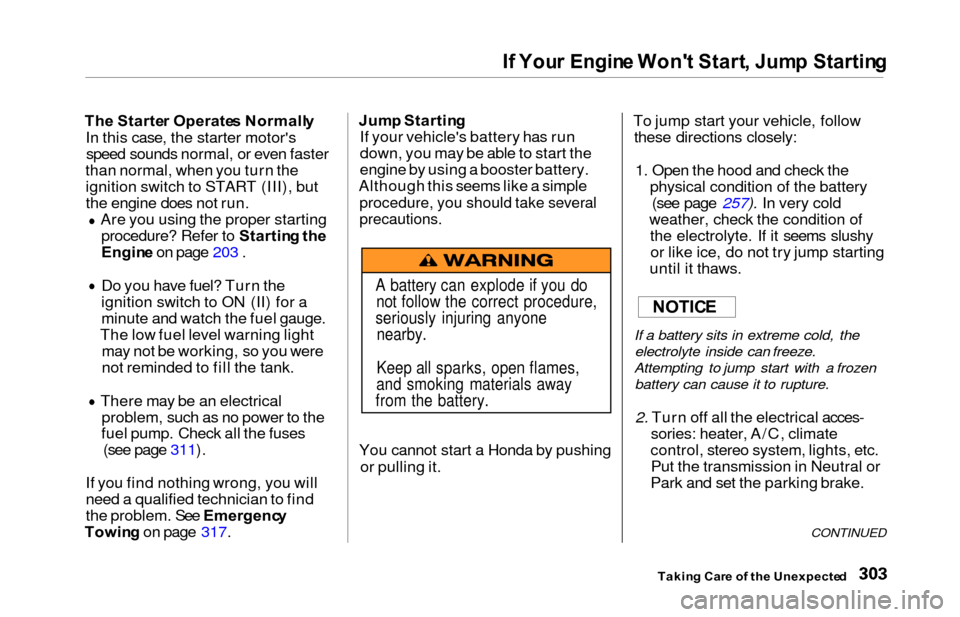
The Starte r Operate s Normall y
In this case, the starter motor's speed sounds normal, or even faster
than normal, when you turn the ignition switch to START (III), but
the engine does not run. Are you using the proper startingprocedure? Refer to Startin g th e
Engin e on page 203 .
Do you have fuel? Turn the
ignition switch to ON (II) for a
minute and watch the fuel gauge.
The low fuel level warning light may not be working, so you were
not reminded to fill the tank.
There may be an electrical problem, such as no power to the
fuel pump. Check all the fuses (see page 311).
If you find nothing wrong, you will
need a qualified technician to find
the problem. See Emergenc y
Towin g on page 317. Jum
p Startin g
If your vehicle's battery has run
down, you may be able to start the
engine by using a booster battery.
Although this seems like a simple
procedure, you should take several
precautions.
You cannot start a Honda by pushing
or pulling it. To jump start your vehicle, follow
these directions closely:
1. Open the hood and check the physical condition of the battery(see page 257). In very cold
weather, check the condition of the electrolyte. If it seems slushyor like ice, do not try jump starting
until it thaws.
If a battery sits in extreme cold, the
electrolyte inside can freeze.
Attempting to jump start with a frozen
battery can cause it to rupture.
2. Turn off all the electrical acces- sories: heater, A/C, climate
control, stereo system, lights, etc. Put the transmission in Neutral or
Park and set the parking brake.
CONTINUED
Takin g Car e o f th e Unexpecte d
A battery can explode if you do
not follow the correct procedure,
seriously injuring anyone nearby.
Keep all sparks, open flames,
and smoking materials away
from the battery.
NOTIC E
Page 311 of 352
Charging Syste m Indicato r
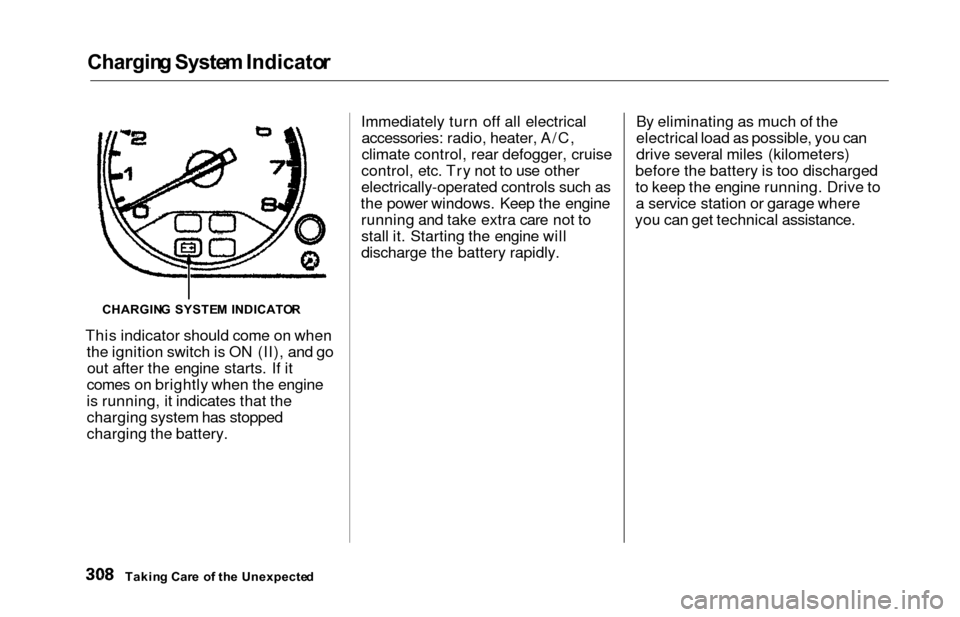
This indicator should come on when
the ignition switch is ON (II), and goout after the engine starts. If it
comes on brightly when the engine
is running, it indicates that the
charging system has stopped
charging the battery. Immediately turn off all electrical
accessories: radio, heater, A/C,
climate control, rear defogger, cruise
control, etc. Try not to use other
electrically-operated controls such as
the power windows. Keep the engine running and take extra care not to
stall it. Starting the engine will
discharge the battery rapidly. By eliminating as much of the
electrical load as possible, you can
drive several miles (kilometers)
before the battery is too discharged
to keep the engine running. Drive to a service station or garage where
you can get technical assistance.
Takin g Car e o f th e Unexpecte d
CHARGIN
G SYSTE M INDICATO R
Page 322 of 352

Technical Informatio n
The diagrams in this section give
you the dimensions and capacities of
your Honda, and the locations of theidentification numbers. The expla-
nations of several electronic and mechanical systems on your Honda
are for the more technically-oriented
owner. Identification Numbers................. 320
Specifications................................. 322
DOT Tire Quality Grading........... 324
Treadwear.................................. 324
Traction....................................... 324
Temperature............................. . 325Oxygenated Fuels.......................... 326
Driving in Foreign Countries....... 327
Emissions Controls........................ 328 The Clean Air Act...................... 328Crankcase Emissions Control System.................................... . 328
Evaporative Emissions Control System.................................... . 328
Exhaust Emissions Controls.... 329
PGM-FI System..................... 329
Ignition Timing Control System................................. 329
Exhaust Gas Recirculation (EGR) System.................... 329
Three Way Catalytic Converter............................ 329
Replacement Parts..................... 329
Three Way Catalytic Converter... 330
Technica l Informatio n
Page 323 of 352
Identification Number s
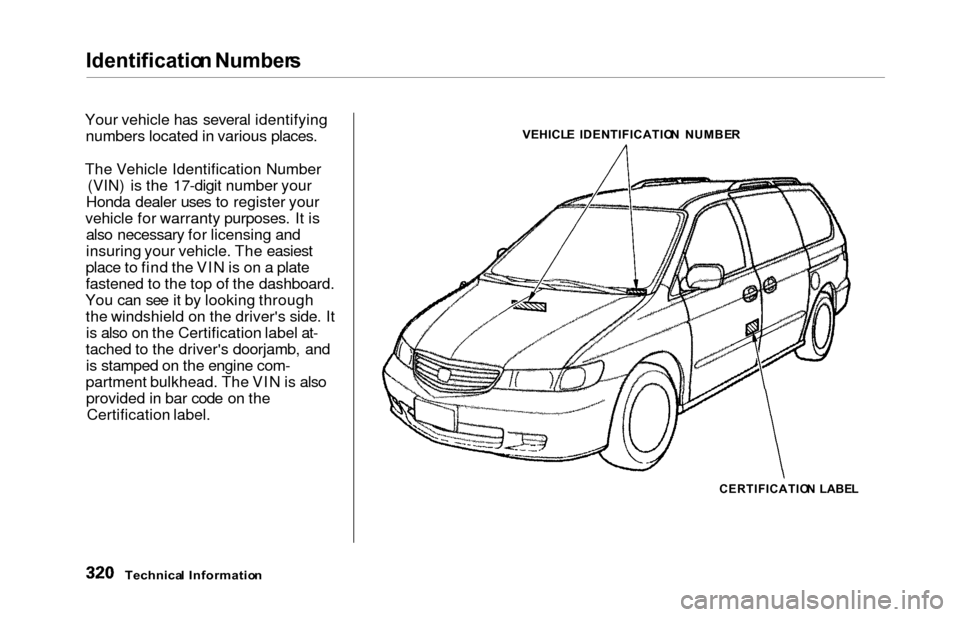
Your vehicle has several identifying
numbers located in various places.
The Vehicle Identification Number (VIN) is the 17-digit number your
Honda dealer uses to register your
vehicle for warranty purposes. It is also necessary for licensing and
insuring your vehicle. The easiest
place to find the VIN is on a plate
fastened to the top of the dashboard.
You can see it by looking through the windshield on the driver's side. Itis also on the Certification label at-
tached to the driver's doorjamb, and is stamped on the engine com-
partment bulkhead. The VIN is also provided in bar code on the Certification label.VEHICL E IDENTIFICATIO N NUMBE R
CERTIFICATIO N LABE L
Technica l Informatio n
Page 324 of 352
Identification Number s
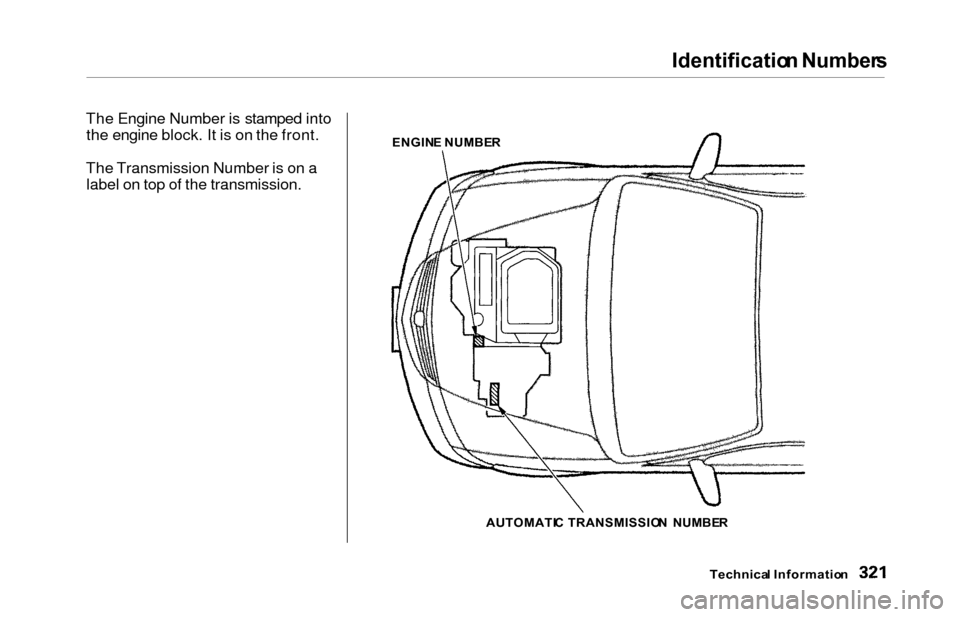
The Engine Number is stamped into
the engine block. It is on the front.
The Transmission Number is on a label on top of the transmission.
ENGIN E NUMBE R
AUTOMATI C TRANSMISSIO N NUMBE R
Technica l Informatio n
Page 325 of 352
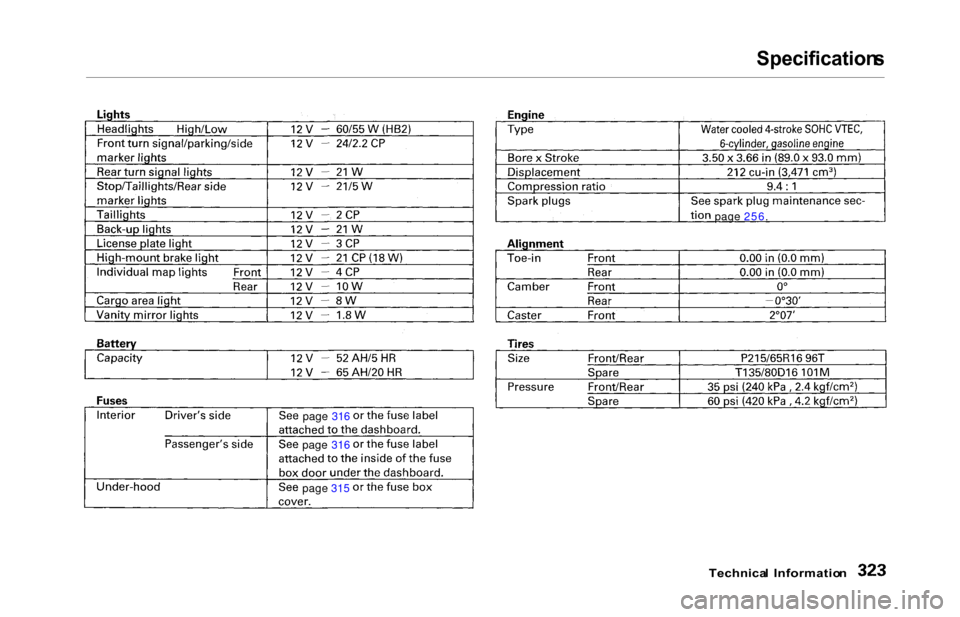
Specifications
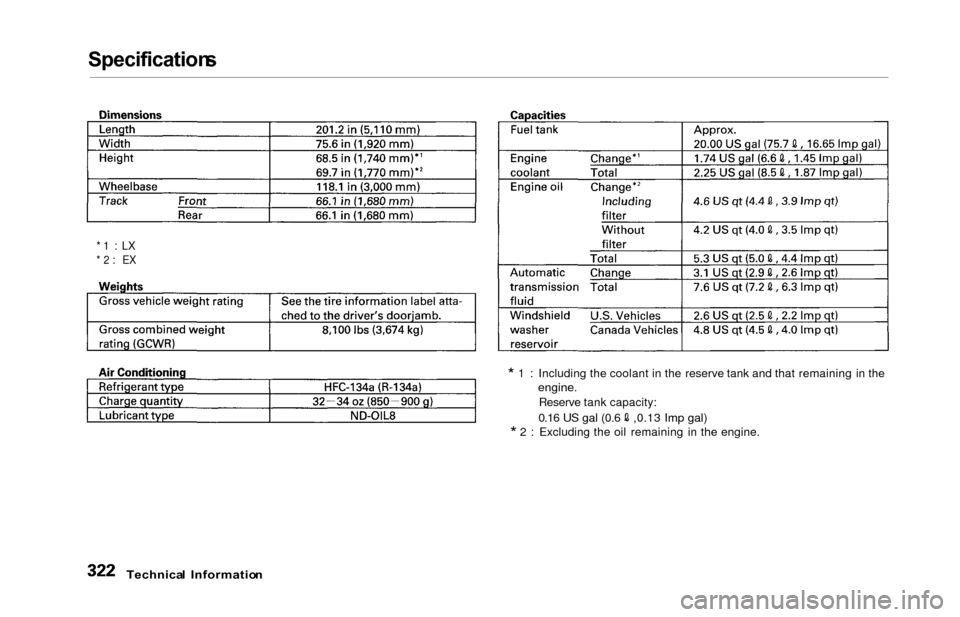
* 1 : Including the coolant in the reserve tank and that remaining in theengine.Reserve tank capacity:0.16 US gal (0.6 ,0.13 Imp gal)
* 2 : Excluding the oil remaining in the engine.
Technical Informatio n
*1 : LX*2: EX
Page 326 of 352
Specifications
Technical Informatio n
page 316
page 316
page 315 page 256.
Page 327 of 352
DOT Tir e Qualit y Gradin g (U.S . Vehicles )
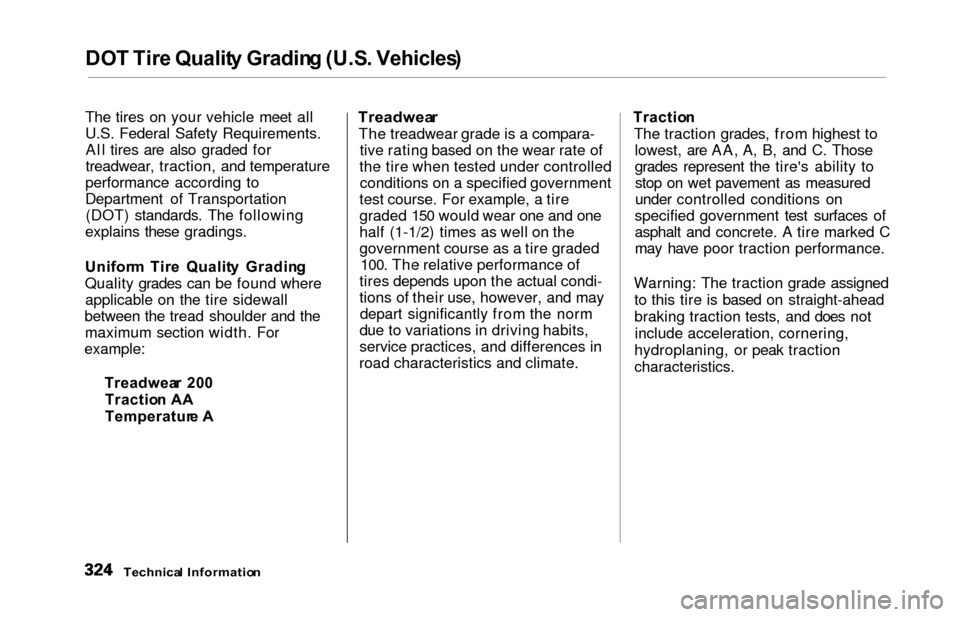
The tires on your vehicle meet all
U.S. Federal Safety Requirements.
All tires are also graded for
treadwear, traction, and temperature
performance according to
Department of Transportation (DOT) standards. The following
explains these gradings.
Unifor m Tir e Qualit y Gradin g
Quality grades can be found where applicable on the tire sidewall
between the tread shoulder and the maximum section width. For
example:
Treadwea r 20 0
Tractio n A A
Temperatur e ATreadwea r
The treadwear grade is a compara-
tive rating based on the wear rate of
the tire when tested under controlled conditions on a specified government
test course. For example, a tire
graded 150 would wear one and one
half (1-1/2) times as well on the
government course as a tire graded 100. The relative performance of
tires depends upon the actual condi-
tions of their use, however, and may depart significantly from the norm
due to variations in driving habits,
service practices, and differences in
road characteristics and climate. Tractio
n
The traction grades, from highest to lowest, are AA, A, B, and C. Those
grades represent the tire's ability tostop on wet pavement as measured
under controlled conditions on
specified government test surfaces of
asphalt and concrete. A tire marked C
may have poor traction performance.
Warning: The traction grade assigned to this tire is based on straight-ahead
braking traction tests, and does notinclude acceleration, cornering,
hydroplaning, or peak traction
characteristics.
Technica l Informatio n