Page 31 of 361
1-13
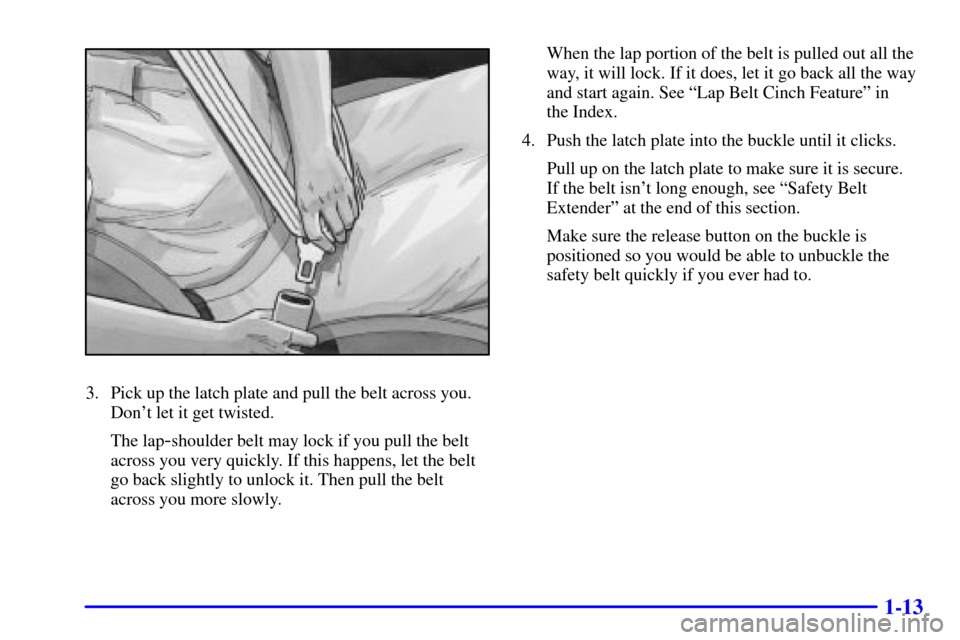
3. Pick up the latch plate and pull the belt across you.
Don't let it get twisted.
The lap
-shoulder belt may lock if you pull the belt
across you very quickly. If this happens, let the belt
go back slightly to unlock it. Then pull the belt
across you more slowly.When the lap portion of the belt is pulled out all the
way, it will lock. If it does, let it go back all the way
and start again. See ªLap Belt Cinch Featureº in
the Index.
4. Push the latch plate into the buckle until it clicks.
Pull up on the latch plate to make sure it is secure.
If the belt isn't long enough, see ªSafety Belt
Extenderº at the end of this section.
Make sure the release button on the buckle is
positioned so you would be able to unbuckle the
safety belt quickly if you ever had to.
Page 39 of 361
1-21
CAUTION:
Air bags inflate with great force, faster than the
blink of an eye. If you're too close to an inflating
air bag, as you would be if you were leaning
forward, it could seriously injure you. Safety
belts help keep you in position before and during
a crash. Always wear your safety belt, even
with air bags. The driver should sit as far back
as possible while still maintaining control of
the vehicle.
CAUTION:
Anyone who is up against, or very close to, any air
bag when it inflates can be seriously injured or killed.
Air bags plus lap
-shoulder belts offer the best
protection for adults, but not for young children and
infants. Neither the vehicle's safety belt system nor its
air bag system is designed for them. Young children
and infants need the protection that a child restraint
system can provide. Always secure children properly
in your vehicle. To read how, see the part of this
manual called ªChildren.º
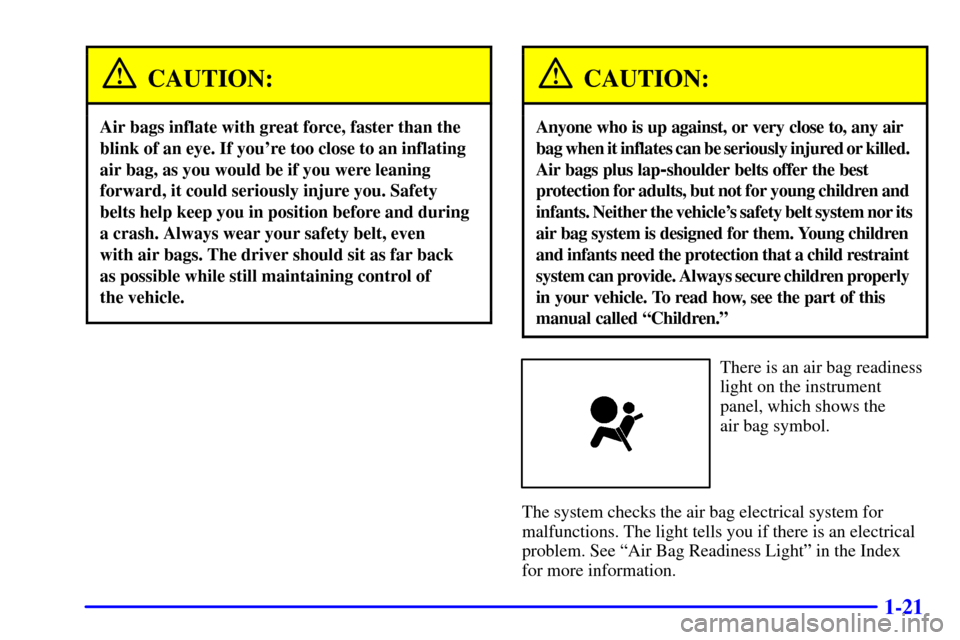
There is an air bag readiness
light on the instrument
panel, which shows the
air bag symbol.
The system checks the air bag electrical system for
malfunctions. The light tells you if there is an electrical
problem. See ªAir Bag Readiness Lightº in the Index
for more information.
Page 44 of 361
1-26 Servicing Your Air Bag-Equipped Vehicle
Air bags affect how your vehicle should be serviced.
There are parts of the air bag system in several places
around your vehicle. You don't want the system to
inflate while someone is working on your vehicle.
Your dealer and the service manual have information
about servicing your vehicle and the air bag system.
To purchase a service manual, see ªService and Owner
Publicationsº in the Index.
CAUTION:
For up to 10 seconds after the ignition key is
turned off and the battery is disconnected, an air
bag can still inflate during improper service. You
can be injured if you are close to an air bag when
it inflates. Avoid yellow wires, wires wrapped
with yellow tape or yellow connectors. They are
probably part of the air bag system. Be sure to
follow proper service procedures, and make sure
the person performing work for you is qualified
to do so.
The air bag system does not need regular maintenance.
Children
Everyone in a vehicle needs protection! That includes
infants and all children smaller than adult size. Neither
the distance to be traveled nor the age and size of the
traveler changes the need, for everyone, to use safety
restraints. In fact, the law in every state in the United
States and in every Canadian province says children up
to some age must be restrained while in a vehicle.
Smaller Children and Babies
CAUTION:
Children who are up against, or very close to, any
air bag when it inflates can be seriously injured
or killed. Air bags plus lap
-shoulder belts offer
the best protection for adults, but not for young
children and infants. Neither the vehicle's safety
belt system nor its air bag system is designed
for them. Young children and infants need the
protection that a child restraint system can
provide. Always secure children properly in
your vehicle.
Page 45 of 361
1-27
CAUTION:
A very young child's hip bones are so small that a
regular belt might not stay low on the hips, as it
should. Instead, the belt will likely be over the
child's abdomen. In a crash, the belt would apply
force right on the child's abdomen, which could
cause serious or fatal injuries. Smaller children
and babies should always be restrained in a
child restraint. However, infants, who should be
restrained in a rear
-facing child restraint, cannot
ride safely in this vehicle. The instructions for
the restraint will say whether it is the right type
and size for your child. If a forward
-facing child
restraint is suitable for your child, be sure the
child is always properly restrained while riding
in this vehicle.
Infants need complete support, including support for
the head and neck. This is necessary because an infant's
neck is weak and its head weighs so much compared
with the rest of its body. In a frontal crash, an infant in a
rear
-facing restraint settles into the restraint, so the crash
forces can be distributed across the strongest part of the
infant's body, the back and shoulders. A baby should
be secured in an appropriate infant restraint, but you
shouldn't secure that type of restraint in this vehicle
because of the air bag risk.
Page 48 of 361
1-30
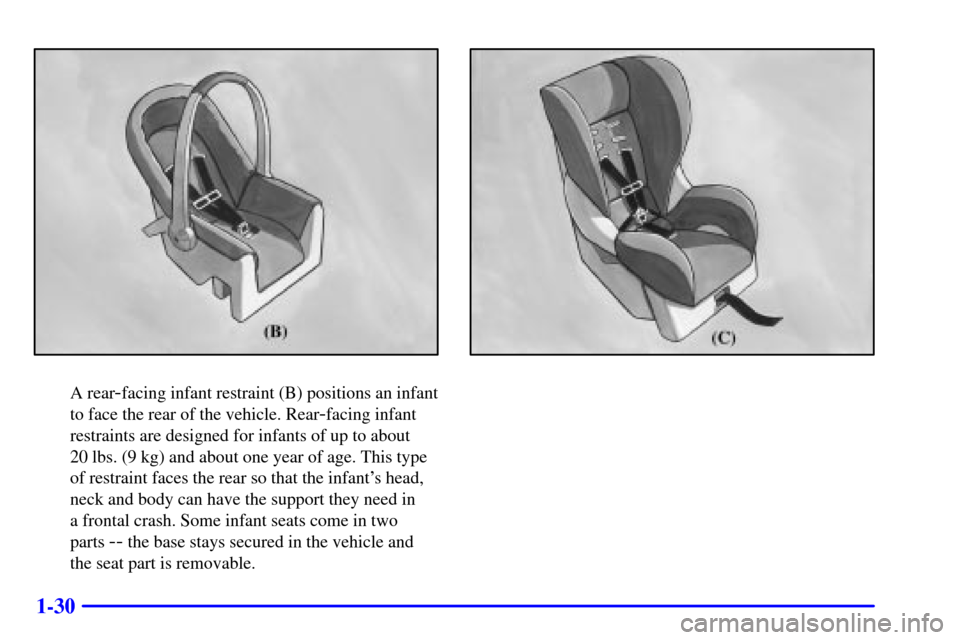
A rear-facing infant restraint (B) positions an infant
to face the rear of the vehicle. Rear
-facing infant
restraints are designed for infants of up to about
20 lbs. (9 kg) and about one year of age. This type
of restraint faces the rear so that the infant's head,
neck and body can have the support they need in
a frontal crash. Some infant seats come in two
parts
-- the base stays secured in the vehicle and
the seat part is removable.
Page 50 of 361
1-32
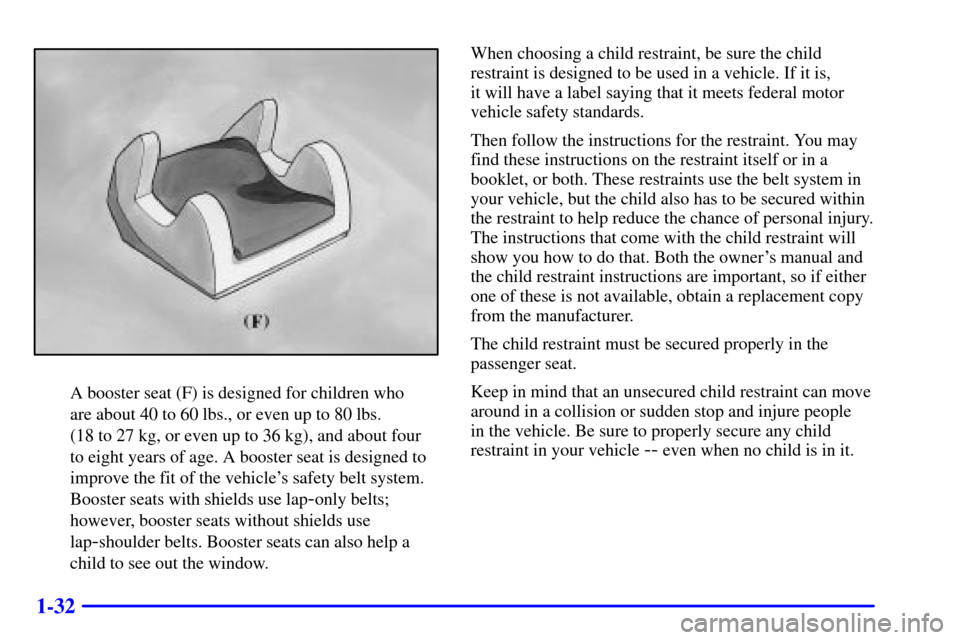
A booster seat (F) is designed for children who
are about 40 to 60 lbs., or even up to 80 lbs.
(18 to 27 kg, or even up to 36 kg), and about four
to eight years of age. A booster seat is designed to
improve the fit of the vehicle's safety belt system.
Booster seats with shields use lap
-only belts;
however, booster seats without shields use
lap
-shoulder belts. Booster seats can also help a
child to see out the window.When choosing a child restraint, be sure the child
restraint is designed to be used in a vehicle. If it is,
it will have a label saying that it meets federal motor
vehicle safety standards.
Then follow the instructions for the restraint. You may
find these instructions on the restraint itself or in a
booklet, or both. These restraints use the belt system in
your vehicle, but the child also has to be secured within
the restraint to help reduce the chance of personal injury.
The instructions that come with the child restraint will
show you how to do that. Both the owner's manual and
the child restraint instructions are important, so if either
one of these is not available, obtain a replacement copy
from the manufacturer.
The child restraint must be secured properly in the
passenger seat.
Keep in mind that an unsecured child restraint can move
around in a collision or sudden stop and injure people
in the vehicle. Be sure to properly secure any child
restraint in your vehicle
-- even when no child is in it.
Page 52 of 361
1-34 Securing a Child Restraint in the Passenger
Seat Position
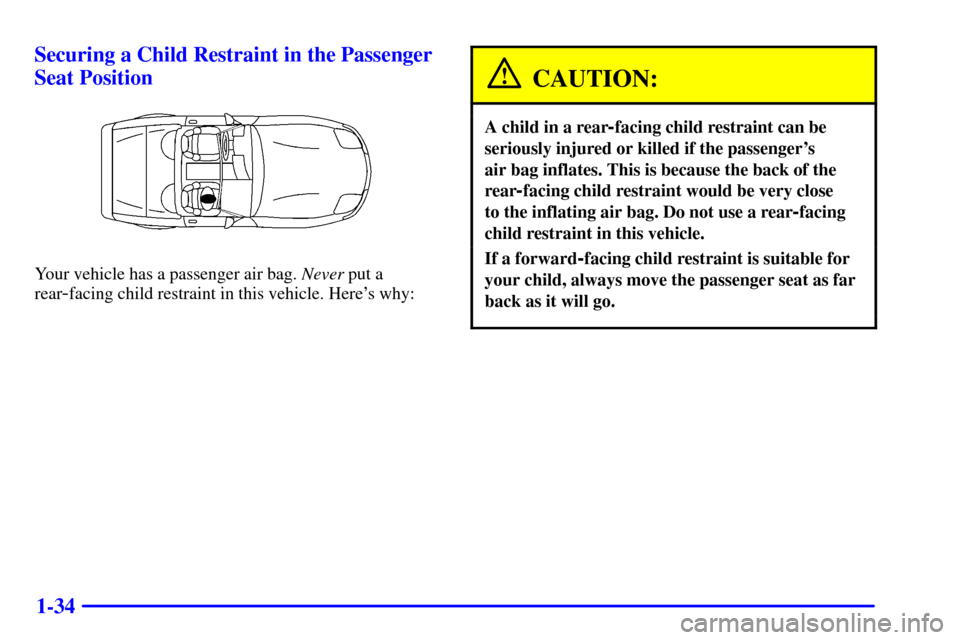
Your vehicle has a passenger air bag. Never put a
rear
-facing child restraint in this vehicle. Here's why:
CAUTION:
A child in a rear-facing child restraint can be
seriously injured or killed if the passenger's
air bag inflates. This is because the back of the
rear
-facing child restraint would be very close
to the inflating air bag. Do not use a rear
-facing
child restraint in this vehicle.
If a forward-facing child restraint is suitable for
your child, always move the passenger seat as far
back as it will go.
Page 53 of 361
1-35
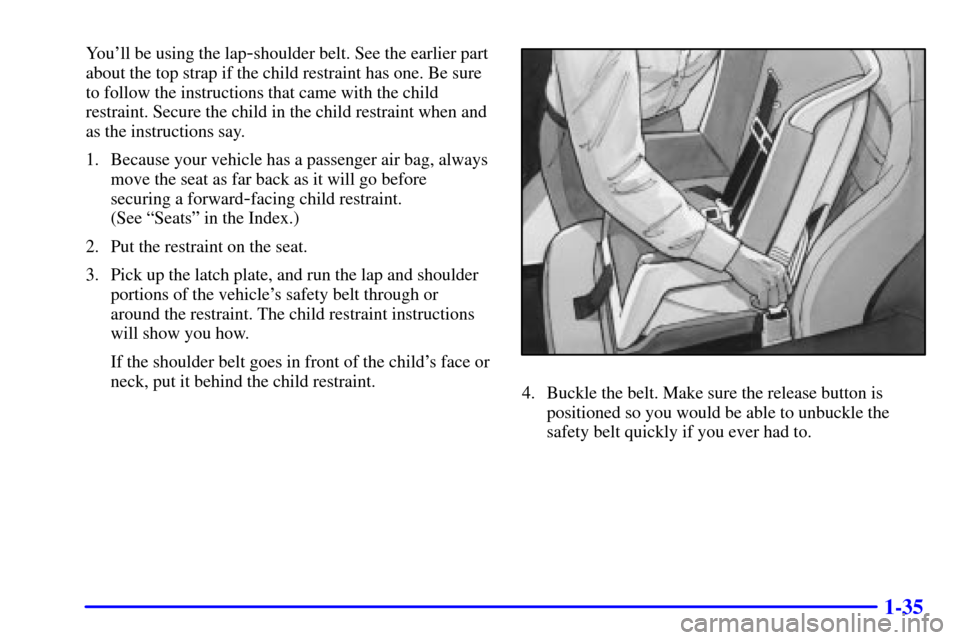
You'll be using the lap-shoulder belt. See the earlier part
about the top strap if the child restraint has one. Be sure
to follow the instructions that came with the child
restraint. Secure the child in the child restraint when and
as the instructions say.
1. Because your vehicle has a passenger air bag, always
move the seat as far back as it will go before
securing a forward
-facing child restraint.
(See ªSeatsº in the Index.)
2. Put the restraint on the seat.
3. Pick up the latch plate, and run the lap and shoulder
portions of the vehicle's safety belt through or
around the restraint. The child restraint instructions
will show you how.
If the shoulder belt goes in front of the child's face or
neck, put it behind the child restraint.
4. Buckle the belt. Make sure the release button is
positioned so you would be able to unbuckle the
safety belt quickly if you ever had to.