Page 12 of 359
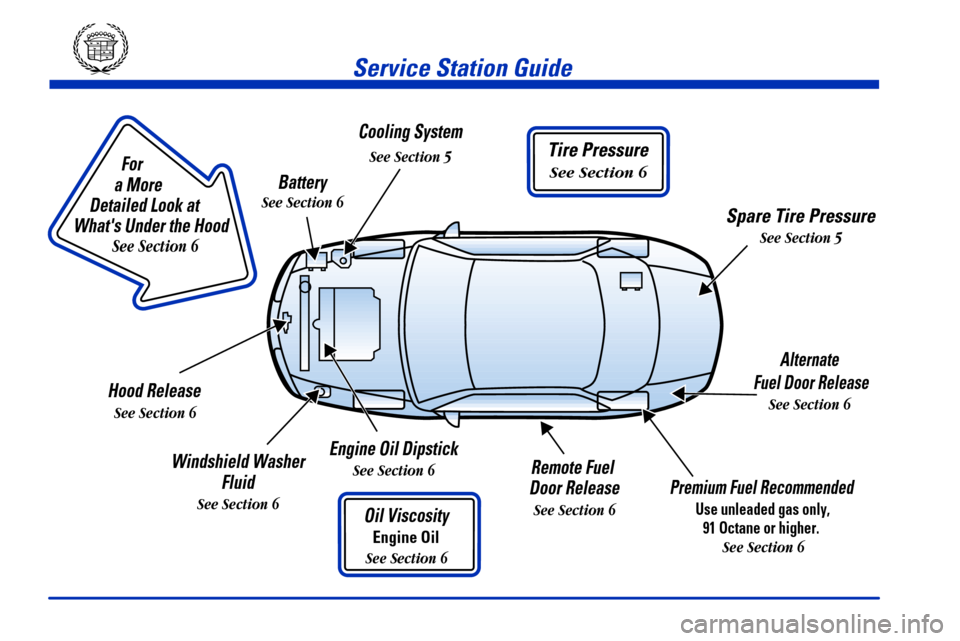
For
a More
Detailed Look at
What's Under the Hood
See Section 6
Tire Pressure
See Section 6
Service Station Guide
Oil Viscosity
Engine Oil
See Section 6
Engine Oil Dipstick
See Section 6Remote Fuel
Door Release
See Section 6
Premium Fuel Recommended
Use unleaded gas only,
91 Octane or higher.
See Section 6
Cooling System
See Section 5
Hood Release
See Section 6
Windshield Washer
Fluid
See Section 6
Spare Tire Pressure
See Section 5
Alternate
Fuel Door Release
See Section 6
Battery
See Section 6
Page 81 of 359
2-21
Engine Coolant Heater (If Equipped)
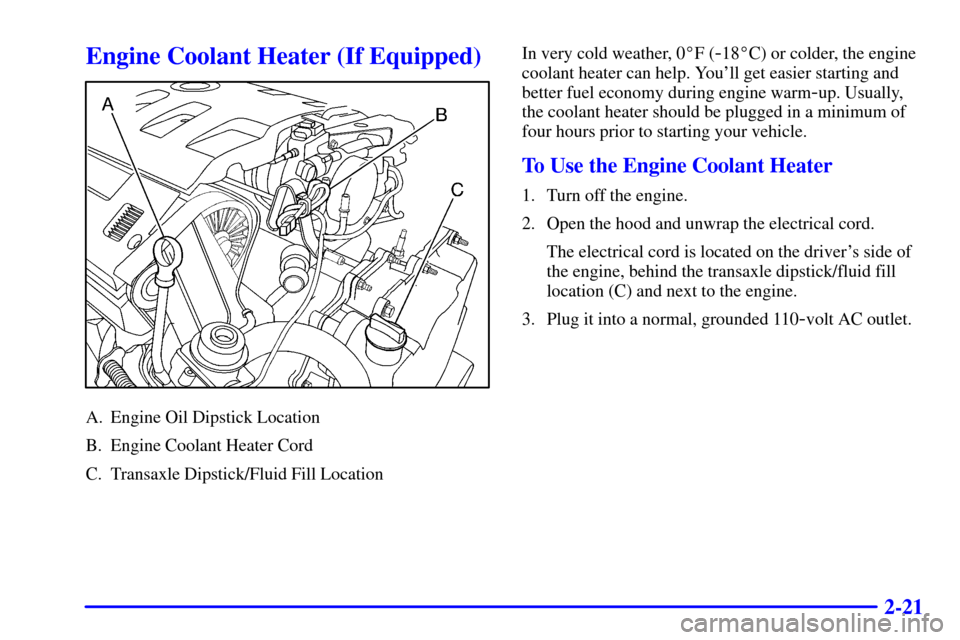
A. Engine Oil Dipstick Location
B. Engine Coolant Heater Cord
C. Transaxle Dipstick/Fluid Fill LocationIn very cold weather, 0�F (
-18�C) or colder, the engine
coolant heater can help. You'll get easier starting and
better fuel economy during engine warm
-up. Usually,
the coolant heater should be plugged in a minimum of
four hours prior to starting your vehicle.
To Use the Engine Coolant Heater
1. Turn off the engine.
2. Open the hood and unwrap the electrical cord.
The electrical cord is located on the driver's side of
the engine, behind the transaxle dipstick/fluid fill
location (C) and next to the engine.
3. Plug it into a normal, grounded 110
-volt AC outlet.
Page 142 of 359

2-82
CHANGE ENGINE OIL - 82: This means that
the life of the engine oil has expired and it should be
changed within 200 miles. See ªEngine Oilº and ªFilter
Recommendationsº in the Maintenance Schedule
booklet. After an oil change, the Oil Life Indicator must
be reset. See ªOil Life Indicator, How to Resetº in
the Index.
CHANGE TRANS FLUID
- 47: This message
will appear when it is time to replace the transaxle fluid.
See the Maintenance Schedule booklet for the proper
fluid and change intervals.
CHECK BRAKE FLUID
- 37: This message will
display if the ignition is in ON to inform the driver
that the brake fluid level is low. Have the brake system
serviced by a technician as soon as possible. See ªBrake
System Warning Lightº in the Index.
CHECK COOLANT LEVEL
- 2: This message
will appear when there is a low level of engine coolant.
Have the cooling system serviced by a technician as
soon as possible.
CHECK FUEL GAGE
- 50: This message will appear
when the fuel supply is less than 5 gallons (18.9 L) and
the display is turned off. A single chime will also sound
when this message is displayed.CHECK GAS CAP
- 61: This message will appear if
the gas cap has not been fully tightened. You should
recheck your gas cap to ensure that it's fully tightened.
CHECK OIL LEVEL
- 36: For correct operation of
the low oil sensing system, your vehicle should be on
a level surface. A false CHECK OIL LEVEL message
may appear if the vehicle is parked on grades. The oil
level sensing system does not check for actual oil level
if the engine has been off for a short period of time, and
the oil level is never sensed while the engine is running.
If the CHECK OIL LEVEL message appears, and
your vehicle has been parked on level ground with the
engine off for at least 30 minutes, the oil level should be
checked by observing the oil dipstick. Prior to checking
the oil level, be sure the engine has been off for a
few minutes and your vehicle is on a level surface.
Then check the dipstick and add oil if necessary.
See ªEngine Oilº in the Index.
CHECK WASHER FLUID
- 25: This message
means that you need washer solvent.
DRIVER DOOR AJAR
- 140: This message will
display anytime the key is in ON, the transaxle is not in
PARK (P) and the driver's door is open or ajar. A chime
will also sound when the vehicle's speed is greater than
3 mph (4.8 km/h).
Page 286 of 359
6-10
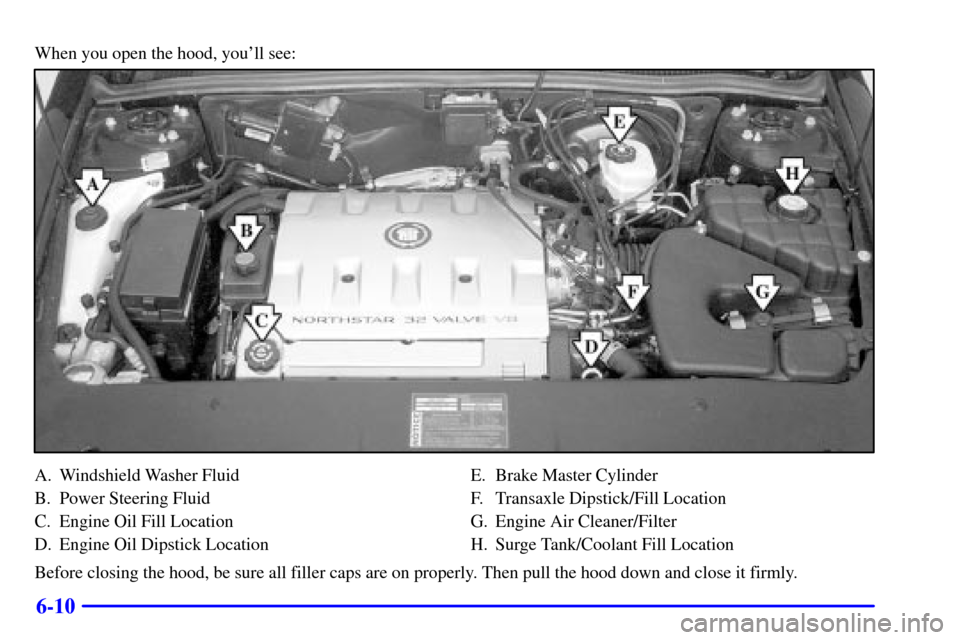
When you open the hood, you'll see:
A. Windshield Washer Fluid
B. Power Steering Fluid
C. Engine Oil Fill Location
D. Engine Oil Dipstick LocationE. Brake Master Cylinder
F. Transaxle Dipstick/Fill Location
G. Engine Air Cleaner/Filter
H. Surge Tank/Coolant Fill Location
Before closing the hood, be sure all filler caps are on properly. Then pull the hood down and close it firmly.
Page 287 of 359
6-11 Underhood Lamp
Turn the parking lamps on to operate the underhood
lamp. The underhood lamp will come on when the hood
is opened.
Engine Oil
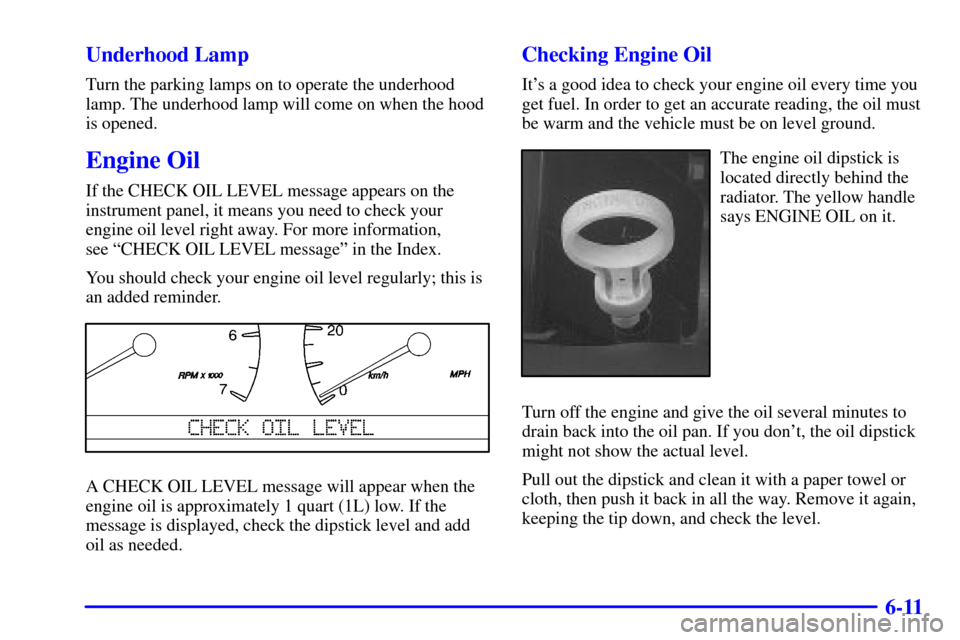
If the CHECK OIL LEVEL message appears on the
instrument panel, it means you need to check your
engine oil level right away. For more information,
see ªCHECK OIL LEVEL messageº in the Index.
You should check your engine oil level regularly; this is
an added reminder.
A CHECK OIL LEVEL message will appear when the
engine oil is approximately 1 quart (1L) low. If the
message is displayed, check the dipstick level and add
oil as needed.
Checking Engine Oil
It's a good idea to check your engine oil every time you
get fuel. In order to get an accurate reading, the oil must
be warm and the vehicle must be on level ground.
The engine oil dipstick is
located directly behind the
radiator. The yellow handle
says ENGINE OIL on it.
Turn off the engine and give the oil several minutes to
drain back into the oil pan. If you don't, the oil dipstick
might not show the actual level.
Pull out the dipstick and clean it with a paper towel or
cloth, then push it back in all the way. Remove it again,
keeping the tip down, and check the level.
Page 288 of 359
6-12
When to Add Engine Oil
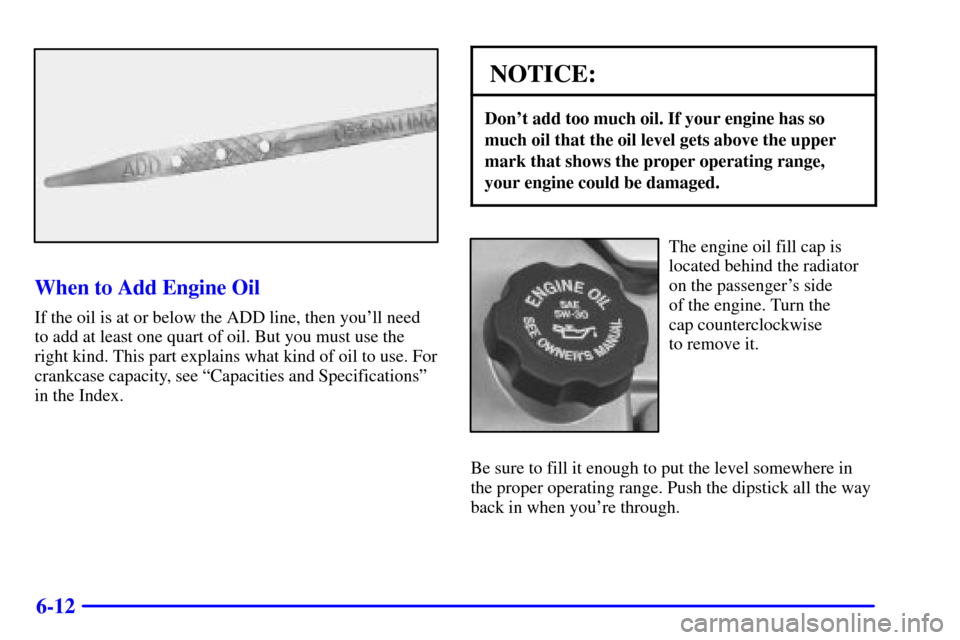
If the oil is at or below the ADD line, then you'll need
to add at least one quart of oil. But you must use the
right kind. This part explains what kind of oil to use. For
crankcase capacity, see ªCapacities and Specificationsº
in the Index.
NOTICE:
Don't add too much oil. If your engine has so
much oil that the oil level gets above the upper
mark that shows the proper operating range,
your engine could be damaged.
The engine oil fill cap is
located behind the radiator
on the passenger's side
of the engine. Turn the
cap counterclockwise
to remove it.
Be sure to fill it enough to put the level somewhere in
the proper operating range. Push the dipstick all the way
back in when you're through.
Page 295 of 359

6-19
Automatic Transaxle Fluid
When to Check and Change
A good time to check your automatic transaxle fluid
level is when the engine oil is changed.
Change both the fluid and filter every 50,000 miles
(83 000 km) if the vehicle is mainly driven under one
or more of these conditions:
�In heavy city traffic where the outside temperature
regularly reaches 90�F (32�C) or higher.
�In hilly or mountainous terrain.
�When doing frequent trailer towing.
�Uses such as found in taxi, police or delivery service.
If you do not use your vehicle under any of these
conditions, the fluid and filter do not require change
until the message CHANGE TRANS FLUID appears
on the Driver Information Center.
See ªScheduled Maintenance Servicesº in the
Maintenance Schedule booklet.
How to Check
Because this operation can be a little difficult, you
may choose to have this done at the dealership
service department.
If you do it yourself, be sure to follow all the instructions
here, or you could get a false reading on the dipstick.
NOTICE:
Too much or too little fluid can damage your
transaxle. Too much can mean that some of the
fluid could come out and fall on hot engine parts
or exhaust system parts, starting a fire. Be sure
to get an accurate reading if you check your
transaxle fluid.
Wait at least 30 minutes before checking the transaxle
fluid level if you have been driving:
�When outside temperatures are above 90�F (32�C).
�At high speed for quite a while.
�In heavy traffic
-- especially in hot weather.
�While pulling a trailer.