Page 82 of 321

2-17
With the key in the
ignition switch, you can
turn the switch to four
different positions.
LOCK (�): Before you put the key in, the ignition
will be in LOCK. This is the only position from which
you can remove the key. This position locks the
ignition, steering wheel and transmission. It's a
theft
-deterrent feature.
OFF (I): This position lets you turn off the engine
but still turn the steering wheel. It doesn't lock the
steering wheel like LOCK. Use OFF if you must
have your vehicle in motion while the engine is off
(for example, if your vehicle is being pushed).ON (II): The ignition is on in this position. ON is used
for driving your vehicle.
START (III): This position starts the engine.
To lock the steering column, remove the key while in
LOCK. Turn the steering wheel until you hear a click.
Retained Accessory Power (RAP)
The radio and the optional cellular phone are the only
accessories on your vehicle that may be used for up to
10 minutes after the ignition is turned to OFF or until
a door is opened.
Power to the door locks is available at all times. Power
to the fuel door and trunk release will be available
for 15 minutes after the ignition is turned to OFF.
The power window controls and the sunroof (optional)
controls are active until a door is opened
-- there is
no time limit as long as the doors remain closed.
Page 86 of 321
2-21
Automatic Transmission Operation
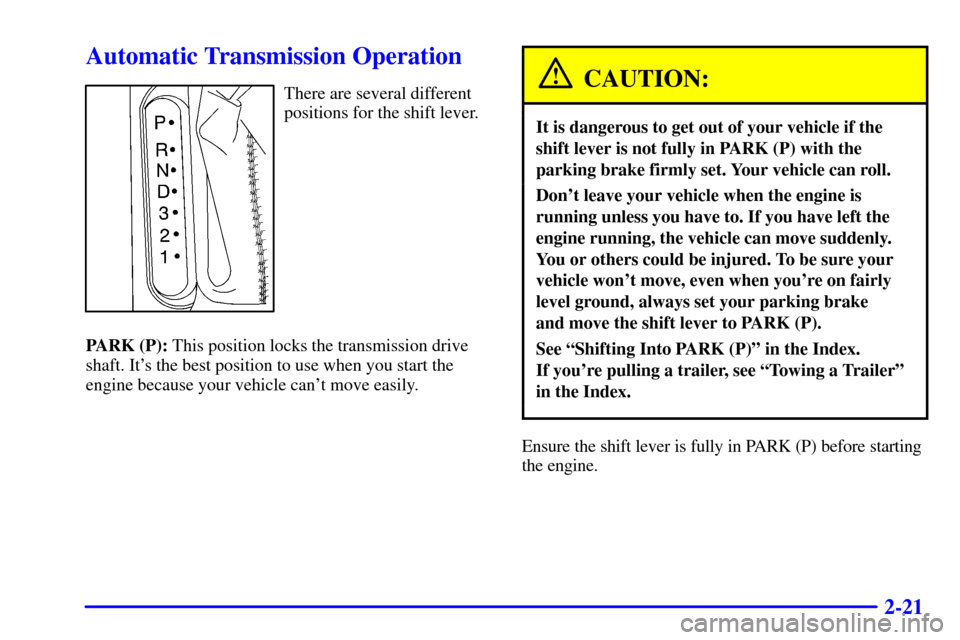
There are several different
positions for the shift lever.
PARK (P): This position locks the transmission drive
shaft. It's the best position to use when you start the
engine because your vehicle can't move easily.CAUTION:
It is dangerous to get out of your vehicle if the
shift lever is not fully in PARK (P) with the
parking brake firmly set. Your vehicle can roll.
Don't leave your vehicle when the engine is
running unless you have to. If you have left the
engine running, the vehicle can move suddenly.
You or others could be injured. To be sure your
vehicle won't move, even when you're on fairly
level ground, always set your parking brake
and move the shift lever to PARK (P).
See ªShifting Into PARK (P)º in the Index.
If you're pulling a trailer, see ªTowing a Trailerº
in the Index.
Ensure the shift lever is fully in PARK (P) before starting
the engine.
Page 87 of 321
2-22
Your vehicle has an automatic transmission shift lock
control system. You have to fully apply the regular
brakes before you can shift from PARK (P) when
the ignition key is in ON. If you cannot shift out of
PARK (P), ease pressure on the shift lever
-- push
the shift lever all the way into PARK (P) as you
maintain brake application. Then move the shift lever
into the gear you wish. See ªShifting Out of PARK (P)º
in this section.
REVERSE (R): Use this gear to back up.
To rock your vehicle back and forth to get out of snow,
ice or sand without damaging the transmission, see
ªStuck: In Sand, Mud, Ice or Snowº in the Index.
NEUTRAL (N): The engine doesn't connect with
the wheels when driving in NEUTRAL (N). Use
NEUTRAL (N) to restart your vehicle when you're
already moving or when your vehicle is being towed.
CAUTION:
Shifting out of PARK (P) or NEUTRAL (N) while
your engine is ªracingº (running at high speed)
is dangerous. Unless your foot is firmly on the
brake pedal, your vehicle could move very
rapidly. You could lose control and hit people
or objects. Don't shift out of PARK (P) or
NEUTRAL (N) while your engine is racing.
NOTICE:
Damage to the transmission caused by shifting
out of PARK (P) or NEUTRAL (N) with the
engine racing isn't covered by your warranty.
Page 93 of 321
2-28
3. Turn the ignition key to LOCK.
4. Remove the ignition key and take it with you.
If you can leave your vehicle with the key in your
hand, your vehicle is in PARK (P).
Leaving Your Vehicle With the
Engine Running
CAUTION:
It can be dangerous to leave your vehicle with
the engine running. Your vehicle could move
suddenly if the shift lever is not fully in PARK (P)
with the parking brake firmly set. And, if you
leave the vehicle with the engine running, it could
overheat and even catch fire. You or others could
be injured. Don't leave your vehicle with the
engine running unless you have to.
If you have to leave your vehicle with the engine
running, be sure your vehicle is in PARK (P) and the
parking brake is firmly set before you leave it. After
you've moved the shift lever into PARK (P), hold the
regular brake pedal down. Then, see if you can move
the shift lever away from PARK (P) without pressing the
button on the shift lever handle. If you can, it means
that the shift lever wasn't fully locked into PARK (P).
Torque Lock
If you are parking on a hill and you don't shift your
transmission into PARK (P) properly, the weight of the
vehicle may put too much force on the parking pawl in
the transmission. You may find it difficult to pull the
shift lever out of PARK (P). This is called ªtorque lock.º
To prevent torque lock, set the parking brake and then
shift into PARK (P) properly before you leave the
driver's seat. To find out how, see ªShifting Into
PARK (P)º in the Index.
If torque lock does occur, you may need to have another
vehicle push yours a little uphill to take some of the
pressure from the parking pawl in the transmission,
so you can pull the shift lever out of PARK (P).
Page 94 of 321
2-29
Shifting Out of PARK (P)
Your vehicle has an automatic transmission shift lock
control system. You have to fully apply your regular
brakes before you can shift from PARK (P) when the
ignition is in ON. See ªAutomatic Transmissionº in
the Index.
If you cannot shift out of PARK (P), ease pressure on
the shift lever
-- push the shift lever all the way into
PARK (P) as you maintain brake application. Then
move the shift lever into the gear you want. If you ever
hold the brake pedal down but still can't shift out of
PARK (P), try this:
1. Turn the ignition key to OFF. Open and close the
driver's door to turn off the Retained Accessory
Power (RAP) feature.
2. Apply and hold the brake until the end of step 8.
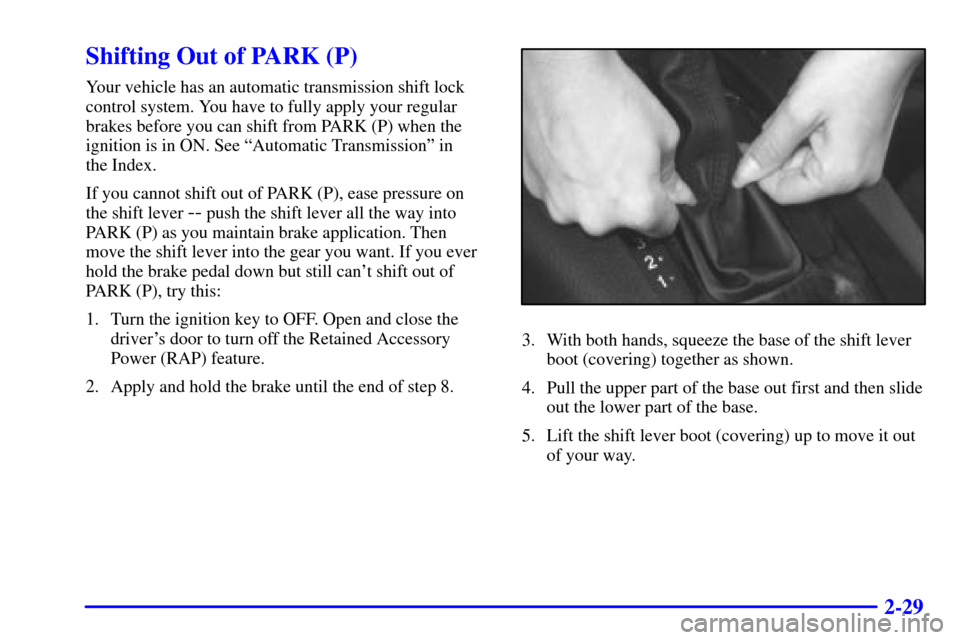
3. With both hands, squeeze the base of the shift lever
boot (covering) together as shown.
4. Pull the upper part of the base out first and then slide
out the lower part of the base.
5. Lift the shift lever boot (covering) up to move it out
of your way.
Page 95 of 321
2-30
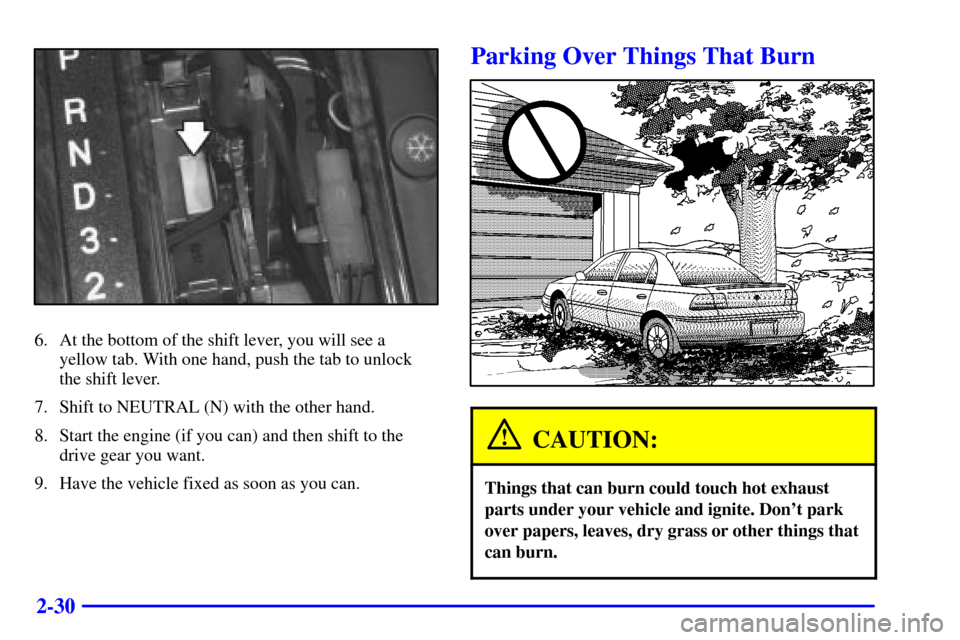
6. At the bottom of the shift lever, you will see a
yellow tab. With one hand, push the tab to unlock
the shift lever.
7. Shift to NEUTRAL (N) with the other hand.
8. Start the engine (if you can) and then shift to the
drive gear you want.
9. Have the vehicle fixed as soon as you can.
Parking Over Things That Burn
CAUTION:
Things that can burn could touch hot exhaust
parts under your vehicle and ignite. Don't park
over papers, leaves, dry grass or other things that
can burn.
Page 98 of 321
2-33
To raise the window, pull up the front of the control.
Pulling the control up for about one second and then
releasing it will express
-close the window.
When you stop your vehicle and turn the ignition
key to LOCK, you can still use the power windows.
The electrical power to operate the windows will not
shut off until a door is opened
-- there is no time
limit to this feature. As soon as a door is opened,
power window movement will stop immediately.
Programming the Power Windows
If the battery on your vehicle has been recharged,
disconnected or is not working, you will need to
reprogram each power window for the express
-open
and close features to work. Before reprogramming, you
will need to replace or recharge your vehicle's battery.
To program each window, follow these steps:
1. Close all doors.
2. Press and hold the power window control until the
window has fully opened.3. Pull the power window control up until the window
is fully closed.
4. Continue holding the control up for approximately
five seconds after the window is completely up.
The window is now programmed. Repeat the process for
each window.
Anti
-Pinch Feature
If a hand, an arm or another object is above the middle
of the window and is in the way of the power window
express
-closing, the window will stop at the obstruction
and express
-open to a preset factory position.
CAUTION:
Pressing and holding the power window control
button will turn off the anti
-pinch feature.
If this happens, a power window won't stop if
something gets in the way. You or others could
be injured, and your window could be damaged.
Be careful not to press and hold the power
window control button.
Page 99 of 321
2-34
Rear Window Lockout
Moving this switch to the
left will disable the rear
passenger window controls.
A red indicator light in
the control will illuminate
as a reminder the rear
passenger window
controls are disabled.
Move the switch to the right to enable the rear passenger
window controls again. A green indicator light in the
control will illuminate to indicate the rear passenger
window controls are active.
Horn
The horn can be sounded by pressing either horn symbol
on the steering wheel. The symbols are located at about
the 9 and 3 o'clock positions.
Tilt Wheel
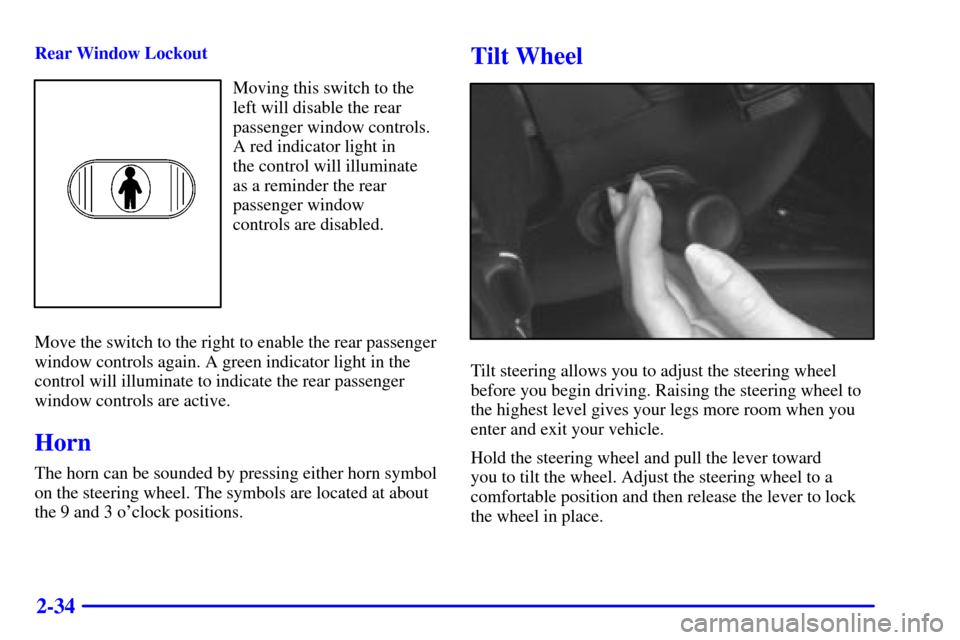
Tilt steering allows you to adjust the steering wheel
before you begin driving. Raising the steering wheel to
the highest level gives your legs more room when you
enter and exit your vehicle.
Hold the steering wheel and pull the lever toward
you to tilt the wheel. Adjust the steering wheel to a
comfortable position and then release the lever to lock
the wheel in place.