Page 59 of 321
1-47
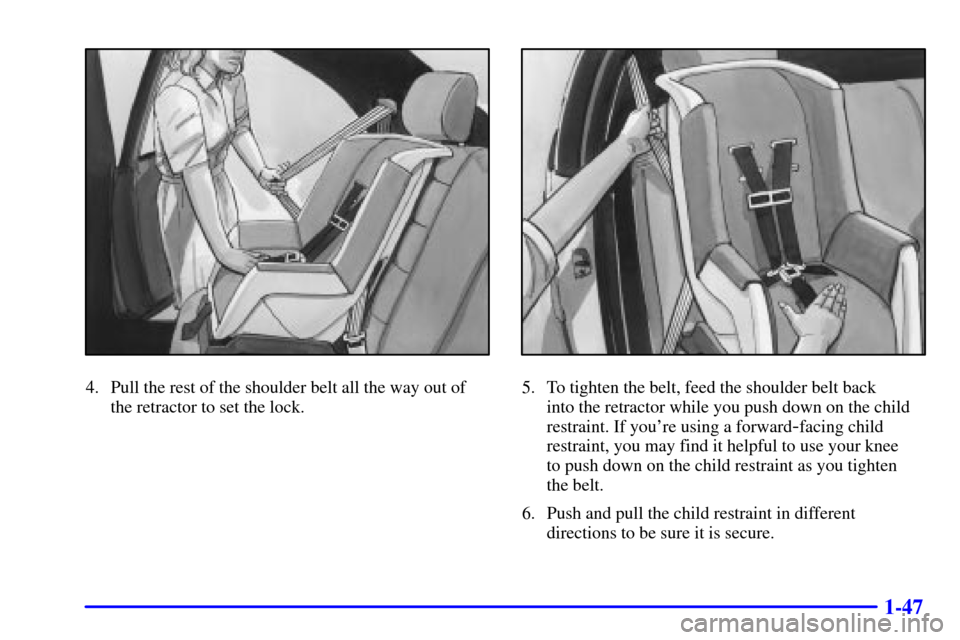
4. Pull the rest of the shoulder belt all the way out of
the retractor to set the lock.5. To tighten the belt, feed the shoulder belt back
into the retractor while you push down on the child
restraint. If you're using a forward
-facing child
restraint, you may find it helpful to use your knee
to push down on the child restraint as you tighten
the belt.
6. Push and pull the child restraint in different
directions to be sure it is secure.
Page 61 of 321
1-49
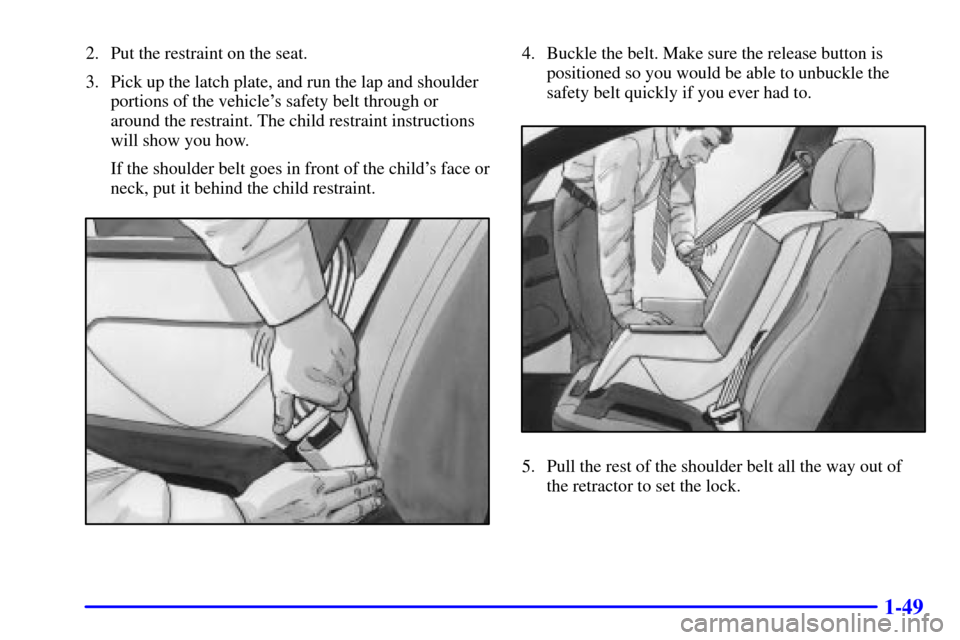
2. Put the restraint on the seat.
3. Pick up the latch plate, and run the lap and shoulder
portions of the vehicle's safety belt through or
around the restraint. The child restraint instructions
will show you how.
If the shoulder belt goes in front of the child's face or
neck, put it behind the child restraint.4. Buckle the belt. Make sure the release button is
positioned so you would be able to unbuckle the
safety belt quickly if you ever had to.
5. Pull the rest of the shoulder belt all the way out of
the retractor to set the lock.
Page 66 of 321

2-
2-1
Section 2 Features and Controls
Here you can learn about the many standard and optional features on your vehicle, and information on starting,
shifting and braking. Also explained are the instrument panel and the warning systems that tell you if everything is
working properly
-- and what to do if you have a problem.
2
- 2 Keys
2
- 4 Door Locks
2
- 7 Remote Keyless Entry System (RKE)
2
- 11 Trunk
2
- 12 Theft
2
- 13 Theft-Deterrent System (Option)
2
- 15 Immobilizer
2
- 16 New VehicleªBreak-Inº
2
- 16 Ignition Positions
2
- 18 Starting Your Engine
2
- 19 Engine Coolant Heater (If Equipped)
2
- 21 Automatic Transmission Operation
2
- 26 Parking Brake
2
- 27 Shifting Into PARK (P)
2
- 29 Shifting Out of PARK (P)
2
- 30 Parking Over Things that Burn2
- 31 Engine Exhaust
2
- 31 Running Your Engine While You're Parked
2
- 32 Windows
2
- 34 Horn
2
- 34 Tilt Wheel
2
- 35 Turn Signal/Multifunction Lever
2
- 41 Exterior Lamps
2
- 47 Interior Lamps
2
- 48 Mirrors
2
- 50 Storage Compartments
2
- 53 OnStar� System (If Equipped)
2
- 54 Sunroof (Option)
2
- 58 HomeLink� Transmitter (If Equipped)
2
- 62 The Instrument Panel -- Your
Information System
2
- 66 Warning Lights, Gages and Indicators
Page 68 of 321
2-3
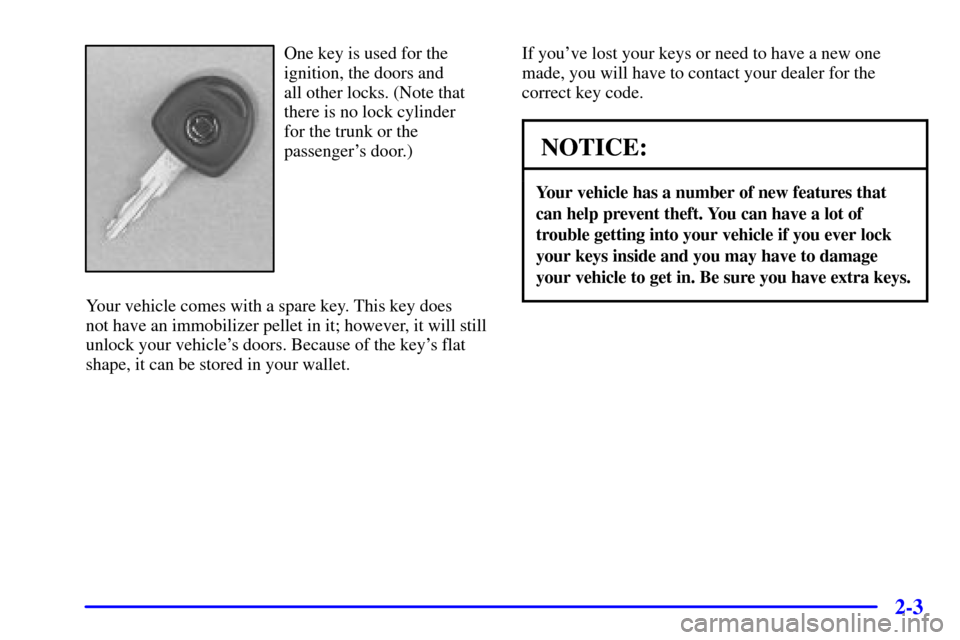
One key is used for the
ignition, the doors and
all other locks. (Note that
there is no lock cylinder
for the trunk or the
passenger's door.)
Your vehicle comes with a spare key. This key does
not have an immobilizer pellet in it; however, it will still
unlock your vehicle's doors. Because of the key's flat
shape, it can be stored in your wallet.If you've lost your keys or need to have a new one
made, you will have to contact your dealer for the
correct key code.
NOTICE:
Your vehicle has a number of new features that
can help prevent theft. You can have a lot of
trouble getting into your vehicle if you ever lock
your keys inside and you may have to damage
your vehicle to get in. Be sure you have extra keys.
Page 69 of 321
2-4
Door Locks
CAUTION:
Unlocked doors can be dangerous.
Passengers -- especially children -- can easily
open the doors and fall out. When a door is
locked, the inside handle won't open it.
Outsiders can easily enter through an unlocked
door when you slow down or stop your vehicle.
This may not be so obvious: You increase the
chance of being thrown out of the vehicle in a
crash if the doors aren't locked. Wear safety belts
properly, lock your doors, and you will be far
better off whenever you drive your vehicle.
There are several ways to lock and unlock your vehicle.
From the outside, use your key or the remote keyless
entry transmitter. This will avoid setting off the optional
theft
-deterrent alarm.
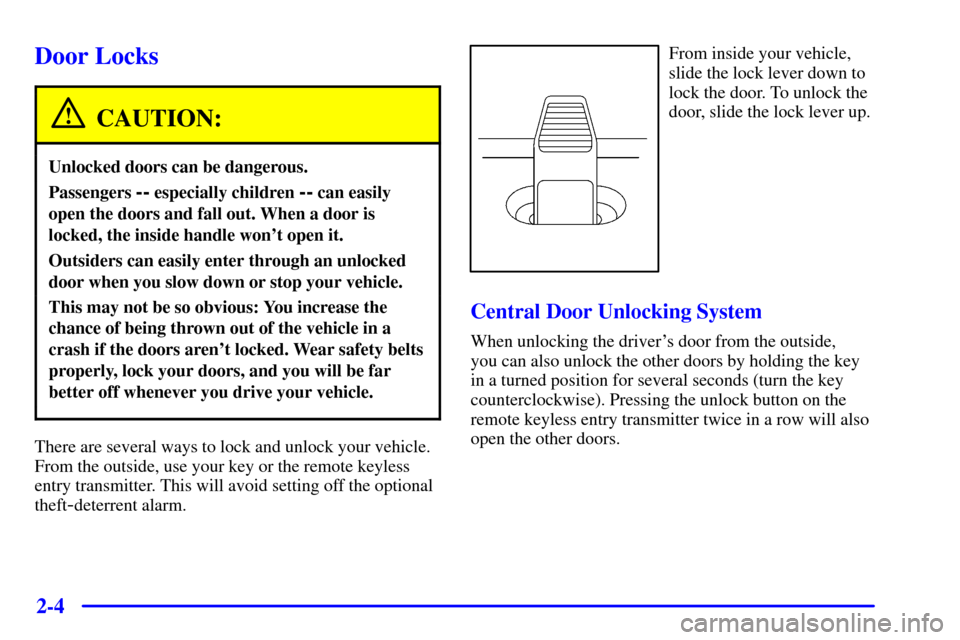
From inside your vehicle,
slide the lock lever down to
lock the door. To unlock the
door, slide the lock lever up.
Central Door Unlocking System
When unlocking the driver's door from the outside,
you can also unlock the other doors by holding the key
in a turned position for several seconds (turn the key
counterclockwise). Pressing the unlock button on the
remote keyless entry transmitter twice in a row will also
open the other doors.
Page 70 of 321

2-5 Power Door Locks
Push the side of the
power door lock switch
with the lock symbol to
lock all the doors.
Push the side of the switch with the unlock symbol to
unlock all the doors.
Automatic Door Locks
Close the doors and turn on the ignition. Every time you
move the shift lever out of PARK (P), all of the doors
will lock. The doors will also unlock every time you
stop the vehicle and move the shift lever into PARK (P).
If someone needs to get out while your vehicle is not in
PARK (P), have that person use the manual or power
door lock. When the door is closed again, it will not lock
automatically. Use the manual or power lock to lock the
door again.
Programmable Automatic Door Locks
Each remote keyless entry transmitter supplied with
your vehicle can be programmed to suit each driver's
door lock preference. The two remote keyless entry
transmitters are identified on the back with either a ª1º or
a ª2º. Each transmitter can be programmed separately.
The automatic door locks can be programmed (using the
remote keyless entry transmitter) for various lock and
unlock options.
With the ignition on, the transmission in PARK (P)
and the brake pedal pressed down, you are now ready
to begin programming.
Page 71 of 321
2-6
To program:
All doors do not unlock when shifting into
PARK (P)
- Press the unlock button on the remote
keyless entry transmitter four times. Each press should
be held for about one second with less than five seconds
in between each press.
All doors unlock when shifting into PARK (P)
- Press
the unlock button on the remote keyless entry transmitter
four times. Each press should be held for about one
second with less than five seconds in between each press.
Please note that the unlock button will toggle between
the above two settings.
All doors do not lock when shifting out of
PARK (P)
- Press the lock button on the remote
keyless entry transmitter four times. Each press should
be held for about one second with less than five seconds
in between each press.
All doors lock when shifting out of PARK (P)
- Press
the lock button on the remote keyless entry four times.
Each press should be held for about one second with less
than five seconds in between each press.
Please note that the lock button will toggle between the
above two settings.
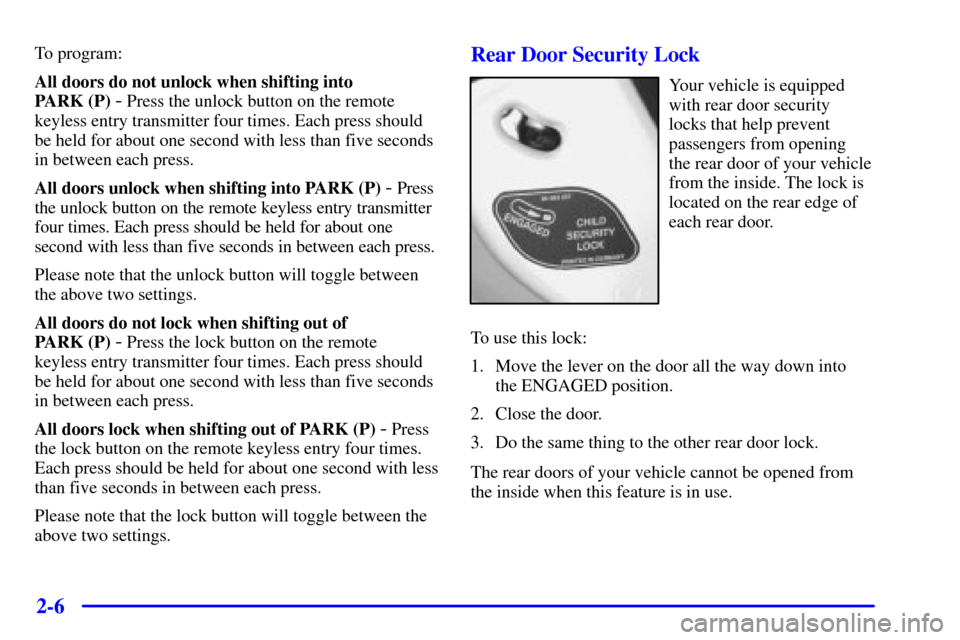
Rear Door Security Lock
Your vehicle is equipped
with rear door security
locks that help prevent
passengers from opening
the rear door of your vehicle
from the inside. The lock is
located on the rear edge of
each rear door.
To use this lock:
1. Move the lever on the door all the way down into
the ENGAGED position.
2. Close the door.
3. Do the same thing to the other rear door lock.
The rear doors of your vehicle cannot be opened from
the inside when this feature is in use.
Page 72 of 321

2-7
When you want to open a rear door when the security
lock is on:
1. Unlock the door from the inside.
2. Then open the door from the outside.
To cancel the rear door lock:
1. Unlock the door from the inside and open the door
from the outside.
2. Move the lever all the way up.
3. Do the same for the other rear door.
The rear door locks will now work normally.
Anti-Lockout Feature
Leaving your key in the ignition with a door open will
prevent locking of the doors with either the power door
lock switches or the remote keyless entry transmitter.
It is always recommended that you remove the ignition
key when locking your vehicle.
The anti
-lockout feature can be overridden by holding
the power door lock switch for three seconds or longer.
Leaving Your Vehicle
If you are leaving your vehicle, open the door, set the
locks from the inside, get out and close the door.
Remote Keyless Entry System (RKE)
If your vehicle has this feature, you can lock and unlock
your doors or unlock your trunk from about 3 feet (1 m)
up to 30 feet (9 m) away using the remote keyless entry
transmitter supplied with your vehicle.
Your keyless entry system operates on a radio frequency
subject to Federal Communications Commission (FCC)
Rules and with Industry Canada.
This device complies with Part 15 of the FCC Rules.
Operation is subject to the following two conditions:
(1) this device may not cause harmful interference,
and (2) this device must accept any interference
received, including interference that may cause
undesired operation.
This device complies with RSS
-210 of Industry Canada.
Operation is subject to the following two conditions:
(1) this device may not cause interference, and (2) this
device must accept any interference received, including
interference that may cause undesired operation of
the device.
Changes or modifications to this system by other than
an authorized service facility could void authorization to
use this equipment.