Page 233 of 321
5-20
Changing a Flat Tire
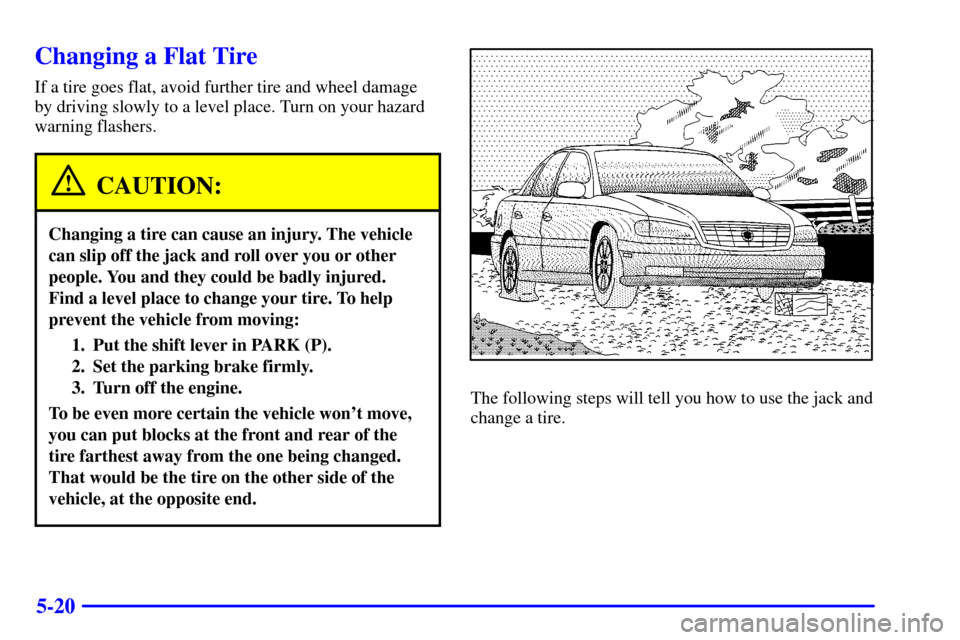
If a tire goes flat, avoid further tire and wheel damage
by driving slowly to a level place. Turn on your hazard
warning flashers.
CAUTION:
Changing a tire can cause an injury. The vehicle
can slip off the jack and roll over you or other
people. You and they could be badly injured.
Find a level place to change your tire. To help
prevent the vehicle from moving:
1. Put the shift lever in PARK (P).
2. Set the parking brake firmly.
3. Turn off the engine.
To be even more certain the vehicle won't move,
you can put blocks at the front and rear of the
tire farthest away from the one being changed.
That would be the tire on the other side of the
vehicle, at the opposite end.The following steps will tell you how to use the jack and
change a tire.
Page 236 of 321
5-23
The tools you'll be using include the jack (A), the wheel
wrench (B) and the screwdriver (C).
Removing the Flat Tire and Installing the
Spare Tire
1. Use the flat end of the screwdriver to pry off the
five black plastic wheel bolt caps. Be careful not to
scratch the wheel edge.
Page 238 of 321
5-25
5. Position the jack under the vehicle.The base of the jack must line up vertically with the
hoisting notch (jack contact point) on the vehicle's
frame, nearest the flat tire. Make sure that the base
is flat against the ground in order to have enough
clearance to turn the jack handle. Then, raise the jack
lift head until it is firmly set into the hoisting notch.
Page 239 of 321
5-26
CAUTION:
Getting under a vehicle when it is jacked up is
dangerous. If the vehicle slips off the jack, you
could be badly injured or killed. Never get under
a vehicle when it is supported only by a jack.
CAUTION:
Raising your vehicle with the jack improperly
positioned can damage the vehicle and even make
the vehicle fall. To help avoid personal injury and
vehicle damage, be sure to fit the jack lift head
into the proper location before raising
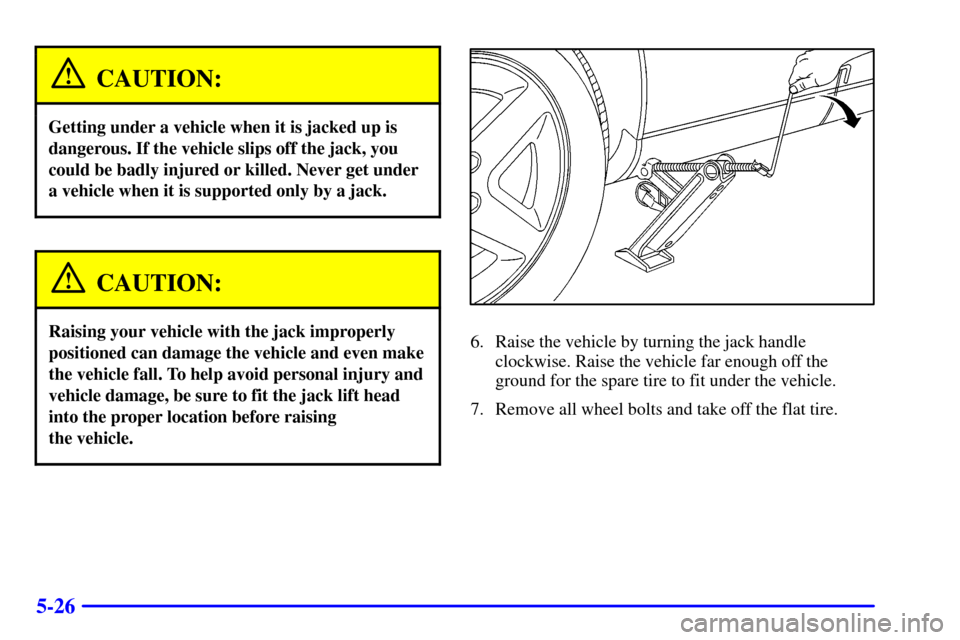
the vehicle.6. Raise the vehicle by turning the jack handle
clockwise. Raise the vehicle far enough off the
ground for the spare tire to fit under the vehicle.
7. Remove all wheel bolts and take off the flat tire.
Page 242 of 321
5-29
NOTICE:
Improperly tightened wheel bolts can lead to
brake pulsation and rotor damage. To avoid
expensive brake repairs, evenly tighten the wheel
bolts in the proper sequence and to the proper
torque specification.
Storing a Flat or Spare Tire and Tools
CAUTION:
Storing a jack, a tire or other equipment in the
passenger compartment of the vehicle could
cause injury. In a sudden stop or collision, loose
equipment could strike someone. Store all these
in the proper place.
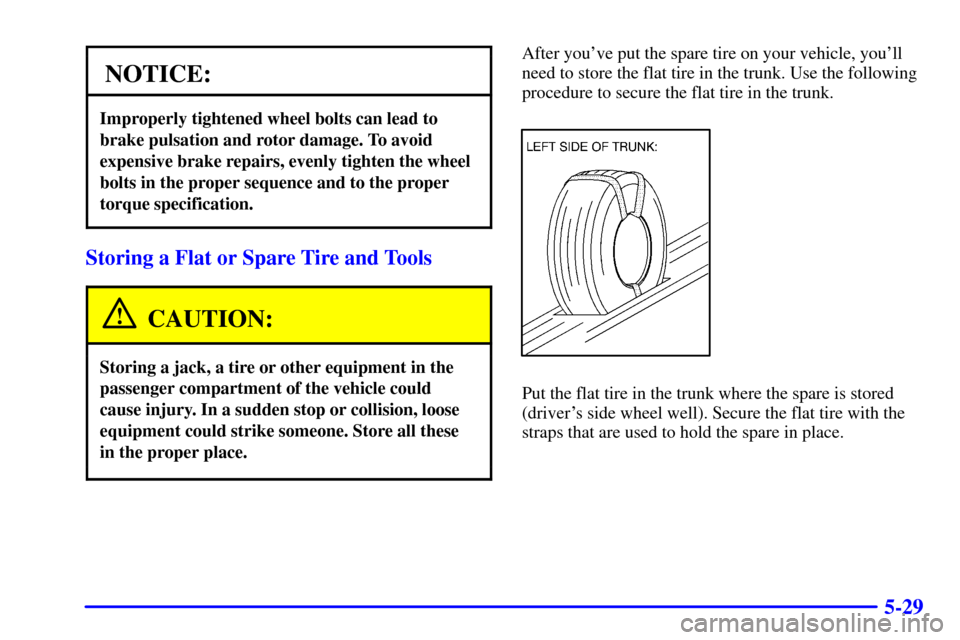
After you've put the spare tire on your vehicle, you'll
need to store the flat tire in the trunk. Use the following
procedure to secure the flat tire in the trunk.
Put the flat tire in the trunk where the spare is stored
(driver's side wheel well). Secure the flat tire with the
straps that are used to hold the spare in place.
Page 282 of 321
6-38
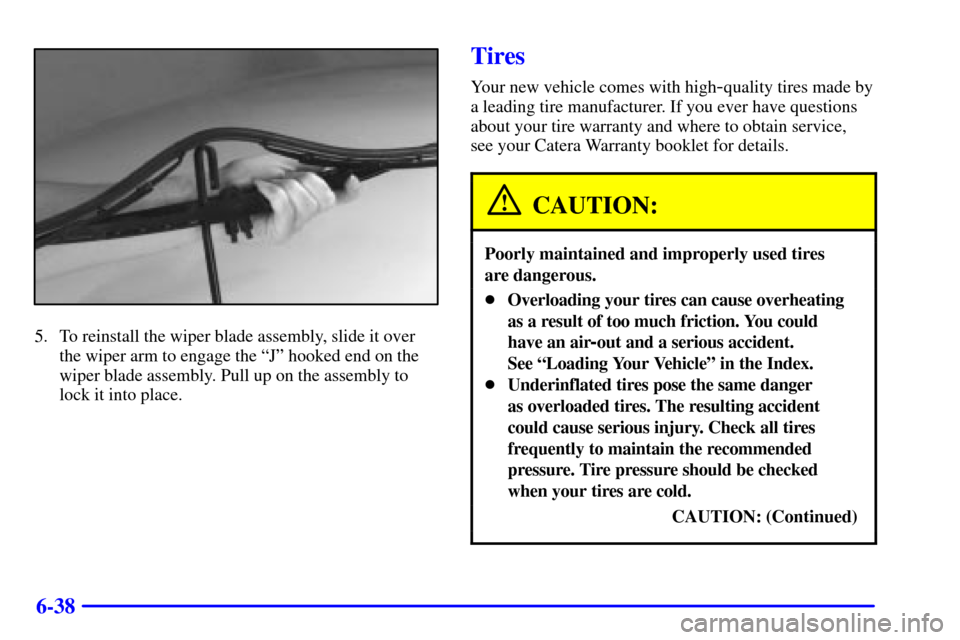
5. To reinstall the wiper blade assembly, slide it over
the wiper arm to engage the ªJº hooked end on the
wiper blade assembly. Pull up on the assembly to
lock it into place.
Tires
Your new vehicle comes with high-quality tires made by
a leading tire manufacturer. If you ever have questions
about your tire warranty and where to obtain service,
see your Catera Warranty booklet for details.
CAUTION:
Poorly maintained and improperly used tires
are dangerous.
�Overloading your tires can cause overheating
as a result of too much friction. You could
have an air
-out and a serious accident.
See ªLoading Your Vehicleº in the Index.
�Underinflated tires pose the same danger
as overloaded tires. The resulting accident
could cause serious injury. Check all tires
frequently to maintain the recommended
pressure. Tire pressure should be checked
when your tires are cold.
CAUTION: (Continued)
Page 283 of 321
6-39
CAUTION: (Continued)
�Overinflated tires are more likely to be
cut, punctured or broken by a sudden
impact
-- such as when you hit a pothole.
Keep tires at the recommended pressure.
�Worn, old tires can cause accidents. If your
tread is badly worn, or if your tires have
been damaged, replace them.
See ªInflation -- Tire Pressureº in this section
for inflation pressure adjustment for higher
speed driving.
Inflation -- Tire Pressure
The Tire-Loading Information label, which is located
on the rear edge of the driver's door, shows the correct
inflation pressures for your tires when they're cold.
ªColdº means your vehicle has been sitting for at least
three hours or driven no more than 1 mile (1.6 km).
If you'll be driving at speeds higher than 100 mph
(160 km/h) where it is legal, raise the cold inflation
pressure of each tire to 38 psi (260 kPa) for tire size
P225/55R16 and to 39 psi (270 kPa) for tire size235/45R17. When you end this very high
-speed
driving, reduce the cold inflation pressures to those
listed on the Tire
-Loading Information label.
NOTICE:
Don't let anyone tell you that underinflation or
overinflation is all right. It's not. If your tires
don't have enough air (underinflation), you can
get the following:
�Too much flexing
�Too much heat
�Tire overloading
�Bad wear
�Bad handling
�Bad fuel economy.
If your tires have too much air (overinflation),
you can get the following:
�Unusual wear
�Bad handling
�Rough ride
�Needless damage from road hazards.
Page 284 of 321

6-40
When to Check
Check your tires once a month or more. Also, check
the tire pressure of the spare tire.
How to Check
Use a good quality pocket
-type gage to check tire
pressure. You can't tell if your tires are properly inflated
simply by looking at them. Radial tires may look
properly inflated even when they're underinflated.
Be sure to put the valve caps back on the valve
stems. They help prevent leaks by keeping out dirt
and moisture.
Tire Inspection and Rotation
Tires should be rotated at 5,000 miles (8 000 km)
and then every 10,000 miles (16 000 km) thereafter.
Any time you notice unusual wear, rotate your tires as
soon as possible and check wheel alignment. Also check
for damaged tires or wheels. See ªWhen It's Time for
New Tiresº and ªWheel Replacementº later in this
section for more information.The purpose of regular rotation is to achieve more
uniform wear for all tires on the vehicle. The first
rotation is the most important. See ªScheduled
Maintenance Servicesº in the Maintenance Schedule
booklet for scheduled rotation intervals.
When rotating your tires, always use the correct rotation
pattern shown here.
After the tires have been rotated, adjust the front and
rear inflation pressures as shown on the Tire
-Loading
Information label. Make certain that all wheel bolts
are properly tightened. See ªWheel Bolt Torqueº in
the Index.