Page 285 of 321
6-41
CAUTION:
Rust or dirt on a wheel, or on the parts to which
it is fastened, can make wheel studs become loose
after a time. The wheel could come off and cause
an accident. When you change a wheel, remove
any rust or dirt from places where the wheel
attaches to the vehicle. In an emergency, you
can use a cloth or a paper towel to do this;
but be sure to use a scraper or wire brush later,
if you need to, to get all the rust or dirt off.
(See ªChanging a Flat Tireº in the Index.)
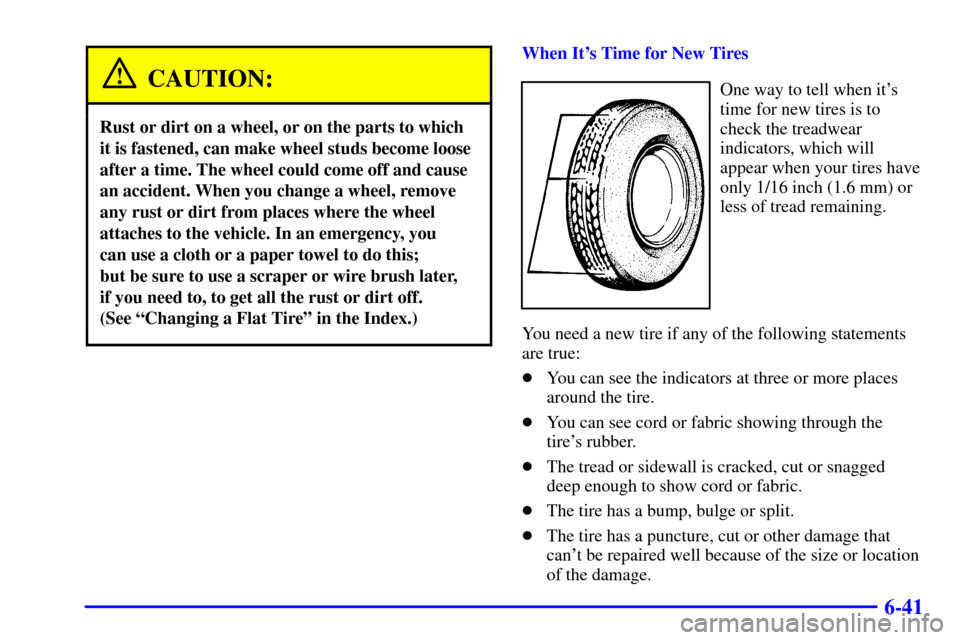
When It's Time for New Tires
One way to tell when it's
time for new tires is to
check the treadwear
indicators, which will
appear when your tires have
only 1/16 inch (1.6 mm) or
less of tread remaining.
You need a new tire if any of the following statements
are true:
�You can see the indicators at three or more places
around the tire.
�You can see cord or fabric showing through the
tire's rubber.
�The tread or sidewall is cracked, cut or snagged
deep enough to show cord or fabric.
�The tire has a bump, bulge or split.
�The tire has a puncture, cut or other damage that
can't be repaired well because of the size or location
of the damage.
Page 288 of 321

6-44
Temperature -- A, B, C
The temperature grades are A (the highest), B, and C,
representing the tire's resistance to the generation of
heat and its ability to dissipate heat when tested under
controlled conditions on a specified indoor laboratory
test wheel. Sustained high temperature can cause the
material of the tire to degenerate and reduce tire life,
and excessive temperature can lead to sudden tire
failure. The grade C corresponds to a level of
performance which all passenger car tires must meet
under the Federal Motor Vehicle Safety Standard
No. 109. Grades B and A represent higher levels of
performance on the laboratory test wheel than the
minimum required by law.
Warning: The temperature grade for this tire is
established for a tire that is properly inflated and
not overloaded. Excessive speed, underinflation, or
excessive loading, either separately or in combination,
can cause heat buildup and possible tire failure.Wheel Alignment and Tire Balance
The wheels on your vehicle were aligned and balanced
carefully at the factory to give you the longest tire life
and best overall performance.
Scheduled wheel alignment and wheel balancing are
not needed. However, if you notice unusual tire wear
or your vehicle pulling one way or the other, the
alignment may need to be reset. If you notice your
vehicle vibrating when driving on a smooth road,
your wheels may need to be rebalanced.
Wheel Replacement
Replace any wheel that is bent, cracked, or badly rusted
or corroded. If wheel bolts keep coming loose, the wheel
and wheel bolts should be replaced. If the wheel leaks
air, replace it (except some aluminum wheels, which can
sometimes be repaired). See your dealer if any of these
conditions exist.
Your dealer will know the kind of wheel you need.
Page 289 of 321
6-45
Each new wheel should have the same load-carrying
capacity, diameter, width, offset and be mounted the
same way as the one it replaces.
If you need to replace any of your wheels or wheel
bolts, replace them only with new GM original
equipment parts. This way, you will be sure to have
the right wheel and wheel bolts for your vehicle.
CAUTION:
Using the wrong replacement wheels and wheel
bolts on your vehicle can be dangerous. It could
affect the braking and handling of your vehicle,
make your tires lose air and make you lose control.
You could have a collision in which you or others
could be injured. Always use the correct wheel and
wheel bolts for replacement.
NOTICE:
The wrong wheel can also cause problems with
bearing life, brake cooling, speedometer or
odometer calibration, headlamp aim, bumper
height, vehicle ground clearance and tire or tire
chain clearance to the body and chassis.
See ªChanging a Flat Tireº in the Index for
more information.
Used Replacement Wheels
CAUTION:
Putting a used wheel on your vehicle is dangerous.
You can't know how it's been used or how far it's
been driven. It could fail suddenly and cause an
accident. If you have to replace a wheel, use a new
GM original equipment wheel.
Page 314 of 321

7-6
Each technician travels with a specially equipped
service vehicle complete with the necessary Catera parts
and tools required to handle most roadside repairs.
Cadillac Roadside Service� can be reached by dialing
1
-800-882-1112, 24 hours a day, 365 days a year.
This service is provided at no charge for any
warranty
-covered situation and for a nominal
charge if the Catera is no longer under warranty.
Roadside Service is available only in the United
States and Canada.
Cadillac Owner Privileges�
Roadside Service provides several Cadillac Owner
Privileges� at ªno charge,º throughout your 2000
Cadillac Warranty Period
-- 48 months/50,000 miles
(80 000 km).Emergency Road Service is performed on site for the
following situations:
�Towing Service
�Battery Jump Starting
�Lock Out Assistance
�Fuel Delivery
�Flat Tire Change (Covers change only)
�Trip Interruption
-- If your trip is interrupted due to a
warranty failure, incidental expenses may be reimbursed
during the 48 months/50,000 miles (80 000 km) warranty
period. Items covered are hotel, meals and rental car.
Page:
< prev 1-8 9-16 17-24