Page 15 of 321
1-3
�To adjust the seat height, lift up or push down on the
center of the control.
�To move the seat forward or rearward, slide the
control in the desired direction.
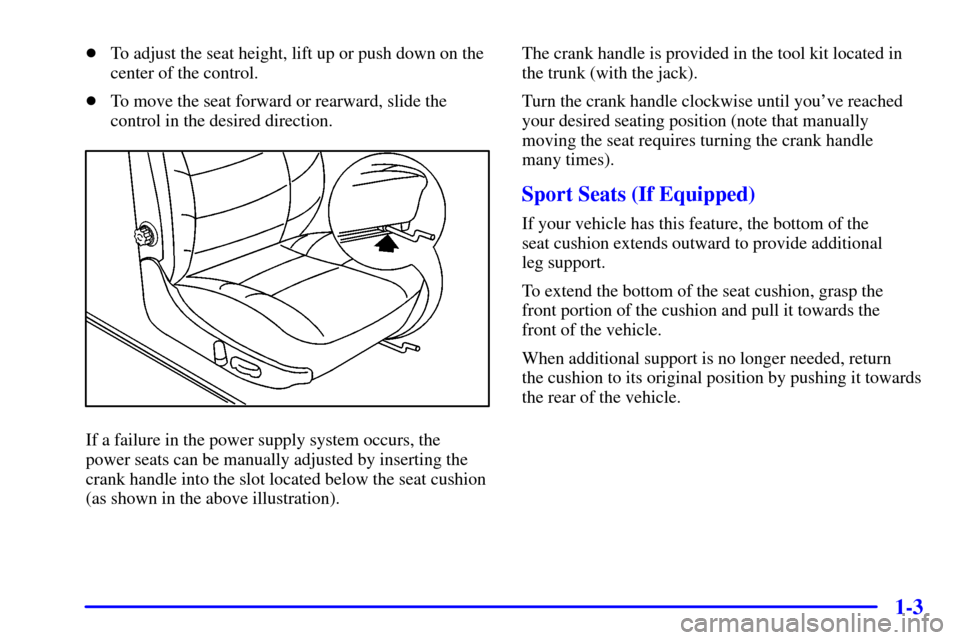
If a failure in the power supply system occurs, the
power seats can be manually adjusted by inserting the
crank handle into the slot located below the seat cushion
(as shown in the above illustration).The crank handle is provided in the tool kit located in
the trunk (with the jack).
Turn the crank handle clockwise until you've reached
your desired seating position (note that manually
moving the seat requires turning the crank handle
many times).
Sport Seats (If Equipped)
If your vehicle has this feature, the bottom of the
seat cushion extends outward to provide additional
leg support.
To extend the bottom of the seat cushion, grasp the
front portion of the cushion and pull it towards the
front of the vehicle.
When additional support is no longer needed, return
the cushion to its original position by pushing it towards
the rear of the vehicle.
Page 19 of 321
1-7 Head Restraints
Slide the head restraint up or down so that the top of the
restraint is closest to the top of your ears. This position
reduces the chance of a neck injury in a crash.
The head restraints tilt forward and rearward also.
The rear seat head restraints in your vehicle are
adjustable. They work the same as the front seat head
restraints, except they do not tilt forward or rearward.
Removable Head Restraints
CAUTION:
If a head restraint is not installed on the seatback
or stored in the vehicle properly, it could be
thrown about the vehicle in a crash or sudden
maneuver. People in the vehicle could be injured.
Remove the head restraints only when you
need to fold the seat, and be sure that the head
restraints are stored securely in the trunk. When
the seat is returned to the passenger position, be
sure the head restraints are installed properly.
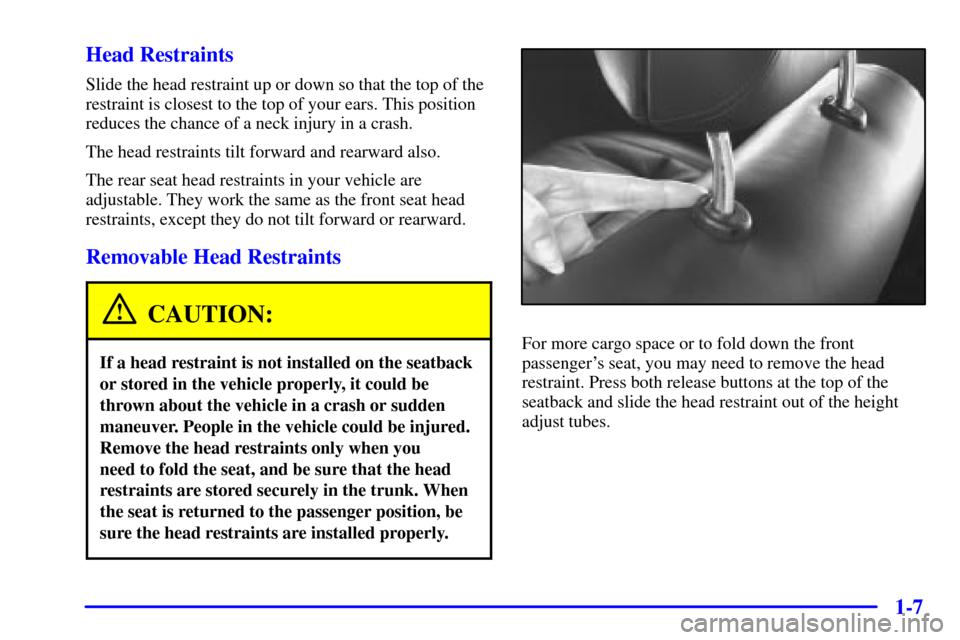
For more cargo space or to fold down the front
passenger's seat, you may need to remove the head
restraint. Press both release buttons at the top of the
seatback and slide the head restraint out of the height
adjust tubes.
Page 31 of 321
1-19
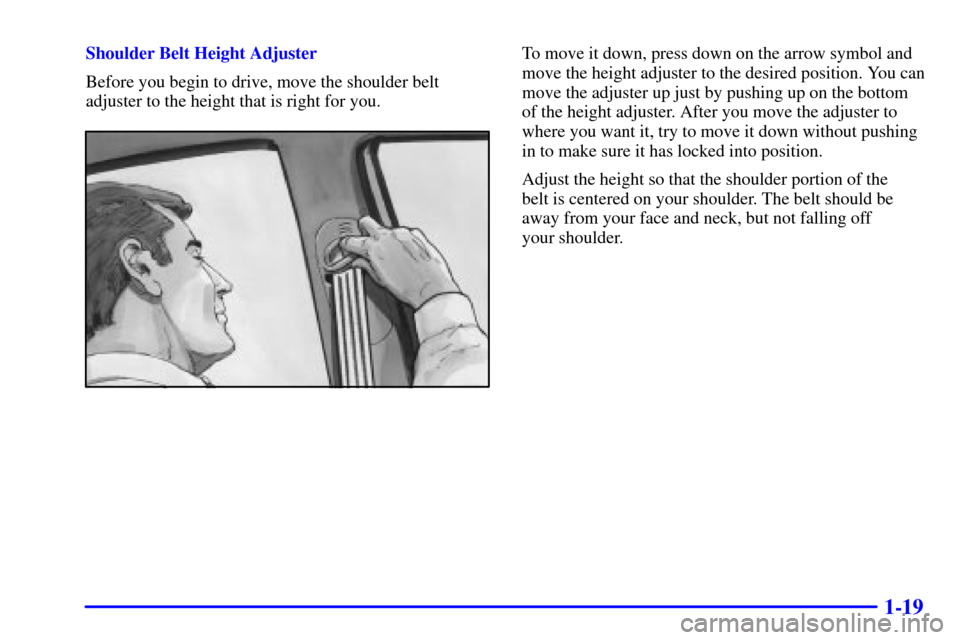
Shoulder Belt Height Adjuster
Before you begin to drive, move the shoulder belt
adjuster to the height that is right for you.To move it down, press down on the arrow symbol and
move the height adjuster to the desired position. You can
move the adjuster up just by pushing up on the bottom
of the height adjuster. After you move the adjuster to
where you want it, try to move it down without pushing
in to make sure it has locked into position.
Adjust the height so that the shoulder portion of the
belt is centered on your shoulder. The belt should be
away from your face and neck, but not falling off
your shoulder.
Page 48 of 321
1-36
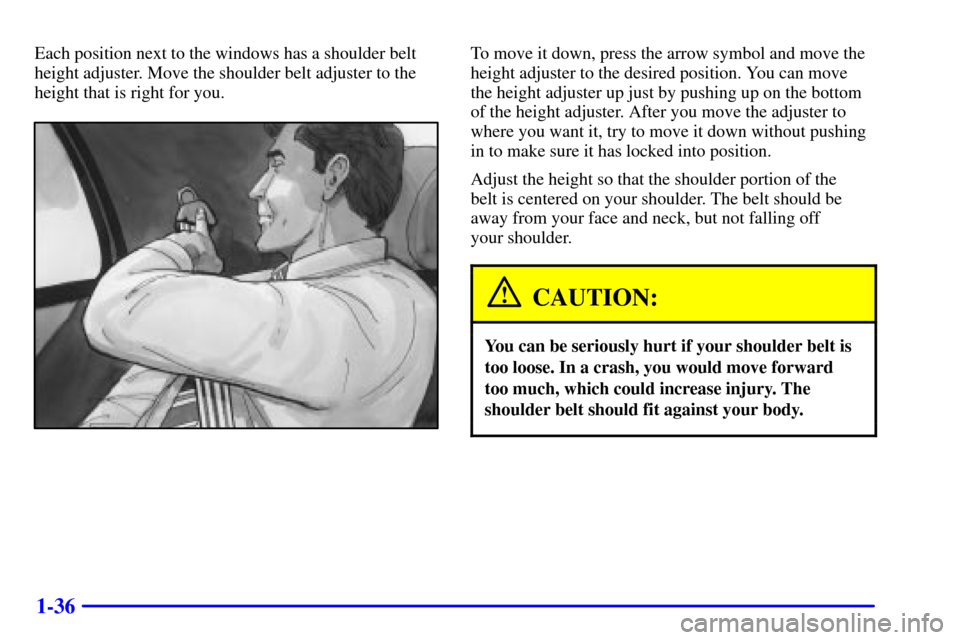
Each position next to the windows has a shoulder belt
height adjuster. Move the shoulder belt adjuster to the
height that is right for you.To move it down, press the arrow symbol and move the
height adjuster to the desired position. You can move
the height adjuster up just by pushing up on the bottom
of the height adjuster. After you move the adjuster to
where you want it, try to move it down without pushing
in to make sure it has locked into position.
Adjust the height so that the shoulder portion of the
belt is centered on your shoulder. The belt should be
away from your face and neck, but not falling off
your shoulder.
CAUTION:
You can be seriously hurt if your shoulder belt is
too loose. In a crash, you would move forward
too much, which could increase injury. The
shoulder belt should fit against your body.
Page 54 of 321
1-42
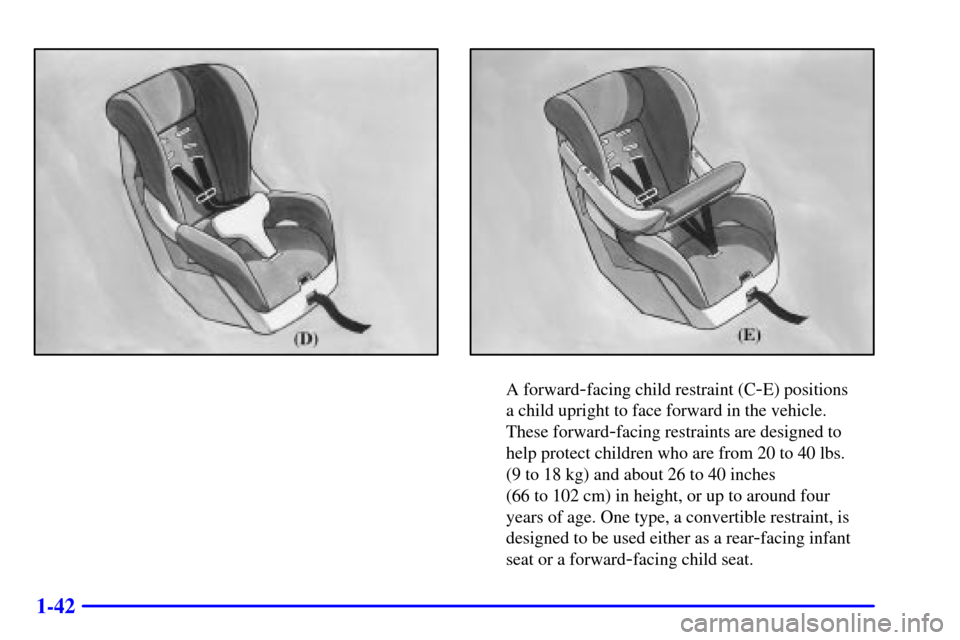
A forward-facing child restraint (C-E) positions
a child upright to face forward in the vehicle.
These forward
-facing restraints are designed to
help protect children who are from 20 to 40 lbs.
(9 to 18 kg) and about 26 to 40 inches
(66 to 102 cm) in height, or up to around four
years of age. One type, a convertible restraint, is
designed to be used either as a rear
-facing infant
seat or a forward
-facing child seat.
Page 273 of 321
6-29
NOTICE:
Continuing to drive with worn-out brake pads
could result in costly brake repair.
Some driving conditions or climates may cause a brake
squeal when the brakes are first applied or lightly
applied. This does not mean something is wrong with
your brakes.
Properly torqued wheel bolts are necessary to help
prevent brake pulsation. When tires are rotated, inspect
brake pads for wear and evenly torque wheel bolts in the
proper sequence to GM specifications.
Brake linings should always be replaced as complete
axle sets.
See ªBrake System Inspectionº in the Maintenance
Schedule booklet under Part C ªPeriodic
Maintenance Inspections.º
Brake Pedal Travel
See your dealer if the brake pedal does not return to
normal height, or if there is a rapid increase in pedal
travel. This could be a sign of brake trouble.
Brake Adjustment
Every time you apply the brakes, with or without the
vehicle moving, your brakes adjust for wear.
Replacing Brake System Parts
The braking system on a vehicle is complex. Its many
parts have to be of top quality and work well together
if the vehicle is to have really good braking. Your
vehicle was designed and tested with top
-quality GM
brake parts. When you replace parts of your braking
system
-- for example, when your brake linings wear
down and you have to have new ones put in
-- be sure
you get new approved GM replacement parts. If you
don't, your brakes may no longer work properly.
For example, if someone puts in brake linings that
are wrong for your vehicle, the balance between your
front and rear brakes can change
-- for the worse.
The braking performance you've come to expect can
change in many other ways if someone puts in the
wrong replacement brake parts.
Page 289 of 321
6-45
Each new wheel should have the same load-carrying
capacity, diameter, width, offset and be mounted the
same way as the one it replaces.
If you need to replace any of your wheels or wheel
bolts, replace them only with new GM original
equipment parts. This way, you will be sure to have
the right wheel and wheel bolts for your vehicle.
CAUTION:
Using the wrong replacement wheels and wheel
bolts on your vehicle can be dangerous. It could
affect the braking and handling of your vehicle,
make your tires lose air and make you lose control.
You could have a collision in which you or others
could be injured. Always use the correct wheel and
wheel bolts for replacement.
NOTICE:
The wrong wheel can also cause problems with
bearing life, brake cooling, speedometer or
odometer calibration, headlamp aim, bumper
height, vehicle ground clearance and tire or tire
chain clearance to the body and chassis.
See ªChanging a Flat Tireº in the Index for
more information.
Used Replacement Wheels
CAUTION:
Putting a used wheel on your vehicle is dangerous.
You can't know how it's been used or how far it's
been driven. It could fail suddenly and cause an
accident. If you have to replace a wheel, use a new
GM original equipment wheel.
Page 308 of 321

6-64 Wheel Bolt Torque
80 lb-ft (110 N´m)
Engine Specifications
Displacement 181 cubic inches (2 962 cc). . . . . . . . .
Type 3.0 L DOHC V6. . . . . . . . . . . . . . . . . . . . . . . . .
VIN Engine Code R. . . . . . . . . . . . . . . . . . . . . . . . . . .
Horsepower 200 (bhp) @ 6000 rpm. . . . . . . . . . . . . .
149 (kW) @ 6000 rpm
Firing Order 1
-2-3-4-5-6 . . . . . . . . . . . . . . . . . . . . . .
Thermostat Starts To Open 198�F (92�C) . . . . . . . . .
Normal Maintenance
Replacement Parts
Air Filter Element 90512851. . . . . . . . . . . . . . . . . . .
Fuel Filter Element 90542540. . . . . . . . . . . . . . . . . .
Engine Oil Filter 9118851. . . . . . . . . . . . . . . . . . . . .
Passenger's Compartment Air Filter 9192320. . . . . .
Spark Plugs 90541059. . . . . . . . . . . . . . . . . . . . . . . .
(Bosch Plug = FLR9LTE)
Windshield Wiper Blades 9118382 (RH). . . . . . . . . . .
118381 (LH)
Vehicle Dimensions
Wheel Base 107.5 inches (273.0 cm). . . . . . . . . . . . .
Length 192.4 inches (492.8 cm). . . . . . . . . . . . . . . . .
Height 56.4 inches (143.2 cm). . . . . . . . . . . . . . . . . . .
Width 70.3 inches (178.6 cm). . . . . . . . . . . . . . . . . . .
Front Tread 59.3 inches (150.6 cm). . . . . . . . . . . . . . .
Rear Tread 59.8 inches (152.0 cm). . . . . . . . . . . . . . .