2000 BMW 540I SEDAN light
[x] Cancel search: lightPage 11 of 217

11n
Controls and features
Operation, care and maintenance
Lamps:
Parking lamps/Low beams94
Instrument lighting94
High beams/Parking lamps95
Fog lamps95
Interior lamps96
Reading lamps96
Controlling the climate
for pleasant driving:
Automatic climate control98
Seat heating 103
Steering wheel heating 103
Roller sun blind 104
Independent ventilation
system 104
Cabin convenience:
BMW Universal Transmitter 105
Glove compartment108
Storage facilities108
Cellular phone 109
Beverage holder 109
Ashtray, front110
Cigarette lighter 110
Ashtray, rear111
Loading and transporting cargo:
Through-loading system 112
Ski bag 113
sport wagon:
Luggage compartment 116
Roll-up cover 116
Separation net 116
Storage areas in the luggage
compartment 118
Cargo loading120
Roof-mounted luggage rack121
Special operating instructions:
Break-in procedure124
Driving notes125
Catalytic converter126
Antilock Brake System
(ABS)127
Disc brakes128
Brake system130
Winter operation130
Power steering132
Level control system 132
Cellular phone 133
Radio reception133
Wheels and tires:
Tire inflation pressure134
Tire condition134
Tire replacement135
Tire rotation136
Wheel and tire
combinations137
Winter tires138
Snow chains 139
Approved wheel and tire
specifications 140
Page 22 of 217
22n
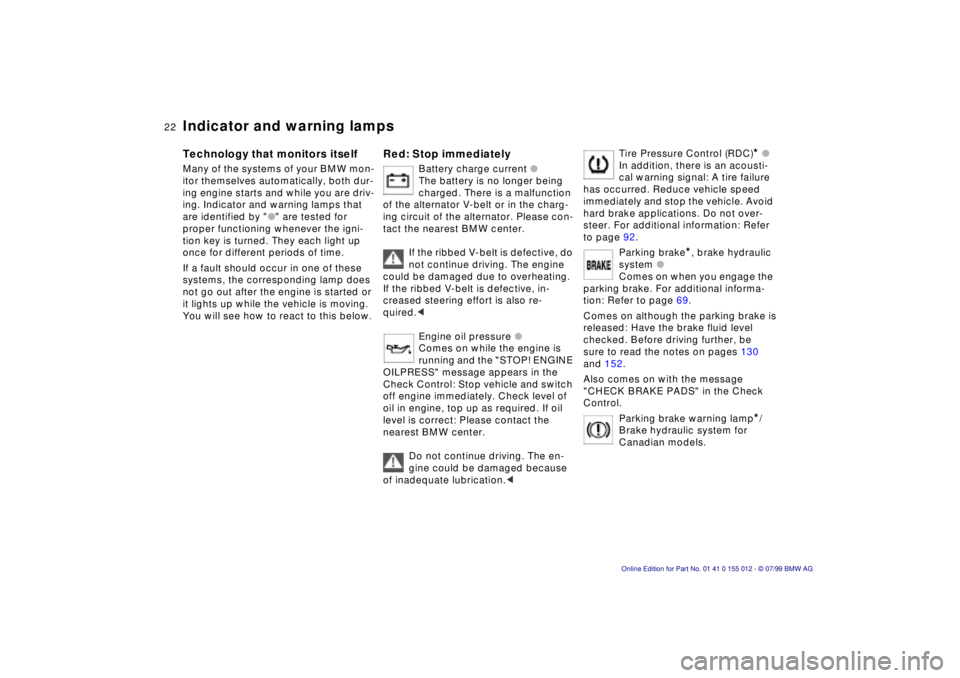
Indicator and warning lampsTechnology that monitors itselfMany of the systems of your BMW mon-
itor themselves automatically, both dur-
ing engine starts and while you are driv-
ing. Indicator and warning lamps that
are identified by "l" are tested for
proper functioning whenever the igni-
tion key is turned. They each light up
once for different periods of time.
If a fault should occur in one of these
systems, the corresponding lamp does
not go out after the engine is started or
it lights up while the vehicle is moving.
You will see how to react to this below.
Red: Stop immediately
Battery charge current l
The battery is no longer being
charged. There is a malfunction
of the alternator V-belt or in the charg-
ing circuit of the alternator. Please con-
tact the nearest BMW center.
If the ribbed V-belt is defective, do
not continue driving. The engine
could be damaged due to overheating.
If the ribbed V-belt is defective, in-
creased steering effort is also re-
quired.<
Engine oil pressure l
Comes on while the engine is
running and the "STOP! ENGINE
OILPRESS" message appears in the
Check Control: Stop vehicle and switch
off engine immediately. Check level of
oil in engine, top up as required. If oil
level is correct: Please contact the
nearest BMW center.
Do not continue driving. The en-
gine could be damaged because
of inadequate lubrication.<
Tire Pressure Control (RDC)
* l
In addition, there is an acousti-
cal warning signal: A tire failure
has occurred. Reduce vehicle speed
immediately and stop the vehicle. Avoid
hard brake applications. Do not over-
steer. For additional information: Refer
to page 92.
Parking brake
*, brake hydraulic
system l
Comes on when you engage the
parking brake. For additional informa-
tion: Refer to page 69.
Comes on although the parking brake is
released: Have the brake fluid level
checked. Before driving further, be
sure to read the notes on pages 130
and 152.
Also comes on with the message
"CHECK BRAKE PADS" in the Check
Control.
Parking brake warning lamp
*/
Brake hydraulic system for
Canadian models.
Page 24 of 217
24n
Indicator and warning lamps
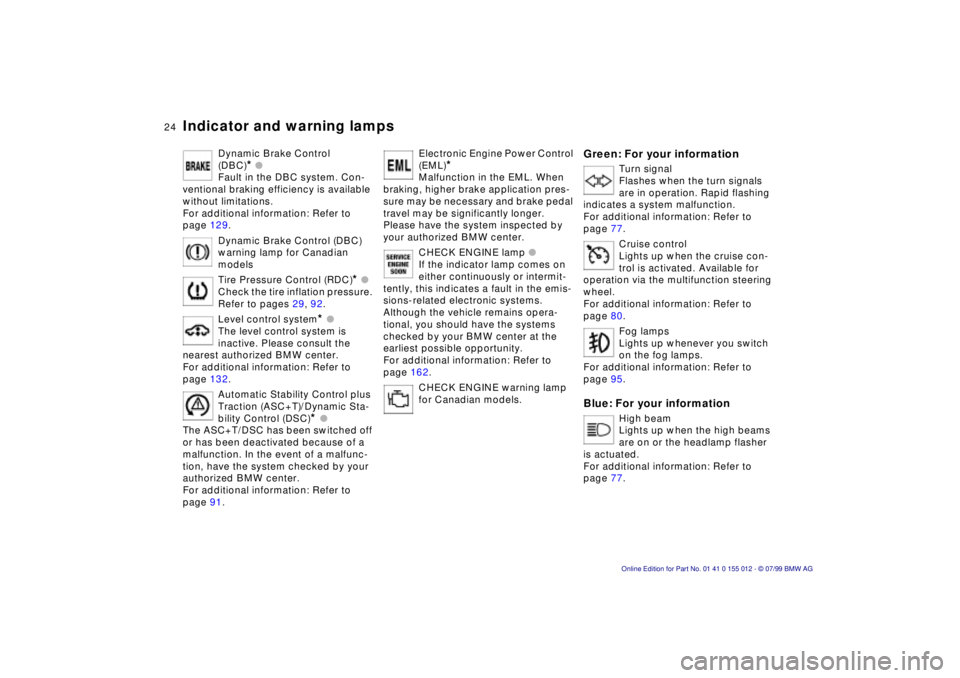
Dynamic Brake Control
(DBC)
* l
Fault in the DBC system. Con-
ventional braking efficiency is available
without limitations.
For additional information: Refer to
page 129.
Dynamic Brake Control (DBC)
warning lamp for Canadian
models
Tire Pressure Control (RDC)
* l
Check the tire inflation pressure.
Refer to pages 29, 92.
Level control system
* l
The level control system is
inactive. Please consult the
nearest authorized BMW center.
For additional information: Refer to
page 132.
Automatic Stability Control plus
Traction (ASC+T)/Dynamic Sta-
bility Control (DSC)
* l
The ASC+T/DSC has been switched off
or has been deactivated because of a
malfunction. In the event of a malfunc-
tion, have the system checked by your
authorized BMW center.
For additional information: Refer to
page 91.
Electronic Engine Power Control
(EML)
*
Malfunction in the EML. When
braking, higher brake application pres-
sure may be necessary and brake pedal
travel may be significantly longer.
Please have the system inspected by
your authorized BMW center.
CHECK ENGINE lamp l
If the indicator lamp comes on
either continuously or intermit-
tently, this indicates a fault in the emis-
sions-related electronic systems.
Although the vehicle remains opera-
tional, you should have the systems
checked by your BMW center at the
earliest possible opportunity.
For additional information: Refer to
page 162.
CHECK ENGINE warning lamp
for Canadian models.
Green: For your information
Turn signal
Flashes when the turn signals
are in operation. Rapid flashing
indicates a system malfunction.
For additional information: Refer to
page 77.
Cruise control
Lights up when the cruise con-
trol is activated. Available for
operation via the multifunction steering
wheel.
For additional information: Refer to
page 80.
Fog lamps
Lights up whenever you switch
on the fog lamps.
For additional information: Refer to
page 95.
Blue: For your information
High beam
Lights up when the high beams
are on or the headlamp flasher
is actuated.
For additional information: Refer to
page 77.
Page 33 of 217
Overview
Controls and features
Operation, care
and maintenance
Owner service procedures
Technical data
Index Advanced technology
33n
RepairsIndexOverview Controls Car care Technology Data
Lamps:
Parking lamps/Low beams94
Instrument lighting94
High beams/Parking lamps95
Fog lamps95
Interior lamps96
Reading lamps96
Controlling the climate for
pleasant driving:
Automatic climate control98
Seat heating103
Steering wheel heating103
Roller sun blind104
Independent ventilation
system104
Cabin convenience:
BMW Universal Transmitter105
Glove compartment108
Storage facilities108
Cellular phone109
Beverage holder 109
Ashtray, front110
Cigarette lighter110
Ashtray, rear111Loading and transporting cargo:
Through-loading system112
Ski bag113
sport wagon:
Luggage compartment116
Roll-up cover116
Separation net116
Storage areas in the luggage
compartment118
Cargo loading120
Roof-mounted luggage rack121
Page 37 of 217
37n
RepairsIndexOverview Controls Car care Technology Data
Opening and closing Ð from the outsideWith the remote controlThe remote control makes opening and
locking the doors of your vehicle very
convenient. Furthermore, it provides
three additional functions which you
can only execute via the remote control:
>To switch on interior lamps:
With this function, you can also
"search for" your vehicle, when
parked in an underground garage, for
instance.
>To open the luggage compartment:
The luggage compartment lid/tail-
gate will open slightly, regardless of
whether it was previously locked or
unlocked.
>Panic Mode:
In case of danger, you can trigger an
alarm.
When the vehicle is unlocked, the anti-
theft system is simultaneously deacti-
vated, the alarm system is disarmed
and the interior lamps are switched on.
Locking the vehicle activates the anti-
theft and alarm systems and switches
the interior lamps off.
You can have an acknowledgment
message set to confirm that the
vehicle has been secured correctly (not
released at this time).<
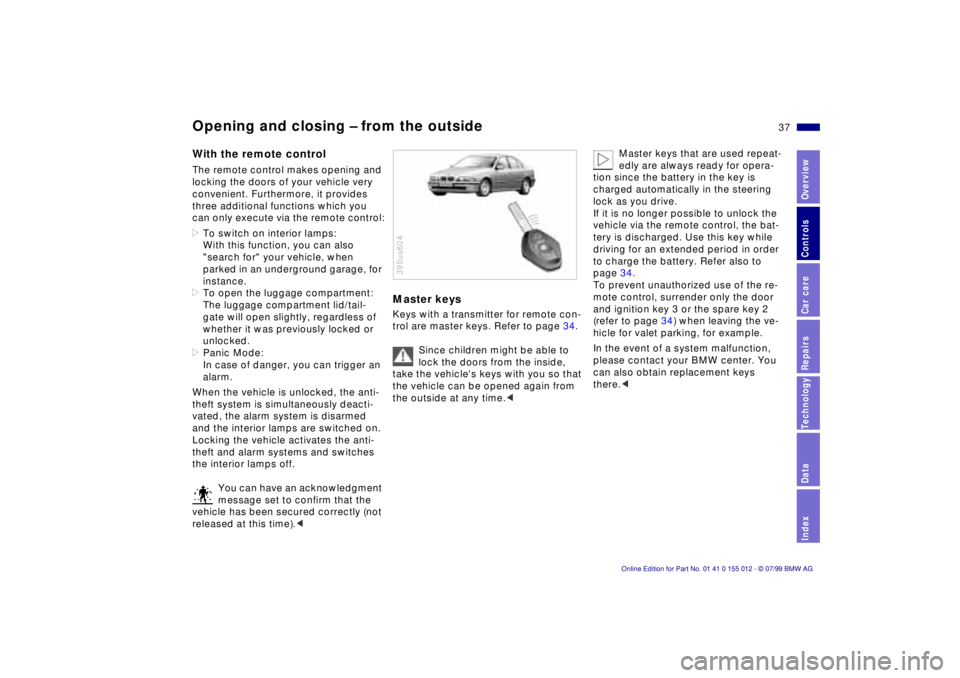
Master keysKeys with a transmitter for remote con-
trol are master keys. Refer to page 34.
Since children might be able to
lock the doors from the inside,
take the vehicle's keys with you so that
the vehicle can be opened again from
the outside at any time.< 390us604
Master keys that are used repeat-
edly are always ready for opera-
tion since the battery in the key is
charged automatically in the steering
lock as you drive.
If it is no longer possible to unlock the
vehicle via the remote control, the bat-
tery is discharged. Use this key while
driving for an extended period in order
to charge the battery. Refer also to
page 34.
To prevent unauthorized use of the re-
mote control, surrender only the door
and ignition key 3 or the spare key 2
(refer to page 34) when leaving the ve-
hicle for valet parking, for example.
In the event of a system malfunction,
please contact your BMW center. You
can also obtain replacement keys
there.<
Page 39 of 217
39n
RepairsIndexOverview Controls Car care Technology Data
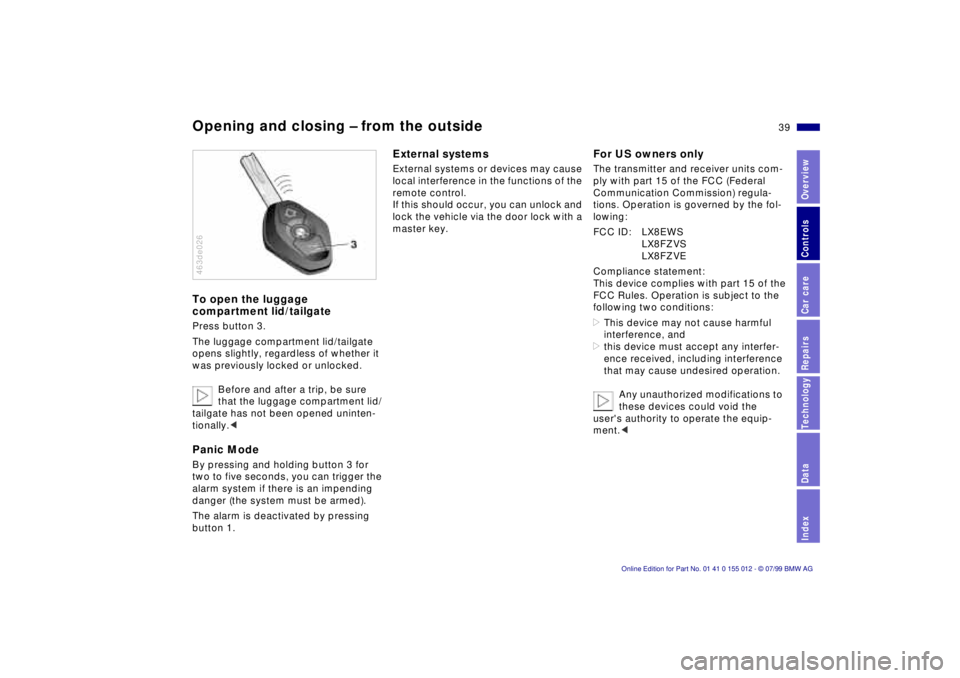
Opening and closing Ð from the outsideTo open the luggage
compartment lid/tailgatePress button 3.
The luggage compartment lid/tailgate
opens slightly, regardless of whether it
was previously locked or unlocked.
Before and after a trip, be sure
that the luggage compartment lid/
tailgate has not been opened uninten-
tionally.< Panic ModeBy pressing and holding button 3 for
two to five seconds, you can trigger the
alarm system if there is an impending
danger (the system must be armed).
The alarm is deactivated by pressing
button 1.463de026
External systemsExternal systems or devices may cause
local interference in the functions of the
remote control.
If this should occur, you can unlock and
lock the vehicle via the door lock with a
master key.
For US owners onlyThe transmitter and receiver units com-
ply with part 15 of the FCC (Federal
Communication Commission) regula-
tions. Operation is governed by the fol-
lowing:
FCC ID: LX8EWS
LX8FZVS
LX8FZVE
Compliance statement:
This device complies with part 15 of the
FCC Rules. Operation is subject to the
following two conditions:
>This device may not cause harmful
interference, and
>this device must accept any interfer-
ence received, including interference
that may cause undesired operation.
Any unauthorized modifications to
these devices could void the
user's authority to operate the equip-
ment.<
Page 41 of 217
41n
RepairsIndexOverview Controls Car care Technology Data
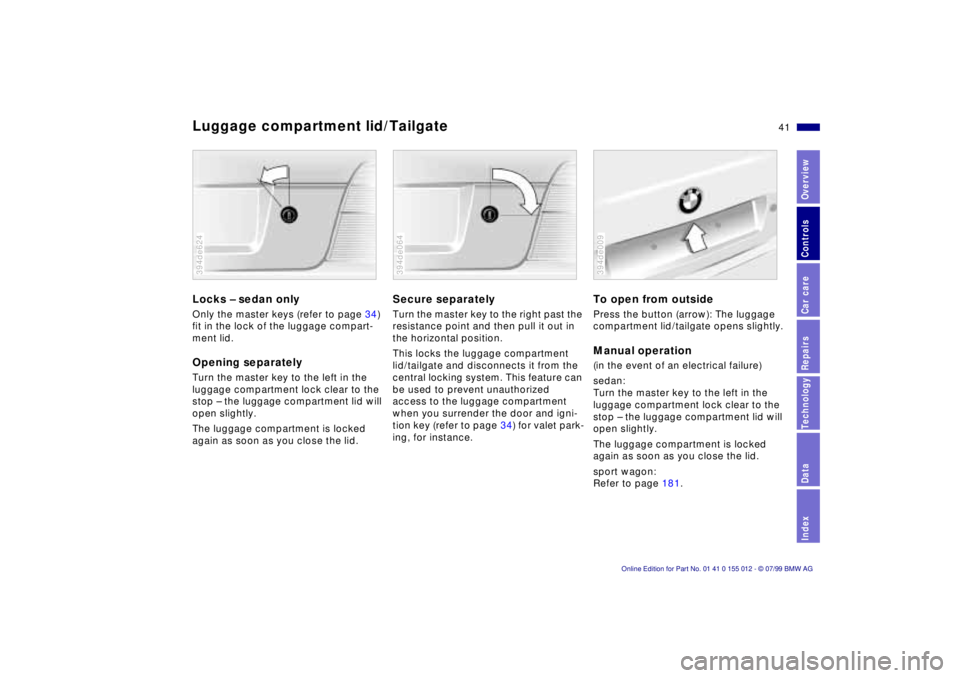
Luggage compartment lid/TailgateLocks Ð sedan onlyOnly the master keys (refer to page 34)
fit in the lock of the luggage compart-
ment lid.Opening separatelyTurn the master key to the left in the
luggage compartment lock clear to the
stop Ð the luggage compartment lid will
open slightly.
The luggage compartment is locked
again as soon as you close the lid.394de624
Secure separatelyTurn the master key to the right past the
resistance point and then pull it out in
the horizontal position.
This locks the luggage compartment
lid/tailgate and disconnects it from the
central locking system. This feature can
be used to prevent unauthorized
access to the luggage compartment
when you surrender the door and igni-
tion key (refer to page 34) for valet park-
ing, for instance.394de064
To open from outsidePress the button (arrow): The luggage
compartment lid/tailgate opens slightly.Manual operation(in the event of an electrical failure)
sedan:
Turn the master key to the left in the
luggage compartment lock clear to the
stop Ð the luggage compartment lid will
open slightly.
The luggage compartment is locked
again as soon as you close the lid.
sport wagon:
Refer to page 181.394de009
Page 42 of 217
42n
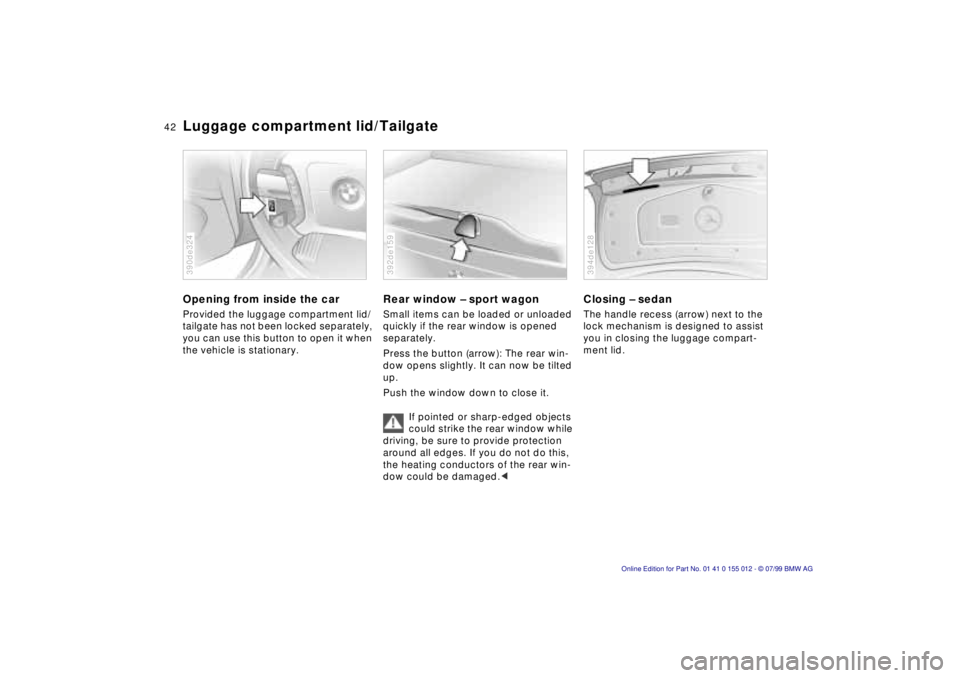
Luggage compartment lid/TailgateOpening from inside the carProvided the luggage compartment lid/
tailgate has not been locked separately,
you can use this button to open it when
the vehicle is stationary.390de324
Rear window Ð sport wagonSmall items can be loaded or unloaded
quickly if the rear window is opened
separately.
Press the button (arrow): The rear win-
dow opens slightly. It can now be tilted
up.
Push the window down to close it.
If pointed or sharp-edged objects
could strike the rear window while
driving, be sure to provide protection
around all edges. If you do not do this,
the heating conductors of the rear win-
dow could be damaged.< 392de159
Closing Ð sedanThe handle recess (arrow) next to the
lock mechanism is designed to assist
you in closing the luggage compart-
ment lid.394de128