2000 BMW 328Ci COUPE Load
[x] Cancel search: LoadPage 101 of 189
99n
RepairsIndexOverview Controls Car care Technology Data
Ski bag
*
The ski bag allows the safe and clean
transport of four pairs of skis or two
snowboards.
The length of the ski bag and the addi-
tional space provided in the luggage
compartment make it possible to carry
skis with a length of up to 6.8 feet
(2.1 meters). The ski bag can only
accommodate two pairs of skis with a
length of 6.8 feet (2.1 meters), because
of the tapered shape of the bag.
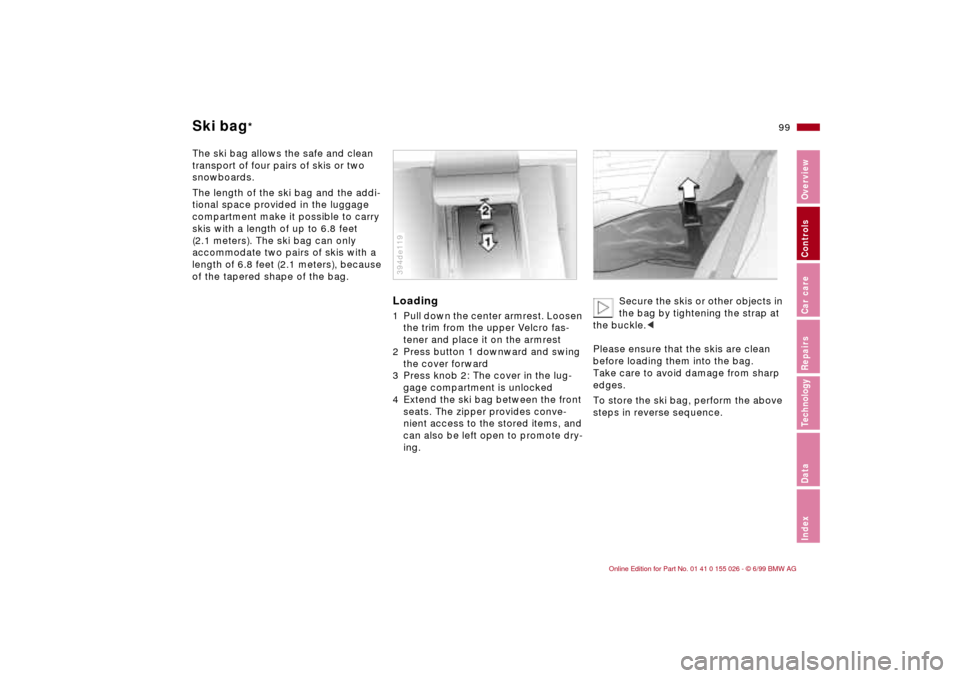
Loading1 Pull down the center armrest. Loosen
the trim from the upper Velcro fas-
tener and place it on the armrest
2 Press button 1 downward and swing
the cover forward
3 Press knob 2: The cover in the lug-
gage compartment is unlocked
4 Extend the ski bag between the front
seats. The zipper provides conve-
nient access to the stored items, and
can also be left open to promote dry-
ing.394de119
Secure the skis or other objects in
the bag by tightening the strap at
the buckle.<
Please ensure that the skis are clean
before loading them into the bag.
Take care to avoid damage from sharp
edges.
To store the ski bag, perform the above
steps in reverse sequence.
380de070
Page 102 of 189
100n
Cargo loadingStowing cargo If you are transporting a load in your
BMW:
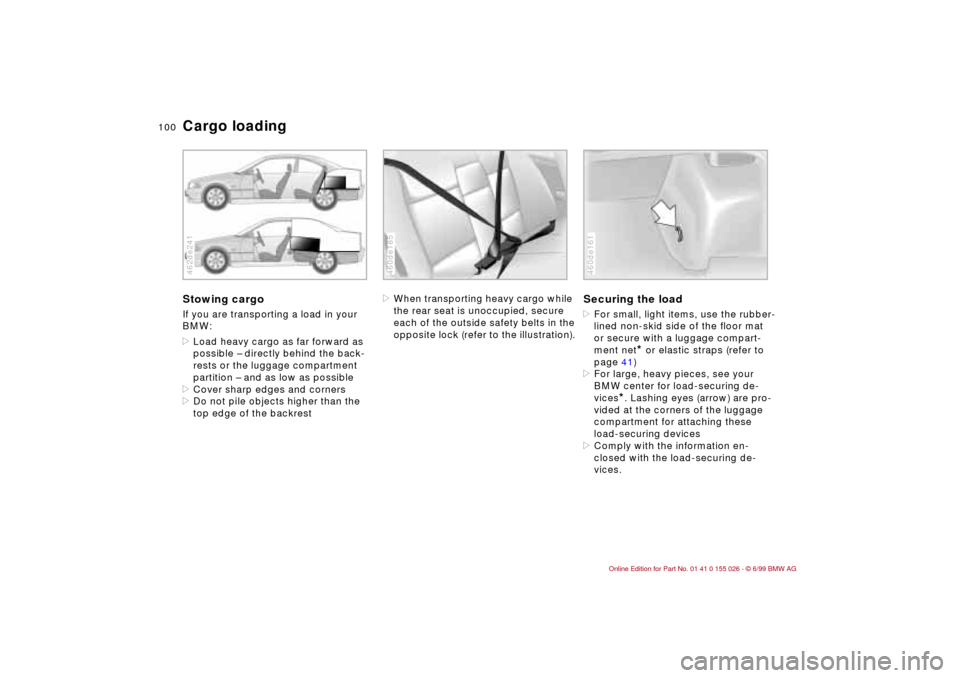
>Load heavy cargo as far forward as
possible – directly behind the back-
rests or the luggage compartment
partition – and as low as possible
>Cover sharp edges and corners
>Do not pile objects higher than the
top edge of the backrest462de241
>When transporting heavy cargo while
the rear seat is unoccupied, secure
each of the outside safety belts in the
opposite lock (refer to the illustration).460de185
Securing the load >For small, light items, use the rubber-
lined non-skid side of the floor mat
or secure with a luggage compart-
ment net
* or elastic straps (refer to
page 41)
>For large, heavy pieces, see your
BMW center for load-securing de-
vices
*. Lashing eyes (arrow) are pro-
vided at the corners of the luggage
compartment for attaching these
load-securing devices
>Comply with the information en-
closed with the load-securing de-
vices.
460de161
Page 103 of 189
101n
RepairsIndexOverview Controls Car care Technology Data
Cargo loading Roof-mounted luggage rack
*
Always position and secure the
load correctly, otherwise it can en-
danger the passengers in the event of
braking or swerving.
Do not exceed the permissible gross
weight and axle load (refer to page 172),
otherwise the vehicle's operating safety
is no longer assured and you are in vio-
lation of the law.
Do not stow heavy or hard objects in the
passenger compartment without first
securing them. Otherwise they would
be thrown around during braking and
evasive maneuvers and endanger the
occupants.<
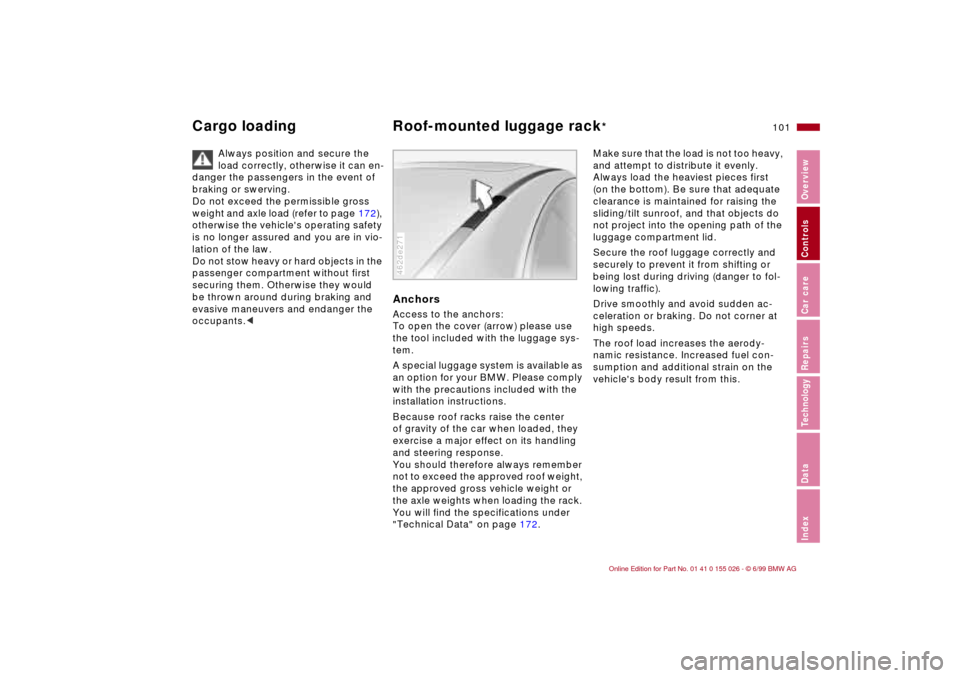
AnchorsAccess to the anchors:
To open the cover (arrow) please use
the tool included with the luggage sys-
tem.
A special luggage system is available as
an option for your BMW. Please comply
with the precautions included with the
installation instructions.
Because roof racks raise the center
of gravity of the car when loaded, they
exercise a major effect on its handling
and steering response.
You should therefore always remember
not to exceed the approved roof weight,
the approved gross vehicle weight or
the axle weights when loading the rack.
You will find the specifications under
"Technical Data" on page 172.462de271
Make sure that the load is not too heavy,
and attempt to distribute it evenly.
Always load the heaviest pieces first
(on the bottom). Be sure that adequate
clearance is maintained for raising the
sliding/tilt sunroof, and that objects do
not project into the opening path of the
luggage compartment lid.
Secure the roof luggage correctly and
securely to prevent it from shifting or
being lost during driving (danger to fol-
lowing traffic).
Drive smoothly and avoid sudden ac-
celeration or braking. Do not corner at
high speeds.
The roof load increases the aerody-
namic resistance. Increased fuel con-
sumption and additional strain on the
vehicle's body result from this.
Page 114 of 189

112n
Power steering Cellular phones
* Radio reception
High steering effort:
Please contact a BMW center.
High steering effort during sudden tran-
sitions:
Have your authorized BMW center in-
spect this system as soon as possible.
If the power steering fails, in-
creased effort will be required to
steer the vehicle.<
Mobile communications systems (cellu-
lar phone, two-way radios, etc.) are only
allowed a power output of up to 10 Watt.
Mobile communications devices not
specifically designed for use in your car
may trigger malfunctions while operat-
ing your vehicle. BMW can neither test
nor assume responsibility for every indi-
vidual product being offered on the mar-
ket. We recommend that you consult
your BMW center before purchasing any
device of this kind.
To ensure that your BMW continues to
provide reliable and trouble-free opera-
tion, refrain from using a mobile phone
or other radio device with an antenna
located inside the passenger compart-
ment. The antenna should always be
fitted on the outside of the vehicle.
Before loading the vehicle on a
car-carrier train or driving it
through a car-wash, remove the an-
tenna.<
The reception and sound quality ob-
tained from mobile radios varies ac-
cording to a variety of factors, including
the broadcast range of the transmitter
and the directional orientation of the
antenna. Interference factors such as
high-tension power lines, buildings and
natural obstructions can all lead to un-
avoidable reception interference, re-
gardless of how well the vehicle's sound
system is operating.
Climatic factors such as intense solar
radiation, fog, rain and snow can also
interfere with reception.
Car telephones or cellular phones not
approved by BMW can also cause in-
terference in the radio during a tele-
phone call. This phenomenon assumes
the form of a low-pitched hum emanat-
ing from the speaker system.
Please refer to the supplementary oper-
ating instructions provided with your
sound system for detailed information
on its use.
Page 115 of 189
113n
RepairsIndexOverview Controls Car care Technology Data
Information for your safetyThe factory-approved radial tires are
matched to the car and have been se-
lected to provide optimum safety and
driving comfort on your car.
It is not merely the tire's service life, but
also driving comfort and – above all
else – driving safety that depend on the
condition of the tires and the mainte-
nance of the specified tire pressure.
Incorrect inflation pressure is a frequent
cause of tire damage. It also signifi-
cantly influences the roadholding ability
of your BMW.
Check tire inflation pressure regu-
larly — including the space-saver
and/or the spare tire — at least twice a
month and before beginning a longer
road trip. Incorrect tire pressure can
otherwise lead to tire damage and acci-
dents.<
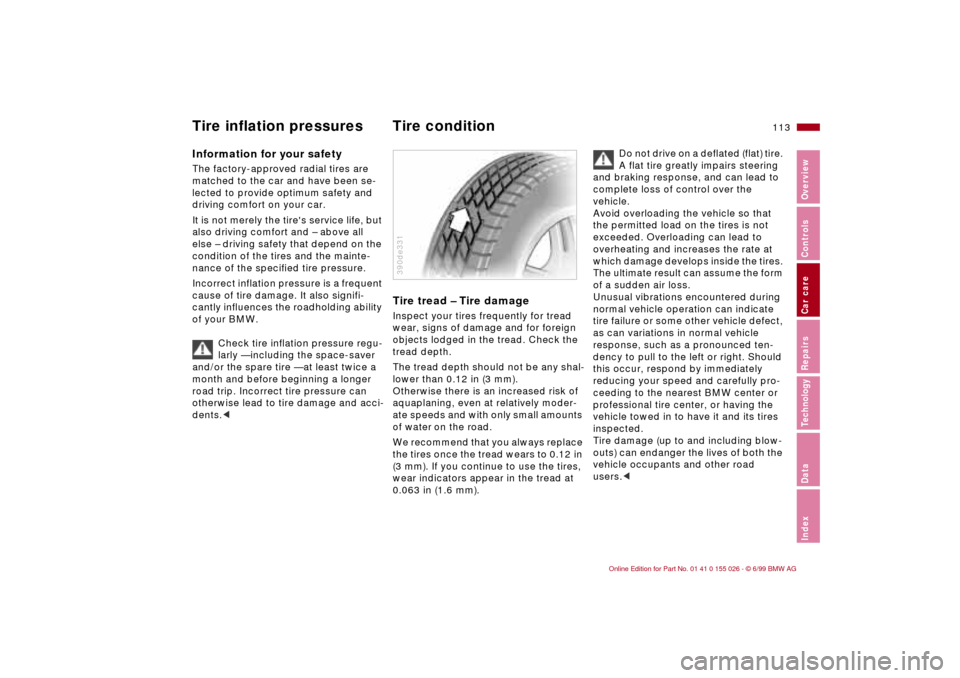
Tire tread – Tire damageInspect your tires frequently for tread
wear, signs of damage and for foreign
objects lodged in the tread. Check the
tread depth.
The tread depth should not be any shal-
lower than 0.12 in (3 mm).
Otherwise there is an increased risk of
aquaplaning, even at relatively moder-
ate speeds and with only small amounts
of water on the road.
We recommend that you always replace
the tires once the tread wears to 0.12 in
(3 mm). If you continue to use the tires,
wear indicators appear in the tread at
0.063 in (1.6 mm).390de331
Do not drive on a deflated (flat) tire.
A flat tire greatly impairs steering
and braking response, and can lead to
complete loss of control over the
vehicle.
Avoid overloading the vehicle so that
the permitted load on the tires is not
exceeded. Overloading can lead to
overheating and increases the rate at
which damage develops inside the tires.
The ultimate result can assume the form
of a sudden air loss.
Unusual vibrations encountered during
normal vehicle operation can indicate
tire failure or some other vehicle defect,
as can variations in normal vehicle
response, such as a pronounced ten-
dency to pull to the left or right. Should
this occur, respond by immediately
reducing your speed and carefully pro-
ceeding to the nearest BMW center or
professional tire center, or having the
vehicle towed in to have it and its tires
inspected.
Tire damage (up to and including blow-
outs) can endanger the lives of both the
vehicle occupants and other road
users.<
Tire inflation pressures Tire condition
Page 117 of 189

115n
RepairsIndexOverview Controls Car care Technology Data
Wheel and tire combinations The right choice Use only BMW-approved tires, refer to
page 117.
Due to the high speeds this vehicle can
achieve, the use of specific tire brands,
specifications and dimensions is man-
datory.
Consult any BMW center for details.
Comply with local/national regulations.
The correct wheel/tire combinaton
affects different sytems, such as
ABS, ATC, DSC. The function of these
systems can be impaired if the correct
combinaton is not used.
Therefore, only use tires of the same
brand and tread pattern. Replace a flat
tire with an approved wheel/tire combi-
nation as soon as possible.<
Codes on the tires and wheels The tire codes will aid you in selecting
the correct tire.
Codes on radial tires:
The speed rating indicates the ap-
proved maximum speed for the tire.
Summer tires:
S = up to 112 mph (180 km/h)
T = up to 118 mph (190 km/h)
H = up to 130 mph (210 km/h)
V = up to 150 mph (240 km/h)
W = up to 167 mph (270 km/h)
Y = above 167 mph (270 km/h)
ZR = above 150 mph (240 km/h) Example:
Nominal width
in mm
Aspect ratio in %
Radial tire code
Rim diameter in inches
Load rating
(not on ZR tires)
Speed rating
(before R on ZR tires)
225/50 R
1692W
Winter tires:
Q M+S = up to 100 mph (160 km/h)
T M+S = up to 118 mph (190 km/h)
H M+S = up to 130 mph (210 km/h)
Codes stamped on light-alloy wheels:
Protect valve inserts against dirt using
screw-on valve stem caps. Dirt in the
valves frequently leads to slow leaks. Example:
Rim width
in inches
Code letter for
flange type
Symbol for full-drop
center rim
Rim diameter in inches
Hump on the 2 rim shoulders
7 x 16 H 2
J
Page 131 of 189
129n
RepairsIndexOverview Controls Car care Technology Data
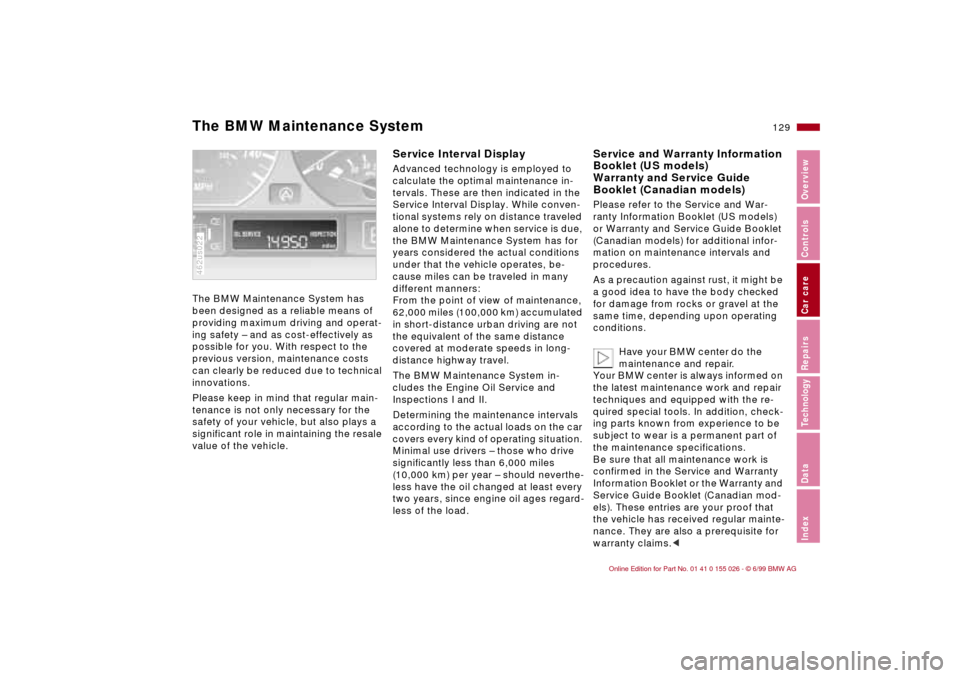
The BMW Maintenance System has
been designed as a reliable means of
providing maximum driving and operat-
ing safety – and as cost-effectively as
possible for you. With respect to the
previous version, maintenance costs
can clearly be reduced due to technical
innovations.
Please keep in mind that regular main-
tenance is not only necessary for the
safety of your vehicle, but also plays a
significant role in maintaining the resale
value of the vehicle. 462us022
Service Interval DisplayAdvanced technology is employed to
calculate the optimal maintenance in-
tervals. These are then indicated in the
Service Interval Display. While conven-
tional systems rely on distance traveled
alone to determine when service is due,
the BMW Maintenance System has for
years considered the actual conditions
under that the vehicle operates, be-
cause miles can be traveled in many
different manners:
From the point of view of maintenance,
62,000 miles (100,000 km) accumulated
in short-distance urban driving are not
the equivalent of the same distance
covered at moderate speeds in long-
distance highway travel.
The BMW Maintenance System in-
cludes the Engine Oil Service and
Inspections I and II.
Determining the maintenance intervals
according to the actual loads on the car
covers every kind of operating situation.
Minimal use drivers – those who drive
significantly less than 6,000 miles
(10,000 km) per year – should neverthe-
less have the oil changed at least every
two years, since engine oil ages regard-
less of the load.
Service and Warranty Information
Booklet (US models)
Warranty and Service Guide
Booklet (Canadian models)Please refer to the Service and War-
ranty Information Booklet (US models)
or Warranty and Service Guide Booklet
(Canadian models) for additional infor-
mation on maintenance intervals and
procedures.
As a precaution against rust, it might be
a good idea to have the body checked
for damage from rocks or gravel at the
same time, depending upon operating
conditions.
Have your BMW center do the
maintenance and repair.
Your BMW center is always informed on
the latest maintenance work and repair
techniques and equipped with the re-
quired special tools. In addition, check-
ing parts known from experience to be
subject to wear is a permanent part of
the maintenance specifications.
Be sure that all maintenance work is
confirmed in the Service and Warranty
Information Booklet or the Warranty and
Service Guide Booklet (Canadian mod-
els). These entries are your proof that
the vehicle has received regular mainte-
nance. They are also a prerequisite for
warranty claims.<
The BMW Maintenance System
Page 152 of 189
150n
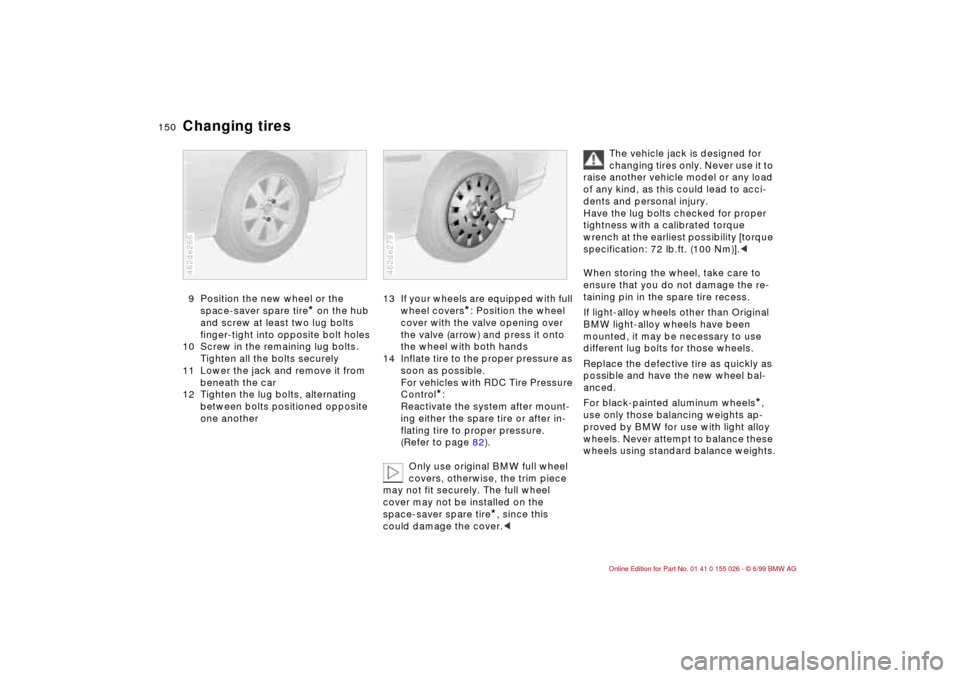
Changing tires9 Position the new wheel or the
space-saver spare tire
* on the hub
and screw at least two lug bolts
finger-tight into opposite bolt holes
10 Screw in the remaining lug bolts.
Tighten all the bolts securely
11 Lower the jack and remove it from
beneath the car
12 Tighten the lug bolts, alternating
between bolts positioned opposite
one another
462de266
13 If your wheels are equipped with full
wheel covers
*: Position the wheel
cover with the valve opening over
the valve (arrow) and press it onto
the wheel with both hands
14 Inflate tire to the proper pressure as
soon as possible.
For vehicles with RDC Tire Pressure
Control
*:
Reactivate the system after mount-
ing either the spare tire or after in-
flating tire to proper pressure.
(Refer to page 82).
Only use original BMW full wheel
covers, otherwise, the trim piece
may not fit securely. The full wheel
cover may not be installed on the
space-saver spare tire
*, since this
could damage the cover.<
462de279
The vehicle jack is designed for
changing tires only. Never use it to
raise another vehicle model or any load
of any kind, as this could lead to acci-
dents and personal injury.
Have the lug bolts checked for proper
tightness with a calibrated torque
wrench at the earliest possibility [torque
specification: 72 lb.ft. (100 Nm)].<
When storing the wheel, take care to
ensure that you do not damage the re-
taining pin in the spare tire recess.
If light-alloy wheels other than Original
BMW light-alloy wheels have been
mounted, it may be necessary to use
different lug bolts for those wheels.
Replace the defective tire as quickly as
possible and have the new wheel bal-
anced.
For black-painted aluminum wheels
*,
use only those balancing weights ap-
proved by BMW for use with light alloy
wheels. Never attempt to balance these
wheels using standard balance weights.