2000 AUDI ALLROAD ECU
[x] Cancel search: ECUPage 176 of 306
Training a Garage Door
Equip ped with Rolling Code
To train your rolling code garage door
opener to operate from your Homelink®
Universal Transmi tter, follow these steps
after completing the "Program
ming" portion of this text (the aid of a sec
ond person may make the training quicker
and easier):
1 - Locate and press and relaaaa the
training (or "learning") button on the
garage door opener motor head unit.
(Exact location and color of the button
may vary by garage door opener brand.)
If there is difficulty locating the training
button, reference the garage door
opener owner's manual or call toll free:
1- 800-355- 3515.
2 - Return to the vehicle and press and re
lease the progr ammed Homelink ®
channel. Press and release the
Homelink ® channel a second time to
complete the progra mming process.
(Some garage door openers may re
qu i· re you to do this procedure a thir d
ti me.) The
garage door opener should now recog
nize the Audi Homelink ® Un iversal Trans
mitter. You may use either the hand-held
transmitter or the Audi Home link® Univer
sal Transmi tter to activate the garage door.
Oper ating the Audi HomeLink ®
Uni versal Transmitter
1 - Tum the ignition switch on.
2 - Select and firmly press and release the
appropriate channel (1, 2, or 3) to acti
vate the trained device (e.g. garage
door, estate gate, home security sy
stem, entry door lock, or home or office
lighting). CONTROLS
AND EQUIPMENT
Erasing the Audi HomeLink ®
Universal Transm itter's Pro
gramming
1 - Turn the ignition switch on.
2 - Simult aneously press and hold chan
nels 1 and 3 until the indicator light be
gins to flash after 20 seconds.
3 - Release both buttons.
This process will erase the trained codes of
the three channels or erase the factory set
default codes.
The Audi Homelink ® Un iversal Transmitter
is now in the train (or progra mming) mode
and can be progra mmed at any time follow
ing steps 3 through 5 in the "Progr amming"
portion of this text.
175
Page 200 of 306
-----------------------VEHICLE OPERATION
Driving on rough roads or rugged terrain
For off road use, your Audi allroad is
equipped with a 4-level air suspension ride
height adjustment system, in addition to all
wheel drive.
Yo ur vehicle's ground clearance (ride height)
can be adjusted to changing terrain condi
tions with the push of a butt on.
At the highe st level setting (maximum clear
ing level), ground clearance is 8.2 inches
(20.8 em).
Some general tips
Navar drive on terra in that is too de
manding for the design of your ve
hicle or for your driving abilities.
Navar t�;�ke any unnecessary
chances!
• Before you take your vehicle off-roa d,
make certain that you know how to operate
the ride height adjustment system-see pa
ge 153. •
Make sure that you adjust the ride height
just before you travel on any rough sections
of terra in.
• Always adjust the vehicle's speed
to the trail and terrain conditions.
• Stow any luggage or other items in the
luggage compartment and make certain
that they are properly secured so that they
do not shift.
• Never travel on any roads, trails or terrain
on which motor vehicle travel is prohibited.
r.:Cib Always protect the environW ment. Respect our natural su�
roundings.
• After traveling off-road, remember to re
move any branches or other foreign objects
caught in the grille, underbody or wheels. In
particular, look for foreign objects (stones)
caught in the tire treads.
Check the vehicle for possible damage.
• Clean dirty windows, headlight and tail
light lenses and license plates. •
Check your brakes after traveling off-road
especially after driving through water.
• If need be, clean the underbody, suspen
sion parts, etc. (for example, in an under
body wash).
Some driving tips
Unpaved roads and off-road
• Drive slowly on unfamiliar roads and ter
rain, and stay alert for unexpected hazards
(for example, potholes, rocks and stumps).
• To avoid hanging up the vehicle and dam
aging the undercarriage on extremely un
even terrain, drive over large humps with
the hump in the center of the vehicle.
Instead, always drive over the hump with
the vehicle wheels on one side of the ve
hicle positioned over the crown of the
hump.
199
Page 209 of 306
VEHICLE OPERA
TION-----------------------
Trailer towing
Yo ur Audi was designed primarily for pas
senger transportat ion. The additional load
will affect durability, economy and perfor
mance.
Tra iler towing not only places more stress
on the vehicle, it also calls for more con
centration from the driver.
For this reasons, always follow the opera
ting and driving instructions given and use
common sense.
208 Te
chnical requirements
Tr ailer hitch
Use a weight-carrying hitch conforming to
the gross trailer weight. The hitch must be
suitable for your vehicle and trailer and
securely bolted to appropriate place on the
vehicle's chassis. Use only a trailer hitch
with removable ball mount. Always check
with the trailer hitch manufacturer to make
sure that you are using the correct hitch.
Do not use a bumper hitch.
The hitch must be installed in such a way
that it does not interfere with the impact-ab
sorbing bumper system. No modifications
should be made to the vehicle exhaust and
brake systems. From time to time, check
that all hitch mounting bolts remain secure
ly fastened. When
you are not towing a trailer, remove
the trailer hitch ball mount. This prevents
the hitch from causing damage should your
vehicle be struck from behind.
�W ARNING
When you are no longer towing a
trailer, remove the entire trailer
hitch. When doing so, seal all bolt
holes to prevent water and deadly
exhaust fumes from entering the
vehicle.
Engine cooling system
To wing a tr ailer make the engine work hard
er. It is important that the engine cooling
system be up to the job. Make sure that the
cooling system has enough fluid.
Page 231 of 306
VEHI
CLE CARE
J'4 WARN ING continued
• If you must work underneath
the vehicle with the wheels on the
ground, always make sure the ve
hicle is on level ground. that the
wheels are always securely
blocked and that the engine can
not be started. Always remove the
ignition key before anyone gets
under the vehicle.
Always make sure the transmis
sion selector lever (automatic
transmission) is in "P" (Park posi
tion) and the hand brake is firmly
applied.
• Always be extremely careful
when working on the vehicle. Always follow commonly accepted safety practices and general com
mon sense. Never risk personal in
jury.
230 �
Changing the engine settings
will adversely aHect emission
levels. This Is detrimental to the en
vi ronment and increases fuel con
sumption.
Always observe environmental reg
ulations when disposing of old en
gine oil. used brake fluid, dirty en
gine coolant, spent batteries or
worn out tires.
Page 232 of 306

Engine
hood
To unlock the engine hood, pull the re
lease lever on the left under the dashboard.
The hood pops up slightly under spring pres
sure.
Note
Before opening the engine hood,
make sure that the windshield wip
ers are folded flat against the wind
shield. Otherwise, they could dam
age the paint on the hood. To
open, pull the release lever in the direc
tion indicated by the arrow. This will release
the hook under the hood.
Open the hood all the way. It will be held up
by gas pressure in the strut. VEH
ICLE CARE
To close
Pull the hood down until the pressure from
the strut is reduced. Then Jet the hood fall
and latch in place -you do not need to
press the hood down again.
m WARNING
• A hood that is not 'completely
latched could fly up and block
your view while driving. When you
close the engine hood, check it to
make sure the safety catch has
properly engaged. The hood
should be flush with the surround
ing vehicle body parts.
• If you ever notice while driving
that the hood is not secured prop
erly, stop at once and close it.
Always heed all WA RNINGS
on next page.
231
Page 237 of 306
VEHICLE CA
RE---------------------------------------------------
Adding engine oil
A Always heed all WA RNINGS
r!!J on page 232.
• Turn off the engine.
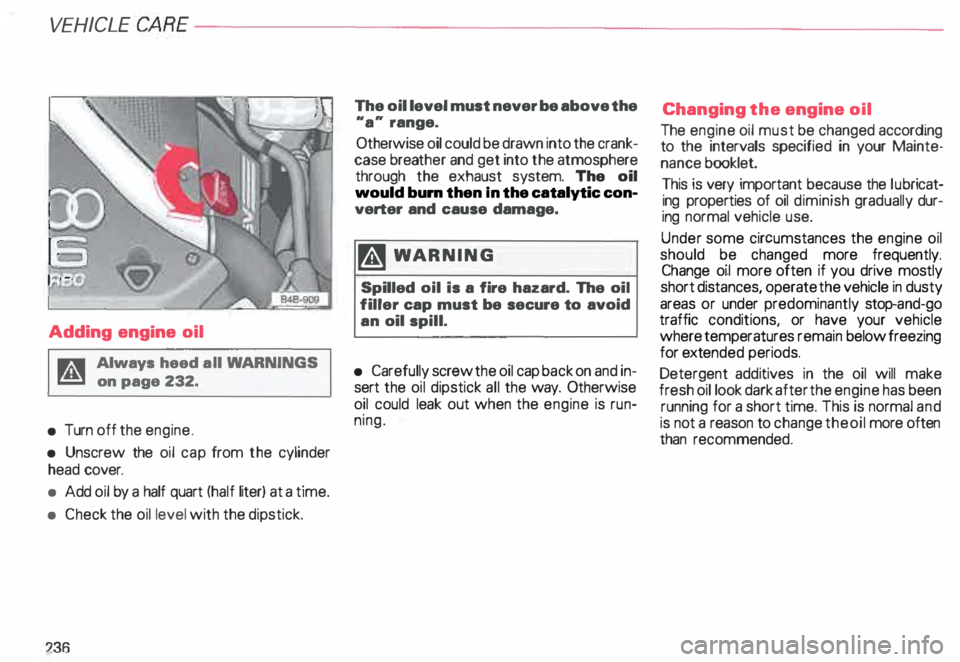
• Unscrew the oil cap from the cylinder
head cover.
• Add oil by a half quart (half liter) at a time.
• Check the oil level with the dipstick.
:236 The
oil level must never be above the
"a .. range.
Otherwise oil could be drawn into the crank
case breather and get into the atmosphere
through the exhaust system. The oil
would bum then In the catalytic con
verter and cause damage.
� WARNING
Spilled oil is a fire hazard. The oil
filler cap must be secure to avoid
an oil spill.
• Carefully screw the oil cap back on and in
sert the oil dipstick all the way. Otherwise
oil could leak out when the engine is run
ning. Changing
the engine oil
The engine oil must be changed according
to the intervals specified in your Mainte
nance booklet.
This is very important because the lubricat
ing properties of oil diminish gradually dur
ing normal vehicle use.
Under some circumstances the engine oil
should be changed more frequently.
Change oil more often if you drive mostly
short distances, operate the vehicle in dusty
areas or under predominantly stop-and-go
traffic conditions, or have your vehicle
where temperatures remain below freezing
for exte nded periods.
Detergent additives in the oil will make
fresh oil look dark after the engine has been
running for a short time. This is normal and
is not a reason to change the oil more often
than recommended.
Page 260 of 306
-------------------------VEHICLE
CARE
Te mperature
The temperature grades are A (the highest),
8, and C, repres enting the tire's resistance to
the generation of heat and its ability to dissi
pate heat when tested under contro lled con
ditions on a specified indoor laboratory test
wheel. Sustained high temJ)erature can
cause the material of the tire to degenerate
and reduce tire life, and excessive tempera
ture can lead to sudden tire failure. The
grade C corres ponds to a level of perfor
mance which all passenger car tires must
meet under the Federal Motor Vehicle Safety
Sta ndard No. 1 09. Grades Band A represent
higher levels of performance on the laborato
ry test wheel than the minimum required by
law.
�W ARNIN G
The temperature grade for this tire
is est ablished for a tire that is
properly inflated and not over
loaded. Excessive speed, under
inflation, or excessive loading, ei
ther separately or in combination,
can causa heat buildup and pos
sible tire failure. Wheel
replacement
If you wish to equip your vehicle with tires
or wheels other than those installed at the
factory, please note the following:
• For technical reasons it is not al
ways possible to use wheels from
other vehicles -under certain condi
tions not even wheels from the same
vehicle model.
• Wheel rims and wheel bolts are
matched to fit your Audi. When
installing different wheels (for ax
ample, wheels with winter tires), the
correct wheel bolts with the proper
length and conical shape of the bolt
head must be used. The secure fit of
the wheels and the proper function
ing of the brake system and safety
are dependent upon this.
• Wheel rims and wheal bolts are
matched to fit your Audi. •
Before you plan on exchanging
steel wheels, light alloy wheals, or
winter tires already mounted on
wheel rims, consult your authorized
Audi Dealer. They have the technical
information necessary to advise you
which wheal rims and wheel bolts
are compatible with the original fac
tory installations.
1ft WARNING
• Incorrect tire/wheel parts may
cause an accident and personal in
jury. Such parts will adversely af
fect the safe operation of your ve
hicle. Always use tires, wheel rims
and wheel bolts that meat specifi
cations of the original factory
installed equipment.
• If wheel trim discs or a front
spoiler are Installed, make sura the
airflow for cooling the brakes is
not obstructed.
259
Page 265 of 306
DO-IT-Y
OURSELF SERVICE----------------------
Jack and
tools
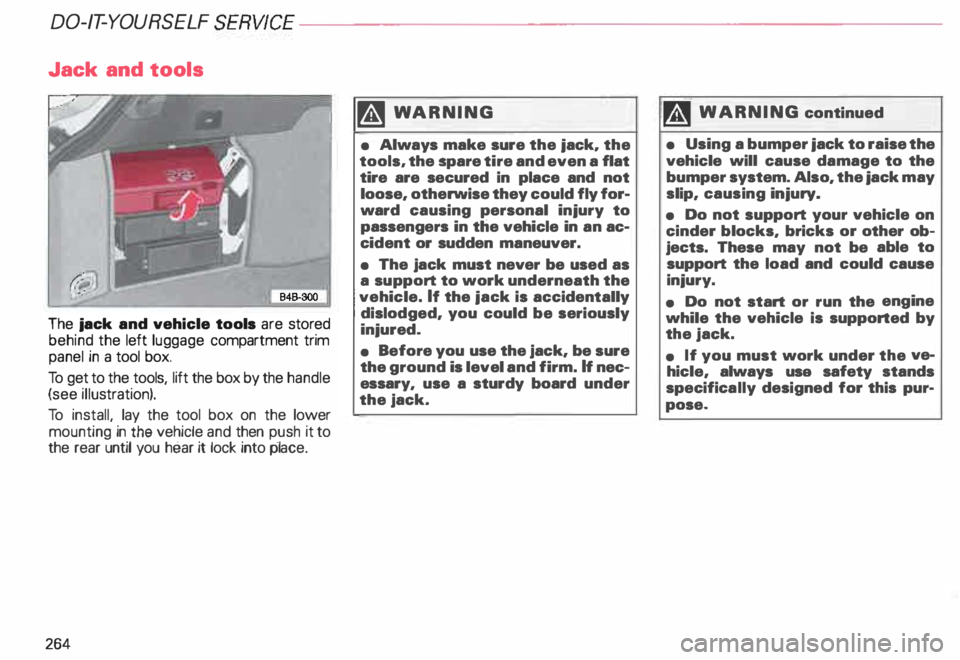
The jack and vehicle tools are stored
behind the left luggage compartment trim
panel in a tool box.
To get to the tools, lift the box by the handle
(see illustration).
To install, lay the tool box on the lower
mounting in the vehicle and then push it to
the rear until you hear it lock into place.
264 �W
ARNING
• Always make sure the jack. the
tools, the spare tire and even a flat
tire are secured in place and not
loose, otherwise they could fly for
ward causing personal injury to
passengers in the vehicle in an ac
cident or sudden maneuver.
• The jack must never be used as
a support to work underneath the
vehicle. If the jack is accidentally
dislodged, you could be seriously
injured.
• Before you use the jack, be sure
the ground is level and firm. If nec
essary, use a sturdy board under
the jack.
, ... WARNING continued
• Using a bumper jack to raise the
vehicle will cause damage to the
bumper system. Also, the jack may
slip, causing injury.
• Do not support your vehicle on
cinder blocks, bricks or other ob
jects. These may not be able to
support the load and could cause
injury.
• Do not start or run the engine
while the vehicle is supported by
the jack.
• If you must work under the ve
hicle, always usa safety stands
specifica lly designed for this pur
pose.