2000 AUDI ALLROAD instrument panel
[x] Cancel search: instrument panelPage 78 of 306
·---------------------CONTROLS AND
EQUIPMENT
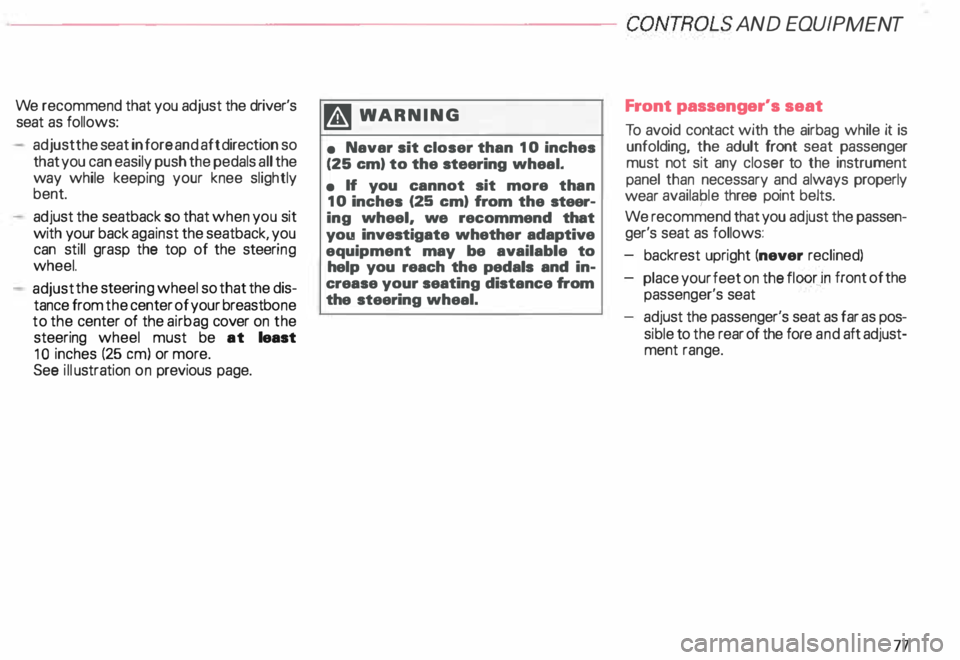
We recommend that you adjust the driver's
seat as follows:
adjust the seat in fore and aft direction so
that you can easily push the pedals all the
way while keeping your knee slightly
bent.
adjust the seatback so that when you sit
with your back against the seatback, you
can still grasp the top of the steeri ng
wheel.
adjust the steeri ng wheel so that the dis
tance from the center of your breastb one
to the center of the airbag cover on the
steering wheel must be at least
10 inches (25 em) or more.
See illustration on previous page. �W
ARNING
• Navar sit closer than 10 inches
(25 em) to the steering wheal.
• If you cannot sit more than
10 inches (25 em) from the steer
ing wheel, we recommend that
you investigate whether adaptive
equipment may be available to
help you reach the pedals and in
crease your seating distance from
the steering wheal. Front
passenger's seat
To avoid contact with the airbag while it is
unfolding, the adult front seat passenger
must not sit any closer to the instrument
panel than necessary and always properly
wear availaple three point belts.
We recommend that you adjust the passen
ger's seat as follows:
backrest upright (never reclined)
place your feet on the
floor _in front
of the
passenger's seat
adjust the passenger's seat as far as pos
sible to the rear of the fore and aft adjust
ment range.
77
Page 79 of 306
CONT
ROLS AND
EQUIPMENT---------------------
�W ARNING
• Always keep both feet on the
floor in front of the seat.
• Never place your feet on the in
strument panel or on the seat. If
the airbag inflates and your feet
are on the instrument panel or on
the seat, you could receive serious
personal injuries to the legs, hips
and even the head if the airbag in
flates.
For safety information on transporti ng chil
dren on the front passenger seat be sure to
read all the information on"ln fant seats,
Convertible seats and Booster seats", see
page 44.
78 �W
ARNING
• To reduce the risk of personal in
jury in an accident, front seat pas
sengers must never ride in a mov
ing vehicle with the seatback re
clined. Safety belts offer protec
tion only when the seatback is up
right and belts are properly posi
tioned on the body. The more the
seatback is reclined, the greater
the risk of perso nal injury from an
out-of -position safety belt.
• Never store items under the
seats. Loose objects can interfere
with the seat latching mechanism
and can also cause personal injury
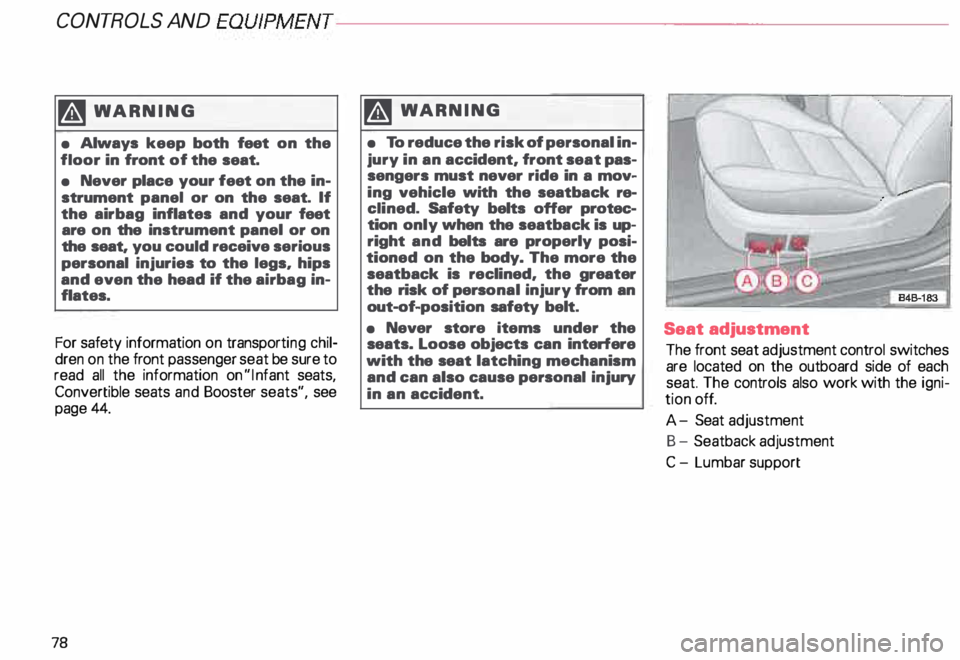
in an accident. Seat
adjustment
The front seat adjustment control switches
are located on the outboard side of each
seat. The controls also work with the igni
tion off.
A- Seat adjustment
B- Seatback adjustment
C - Lumbar support
Page 100 of 306
---------------------CONTROLS
AND EQUIPMEN T
U WARNING continued
• The front seats must not be
pushed too close to the steering
wheel or to the instrument panel.
Never sit closer than 10 inches
(25 em) to the steering wheel.
• If you cannot sit more than
1 0 inches (26 em) from the steer
ing wheel, we recommend that
you investigate whether adaptive
equipment may be available to
help you reach the pedals and in
crease your seating distance from
the stee ring wheel.
• Pointing the stee ring wheel to
ward your face decreases the abil
ity of the supplemental driver's air
bag to protect you in an accident. �
WARNING continued
• Always hold the steering wheel
on the outside of the steering
wheel rim with your hands at the
9 o'clock and 3 o'clock positions
to help reduce the risk of personal
injury if the driver's airbag in
flates.
• Never hold the steering wheel at
the 12 o'clock position or with
your hands at other positions in·
side the steering wheel rim or on
the stee ring wheel hub.
• Holding the steering wheel the
wrong way can cause serious inju
ries to the hands. arms and head if
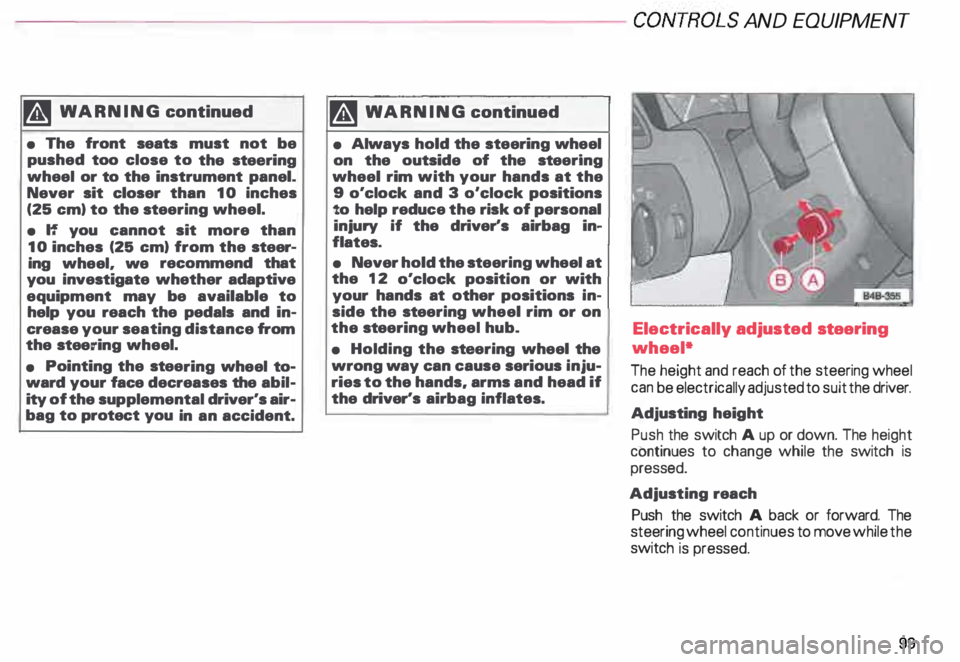
the driver's airbag inflates. Electrically
adjusted steering
wheel*
The height and reach of the steering wheel
can be electrically adjusted to suit the driver.
Adjusting height
Push the switch A up or down. The height
continues to change while the switch is
pressed.
Adjusting reach
Push the switch A back or forward. The
steering wheel continues to move while the
switch is pressed.
99
Page 101 of 306
CONT
ROLS AND
EQUIPMEN T---------------------
BBN-163 I
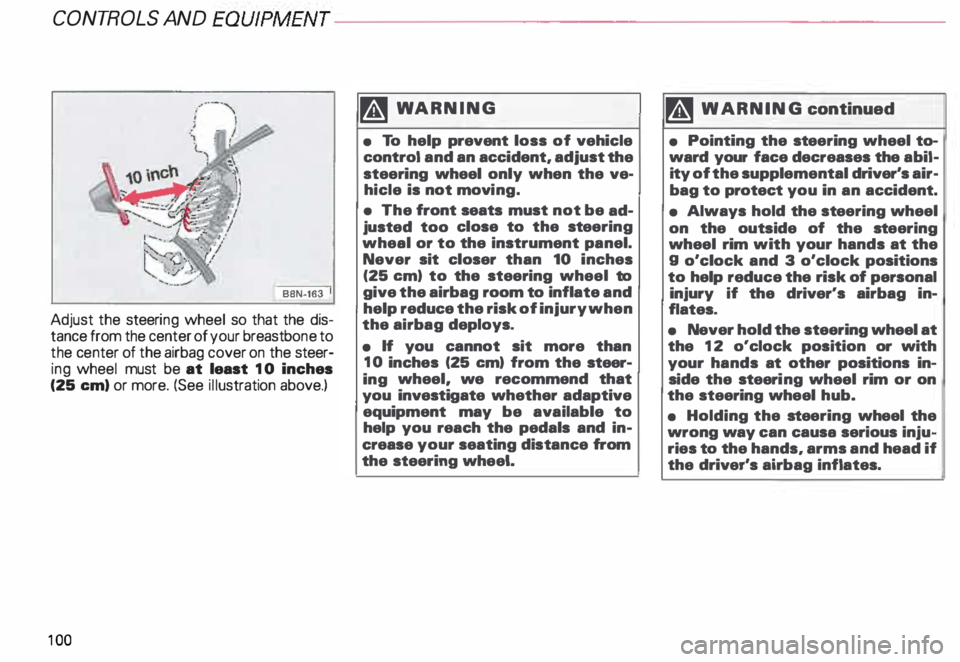
Adjust the steeri ng wheel so that the dis
tance from the center of your breastb one to
the center of the airbag cover on the steer
ing wheel must be at least 10 inches
(25 em) or more. (See illustration above.)
10 0 �W
ARNING
• To help prevent loss of vehicle
control and an accident, adjust the
steering wheel only when the ve
hicle is not movi ng.
• The front seats must not be ad
justed too close to the steering
wheal or to the instrument panel.
Never sit closer than 10 inches
(25 em) to the steering wheel to
give the airbag room to inflate and
help reduce the risk of injury when
the airbag deploys.
• If you cannot sit more than
10 inches (25 em) from the steer
ing wheel, we recommend that
you investigate whether adaptive
equipment may be available to
help you reach the pedals and in
crease your seating distance from
the steering wheel. '4
WARNING continued
• Pointing the stee ring wheel to
ward your face decreases the abil
ity of the supplemental driver's air
bag to protect you in an accident.
• Always hold the st eering wheel
on the outside of the steering
wheel rim with your hands at the
g o'clock and 3 o'clock positions
to help reduce the risk of personal
injury if the driver's airbag in
flates.
• Never hold the steering wheel at
the 12 o'clock position or with
your hands at other positions in
side the steeri ng wheel rim or on
the steering wheel hub.
• Holding the steering wheel the
wrong way can causa serious inju
ries to the hands, arms and head if
the driver's airbag inflates.
Page 300 of 306

- Capacities
. . . • . . . . . . . . • . . . 287
-C oolant . . . . . . . .
238
-W indshield washer tank . . . . 250
Fog lights .. .. .. .. .
. 149
Folding master key _ . . . . . . • . . 56
Four- Wheel Drive . . . . . • • . . 207
Front airbags .
. . . • • • . . . 25
Front axle load . . . • • . • • • . 289
Front fog lights .... ... .... .. .. 149
Front seats . . . . . . . . . . . . . . . . . . . . 76
Fuel -Tank capacity . . . . . . . . . . 222
Fuel economy . . . . . . . . . • . 19
5
Fuel gauge . . . . • • . . . .
119
Fuel supply . . . . . . . . . . . . . • . . . . . 225
Fuel tank . . . . . • . . . . . . . . 222
- Capacity
. • . • • . . • . . • • • . . 287
Fuses . . . •
... .•.. .• • .. . .. 274
G
Garage door opener ...• , • . . . . 173
Gas discharge lamps . . .
277
Gasoline additives . . . . .
227
Gauges and instruments
- Coolant temperature 118 -
Engine oil temperature
-F uel ........ . ..
117
.. 119
- Odometer . . . . . • . . • . . • . . . 11 9
- Speedometer . • . . . . . . . . . . 119
-T achome ter .. _. _...... ... 117
General illustration .
. . . . 8
Gen erator ....... ..... .
Glove box light ... .
Glo ve compartment . . . .
Ground clearance ... . _ .. 12
0, 127
17 8
17 8
153
Gross axle weight rating ...... . 289
289
Gross vehicle weight rating .... .
H
Head airbags . • . • . . • • • .•. . . 39
Head restraints . . . . • . . . . . 75
Headlight adjustment . . • . • • .
148
Headlight dimmer .....• , • . . . .
156
Headlight flasher . . . . . . . . . . . • . . 157
Headlights -Cleaning . .
214
Heated seats . . . . . . . . .
150
Heated steering wheel . 150
Heating . . . . . . . . . . . . . . 162
High beam . . . . . . . . . . . • . . . . . . 12
5 ALP
HABETIC AL INDE X
High voltage label
. . . . . • • . • 291
Hood release . . .
231
Hooks . . . . . . . . . • • • • • . .
.. 89
Horn . . . . . . . . . . . • • • . _ .. . .. .. . . . 8
Hydropla ning . . . . 195, 207
I
Identification label ..
291
Identification number ....... ... 290
Ign ition .................. ... 113
Ignition key safety interlock ..... 104
Immobilize r............. 57,
124
Increasing size of luggage
compartment ..... .
Ind icator lights ...... .
Infant seats .......... .
Inside day-night mirror
Installing a radio ..... .
Installing a roof rack ..
Installing wiper blades
Instru ment cluster .... ....
88
10, 122
. 45
. 72
277
191
. . .. -... 251
. . 116
Ins trument illumination . 14 9
Instrument panel . . . . .
. . . 8
Interior lights . . . . . . . . . . . . . . . 171