2000 AUDI ALLROAD light
[x] Cancel search: lightPage 234 of 306
When
adding fluids, always make
sure that they are poured into the
proper container or filler opening,
otherwise serious damage to ve
hicle systems will occur. r:Gb To detect leaks in time, inspect
� the vehicle floor pen from under
neath regular ly. If you see spots
from oil or other vehicle fluids, have
your vehicle inspected by an autho
ri zed Audi Dealer .
D Always heed all WA RNINGS
� on page 232.
Always exercise extreme caution
when working under the engine
hood. -
VE HICLE CARE
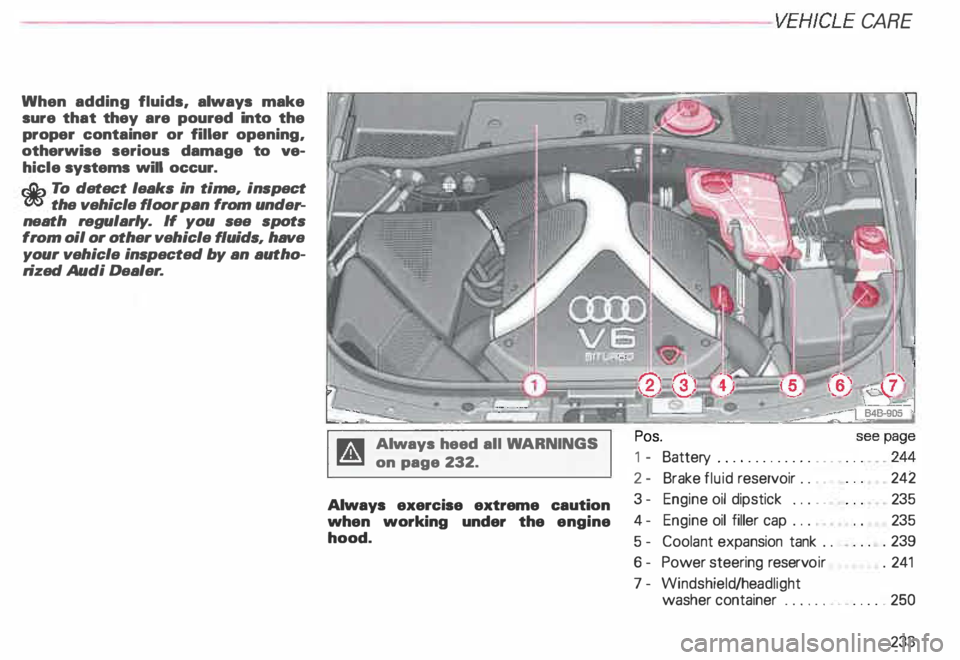
Pos.
1 - Battery ............. . _ .. .. .
2- Brake fluid reservoir . . . 242
3 - Engine oil dipstick ... . _ 235
4- Engine oil filler cap . . . 235
5- Coolant expansion tank . . . 239
6 - Power steering reservoir .
241
7 - Windshield /headlight
washer container ......•• _ .... . 250
233
Page 236 of 306
Engine
oil consumption
The rate of the oil consumption depends on
the quality and viscosity of oil, the speed at
which the engine is operated, the climate,
and road conditions as well as amount of
dilution and oxidation of the lubricant.
Because of these variables, no standard
rate of oil consumption can be established,
but drivers should expect higher oil con
sumption at high speeds and when the en
gine is new.
Therefore, we recommend that you check
the oil level at regular intervals (for example,
each time you are refuelling, or before going
on a long trip).
If the oil level should go below the minimal
level, the check engine oil level warn
ing light* in the instrument cluster will
come on. See page 144. You should check
the oil level using the oil dip stick as soon as
possible, and then top off the oil as neces
sary. Notes
• The engine in your vehicle de
pends on oil to lubricate and cool all
of its moving parts. Therefore the
engine oil should be checked regu
larly and kept at the required level.
• Lack of sufficient engine oil may
lead to severe engine damage.
• The oil pressure warning light is
not an oil level indicator.
A Always
heed all WAR NINGS
� on page 232.
Checking the engine oil level
The best time to check the engine oil level
is when the oil is warm.
To get a true reading, the vehicle must be on
level ground.
A Always heed all WAR NINGS
� on page 232.
• After turning off the engine, wait a few
minu tes for the oil to return to the oil pan. VE
HICLE CARE
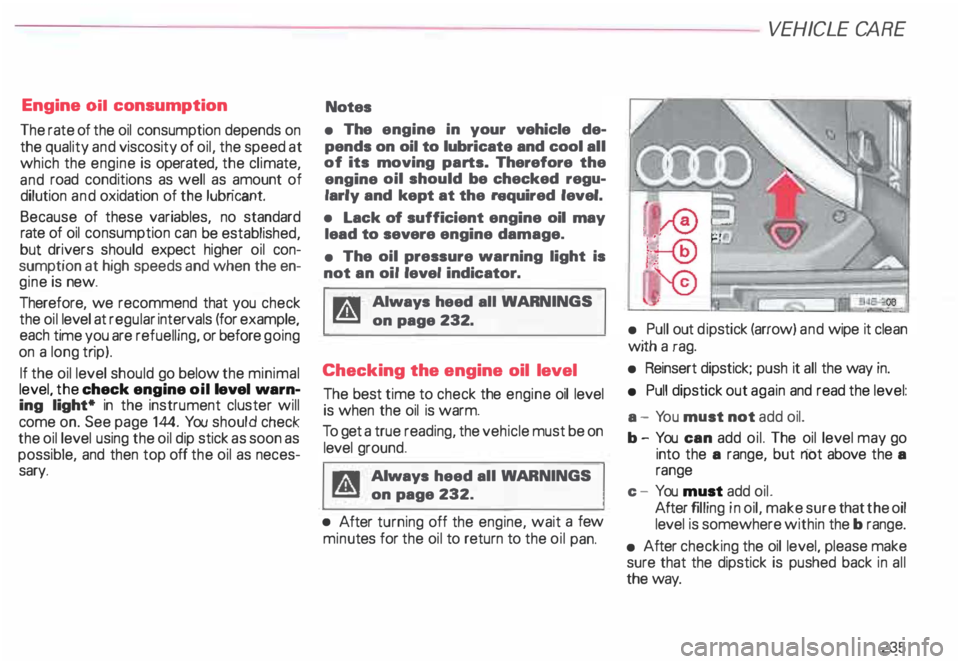
• Pull out dipstick (arrow) and wipe it clean
with a rag.
• Reinsert dipstick; push it all the way in.
• Pull dipstick out again and read the level:
a - Yo u must not add oil.
b- You can add oil. The oil level may go
into the a range, but riot above the a
range
c - You must add oil.
After filling in oil, make sure that the oil
level is somewhere within the b range.
• After checking the oil level, please make
sure that the dipstick is pushed back in all
the way.
235
Page 240 of 306
Checking the
engine coolant
level
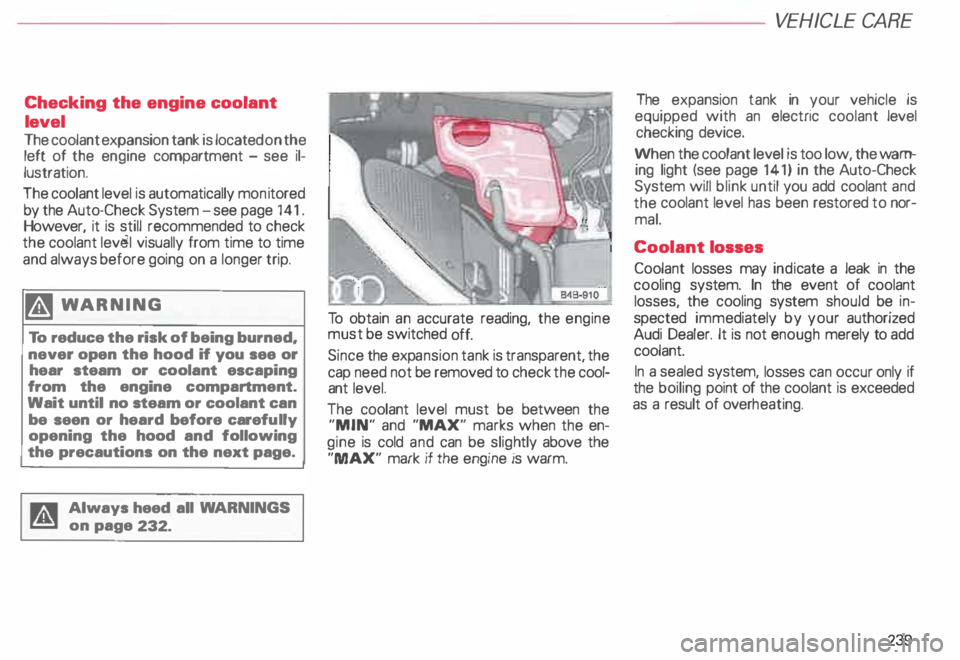
The coolant expansion tank is located on the
left of the engine compartment -see il
lustration.
The coolant level is automatically monitored
by the Auto-Check System -see page 141.
However, it is still recommended to check
the coolant lev�l visually from time to time
and always before going on a longer trip.
�W ARNING
To reduce the risk of being burned.
never open the hood if you see or
hear steam or coolant escaping
from the engine compartment.
Wait until no steam or coolant can
be seen or heard before carefully
opening the hood and following
the precautions on the next page.
Always heed all WA RNINGS
on page 232. To
obtain an accurate reading, the engine
must be switched off.
Since the expa nsion tank is transparent, the
cap need not be removed to check the cool
ant level.
The coolant level must be between the
"MIN" and "MAX" marks when the en
gine is cold and can be slig htly above the
"MAX" mark if the engine is warm. VE
HICLE CARE
The expansion tank in your vehicle is
equipped with an electric coolant level
checking device.
When the coolant level is too low, the warn
ing light (see page 141) in the Auto-Check
System will blink until you add coolant and
the coolant level has been restored to nor
mal.
Coolant losses
Coolant losses may indicate a leak in the
cooling system. In the event of coolant
losses, the cooling system should be in
spected immediately by your authorized
Audi Dealer. It is not enough merely to add
coolant.
In a sealed system, losses can occur only if
the boiling point of the coolant is exceeded
as a result of overheating.
239
Page 241 of 306
VE
HICLE CARE
Adding coolant
� WARNING
The cooling system is under pres
sura and can get very hot. Reduce
the risk of scalding from hot cool
ant by following these steps.
• Turn off the engine and allow it
to cool down.
• Protect face, hands and arms es
caping fluid and steam by covering
the cap with a large, thick rag.
• Turn the cap slowly and very
care fully in a counter--clockwise di
rection while applying light, down
ward pressure on the top of the
cap.
• To help avoid being burned, do
not spill antifreeze or coolant on
the exhaust system or hot engine
parts. Under some conditions, the
ethylene glycol in engine coolant
can catch fire.
240 If,
in an emergency, only water can be add
ed, the correct ratio between water and an
tifreeze (see page 238) must be restored as
soon as possible.
If you have lost a considerable amount of
coolant. then you should add cold antifreeze
and cold water only when the engine is cold.
Do not fill coolant above the "MAX"
mark.
Note
Coolant pollutes the environment
and could cause an engine fire. Ex
cess coolant will be forced out
through the pressure relief valve in
the cap when the engine becomes
hot. Screw cap
on again tightly.
� WARNING
Antifreeze is poisonous. Always
store antifreeze in its original con
tainer and well out of the reach of
children. If you drain the coolant,
it must be caught and safely
stored in a proper container
clearly marked "poison ...
<£> Drained coolant should not be
reused. Always dispose of used
coolant observing all env ironmen
tal regulations.
Always heed all WARNINGS
on page 232.
Page 243 of 306
VE
HICLE CA
RE----------------------------------------------------
Brake fluid
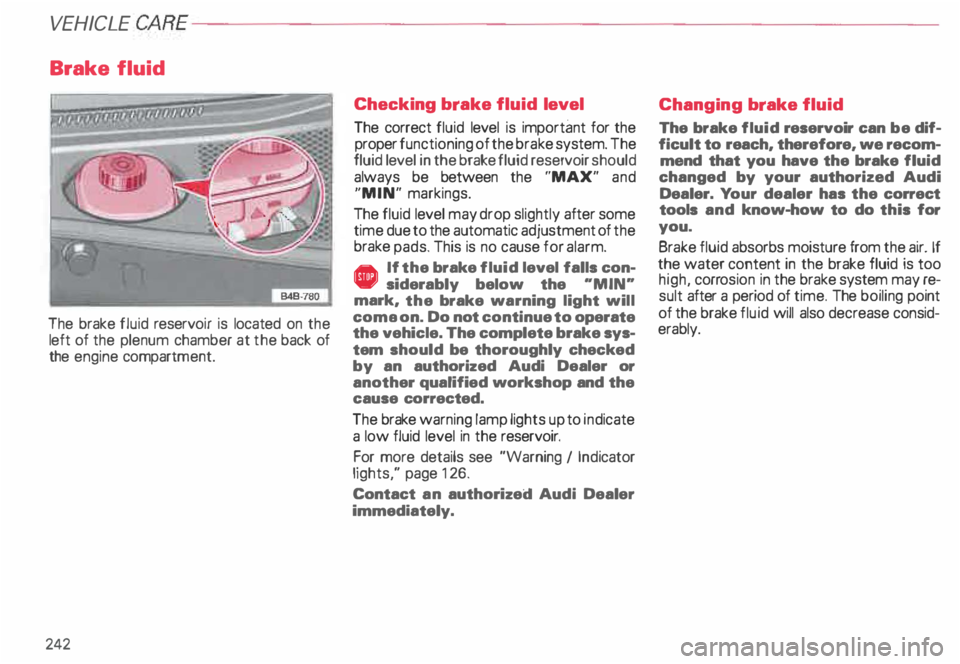
The brake fluid reservo ir is located on the
left of the plenum chamber at the back of
the engine compartm ent.
242 Checking
brake fluid level
The correct fluid level is important for the
proper functioning of the brake system. The
fluid level in the brake fluid reservoir should
always be between the "MAX" and
"MIN" markings.
The fluid level may drop slightly after some
time due to the automatic adjustment of the
brake pads. This is no cause for alarm.
• If the brake fluid level falls con
siderably below the "MIN"
mark, the brake warning light will
coma on. Do not continue to operate
the vehicle. The complete brake sys
tem should be thoroughly checked
by an authorized Audi Dealer or
another qualified workshop and the
cause corrected.
The brake warning lamp lights up to indicate
a low fluid level in the reservoir.
For more details see "Warning I Ind icator
lights," page 126.
Contact an authorized Audi Dealer
immediately. Changing
brake fluid
The brake fluid reservoir can be dif
ficult to reach, therefore, we recom
mend that you have the brake fluid
changed by your authorized Audi
Dealer. Your dealer has the correct
tools and know-how to do this for
you.
Brake fluid absorbs moisture from the air. If
the water content in the brake fluid is too
high, corrosion in the brake system may re
sult after a period of time. The boiling point
of the brake fluid will also decrease consid
erably.
Page 245 of 306
VE
HICLE CA
RE----------------------------------------------------
Battery
�W ARNING
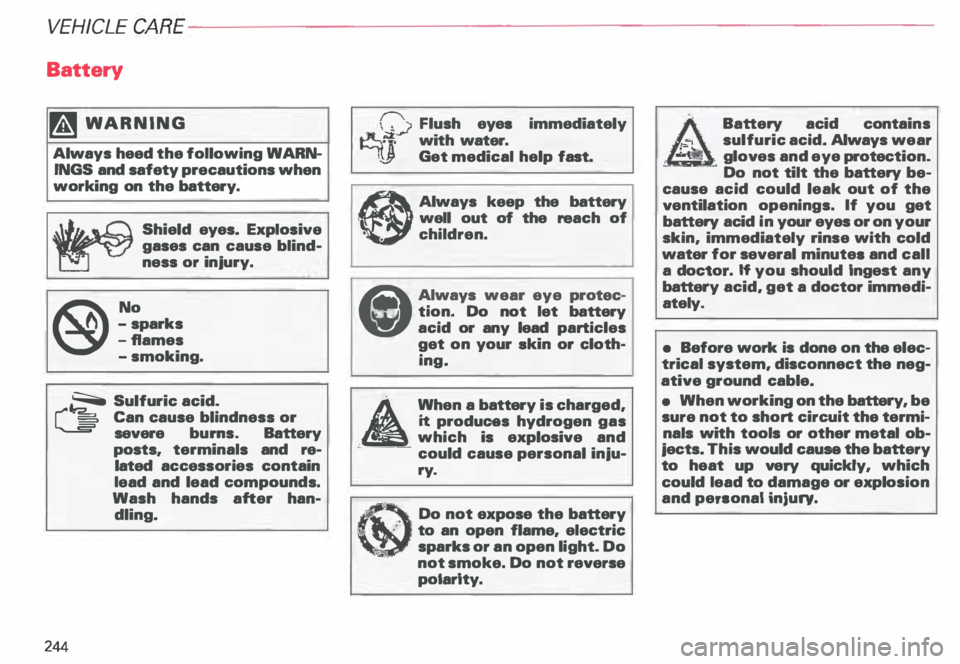
Always heed the following WARN
INGS and safety precautions when
working on the battery.
Shield eyes. Explosive
gases can cause blind
ness or injury.
@ No
-s parks
-f lames
-s moking.
� Sulfuric acid.
� Can cause blindness or
severe bums. Battery
posts, terminals and re
lated accessories contain
lead and lead compounds.
Wash hands after han dling.
244
() Flush eyes immediately
�i'l with water.
� Get medical help fast.
@ Always keep the battery
well out of the reach of
children.
f) Always wear eye protec
tion. Do not let battery
acid or any lead particles
get on your akin or cloth
ing.
A . When a battery is charged,
it
produces hydrogen gas
. which is explosive and
·
could cause personal inju
ry.
® Do not expose the battery
to an open flame, electric
"""' sparks or an open light. Do
not smoke. Do not reverse
polarity.
&·. Battery acid contains
sulfuric acid. Always wear
gloves and eye protection.
Do not tilt the battery be
cause acid could leak out of the
ventilation openings. If you get
battery acid in your eyes or on your
skin, immediately rinse with cold
water for several minutes and call
a doctor. If you should ingest any
battery acid, get a doctor immedi
ately.
• Before work is done on the elec
trical system, disconnect the neg
ative ground cable.
• When working on the battery, be
sure not to short circuit the termi
nals with tools or other metal ob
jects. This would cause the battery
to heat up very quickly, which
could lead to damage or expl osion
and personal injury.
Page 246 of 306
-------------------------VEHICL E CA RE
Do not disconnect the vehicle bat
tery when the ignition is switched
on or when the engine is running.
Otherwise, you will damage elec
tronic components in the electrical
system.
When working on the engine, pro
tect the battery housing from ultra
violet (UV) rays by not parking the
vehicle in direct sunlight. Winter
operation
During the winter months, battery capacity
tends to decrease as temperatures drop.
More power is also consumed while start
ing, and the headli ghts, rear window defog
ger, etc., are used more often.
Av oid unne cessary power consumption,
particularly in city traffic or when trave:ling
only short distances. Let your authonzed
Audi Dealer check the capacity of the ve
hicle battery before winter sets in. A well
charged battery will not only prevent start
ing problems but will also last longer.
If your vehicle is left standing for
several weeks at extremely low tem
peratures, the vehicle battery
should be removed and stored
where it will not freeze. This will
prevent it from being damaged. Location
of vehicle battery
g Always heed all WAR NINGS
� on page 232.
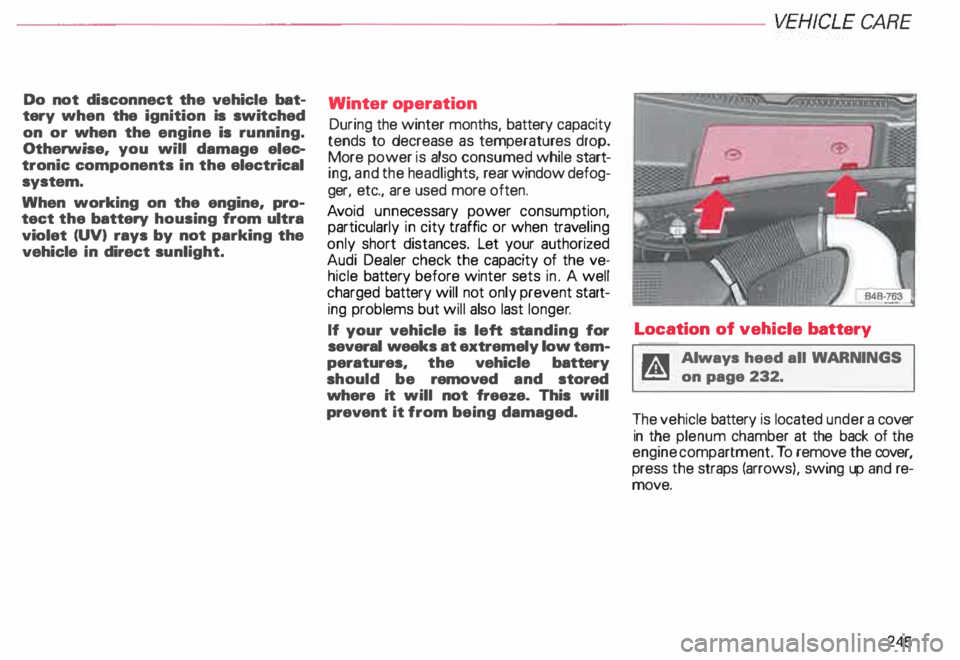
The vehicle battery is located under a cover
in the plenum chamber at the back of the
engine compartment. To remove the cover,
press the straps (arrows ), swing up and re
move.
245
Page 251 of 306
VEHI
CLE CA
RE---------------------------------------------------
Windshield I headlight washer container
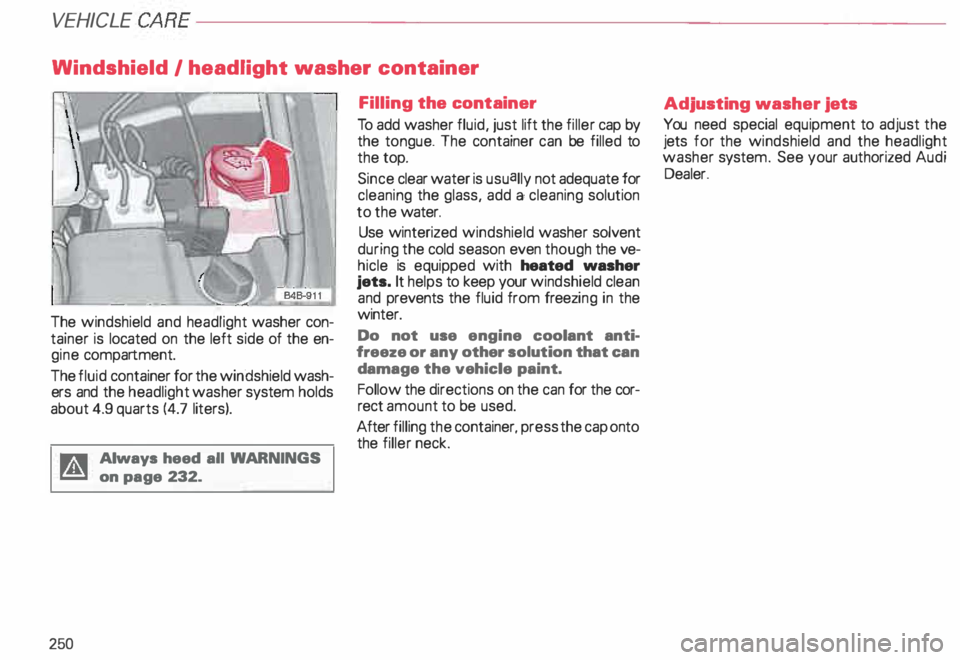
The windshield and headlight washer con
tainer is located on the left side of the en
gine compartment.
The fluid container for the windshield wash
ers and the headlight washer system holds
about 4.9 quarts (4.7 liters).
A Always heed all WAR NINGS
� on page 232.
250 Filling
the container
To add washer fluid, just lift the filler cap by
the tongue. The container can be filled to
the top.
Since clear water is usually not adequate for
cleaning the glass, add a cleaning solution
to the water.
Use winterized windshield washer solvent
during the cold season even though the ve
hicle is equipped with heated washer
jets. It helps to keep your windshield clean
and prevents the fluid from freezing in the
winter.
Do not use engine coolant anti·
freeze or any other solution that can
damage the vehicle paint.
Follow the directions on the can for the cor
rect amount to be used.
After filling the container, press the cap onto
the filler neck. Adjusting
washer jets
You need special equipment to adjust the
jets for the windshield and the headlight
washer system. See your authorized Audi
Dealer.