Page 156 of 656
ANTILOCK BRAKE SYSTEM (ABS) 5E2-31
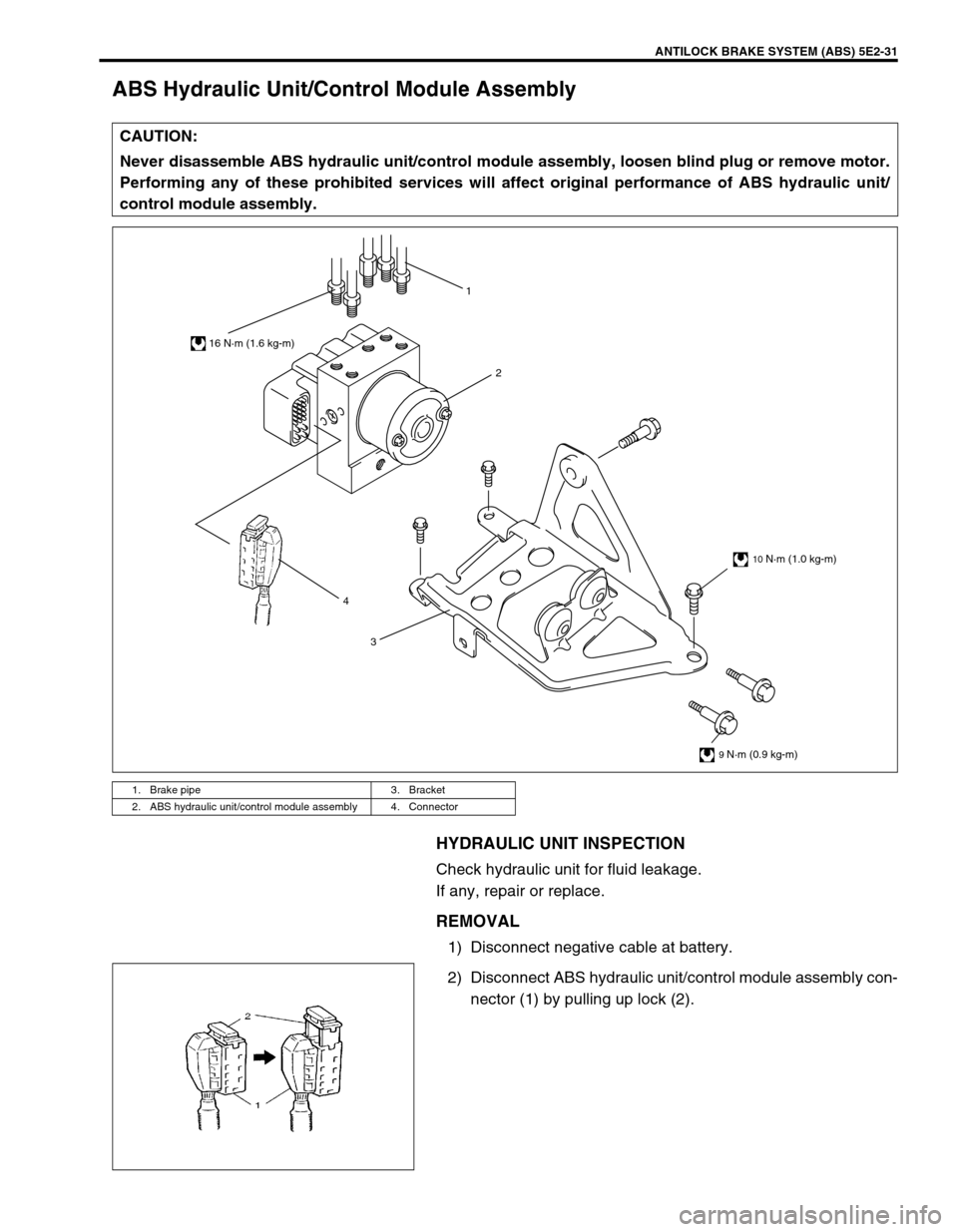
ABS Hydraulic Unit/Control Module Assembly
HYDRAULIC UNIT INSPECTION
Check hydraulic unit for fluid leakage.
If any, repair or replace.
REMOVAL
1) Disconnect negative cable at battery.
2) Disconnect ABS hydraulic unit/control module assembly con-
nector (1) by pulling up lock (2). CAUTION:
Never disassemble ABS hydraulic unit/control module assembly, loosen blind plug or remove motor.
Performing any of these prohibited services will affect original performance of ABS hydraulic unit/
control module assembly.
1. Brake pipe 3. Bracket
2. ABS hydraulic unit/control module assembly 4. Connector
4
32 1
16 N·m (1.6 kg-m)
10 N·m (1.0 kg-m)
9 N·m (0.9 kg-m)
Page 157 of 656
5E2-32 ANTILOCK BRAKE SYSTEM (ABS)
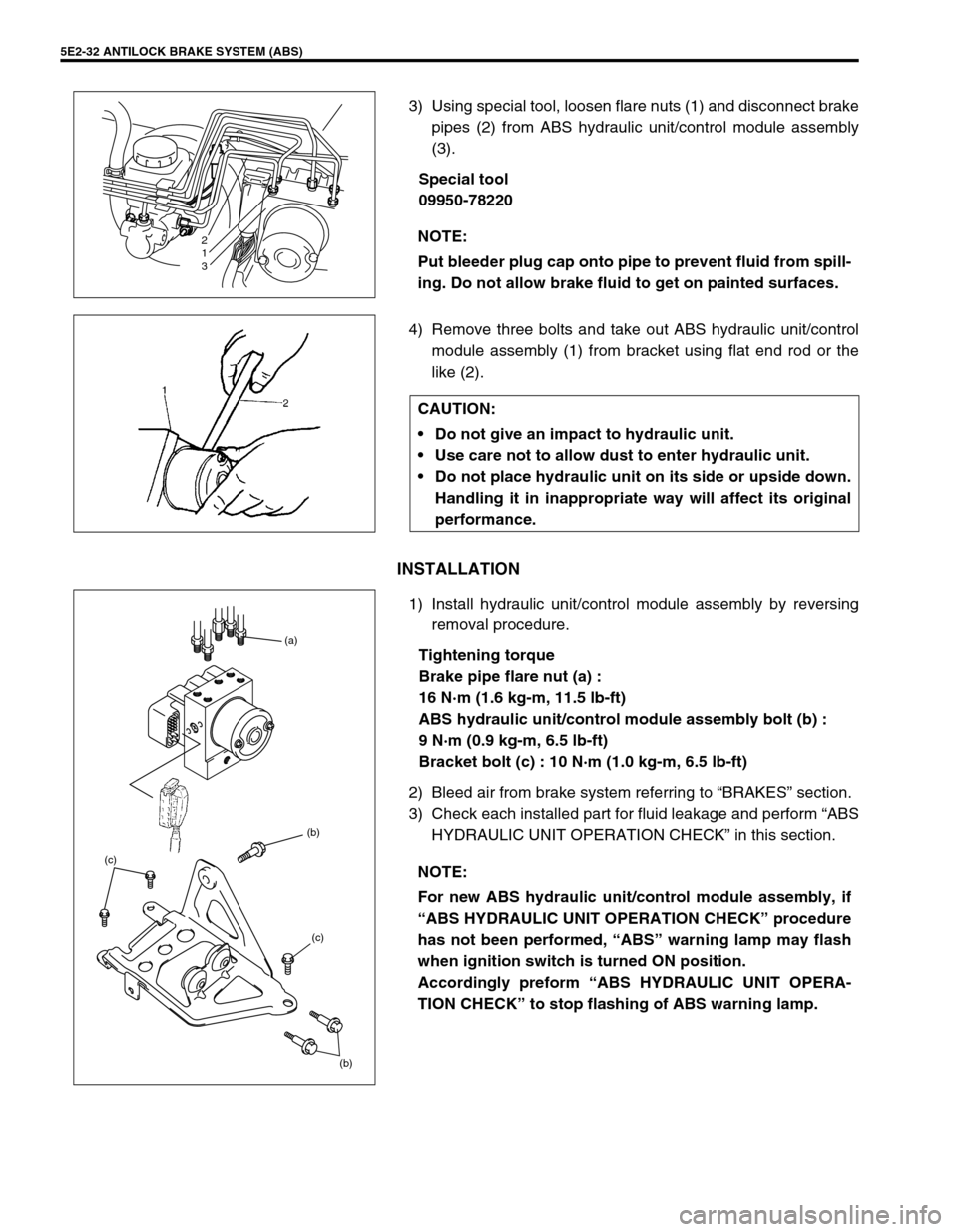
3) Using special tool, loosen flare nuts (1) and disconnect brake
pipes (2) from ABS hydraulic unit/control module assembly
(3).
Special tool
09950-78220
4) Remove three bolts and take out ABS hydraulic unit/control
module assembly (1) from bracket using flat end rod or the
like (2).
INSTALLATION
1) Install hydraulic unit/control module assembly by reversing
removal procedure.
Tightening torque
Brake pipe flare nut (a) :
16 N·m (1.6 kg-m, 11.5 lb-ft)
ABS hydraulic unit/control module assembly bolt (b) :
9 N·m (0.9 kg-m, 6.5 lb-ft)
Bracket bolt (c) : 10 N·m (1.0 kg-m, 6.5 lb-ft)
2) Bleed air from brake system referring to “BRAKES” section.
3) Check each installed part for fluid leakage and perform “ABS
HYDRAULIC UNIT OPERATION CHECK” in this section. NOTE:
Put bleeder plug cap onto pipe to prevent fluid from spill-
ing. Do not allow brake fluid to get on painted surfaces.
2
1
3
CAUTION:
Do not give an impact to hydraulic unit.
Use care not to allow dust to enter hydraulic unit.
Do not place hydraulic unit on its side or upside down.
Handling it in inappropriate way will affect its original
performance.
NOTE:
For new ABS hydraulic unit/control module assembly, if
“ABS HYDRAULIC UNIT OPERATION CHECK” procedure
has not been performed, “ABS” warning lamp may flash
when ignition switch is turned ON position.
Accordingly preform “ABS HYDRAULIC UNIT OPERA-
TION CHECK” to stop flashing of ABS warning lamp.
(b) (b) (a)
(c) (c)
Page 159 of 656
5E2-34 ANTILOCK BRAKE SYSTEM (ABS)
Tightening Torque Specification
Special Tool
Fastening partTightening torque
Nm kg-m lb-ft
Brake pipe flare nut : (a) 16 1.6 11.5
ABS hydraulic unit bolt : (b) 9 0.9 6.5
ABS hydraulic unit bracket bolt : (c) 10 1.0 7.5
Wheel speed sensor bolt (Front) : (d) 23 2.3 17.0
Wheel speed sensor bolt (Rear) : (e) 21 2.1 15.5
Parking lever assembly mounting bolt : (f) 23 2.3 17.0
(b) (b) (a)
(c) (c)
09950-78220 09931-76011 09931-76030
Flare nut wrench (10 mm) Tech 1A kit (SUZUKI scan
tool)
(See NOTE A.)Mass storage cartridge for
Tech 1A16/14 pin DLC cable for
Tech 1A
Page 197 of 656
6-1-36 ENGINE GENERAL INFORMATION AND DIAGNOSIS (H27 ENGINE)
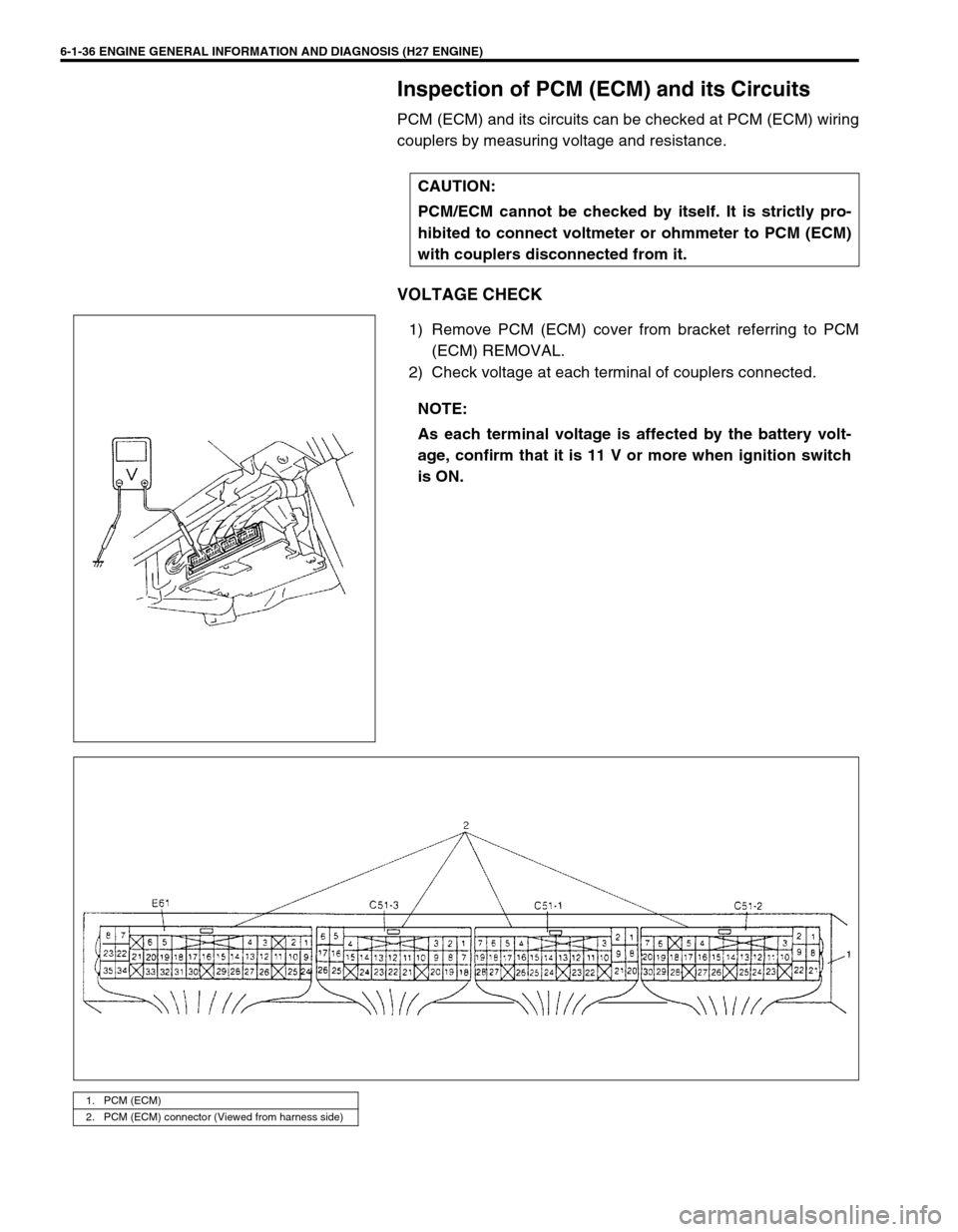
Inspection of PCM (ECM) and its Circuits
PCM (ECM) and its circuits can be checked at PCM (ECM) wiring
couplers by measuring voltage and resistance.
VOLTAGE CHECK
1) Remove PCM (ECM) cover from bracket referring to PCM
(ECM) REMOVAL.
2) Check voltage at each terminal of couplers connected.CAUTION:
PCM/ECM cannot be checked by itself. It is strictly pro-
hibited to connect voltmeter or ohmmeter to PCM (ECM)
with couplers disconnected from it.
NOTE:
As each terminal voltage is affected by the battery volt-
age, confirm that it is 11 V or more when ignition switch
is ON.
1. PCM (ECM)
2. PCM (ECM) connector (Viewed from harness side)
Page 291 of 656

6A2-4 ENGINE MECHANICAL (H27 ENGINE)
8) Disconnect accelerator cable (1) and A/T throttle cable (2)
(for A/T vehicle) from throttle body.
9) Disconnect water hoses (3) from throttle body.
10) Disconnect injector wire (1) coupler.
11) Disconnect brake booster hose (2) from intake manifold.
12) Disconnect couplers of TP sensor (1) and IAC valve (2).
13) Disconnect earth terminal (3) from intake collector.
14) Remove clamp bracket (4) from intake collector.
15) Disconnect couplers from manifold absolute pressure (MAP)
sensor, EVAP canister purge valve, earth terminal and EGR
valve.
16) Disconnect PCV hose from cylinder head cover.
Disconnect breather hoses from throttle body or cylinder
head cover.
17) Disconnect hoses of EVAP canister purge valve and heater.
18) Remove EGR pipe.
12
33
2
1
2
14
3
1. EVAP canister purge valve 6. PCV hose
2. EGR valve 7. Water hose
3. EGR pipe 8. Breather hose
4. EVAP canister purge valve hose 9. Earth terminal coupler
5. Heater hose
9
4
1 7
6
2
35
8
Page 294 of 656
ENGINE MECHANICAL (H27 ENGINE) 6A2-7
6) Connect hoses of heater, EVAP canister, fuel feed and fuel
return.
7) Install EGR pipe with new gaskets.
8) Connect hoses of EVAP canister purge valve and heater.
9) Connect hoses of PCV, breather and water.
10) Connect couplers of manifold absolute pressure (MAP) sen-
sor, EVAP canister purge valve and EGR valve.
Fix wire harness with clamps.
11) Install clamp bracket (4) to intake collector.
12) Connect earth terminal (3) to intake collector.
13) Connect couplers of TP sensor (1) and IAC valve (2).
14) Connect brake booster hose (2) to intake manifold.
15) Connect injector wire (1) coupler.
1. Heater hose
2. Fuel feed hose
3. Fuel return hose
4. EVAP canister hose
13
2 4
1. EVAP canister purge valve 6. PCV hose
2. EGR valve 7. Water hose
3. EGR pipe 8. Breather hose
4. EVAP canister purge valve hose 9. Earth terminal coupler
5. Heater hose9
4
1 7
6
2
35
8
2
14
3
2
1
Page 296 of 656
ENGINE MECHANICAL (H27 ENGINE) 6A2-9
26) Upon completion of installation, verify that there is no fuel
leakage at each connection according to procedure
described in Section 6.
Exhaust Manifold
REMOVAL
1) Disconnect negative (–) cable at battery.
2) Remove air cleaner upper case and intake air hose if right
side exhaust manifold is removed.
3) Detach couplers from their bracket and disconnect oxygen
sensor lead wires at couplers. WARNING:
To avoid danger of being burned, do not service exhaust
system while it is still hot. Service should be performed
after system has cooled off.
1. Left (No.1) exhaust manifold
Right (No.2) exhaust manifold
2. Exhaust manifold cover
3. Exhaust No.1 pipe
A. Without WU-TWC
B. With WU-TWC
1. HO2S-1 (Green connector)
2. HO2S-2 (Black connector)
Page 309 of 656
6A2-22 ENGINE MECHANICAL (H27 ENGINE)
INSPECTION
Cylinders
•Inspect cylinder walls for scratches, roughness, or ridges
which indicate excessive wear. If cylinder bore is very rough
or deeply scratched, or ridged, rebore cylinder and use over
size piston.
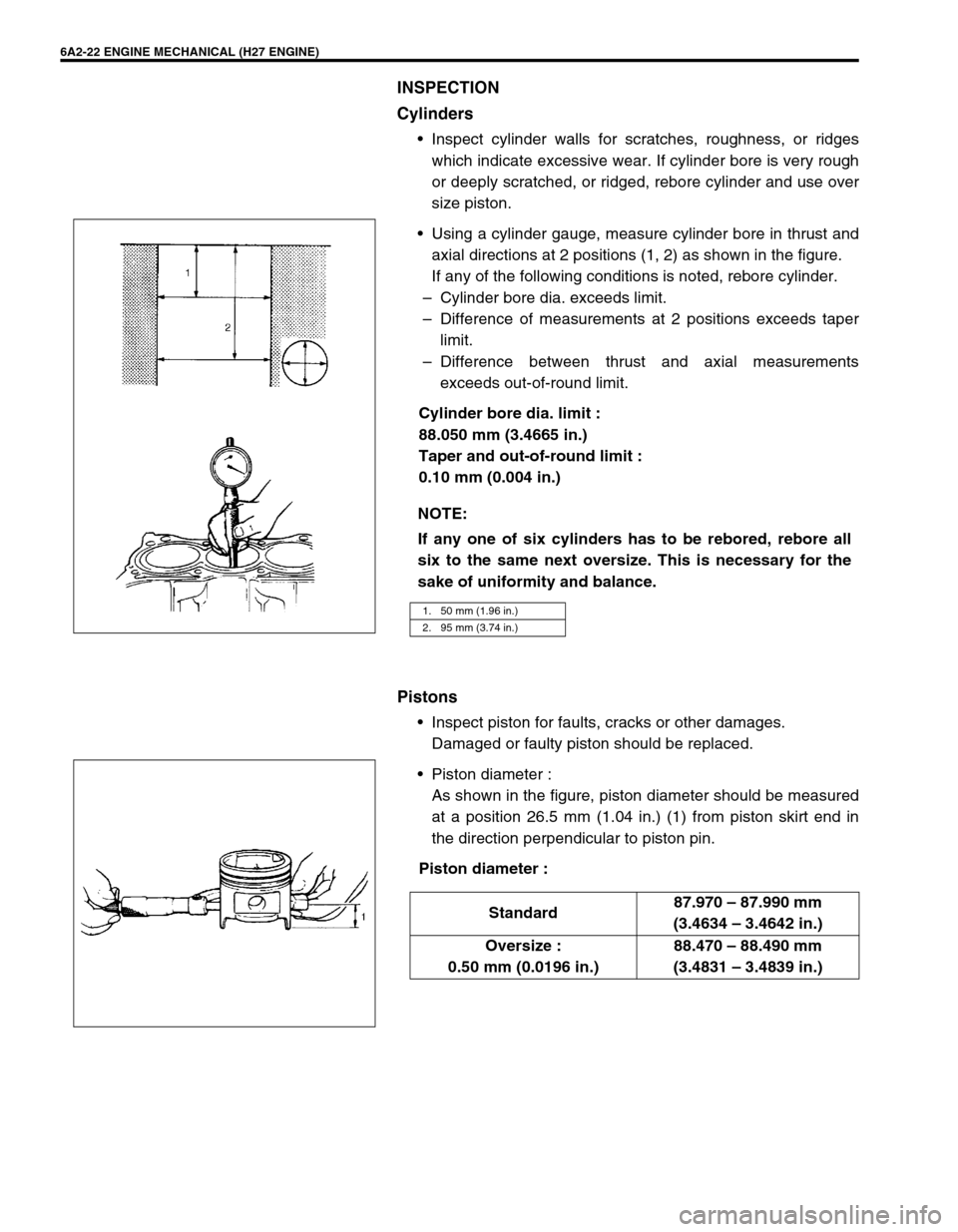
•Using a cylinder gauge, measure cylinder bore in thrust and
axial directions at 2 positions (1, 2) as shown in the figure.
If any of the following conditions is noted, rebore cylinder.
–Cylinder bore dia. exceeds limit.
–Difference of measurements at 2 positions exceeds taper
limit.
–Difference between thrust and axial measurements
exceeds out-of-round limit.
Cylinder bore dia. limit :
88.050 mm (3.4665 in.)
Taper and out-of-round limit :
0.10 mm (0.004 in.)
Pistons
•Inspect piston for faults, cracks or other damages.
Damaged or faulty piston should be replaced.
•Piston diameter :
As shown in the figure, piston diameter should be measured
at a position 26.5 mm (1.04 in.) (1) from piston skirt end in
the direction perpendicular to piston pin.
Piston diameter : NOTE:
If any one of six cylinders has to be rebored, rebore all
six to the same next oversize. This is necessary for the
sake of uniformity and balance.
1. 50 mm (1.96 in.)
2. 95 mm (3.74 in.)
Standard87.970 – 87.990 mm
(3.4634 – 3.4642 in.)
Oversize :
0.50 mm (0.0196 in.)88.470 – 88.490 mm
(3.4831 – 3.4839 in.)