1999 SUZUKI GRAND VITARA rack
[x] Cancel search: rackPage 79 of 656
3C1-4 AIR BAG STEERING WHEEL AND COLUMN
Steering Column
REMOVAL
1) Disconnect negative (–) cable at battery.
2) Disable air bag system. Refer to “DISABLING AIR BAG SYSTEM” under “SERVICE PRECAUTIONS” in
Section 10B.
3) Remove steering wheel and contact coil and combination switch assembly, if necessary. Refer to “STEER-
ING WHEEL” and “CONTACT COIL AND COMBINATION SWITCH ASSEMBLY” in this section.
Perform the following procedure if not removing steering wheel and/or combination switch.
a) Turn steering wheel so that vehicle’s front tires are at straight-ahead position.
b) Turn ignition switch to “LOCK” position and remove key.
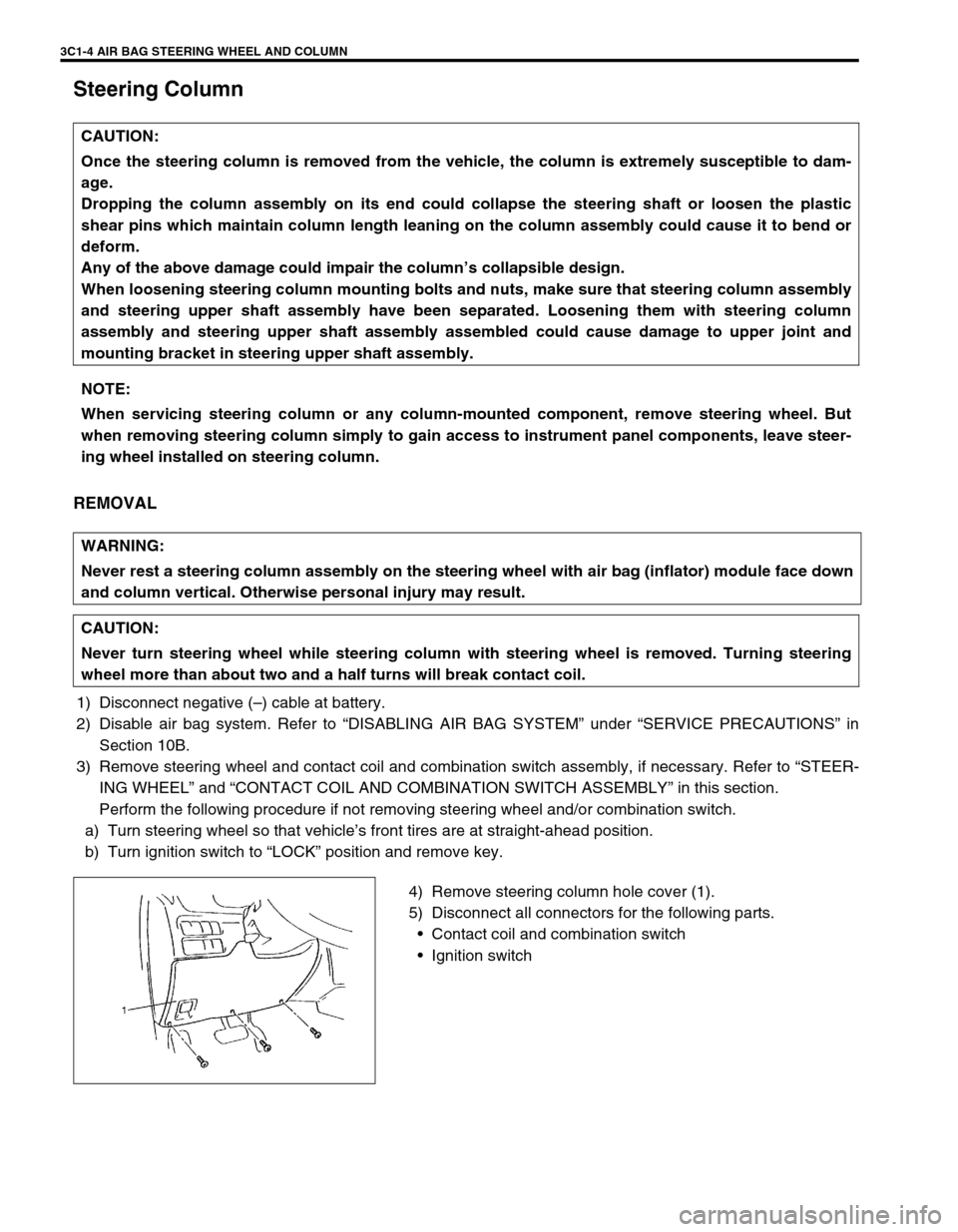
4) Remove steering column hole cover (1).
5) Disconnect all connectors for the following parts.
Contact coil and combination switch
Ignition switch CAUTION:
Once the steering column is removed from the vehicle, the column is extremely susceptible to dam-
age.
Dropping the column assembly on its end could collapse the steering shaft or loosen the plastic
shear pins which maintain column length leaning on the column assembly could cause it to bend or
deform.
Any of the above damage could impair the column’s collapsible design.
When loosening steering column mounting bolts and nuts, make sure that steering column assembly
and steering upper shaft assembly have been separated. Loosening them with steering column
assembly and steering upper shaft assembly assembled could cause damage to upper joint and
mounting bracket in steering upper shaft assembly.
NOTE:
When servicing steering column or any column-mounted component, remove steering wheel. But
when removing steering column simply to gain access to instrument panel components, leave steer-
ing wheel installed on steering column.
WARNING:
Never rest a steering column assembly on the steering wheel with air bag (inflator) module face down
and column vertical. Otherwise personal injury may result.
CAUTION:
Never turn steering wheel while steering column with steering wheel is removed. Turning steering
wheel more than about two and a half turns will break contact coil.
Page 81 of 656
3C1-6 AIR BAG STEERING WHEEL AND COLUMN
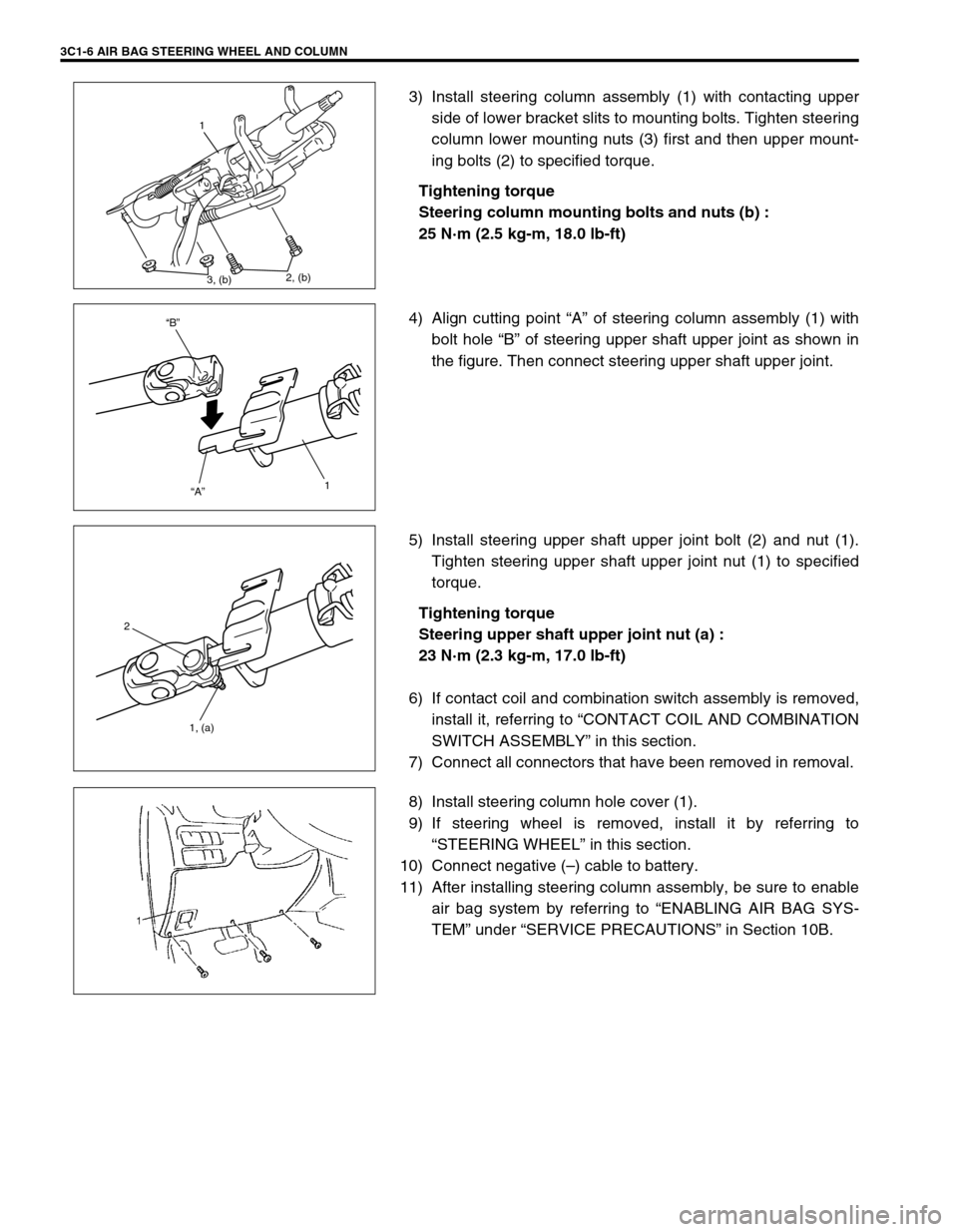
3) Install steering column assembly (1) with contacting upper
side of lower bracket slits to mounting bolts. Tighten steering
column lower mounting nuts (3) first and then upper mount-
ing bolts (2) to specified torque.
Tightening torque
Steering column mounting bolts and nuts (b) :
25 N·m (2.5 kg-m, 18.0 lb-ft)
4) Align cutting point “A” of steering column assembly (1) with
bolt hole “B” of steering upper shaft upper joint as shown in
the figure. Then connect steering upper shaft upper joint.
5) Install steering upper shaft upper joint bolt (2) and nut (1).
Tighten steering upper shaft upper joint nut (1) to specified
torque.
Tightening torque
Steering upper shaft upper joint nut (a) :
23 N·m (2.3 kg-m, 17.0 lb-ft)
6) If contact coil and combination switch assembly is removed,
install it, referring to “CONTACT COIL AND COMBINATION
SWITCH ASSEMBLY” in this section.
7) Connect all connectors that have been removed in removal.
8) Install steering column hole cover (1).
9) If steering wheel is removed, install it by referring to
“STEERING WHEEL” in this section.
10) Connect negative (–) cable to battery.
11) After installing steering column assembly, be sure to enable
air bag system by referring to “ENABLING AIR BAG SYS-
TEM” under “SERVICE PRECAUTIONS” in Section 10B.
1
3, (b)2, (b)
“B”
“A”
1
2
1, (a)
Page 86 of 656
AIR BAG STEERING WHEEL AND COLUMN 3C1-11
Checking Steering Column and Steering
Upper Shaft for Accident Damage
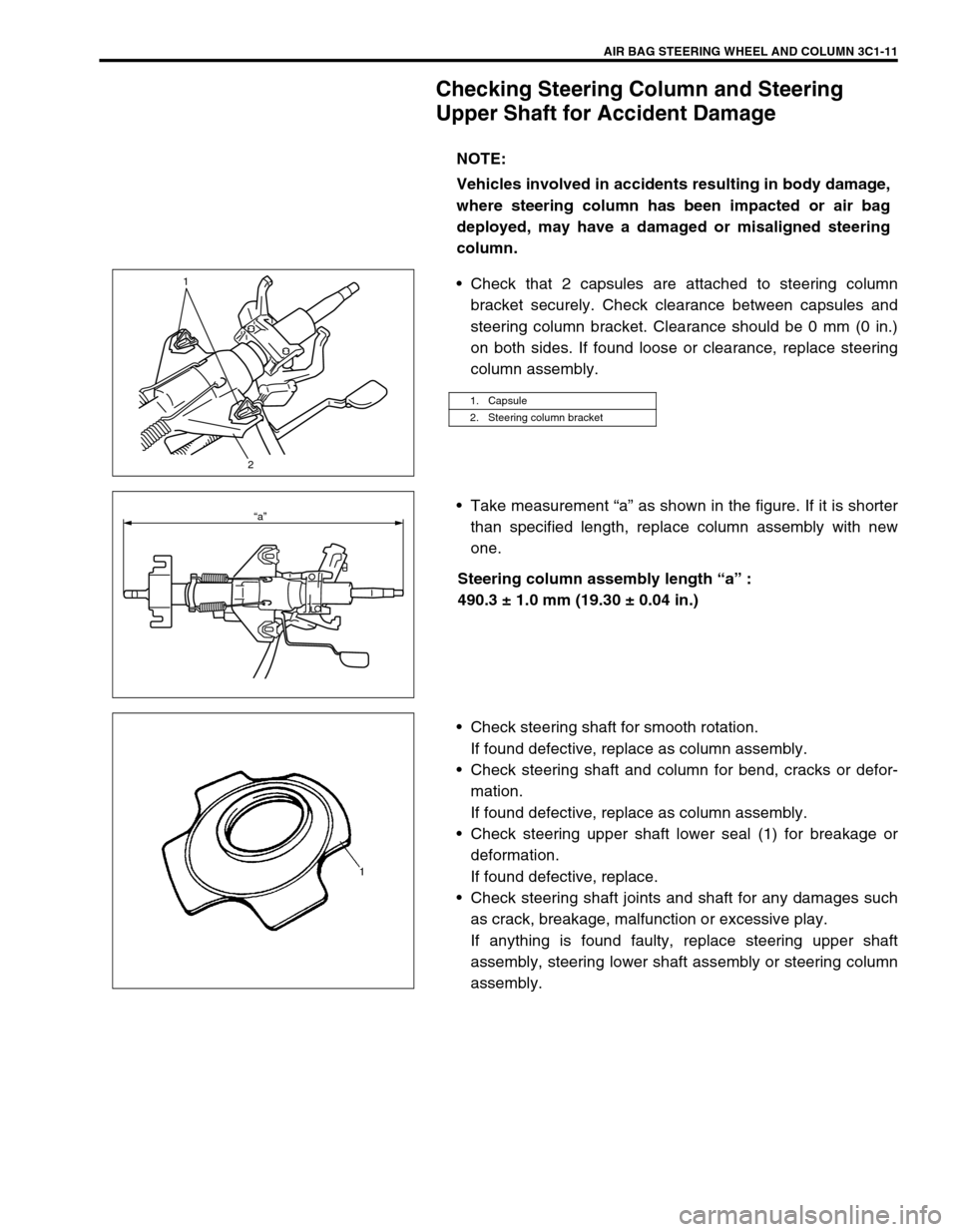
Check that 2 capsules are attached to steering column
bracket securely. Check clearance between capsules and
steering column bracket. Clearance should be 0 mm (0 in.)
on both sides. If found loose or clearance, replace steering
column assembly.
Take measurement “a” as shown in the figure. If it is shorter
than specified length, replace column assembly with new
one.
Steering column assembly length “a” :
490.3 ± 1.0 mm (19.30 ± 0.04 in.)
Check steering shaft for smooth rotation.
If found defective, replace as column assembly.
Check steering shaft and column for bend, cracks or defor-
mation.
If found defective, replace as column assembly.
Check steering upper shaft lower seal (1) for breakage or
deformation.
If found defective, replace.
Check steering shaft joints and shaft for any damages such
as crack, breakage, malfunction or excessive play.
If anything is found faulty, replace steering upper shaft
assembly, steering lower shaft assembly or steering column
assembly. NOTE:
Vehicles involved in accidents resulting in body damage,
where steering column has been impacted or air bag
deployed, may have a damaged or misaligned steering
column.
1. Capsule
2. Steering column bracket
1
2
“a”
Page 110 of 656
BRAKES PIPE/HOSE/MASTER CYLINDER 5A-3
On-Vehicle Service
Front Brake Hose/Pipe
REMOVAL
1) Raise and suitably support vehicle. Remove tire and wheel.
This operation is not necessary when removing pipes connecting master cylinder and flexible hose.
2) Clean dirt and foreign material from both hose end or pipe end fittings. Remove brake hose or pipe.
INSTALLATION
1) Reverse removal procedure for brake hose and pipe installation procedure.
For installation, make sure that steering wheel is in straightforward position and hose has no twist or kink.
Check to make sure that hose doesn't contact any part of suspension, both in extreme right and extreme left
turn conditions. If it does at any point, remove and correct. Fill and maintain brake fluid level in reservoir.
Bleed brake system.
2) Perform brake test and check installed part for fluid leakage.
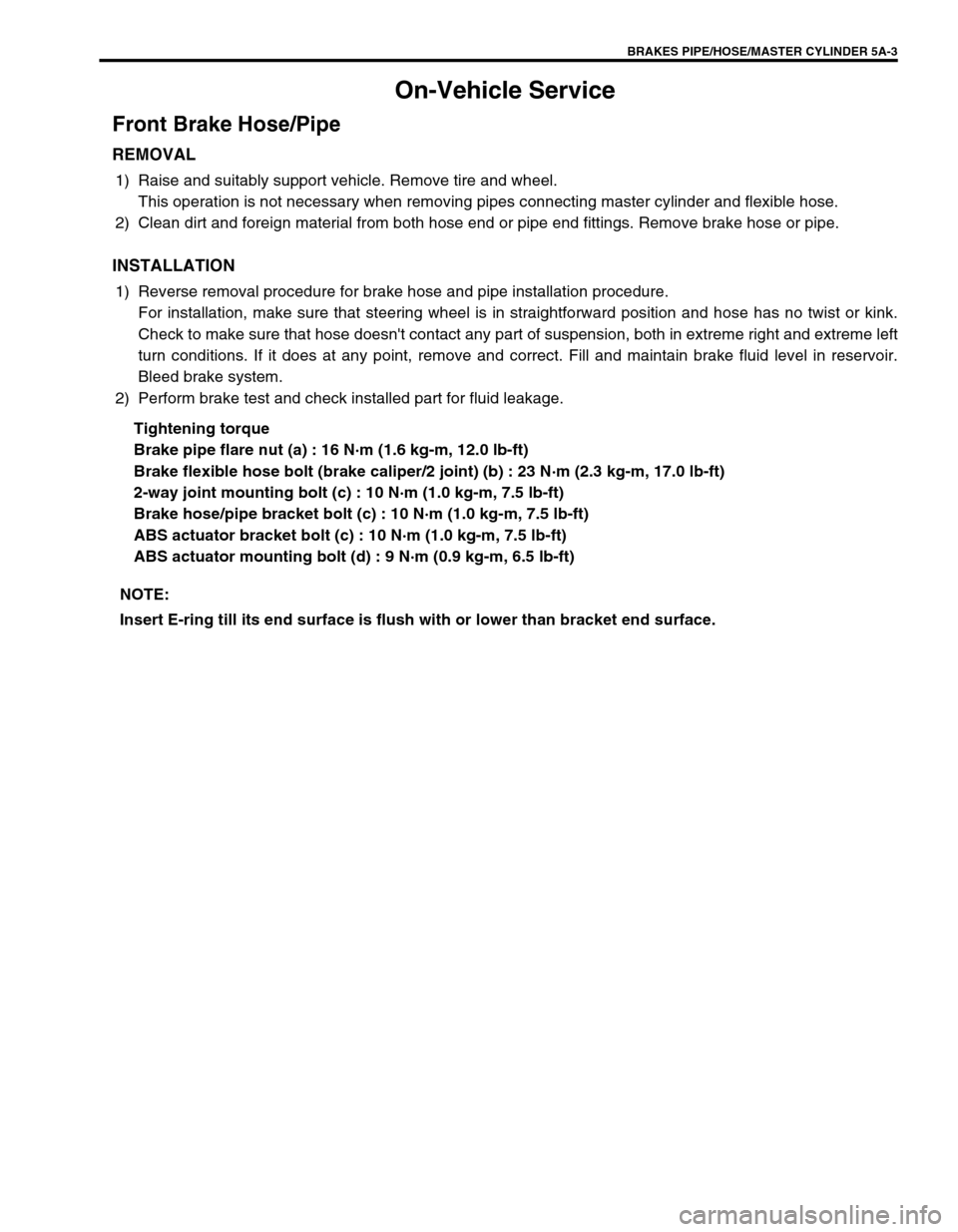
Tightening torque
Brake pipe flare nut (a) : 16 N·m (1.6 kg-m, 12.0 lb-ft)
Brake flexible hose bolt (brake caliper/2 joint) (b) : 23 N·m (2.3 kg-m, 17.0 lb-ft)
2-way joint mounting bolt (c) : 10 N·m (1.0 kg-m, 7.5 lb-ft)
Brake hose/pipe bracket bolt (c) : 10 N·m (1.0 kg-m, 7.5 lb-ft)
ABS actuator bracket bolt (c) : 10 N·m (1.0 kg-m, 7.5 lb-ft)
ABS actuator mounting bolt (d) : 9 N·m (0.9 kg-m, 6.5 lb-ft)
NOTE:
Insert E-ring till its end surface is flush with or lower than bracket end surface.
Page 117 of 656
5A-10 BRAKES PIPE/HOSE/MASTER CYLINDER
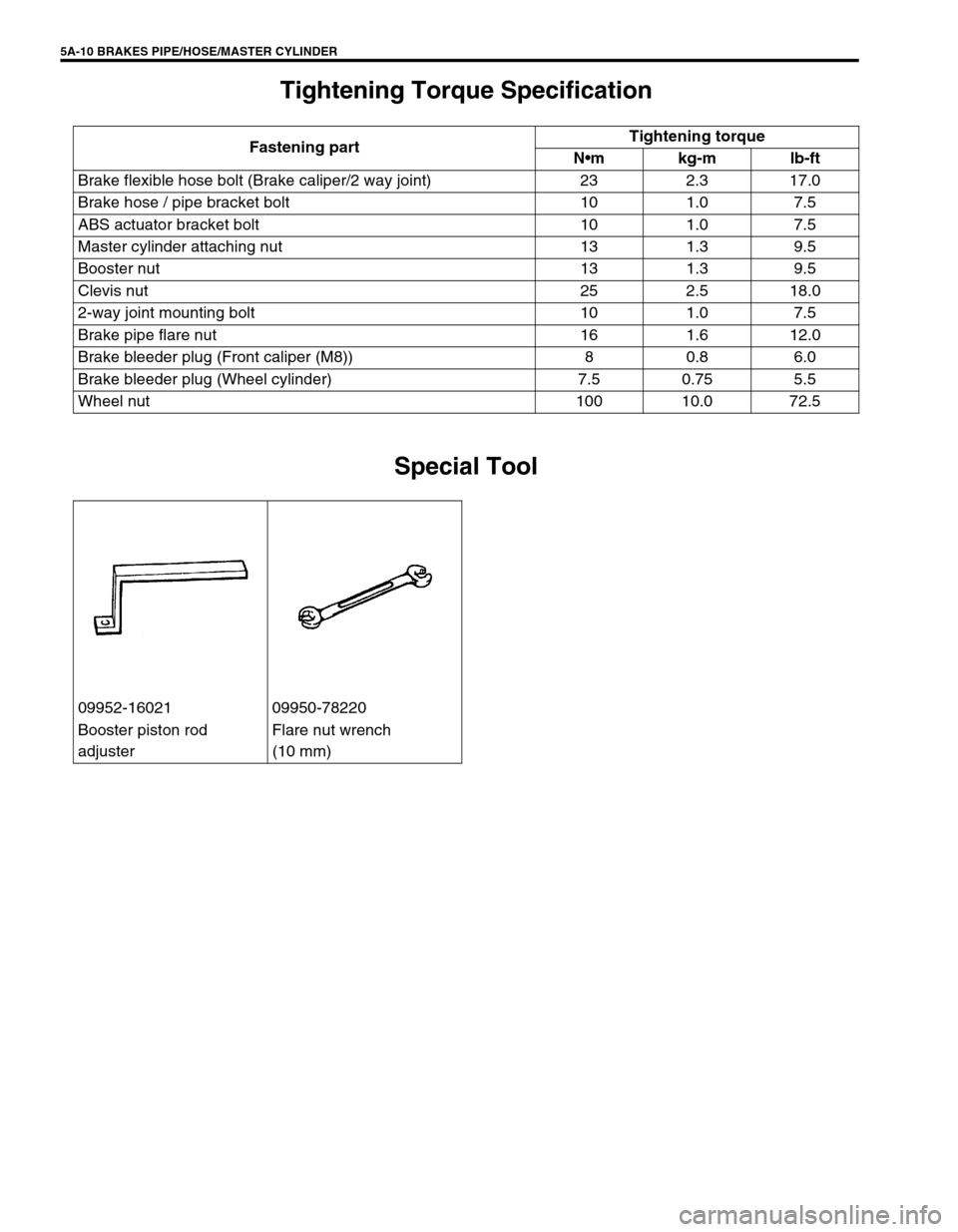
Tightening Torque Specification
Special Tool
Fastening partTightening torque
Nm kg-m lb-ft
Brake flexible hose bolt (Brake caliper/2 way joint) 23 2.3 17.0
Brake hose / pipe bracket bolt 10 1.0 7.5
ABS actuator bracket bolt 10 1.0 7.5
Master cylinder attaching nut 13 1.3 9.5
Booster nut 13 1.3 9.5
Clevis nut 25 2.5 18.0
2-way joint mounting bolt 10 1.0 7.5
Brake pipe flare nut 16 1.6 12.0
Brake bleeder plug (Front caliper (M8)) 8 0.8 6.0
Brake bleeder plug (Wheel cylinder) 7.5 0.75 5.5
Wheel nut 100 10.0 72.5
09952-16021 09950-78220
Booster piston rod
adjusterFlare nut wrench
(10 mm)
Page 120 of 656

PARKING AND REAR BRAKE 5C-3
On-Vehicle Service
Parking Brake CableBrake Drum
INSPECTION
Brake drum
Inspect drum for cleanliness. Check wear of its braking surface by
measuring its inside diameter.
Whenever brake drums are removed, they should be thoroughly
cleaned and inspected for cracks, scores, deep grooves.Brake dram inside diameter “a ”
S ta n dard : 2 54 mm (9.99 in .)
S erv ic e L im it : 2 56 m m ( 10.07 i n.)
1. Parking brake switch 6. Equalizer 11. Color ring 16. Crossmember 21. Parking brake cable nut
2. Parking brake lever 7. Pin 12. Cable 17. Chassis frame Tightening torque
3. Parking brake lever bolt 8. Equalizer 13. Grommet 18. Hanger
4. Floor 9. Adjust rod 14. Bolt 19. Rear axle
5. Locking nut 10. Coupler 15. Clamp (if equipped) 20. G-sensor (if equipped)
Page 121 of 656
5C-4 PARKING AND REAR BRAKE
Cracked, scored, or grooved drum
A cracked, drum is unsafe for further service and must be
replaced.
Do not attempt to weld a cracked drum.
Smooth up any slight scores. Heavy or extensive scoring will
cause excessive brake lining wear and it will probably be neces-
sary to resurface drum braking surface.
If brake linings are slightly worn and drum is grooved, drum
should be polished with fine emery cloth but should no be turned.
Brake shoe
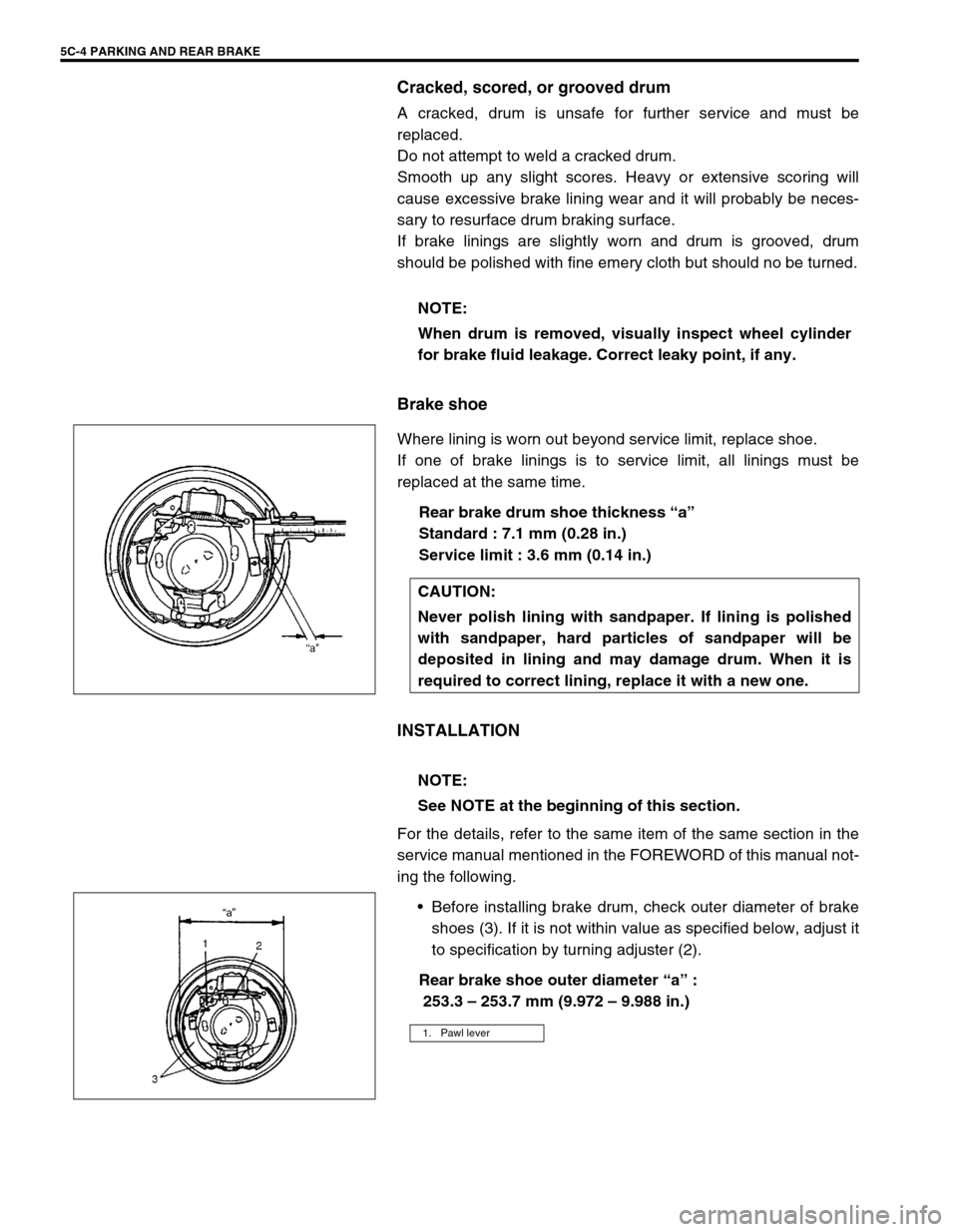
Where lining is worn out beyond service limit, replace shoe.
If one of brake linings is to service limit, all linings must be
replaced at the same time.
Rear brake drum shoe thickness “a”
Standard : 7.1 mm (0.28 in.)
Service limit : 3.6 mm (0.14 in.)
INSTALLATION
For the details, refer to the same item of the same section in the
service manual mentioned in the FOREWORD of this manual not-
ing the following.
Before installing brake drum, check outer diameter of brake
shoes (3). If it is not within value as specified below, adjust it
to specification by turning adjuster (2).
Rear brake shoe outer diameter “a” :
253.3 – 253.7 mm (9.972 – 9.988 in.) NOTE:
When drum is removed, visually inspect wheel cylinder
for brake fluid leakage. Correct leaky point, if any.
CAUTION:
Never polish lining with sandpaper. If lining is polished
with sandpaper, hard particles of sandpaper will be
deposited in lining and may damage drum. When it is
required to correct lining, replace it with a new one.
NOTE:
See NOTE at the beginning of this section.
1. Pawl lever
Page 146 of 656

ANTILOCK BRAKE SYSTEM (ABS) 5E2-21
INSPECTION
Step Action Yes No
1 1) Turn ignition switch ON.
Does 4WD lamp turn ON when 4WD switch
turns ON?Go to Step 2. Replace bulb or repair its
circuit.
2 1) Ignition switch OFF.
2) Check for proper connection to ECM (PCM)
and 4WD switch.
3) If OK, then check 4WD control system refer-
ring to DIAGNOSIS in SECTION 7E.
Is it good condition?Go to Step 3. Repair 4WD control sys-
tem.
3 1) Ignition switch OFF.
2) Disconnect connector from ABS hydraulic
with/control module assembly.
3) Check for proper connection to ABS control
module at terminal “E136-17”
4) If OK, then turn ignition switch ON and 4WD
switch ON.
5) Measure voltage between terminal “E136-
17” of module connector and body ground.
Is it 10 – 14 V?Go to Step 4.“ORN/BLK” circuit open or
short to ground.
4 Is G sensor installed to 2WD vehicle? Remove G sensor. Go to Step 5.
5 Is G sensor installed floor securely? Go to Step 6. Tighten sensor or bracket
screw securely. If not,
using new screw.
6 1) Ignition switch OFF.
2) Remove G sensor with bracket.
3) Check for proper connection to G sensor.
4) If OK then check G sensor referring to
INSPECTION of “G SENSOR”.
Is it in good condition?Go to Step 7. Replace G sensor.
7 1) Disconnect connectors from ABS hydraulic
unit/control module assembly and G sensor.
2) Check for proper connection to ABS control
module at terminals “E136-11” and “E136-
13”.
3) If OK, then turn ignition switch ON and mea-
sure voltage between “BLK/WHT” terminal
of sensor connector and body ground.
Is it 10 – 14 V?Go to Step 8.“BLK/WHT circuit open.
8 Measure voltage between “ORN/WHT” terminal
of sensor connector and body ground.
Is it 0 V?Go to Step 9.“ORN/WHT” circuit
shorted to power circuit.
9 1) Ignition switch OFF.
2) Check that “ORN/WHT” circuit is free from
open or short to ground and “ORN/GRN”
circuit.
Is it in good condition?“ORN/GRN” circuit open.
If circuit is OK, substitute
a known-good ABS
hydraulic unit/control
module assembly.“ORN/WHT” circuit open
or shorted to ground or
“ORN/GRN” circuit.