Page 275 of 656

6-1-114 ENGINE GENERAL INFORMATION AND DIAGNOSIS (H27 ENGINE)
DTC P1500 Engine Starter Signal Circuit Malfunction
WIRING DIAGRAM
DTC DETECTING CONDITION AND TROUBLE AREA
DTC CONFIRMATION PROCEDURE
1) Connect scan tool to DLC with ignition switch OFF.
2) Turn ON ignition switch and clear DTC by using scan tool, then start engine and run it for 3 min. or more.
3) Check pending DTC by using scan tool.
TROUBLESHOOTING
1. Engine start switch in ignition (main) switch 2. Starting motor 3. Transmission range sensor (switch) 4. ECM (PCM)
DTC DETECTING CONDITION TROUBLE AREA
•Engine starts even though vehicle is at stop and engine start signal is
not inputted.
or
•Engine start signal is inputted continuously for specified time while
engine is running.
(2 driving cycle detection logic)•Engine start signal circuit
•ECM (PCM)
NOTE:
Check to make sure that following condition is satisfied when using this “DTC CONFIRMATION PRO-
CEDURE”.
Intake air temp. : – 8°C (18°F) or higher
Engine coolant temp. : – 8 – 110°C (18 – 230°F)
Altitude (barometric pressure) : 2400 m, 8000 ft or less (560 mmHg (75 kPa) or more)
Step Action Yes No
1Was “ENGINE DIAG. FLOW TABLE” per-
formed?Go to Step 2. Go to “ENGINE DIAG. FLOW TABLE”
in this section.
2 Check for voltage at terminal C51-1-24 of
ECM (PCM) connector connected, under fol-
lowing condition.
Engine starter signal specification :
While engine cranking : 6 – 14 V
After starting engine : 0 – 1 V
Is voltage as specified?Poor C51-1-24 connection or
intermittent trouble.
Check for intermittent referring to
“INTERMITTENT AND POOR
CONNECTION” in Section 0A.
If wire and connections are OK,
substitute a known-good ECM
(PCM) and recheck.“BLK/YEL” circuit open.
Page 348 of 656
ENGINE AND EMISSION CONTROL SYSTEM (SEQUENTIAL MULTIPORT FUEL INJECTION FOR H27 ENGINE) 6E2-15
Idle Speed/Idle Air Control (IAC) Duty Inspec-
tion
Before idle speed/IAC duty check, make sure of the following.
•Lead wires and hoses of engine/emission control systems
are connected securely.
•Accelerator cable is adjusted.
•Ignition timing is within specification.
•All accessories (wipers, heater, lights, A/C, etc.) are out of
service.
•Air cleaner has been properly installed and is in good condi-
tion.
•ECM (PCM) does not detect any malfunction DTC.
After above items are all confirmed, check idle speed and IAC
duty as follows.
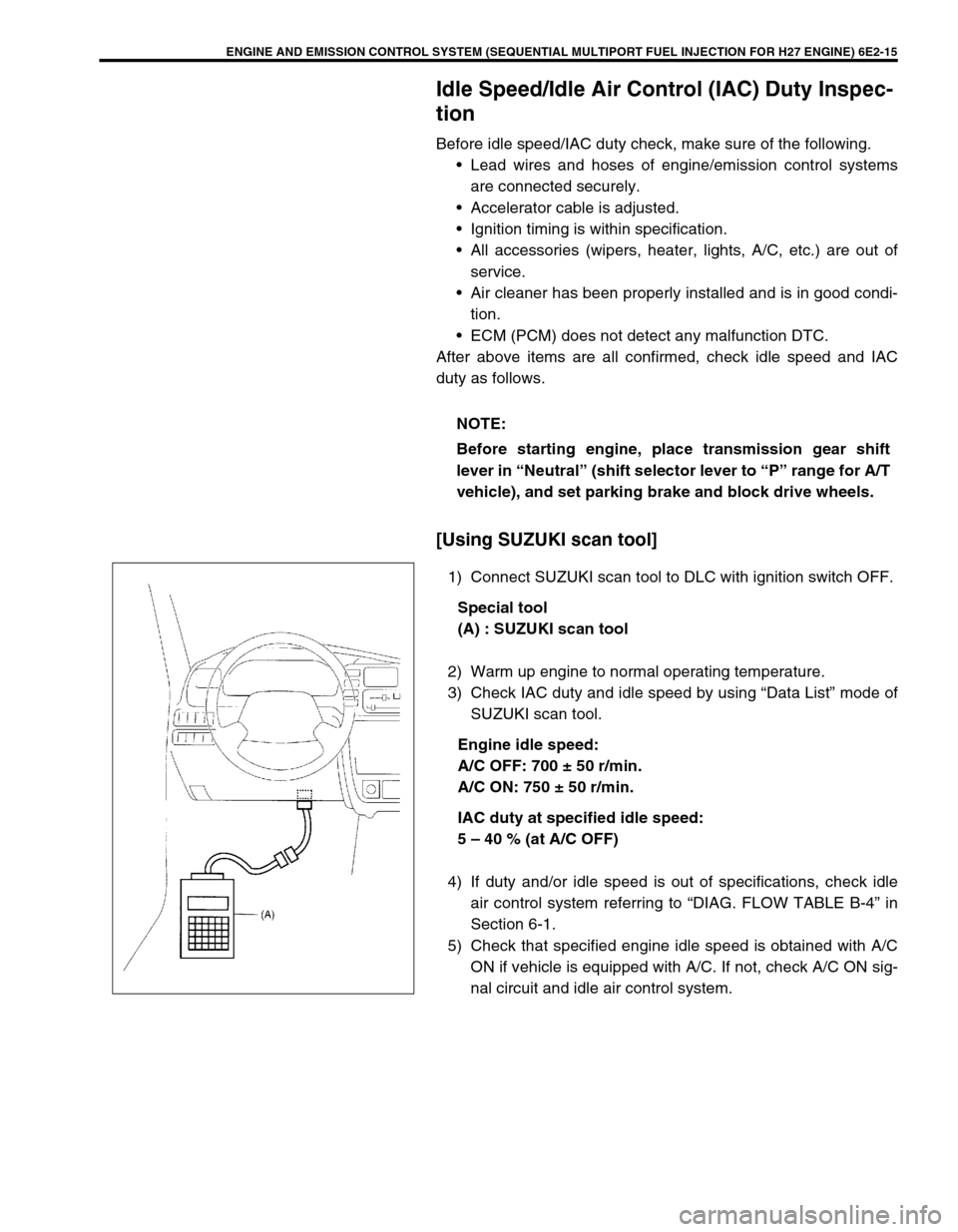
[Using SUZUKI scan tool]
1) Connect SUZUKI scan tool to DLC with ignition switch OFF.
Special tool
(A) : SUZUKI scan tool
2) Warm up engine to normal operating temperature.
3) Check IAC duty and idle speed by using “Data List” mode of
SUZUKI scan tool.
Engine idle speed:
A/C OFF: 700 ± 50 r/min.
A/C ON: 750 ± 50 r/min.
IAC duty at specified idle speed:
5 – 40 % (at A/C OFF)
4) If duty and/or idle speed is out of specifications, check idle
air control system referring to “DIAG. FLOW TABLE B-4” in
Section 6-1.
5) Check that specified engine idle speed is obtained with A/C
ON if vehicle is equipped with A/C. If not, check A/C ON sig-
nal circuit and idle air control system. NOTE:
Before starting engine, place transmission gear shift
lever in “Neutral” (shift selector lever to “P” range for A/T
vehicle), and set parking brake and block drive wheels.
Page 389 of 656
6F2-6 IGNITION SYSTEM (FOR H27 ENGINE)
Ignition Spark Check
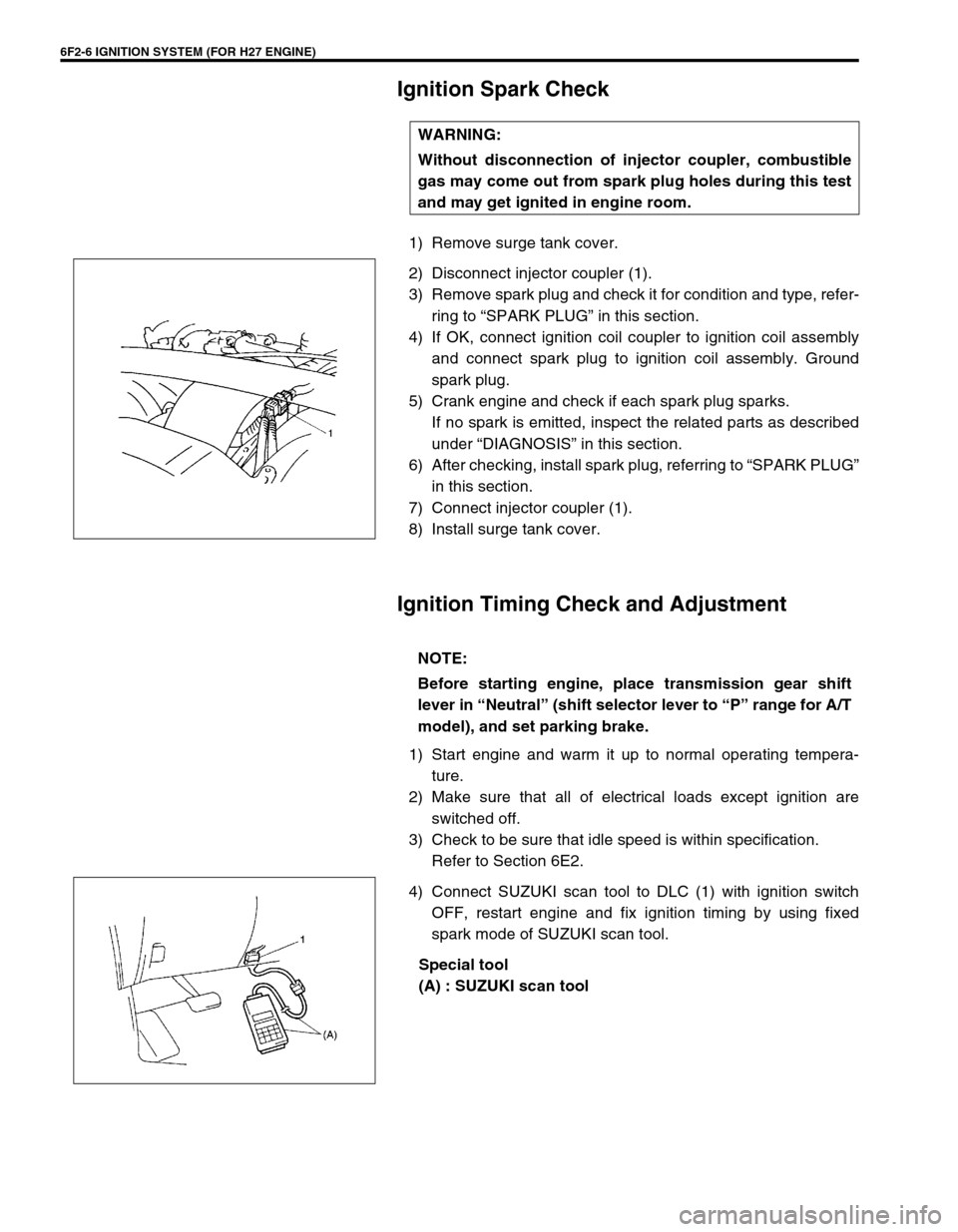
1) Remove surge tank cover.
2) Disconnect injector coupler (1).
3) Remove spark plug and check it for condition and type, refer-
ring to “SPARK PLUG” in this section.
4) If OK, connect ignition coil coupler to ignition coil assembly
and connect spark plug to ignition coil assembly. Ground
spark plug.
5) Crank engine and check if each spark plug sparks.
If no spark is emitted, inspect the related parts as described
under “DIAGNOSIS” in this section.
6) After checking, install spark plug, referring to “SPARK PLUG”
in this section.
7) Connect injector coupler (1).
8) Install surge tank cover.
Ignition Timing Check and Adjustment
1) Start engine and warm it up to normal operating tempera-
ture.
2) Make sure that all of electrical loads except ignition are
switched off.
3) Check to be sure that idle speed is within specification.
Refer to Section 6E2.
4) Connect SUZUKI scan tool to DLC (1) with ignition switch
OFF, restart engine and fix ignition timing by using fixed
spark mode of SUZUKI scan tool.
Special tool
(A) : SUZUKI scan tool WARNING:
Without disconnection of injector coupler, combustible
gas may come out from spark plug holes during this test
and may get ignited in engine room.
NOTE:
Before starting engine, place transmission gear shift
lever in “Neutral” (shift selector lever to “P” range for A/T
model), and set parking brake.
Page 392 of 656

IGNITION SYSTEM (FOR H27 ENGINE) 6F2-9
INSPECTION
Inspect them for electrode wear, carbon deposits and Insulator
damage.
If any abnormality is found, replace them with specified new plug.
Spark plug air gap “a” :
1.0 – 1.1 mm (0.039 – 0.043 in.)
Spark plug type :
DENSO K20PR-U11/SK16PR11
NGK BKR6E-11/*IFR5J11
INSTALLATION
1) Install spark plug (3) and tighten them to specified torque.
Tightening torque
Spark plug (a) : 25 N·m (2.5 kg-m, 18.0 lb-ft)
2) Install ignition coil assembly (2) securely.
3) Tighten ignition coil bolt (1), and then connect ignition coil
coupler.
4) Install ignition coil cover.CAUTION:
When servicing the iridium/platinum spark plugs (slender
center electrode type plugs), do not touch the center
electrode to avoid damage to it. The electrode is not
strong enough against mechanical force as it is slender
and its material is not mechanically tough.
NOTE:
Under –25°C (–13°F), it is highly recommended to use the
spark plugs with an asterisk (*) for better engine starting
performance.
Page 502 of 656
DIFFERENTIAL (REAR) 7F-17
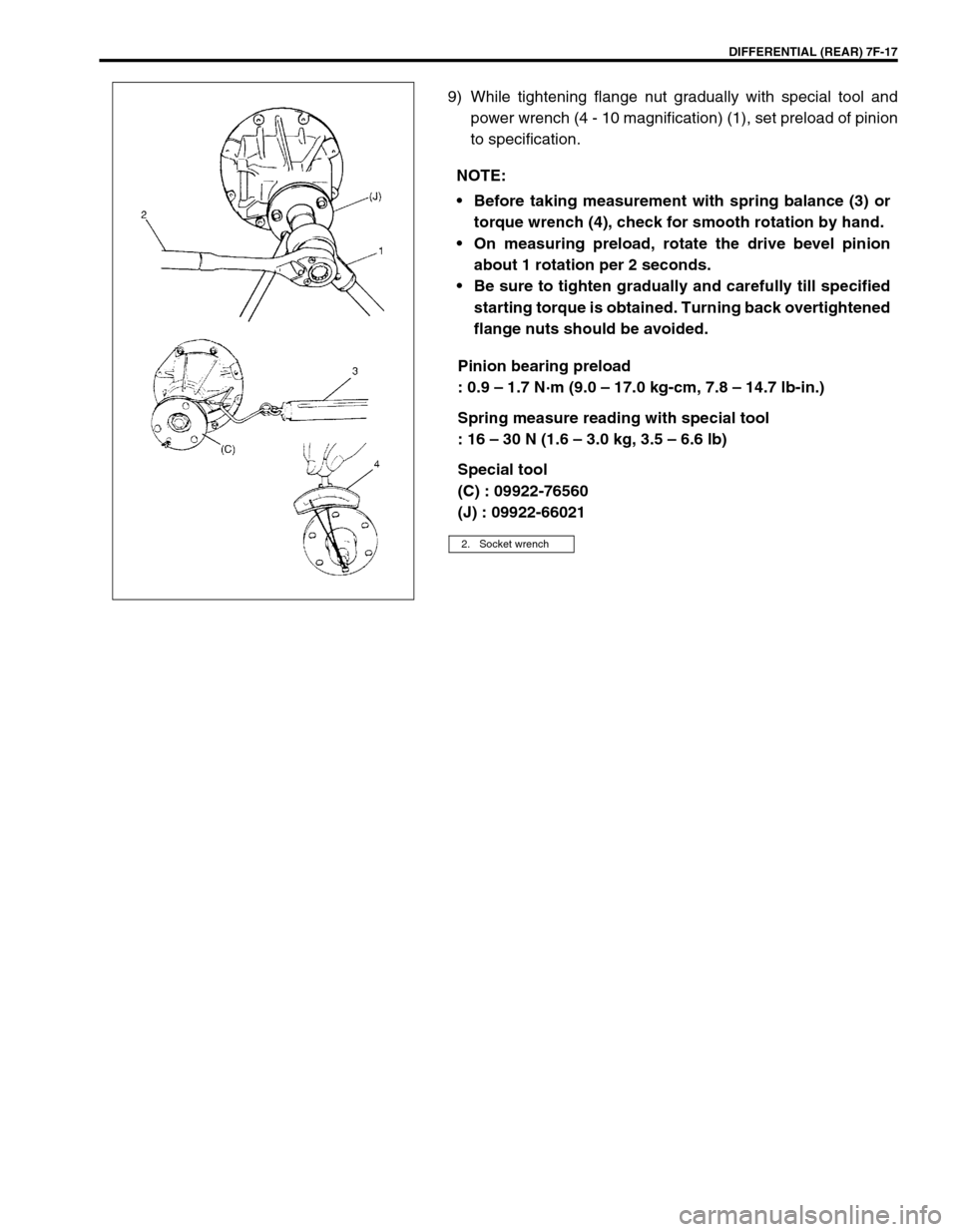
9) While tightening flange nut gradually with special tool and
power wrench (4 - 10 magnification) (1), set preload of pinion
to specification.
Pinion bearing preload
: 0.9 – 1.7 N·m (9.0 – 17.0 kg-cm, 7.8 – 14.7 lb-in.)
Spring measure reading with special tool
: 16 – 30 N (1.6 – 3.0 kg, 3.5 – 6.6 lb)
Special tool
(C) : 09922-76560
(J) : 09922-66021 NOTE:
Before taking measurement with spring balance (3) or
torque wrench (4), check for smooth rotation by hand.
On measuring preload, rotate the drive bevel pinion
about 1 rotation per 2 seconds.
Be sure to tighten gradually and carefully till specified
starting torque is obtained. Turning back overtightened
flange nuts should be avoided.
2. Socket wrench
Page 572 of 656
SEAT BELT 10A-3
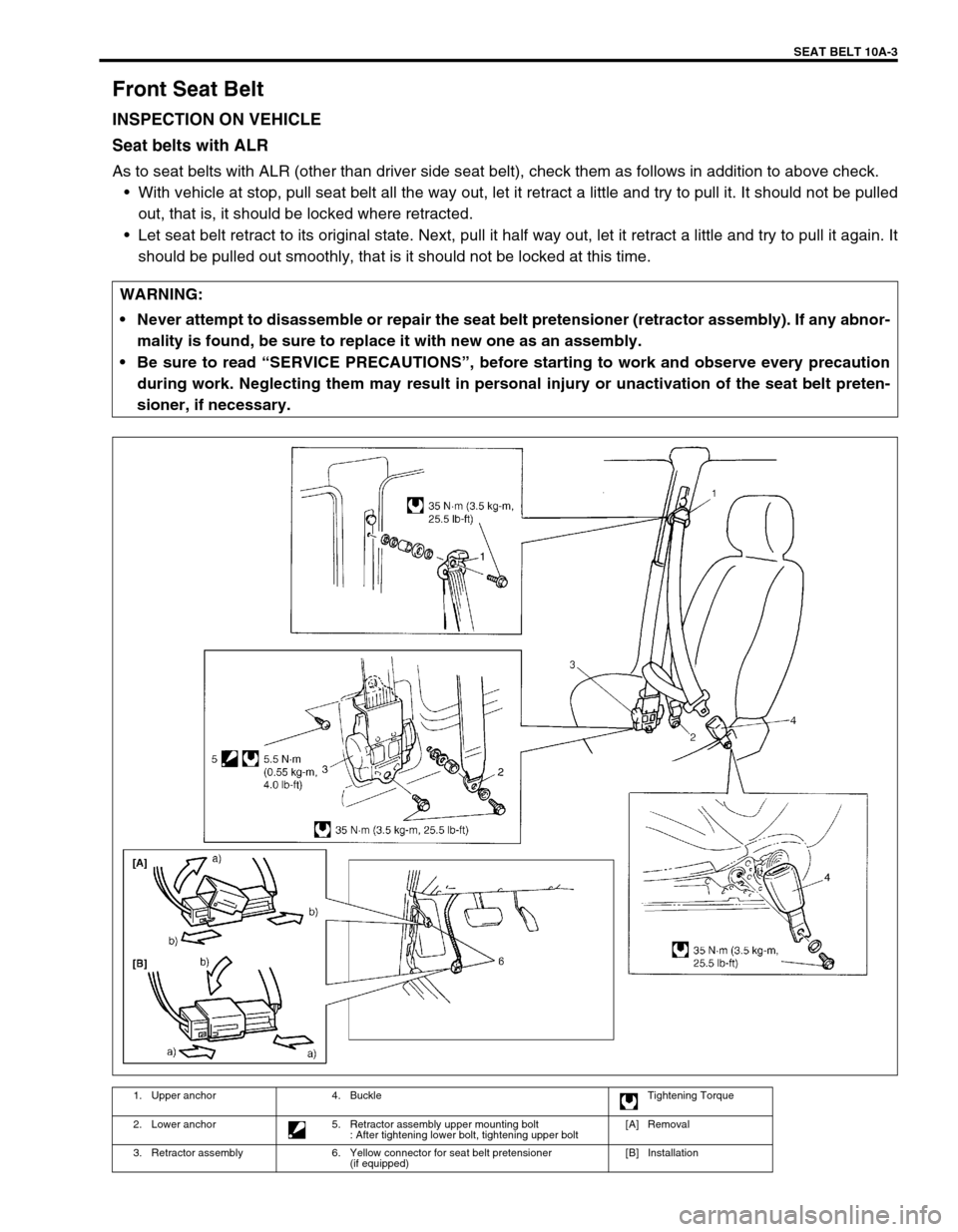
Front Seat Belt
INSPECTION ON VEHICLE
Seat belts with ALR
As to seat belts with ALR (other than driver side seat belt), check them as follows in addition to above check.
•With vehicle at stop, pull seat belt all the way out, let it retract a little and try to pull it. It should not be pulled
out, that is, it should be locked where retracted.
•Let seat belt retract to its original state. Next, pull it half way out, let it retract a little and try to pull it again. It
should be pulled out smoothly, that is it should not be locked at this time.
WARNING:
Never attempt to disassemble or repair the seat belt pretensioner (retractor assembly). If any abnor-
mality is found, be sure to replace it with new one as an assembly.
Be sure to read “SERVICE PRECAUTIONS”, before starting to work and observe every precaution
during work. Neglecting them may result in personal injury or unactivation of the seat belt preten-
sioner, if necessary.
1. Upper anchor 4. Buckle Tightening Torque
2. Lower anchor 5. Retractor assembly upper mounting bolt
: After tightening lower bolt, tightening upper bolt[A] Removal
3. Retractor assembly 6. Yellow connector for seat belt pretensioner
(if equipped)[B] Installation
Page 575 of 656
10A-6 SEAT BELT
Second Rear Seat Belt
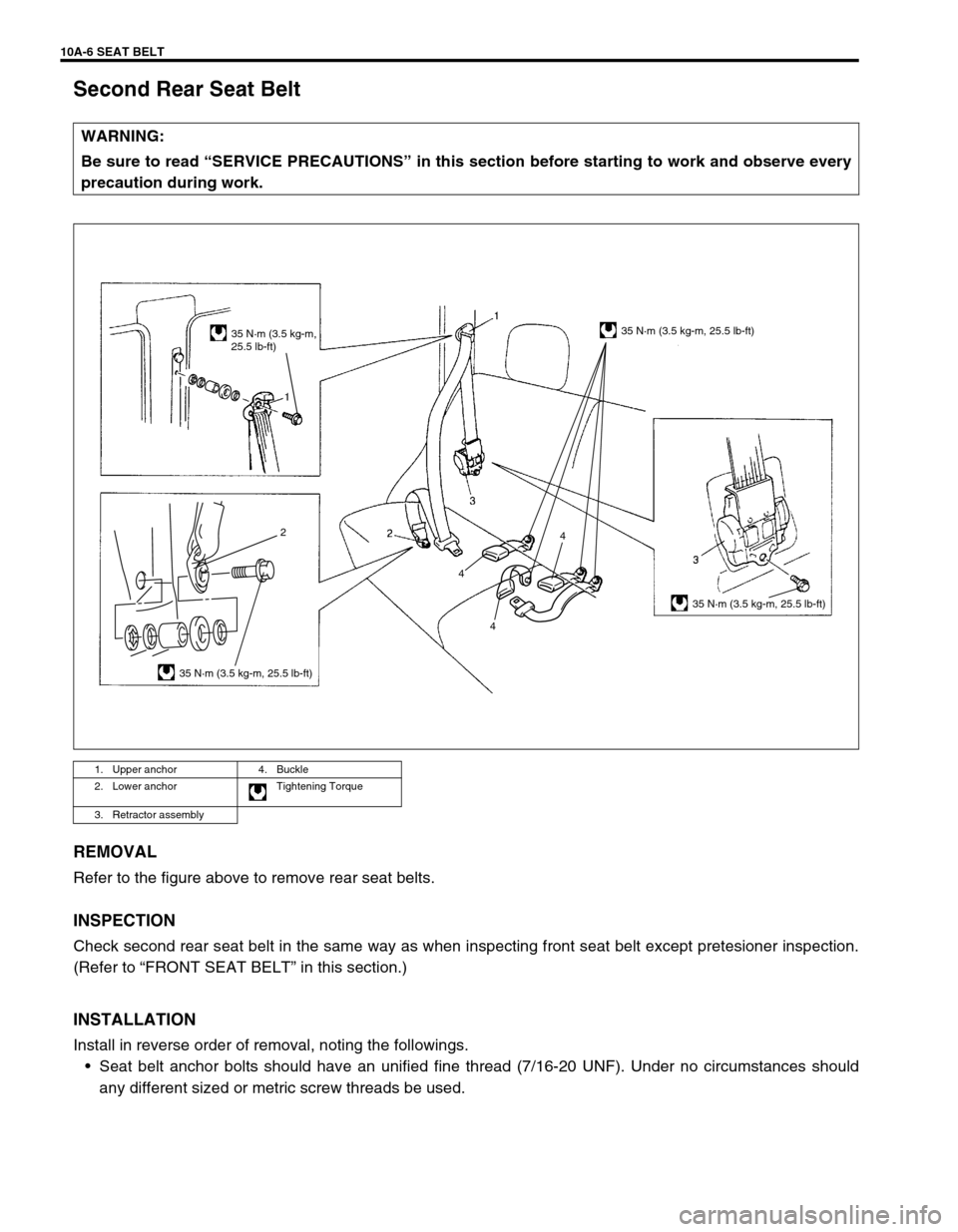
REMOVAL
Refer to the figure above to remove rear seat belts.
INSPECTION
Check second rear seat belt in the same way as when inspecting front seat belt except pretesioner inspection.
(Refer to “FRONT SEAT BELT” in this section.)
INSTALLATION
Install in reverse order of removal, noting the followings.
•Seat belt anchor bolts should have an unified fine thread (7/16-20 UNF). Under no circumstances should
any different sized or metric screw threads be used. WARNING:
Be sure to read “SERVICE PRECAUTIONS” in this section before starting to work and observe every
precaution during work.
1. Upper anchor 4. Buckle
2. Lower anchor Tightening Torque
3. Retractor assembly
2
35 N·m (3.5 kg-m, 25.5 lb-ft)
35 N·m (3.5 kg-m, 25.5 lb-ft)
35 N·m (3.5 kg-m, 25.5 lb-ft)
35 N·m (3.5 kg-m,
25.5 lb-ft)
4
4
4
Page 576 of 656
SEAT BELT 10A-7
Third Rear Seat Belt (If Equipped)
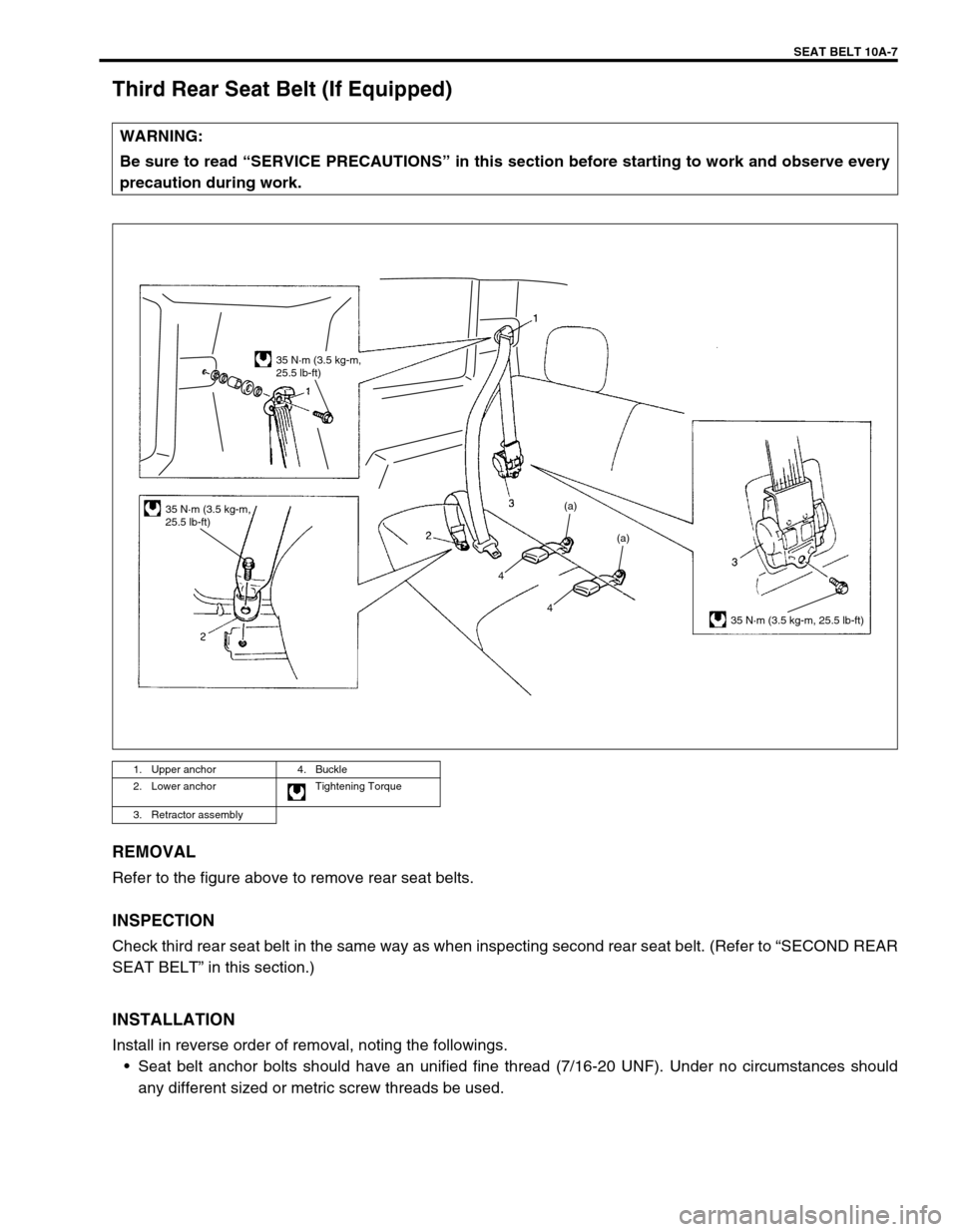
REMOVAL
Refer to the figure above to remove rear seat belts.
INSPECTION
Check third rear seat belt in the same way as when inspecting second rear seat belt. (Refer to “SECOND REAR
SEAT BELT” in this section.)
INSTALLATION
Install in reverse order of removal, noting the followings.
•Seat belt anchor bolts should have an unified fine thread (7/16-20 UNF). Under no circumstances should
any different sized or metric screw threads be used. WARNING:
Be sure to read “SERVICE PRECAUTIONS” in this section before starting to work and observe every
precaution during work.
1. Upper anchor 4. Buckle
2. Lower anchor Tightening Torque
3. Retractor assembly
35 N·m (3.5 kg-m,
25.5 lb-ft)
35 N·m (3.5 kg-m,
25.5 lb-ft)
35 N·m (3.5 kg-m, 25.5 lb-ft)
4
4
(a)
(a)