1999 SUZUKI GRAND VITARA Starting
[x] Cancel search: StartingPage 583 of 656
10B-6 AIR BAG SYSTEM
Diagnosis
Diagnostic Trouble Code (DTC)
The AIR BAG DIAGNOSTIC SYSTEM CHECK must always be the starting point of any air bag system diagno-
sis. The AIR BAG DIAGNOSTIC SYSTEM CHECK checks for proper “AIR BAG” warning lamp operation and
checks for air bag diagnostic trouble codes (DTCs) using on-board diagnosis function or SUZUKI scan tool.
Use of Special Tool
You should be familiar with the tools listed in this section under the heading SPECIAL TOOLS. You should be
able to measure voltage and resistance. You should be familiar with proper use of a scan tool such as Air Bag
Driver/Passenger Load Tool, Connector Test Adapter Kit and the Digital Multimeter.
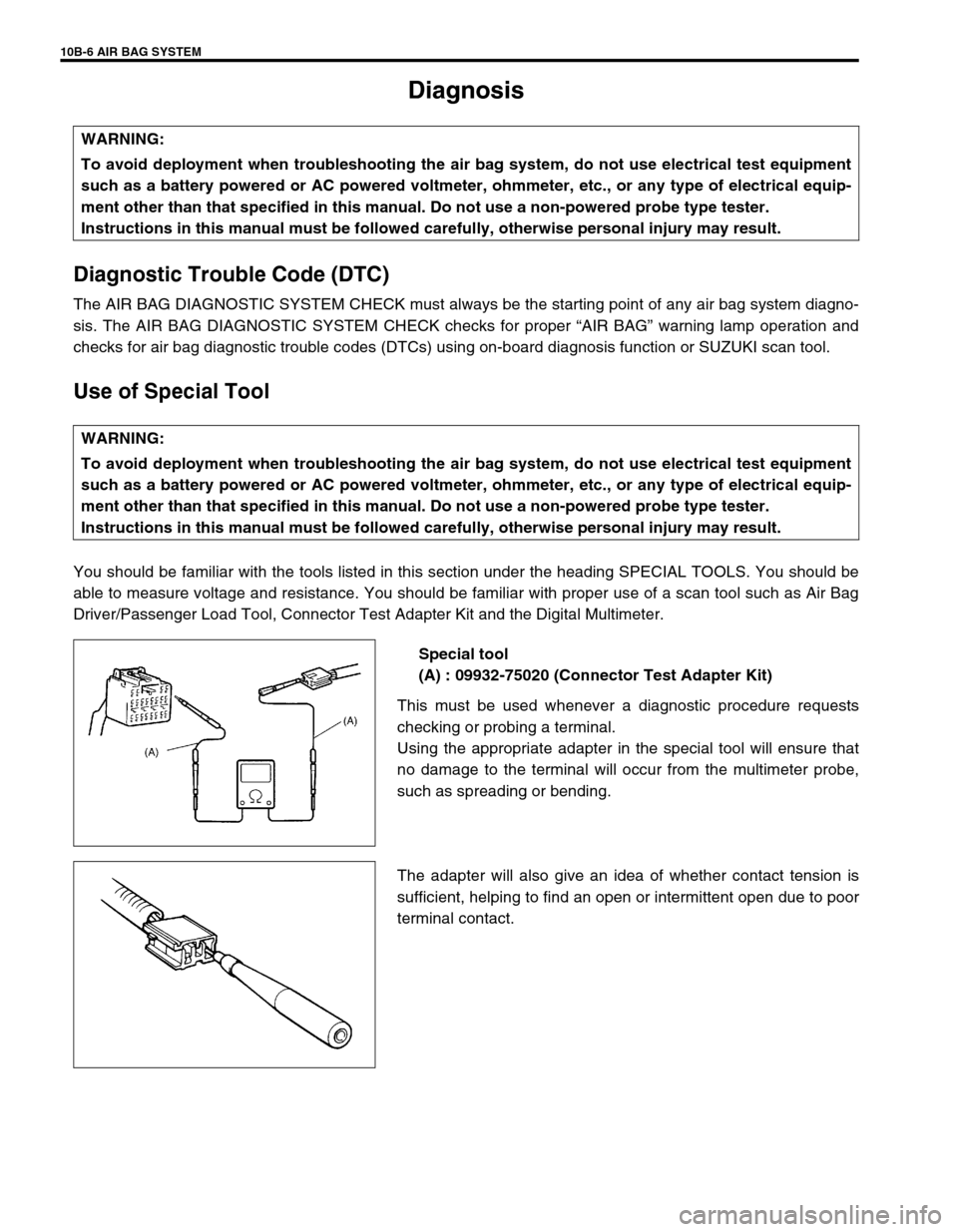
Special tool
(A) : 09932-75020 (Connector Test Adapter Kit)
This must be used whenever a diagnostic procedure requests
checking or probing a terminal.
Using the appropriate adapter in the special tool will ensure that
no damage to the terminal will occur from the multimeter probe,
such as spreading or bending.
The adapter will also give an idea of whether contact tension is
sufficient, helping to find an open or intermittent open due to poor
terminal contact. WARNING:
To avoid deployment when troubleshooting the air bag system, do not use electrical test equipment
such as a battery powered or AC powered voltmeter, ohmmeter, etc., or any type of electrical equip-
ment other than that specified in this manual. Do not use a non-powered probe type tester.
Instructions in this manual must be followed carefully, otherwise personal injury may result.
WARNING:
To avoid deployment when troubleshooting the air bag system, do not use electrical test equipment
such as a battery powered or AC powered voltmeter, ohmmeter, etc., or any type of electrical equip-
ment other than that specified in this manual. Do not use a non-powered probe type tester.
Instructions in this manual must be followed carefully, otherwise personal injury may result.
Page 586 of 656
AIR BAG SYSTEM 10B-9
Air Bag Diagnostic System Check
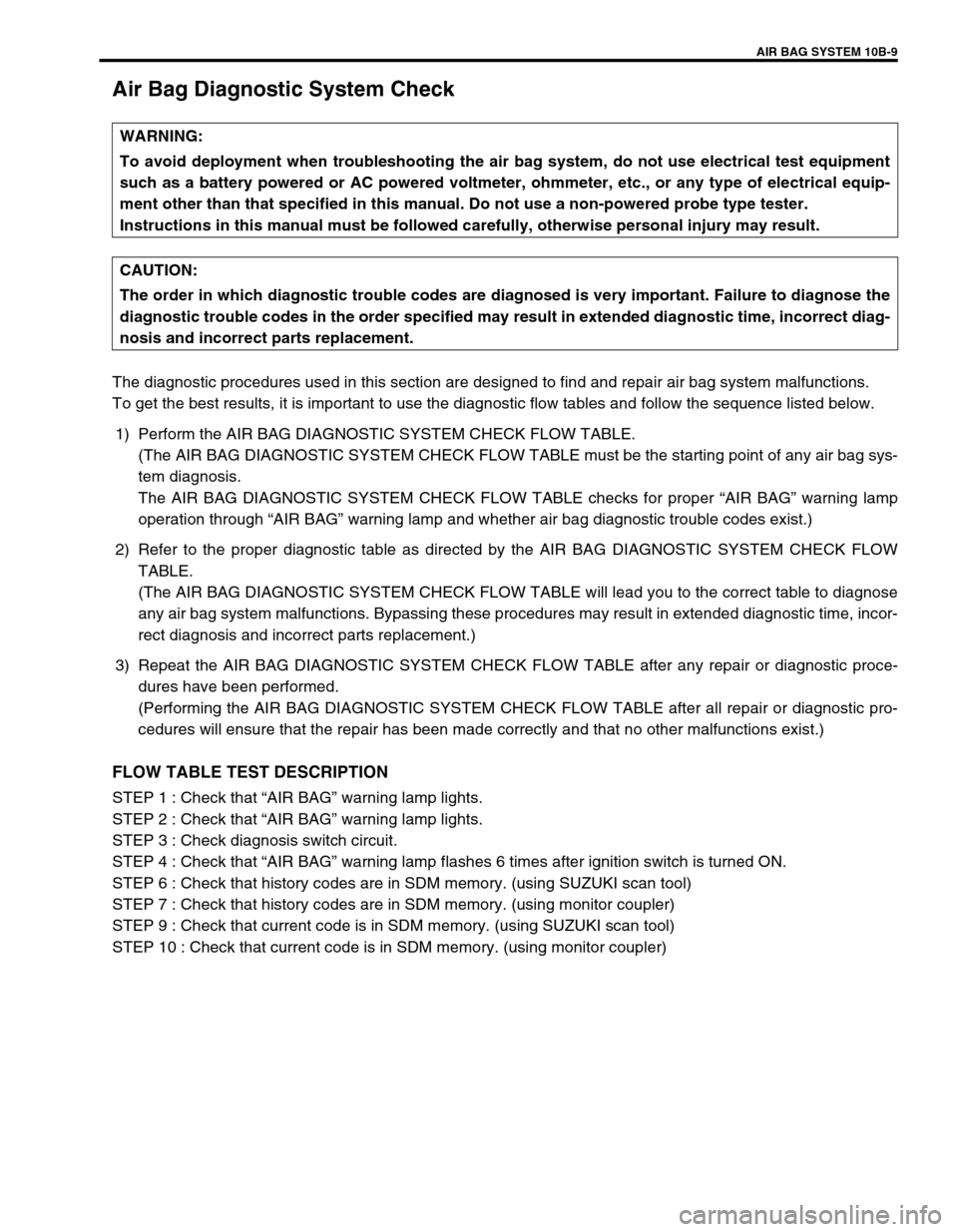
The diagnostic procedures used in this section are designed to find and repair air bag system malfunctions.
To get the best results, it is important to use the diagnostic flow tables and follow the sequence listed below.
1) Perform the AIR BAG DIAGNOSTIC SYSTEM CHECK FLOW TABLE.
(The AIR BAG DIAGNOSTIC SYSTEM CHECK FLOW TABLE must be the starting point of any air bag sys-
tem diagnosis.
The AIR BAG DIAGNOSTIC SYSTEM CHECK FLOW TABLE checks for proper “AIR BAG” warning lamp
operation through “AIR BAG” warning lamp and whether air bag diagnostic trouble codes exist.)
2) Refer to the proper diagnostic table as directed by the AIR BAG DIAGNOSTIC SYSTEM CHECK FLOW
TABLE.
(The AIR BAG DIAGNOSTIC SYSTEM CHECK FLOW TABLE will lead you to the correct table to diagnose
any air bag system malfunctions. Bypassing these procedures may result in extended diagnostic time, incor-
rect diagnosis and incorrect parts replacement.)
3) Repeat the AIR BAG DIAGNOSTIC SYSTEM CHECK FLOW TABLE after any repair or diagnostic proce-
dures have been performed.
(Performing the AIR BAG DIAGNOSTIC SYSTEM CHECK FLOW TABLE after all repair or diagnostic pro-
cedures will ensure that the repair has been made correctly and that no other malfunctions exist.)
FLOW TABLE TEST DESCRIPTION
STEP 1 : Check that “AIR BAG” warning lamp lights.
STEP 2 : Check that “AIR BAG” warning lamp lights.
STEP 3 : Check diagnosis switch circuit.
STEP 4 : Check that “AIR BAG” warning lamp flashes 6 times after ignition switch is turned ON.
STEP 6 : Check that history codes are in SDM memory. (using SUZUKI scan tool)
STEP 7 : Check that history codes are in SDM memory. (using monitor coupler)
STEP 9 : Check that current code is in SDM memory. (using SUZUKI scan tool)
STEP 10 : Check that current code is in SDM memory. (using monitor coupler)WARNING:
To avoid deployment when troubleshooting the air bag system, do not use electrical test equipment
such as a battery powered or AC powered voltmeter, ohmmeter, etc., or any type of electrical equip-
ment other than that specified in this manual. Do not use a non-powered probe type tester.
Instructions in this manual must be followed carefully, otherwise personal injury may result.
CAUTION:
The order in which diagnostic trouble codes are diagnosed is very important. Failure to diagnose the
diagnostic trouble codes in the order specified may result in extended diagnostic time, incorrect diag-
nosis and incorrect parts replacement.
Page 593 of 656
10B-16 AIR BAG SYSTEM
Table A - “AIR BAG” Warning Lamp Comes ON Steady
Table B - “AIR BAG” Warning Lamp Does Not Come ON
Table C - “AIR BAG” Warning Lamp Flashes
Table D - “AIR BAG” Warning Lamp Cannot Indicate Flashing Pattern of DTC
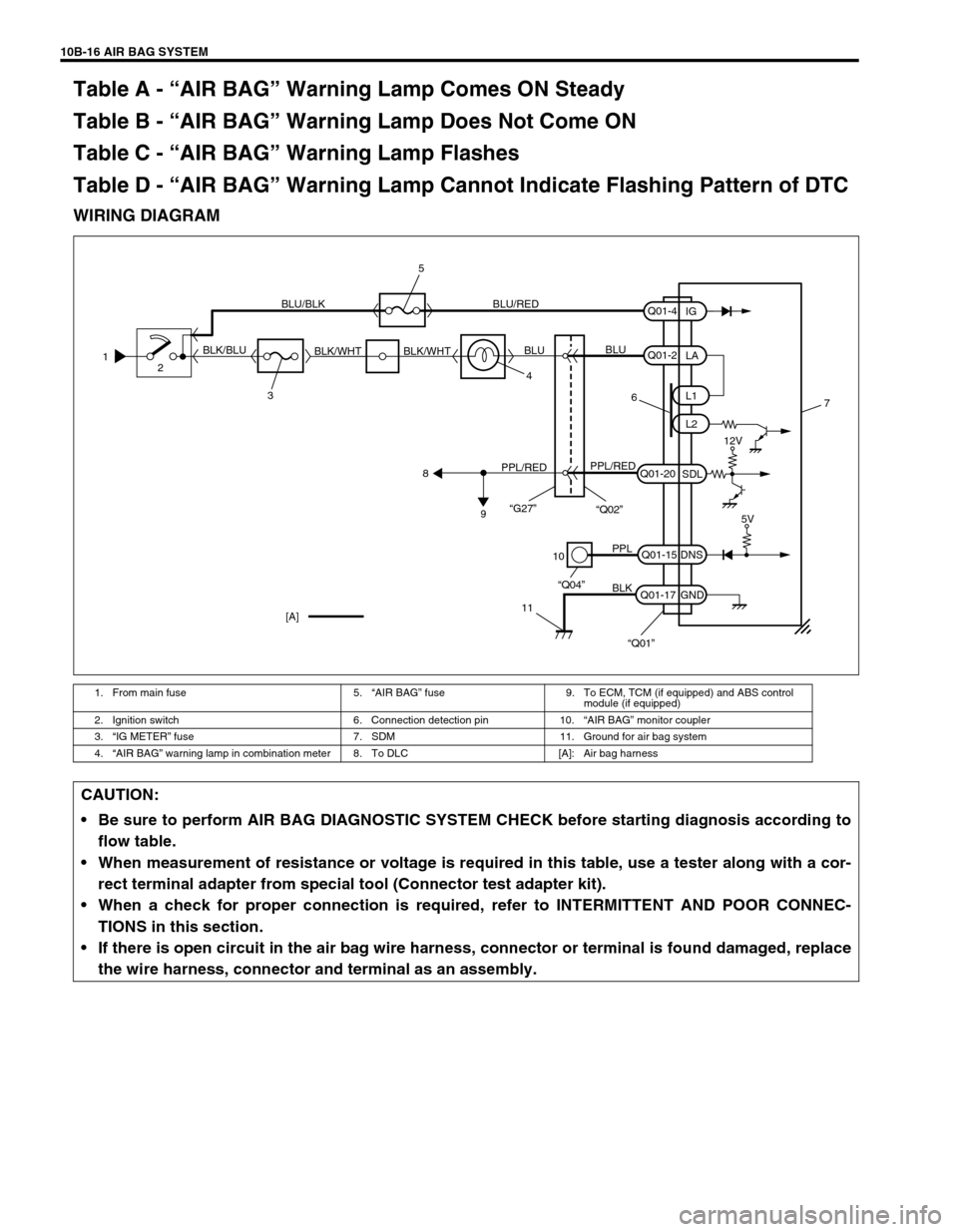
WIRING DIAGRAM
1. From main fuse 5.“AIR BAG” fuse 9. To ECM, TCM (if equipped) and ABS control
module (if equipped)
2. Ignition switch 6. Connection detection pin 10.“AIR BAG” monitor coupler
3.“IG METER” fuse 7. SDM 11. Ground for air bag system
4.“AIR BAG” warning lamp in combination meter 8. To DLC [A]: Air bag harness
1
2
34 BLK/BLUBLU/BLK BLU/RED
BLK/WHT BLK/WHTBLUBLU
6
PPL/REDPPL/RED
8
9
10
11
PPL
BLK
“Q04”
“Q01”
Q01-2
Q01-20
Q01-15
Q01-17L1
L2
SDL
DNS
GNDLA
Q01-4
IG
7
[A]
12V
5V
“G27”“Q02”
5
CAUTION:
Be sure to perform AIR BAG DIAGNOSTIC SYSTEM CHECK before starting diagnosis according to
flow table.
When measurement of resistance or voltage is required in this table, use a tester along with a cor-
rect terminal adapter from special tool (Connector test adapter kit).
When a check for proper connection is required, refer to INTERMITTENT AND POOR CONNEC-
TIONS in this section.
If there is open circuit in the air bag wire harness, connector or terminal is found damaged, replace
the wire harness, connector and terminal as an assembly.
Page 598 of 656
AIR BAG SYSTEM 10B-21
Table E - SDM Cannot Communicate through The Serial Data Circuit
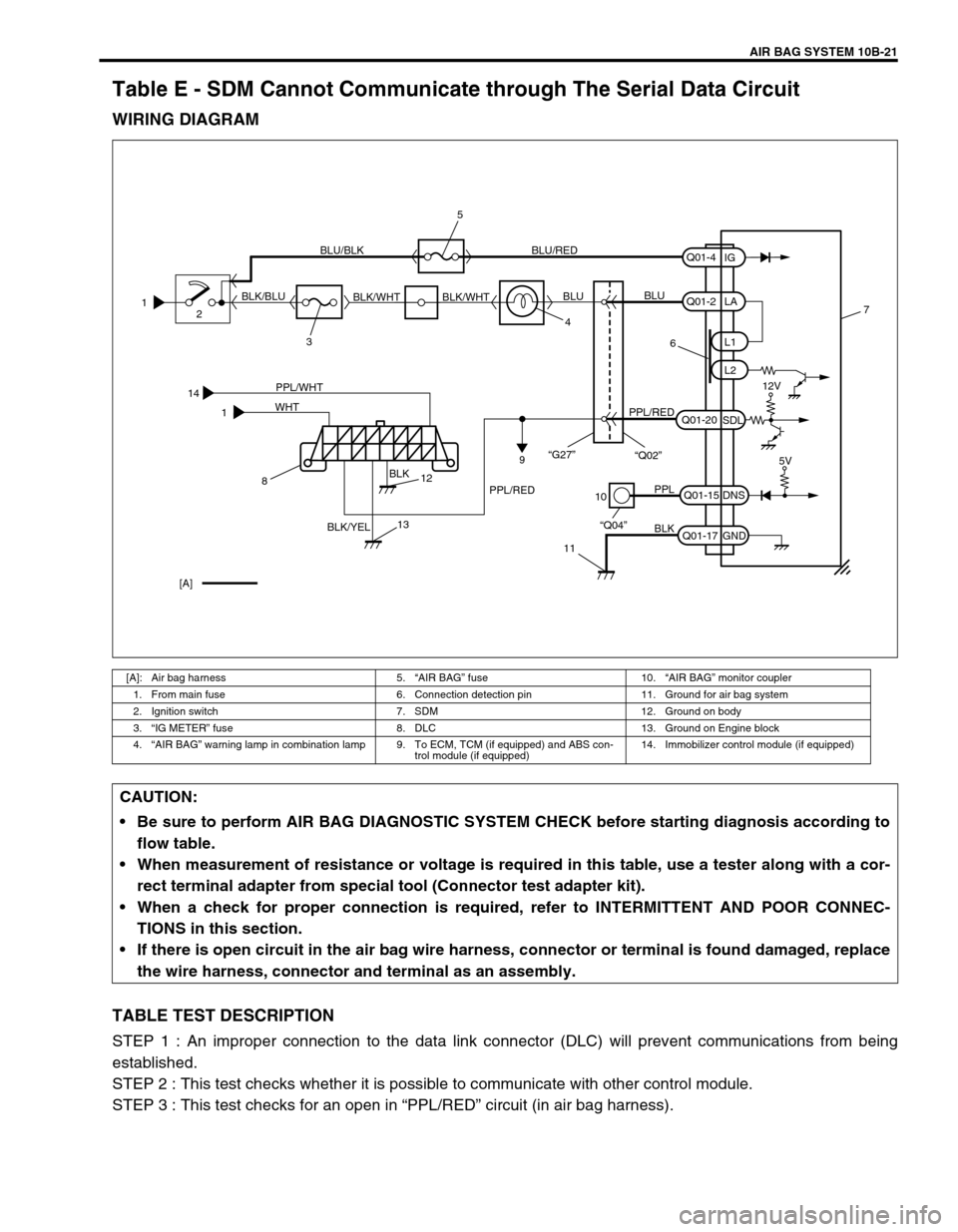
WIRING DIAGRAM
TABLE TEST DESCRIPTION
STEP 1 : An improper connection to the data link connector (DLC) will prevent communications from being
established.
STEP 2 : This test checks whether it is possible to communicate with other control module.
STEP 3 : This test checks for an open in “PPL/RED” circuit (in air bag harness).
[A]: Air bag harness 5.“AIR BAG” fuse 10.“AIR BAG” monitor coupler
1. From main fuse 6. Connection detection pin 11. Ground for air bag system
2. Ignition switch 7. SDM 12. Ground on body
3.“IG METER” fuse 8. DLC 13. Ground on Engine block
4.“AIR BAG” warning lamp in combination lamp 9. To ECM, TCM (if equipped) and ABS con-
trol module (if equipped)14. Immobilizer control module (if equipped)
14
1PPL/WHT
BLK
BLK/YEL WHT
10
11
PPL
BLK
“Q04”Q01-15
Q01-17DNS
GND7
[A]5V
812
13
1
2
34 BLK/BLUBLU/BLK BLU/RED
BLK/WHT BLK/WHTBLUBLU
6
PPL/REDPPL/RED
9
Q01-2
Q01-20L1
L2
SDLLA
Q01-4
IG
12V
“G27”
“Q02”
5
CAUTION:
Be sure to perform AIR BAG DIAGNOSTIC SYSTEM CHECK before starting diagnosis according to
flow table.
When measurement of resistance or voltage is required in this table, use a tester along with a cor-
rect terminal adapter from special tool (Connector test adapter kit).
When a check for proper connection is required, refer to INTERMITTENT AND POOR CONNEC-
TIONS in this section.
If there is open circuit in the air bag wire harness, connector or terminal is found damaged, replace
the wire harness, connector and terminal as an assembly.
Page 600 of 656
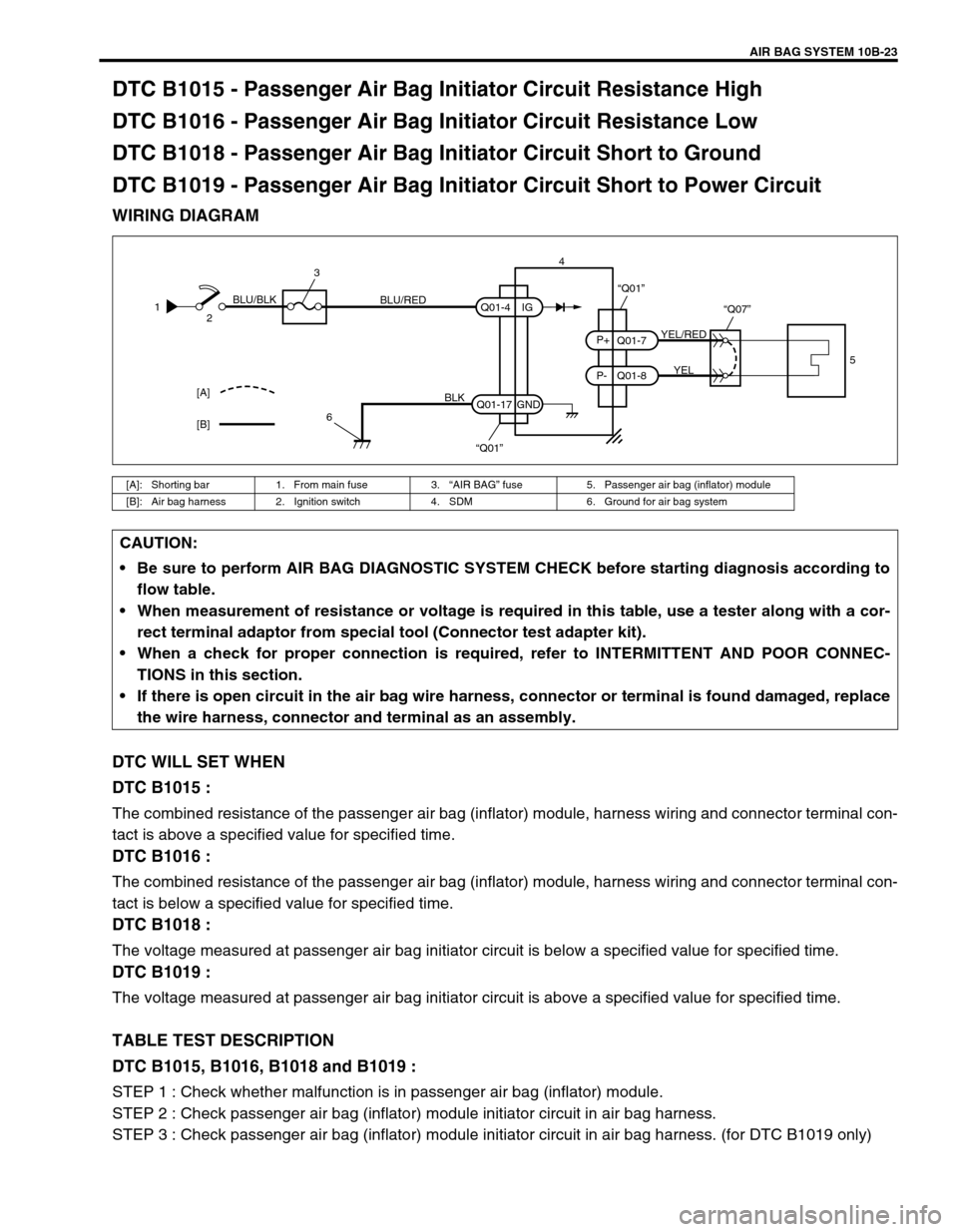
AIR BAG SYSTEM 10B-23
DTC B1015 - Passenger Air Bag Initiator Circuit Resistance High
DTC B1016 - Passenger Air Bag Initiator Circuit Resistance Low
DTC B1018 - Passenger Air Bag Initiator Circuit Short to Ground
DTC B1019 - Passenger Air Bag Initiator Circuit Short to Power Circuit
WIRING DIAGRAM
DTC WILL SET WHEN
DTC B1015 :
The combined resistance of the passenger air bag (inflator) module, harness wiring and connector terminal con-
tact is above a specified value for specified time.
DTC B1016 :
The combined resistance of the passenger air bag (inflator) module, harness wiring and connector terminal con-
tact is below a specified value for specified time.
DTC B1018 :
The voltage measured at passenger air bag initiator circuit is below a specified value for specified time.
DTC B1019 :
The voltage measured at passenger air bag initiator circuit is above a specified value for specified time.
TABLE TEST DESCRIPTION
DTC B1015, B1016, B1018 and B1019 :
STEP 1 : Check whether malfunction is in passenger air bag (inflator) module.
STEP 2 : Check passenger air bag (inflator) module initiator circuit in air bag harness.
STEP 3 : Check passenger air bag (inflator) module initiator circuit in air bag harness. (for DTC B1019 only)
[A]: Shorting bar 1. From main fuse 3.“AIR BAG” fuse 5. Passenger air bag (inflator) module
[B]: Air bag harness 2. Ignition switch 4. SDM 6. Ground for air bag system
1
2BLU/BLK
BLU/RED
3
6
BLK
“Q01” Q01-4
Q01-17IG
GND4
YEL/RED
YEL Q01-7
Q01-8 P- P+“Q07”
“Q01”
5
[A]
[B]
CAUTION:
Be sure to perform AIR BAG DIAGNOSTIC SYSTEM CHECK before starting diagnosis according to
flow table.
When measurement of resistance or voltage is required in this table, use a tester along with a cor-
rect terminal adaptor from special tool (Connector test adapter kit).
When a check for proper connection is required, refer to INTERMITTENT AND POOR CONNEC-
TIONS in this section.
If there is open circuit in the air bag wire harness, connector or terminal is found damaged, replace
the wire harness, connector and terminal as an assembly.
Page 605 of 656
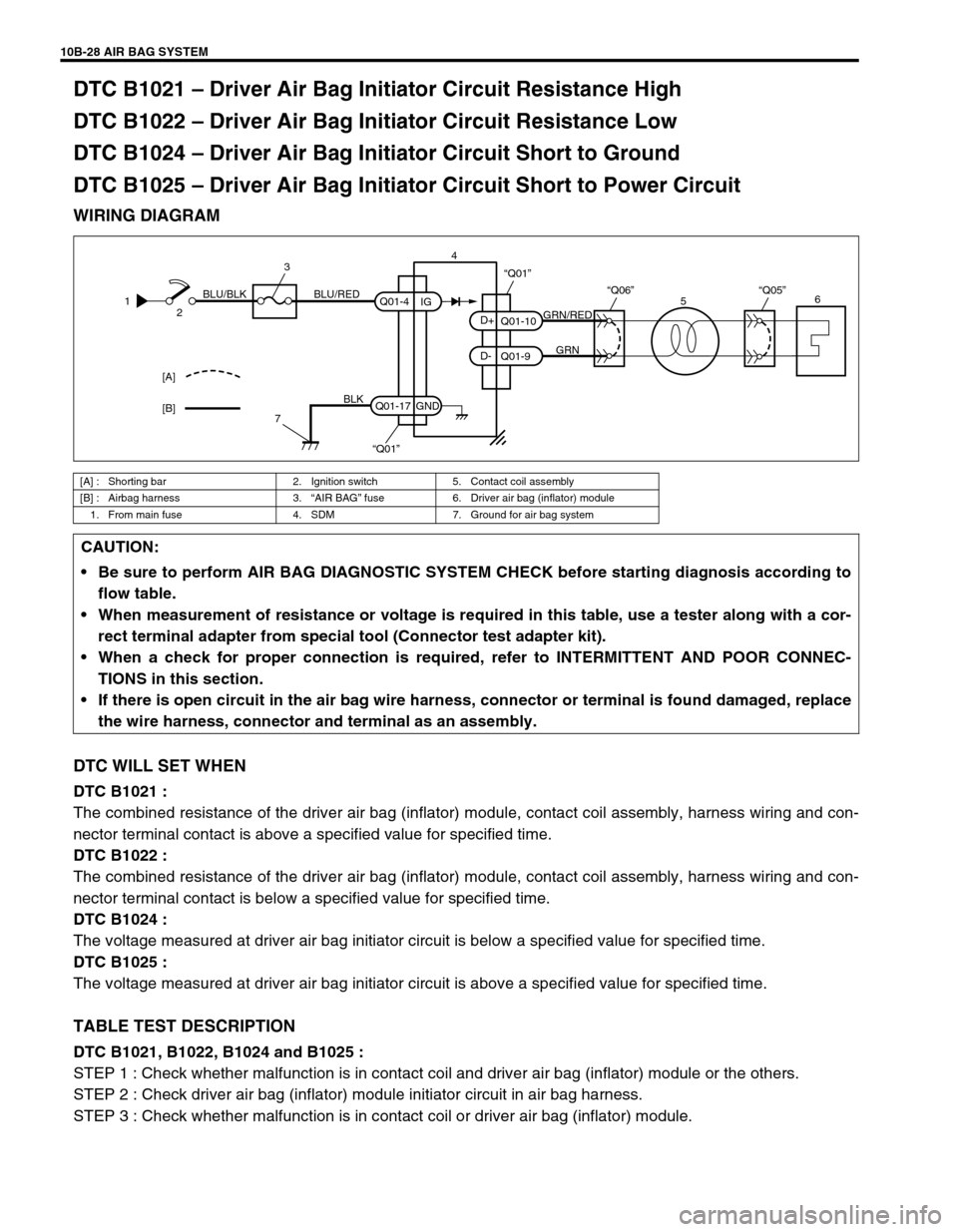
10B-28 AIR BAG SYSTEM
DTC B1021 – Driver Air Bag Initiator Circuit Resistance High
DTC B1022 – Driver Air Bag Initiator Circuit Resistance Low
DTC B1024 – Driver Air Bag Initiator Circuit Short to Ground
DTC B1025 – Driver Air Bag Initiator Circuit Short to Power Circuit
WIRING DIAGRAM
DTC WILL SET WHEN
DTC B1021 :
The combined resistance of the driver air bag (inflator) module, contact coil assembly, harness wiring and con-
nector terminal contact is above a specified value for specified time.
DTC B1022 :
The combined resistance of the driver air bag (inflator) module, contact coil assembly, harness wiring and con-
nector terminal contact is below a specified value for specified time.
DTC B1024 :
The voltage measured at driver air bag initiator circuit is below a specified value for specified time.
DTC B1025 :
The voltage measured at driver air bag initiator circuit is above a specified value for specified time.
TABLE TEST DESCRIPTION
DTC B1021, B1022, B1024 and B1025 :
STEP 1 : Check whether malfunction is in contact coil and driver air bag (inflator) module or the others.
STEP 2 : Check driver air bag (inflator) module initiator circuit in air bag harness.
STEP 3 : Check whether malfunction is in contact coil or driver air bag (inflator) module.
[A] : Shorting bar 2. Ignition switch 5. Contact coil assembly
[B] : Airbag harness 3.“AIR BAG” fuse 6. Driver air bag (inflator) module
1. From main fuse 4. SDM 7. Ground for air bag system
1
2BLU/RED BLU/BLK
3
7
BLK
“Q01” Q01-4
Q01-17IG
GND4
[A]
[B]
GRN/RED
GRN Q01-10
Q01-9 D- D+“Q06”
“Q01”
“Q05”6
5
CAUTION:
Be sure to perform AIR BAG DIAGNOSTIC SYSTEM CHECK before starting diagnosis according to
flow table.
When measurement of resistance or voltage is required in this table, use a tester along with a cor-
rect terminal adapter from special tool (Connector test adapter kit).
When a check for proper connection is required, refer to INTERMITTENT AND POOR CONNEC-
TIONS in this section.
If there is open circuit in the air bag wire harness, connector or terminal is found damaged, replace
the wire harness, connector and terminal as an assembly.
Page 610 of 656
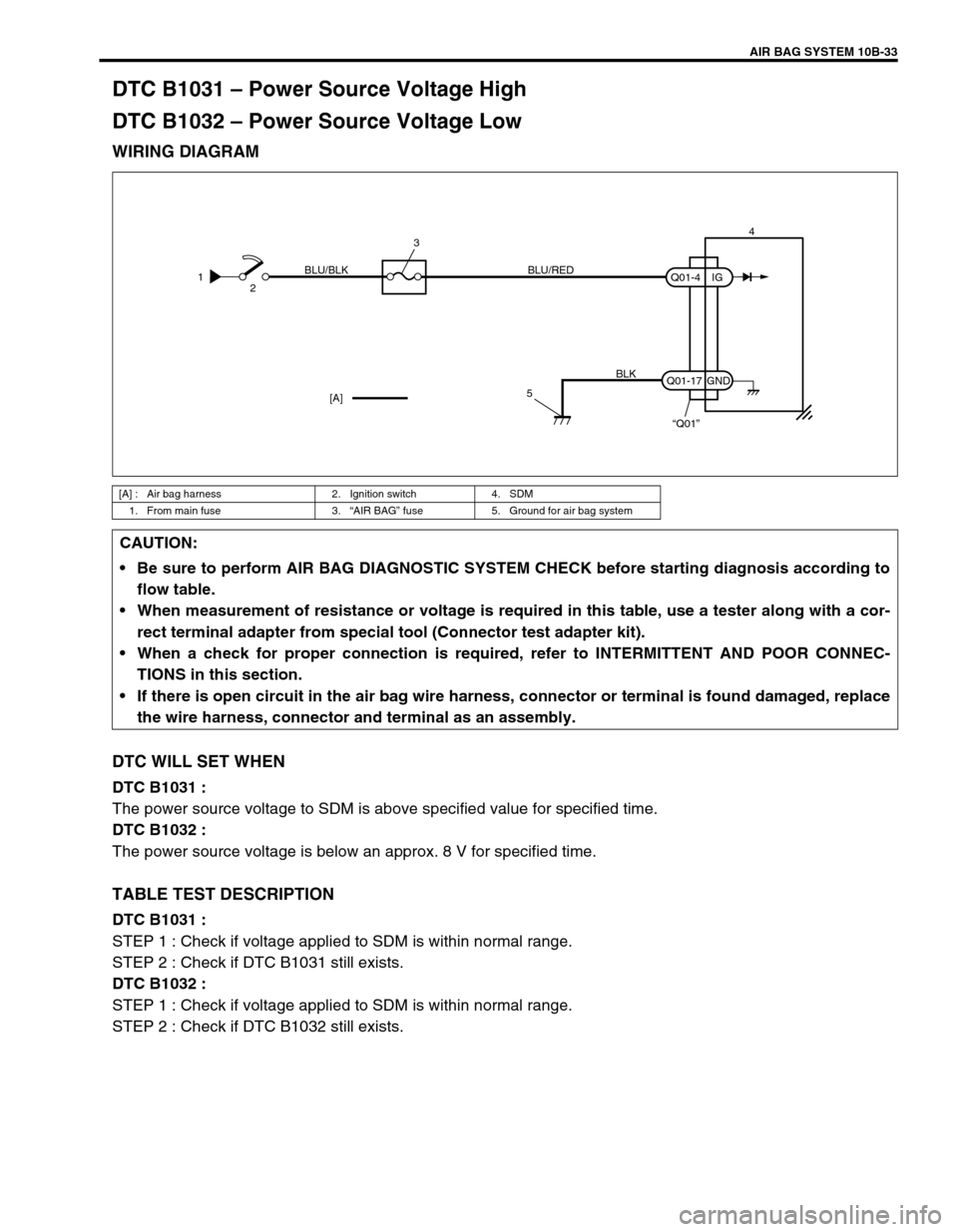
AIR BAG SYSTEM 10B-33
DTC B1031 – Power Source Voltage High
DTC B1032 – Power Source Voltage Low
WIRING DIAGRAM
DTC WILL SET WHEN
DTC B1031 :
The power source voltage to SDM is above specified value for specified time.
DTC B1032 :
The power source voltage is below an approx. 8 V for specified time.
TABLE TEST DESCRIPTION
DTC B1031 :
STEP 1 : Check if voltage applied to SDM is within normal range.
STEP 2 : Check if DTC B1031 still exists.
DTC B1032 :
STEP 1 : Check if voltage applied to SDM is within normal range.
STEP 2 : Check if DTC B1032 still exists.
[A] : Air bag harness 2. Ignition switch 4. SDM
1. From main fuse 3.“AIR BAG” fuse 5. Ground for air bag system
1
2BLU/RED BLU/BLK
3
5
BLK
“Q01” Q01-4
Q01-17IG
GND4
[A]
CAUTION:
Be sure to perform AIR BAG DIAGNOSTIC SYSTEM CHECK before starting diagnosis according to
flow table.
When measurement of resistance or voltage is required in this table, use a tester along with a cor-
rect terminal adapter from special tool (Connector test adapter kit).
When a check for proper connection is required, refer to INTERMITTENT AND POOR CONNEC-
TIONS in this section.
If there is open circuit in the air bag wire harness, connector or terminal is found damaged, replace
the wire harness, connector and terminal as an assembly.
Page 613 of 656

10B-36 AIR BAG SYSTEM
DTC B1035 – RH Forward Sensor Circuit Open or Short to Ground
DTC B1036 – RH Forward Sensor Circuit Short Between Two Wires or Short to
Power Circuit
DTC B1037 – LH Forward Sensor Circuit Open or Short to Ground
DTC B1038 – LH Forward Sensor Circuit Short Between Two Wires or Short to
Power Circuit
WIRING DIAGRAM
DTC WILL SET WHEN
DTC B1035 and B0137 :
The voltage measured at forward sensor circuit (terminal Q01-18, Q01-14) is below a specified value for speci-
fied time.
DTC B1036 and B0138 :
The voltage measured at forward sensor circuit (terminal Q01-18, Q01-14) is above a specified value for speci-
fied time.
TABLE TEST DESCRIPTION
DTC B1035 and B1037 :
STEP 1 : Check whether malfunction is in forward sensor.
STEP 2 : Check if forward sensor circuit is open.
STEP 3 : Check if forward sensor circuit is shorted to ground.
[A] : Air bag harness 2. RH Forward sensor
1. LH Forward sensor 3. SDM
5V
ORN/GRN
ORN/BLU
YEL/GRN
YEL/BLUORN/GRN
ORN/BLU
YEL/GRN
YEL/BLUORN/GRN
ORN/BLU
YEL/GRN
YEL/BLU “G27”
2 1
“Q02”“Q01”
Q01-19
SL+
Q01-18
SL-
Q01-13
SR+
Q01-14
SR-
[A]
3
CAUTION:
Be sure to perform AIR BAG DIAGNOSTIC SYSTEM CHECK before starting diagnosis according to
flow table.
When measurement of resistance or voltage is required in this table, use a tester along with a cor-
rect terminal adapter from special tool (Connector test adapter kit).
When a check for proper connection is required, refer to INTERMITTENT AND POOR CONNEC-
TIONS in this section.
If there is open circuit in the air bag wire harness, connector or terminal is found damaged, replace
the wire harness, connector and terminal as an assembly.