1999 SUZUKI BALENO Air
[x] Cancel search: AirPage 19 of 65

60G-74E
INSTRUMENT PANEL
INSTRUMENT CLUSTER
© Speedometer
® Odometer
© Trip meter (if equipped)
© Trip meter reset knob
© Tachometer (if equipped)
© Fuel gauge
® Temperature gauge
© Warning and indicator lights
60G-05-002
39
5-2
INSTRUMENT PANEL
60G-74E
WARNING AND INDICATOR LIGHTS
70F-07-070
Brake fluid level warning/Parking Brake
Indicator light
This light operates under three conditions:
1) when the ignition switch is turned to the
"START' position, 2) when the fluid in the brake
fluid reservoir falls below the specified level
or 3) when the parking brake is not fully
released and the ignition switch is in the "ON"
position. The light should go out after starting
the engine and fully releasing the parking
brake, if the fluid in the brake fluid reservoir is
adequate. If the light does not go off or comes
on whilst you are driving, it may mean that
there is something wrong with the vehicle's
braking system. If this happens, you should:
1) Pull off the road and stop carefully.
Remember that stopping distance may
be longer, you may have to push
harder on the pedal, and the pedal
may go down farther than normal.
2) Test the brakes by carefully starting and
stopping at the side of the road.
3) If you determine that it is safe, drive
carefully at low speed to the nearest dealer
for repairs.
Have the vehicle towed to the nearest
dealer for repairs.
or
4)
If any of the following conditions occur,
you should Immediately ask your
MARUTI dealer to inspect the brake
system.
• If the brake fluid level warning light
does not go out after the engine has
been started and the parking brake
has been fully released.
• If the brake fluid level warning light
does not come on when the ignition
switch is turned to the "START"
position.
• If the brake fluid level warning light
comes on at any time during vehicle
operation.
NOTE:
Because the disc brake system is self
adjusting, the fluid level will drop as the brake
pads become worn.
Replenishing the brake fluid reservoir is
considered normal periodic maintenance.
70F-03-039
Oil Pressure Light
This light comes on when the ignition switch
is turned on, and goes out when the engine
is started. The light will come on and remain
on if there is insufficient oil pressure. If the
light comes on when driving, pull off the
road as soon as you can and stop the
engine. Check the oil level and add oil if
necessary (see pages 9-8 and 9-9). If there
is enough oil, the lubrication system should
be inspected by your MARUTI dealer before
you drive the vehicle again.
5-3
40
Page 22 of 65

60G-74E
INSTRUMENT PANEL
ASHTRAY
GLOVE BOX
60G-05-010
843-05-011E
Front Ashtray
To remove the front panel ashtray for cleaning,
push down on the metal plate, and pull the
ashtray completely out of its holder.
Rear Ashtray
To remove the rear ashtray, push down on the
tongue and pull the ashtray out of its holder.
Make sure tobacco is fully extinguished
before closing the ashtray. Never throw
waste in the ashtray: it could create a
fire hazard.
60G-05-011
To open the glove box, pull the latch lever.
To close it, push the lid until It latches securely.
If a lock is equipped on the latch lever, lock
the glove box by inserting the key and turning
it clockwise and unlock the glove box by
turning the key counterclockwise.
Never drive with the glove box lid open.
It could cause injury if an accident
occurs.
45
5-8
INSTRUMENT PANEL
60G-74E
HEATING SYSTEM (if equipped)
The heating system provides heating
demisting, and ventilation.
a. Windscreen defroster
b. Side defroster
c. Side outlet
d. Center outlet
e. Floor outlet
60G-05-012
@
RECIRCULATED AIR FRESH AIR
60G-05-013
5-9
46
Page 23 of 65
60G-74E
INSTRUMENT PANEL
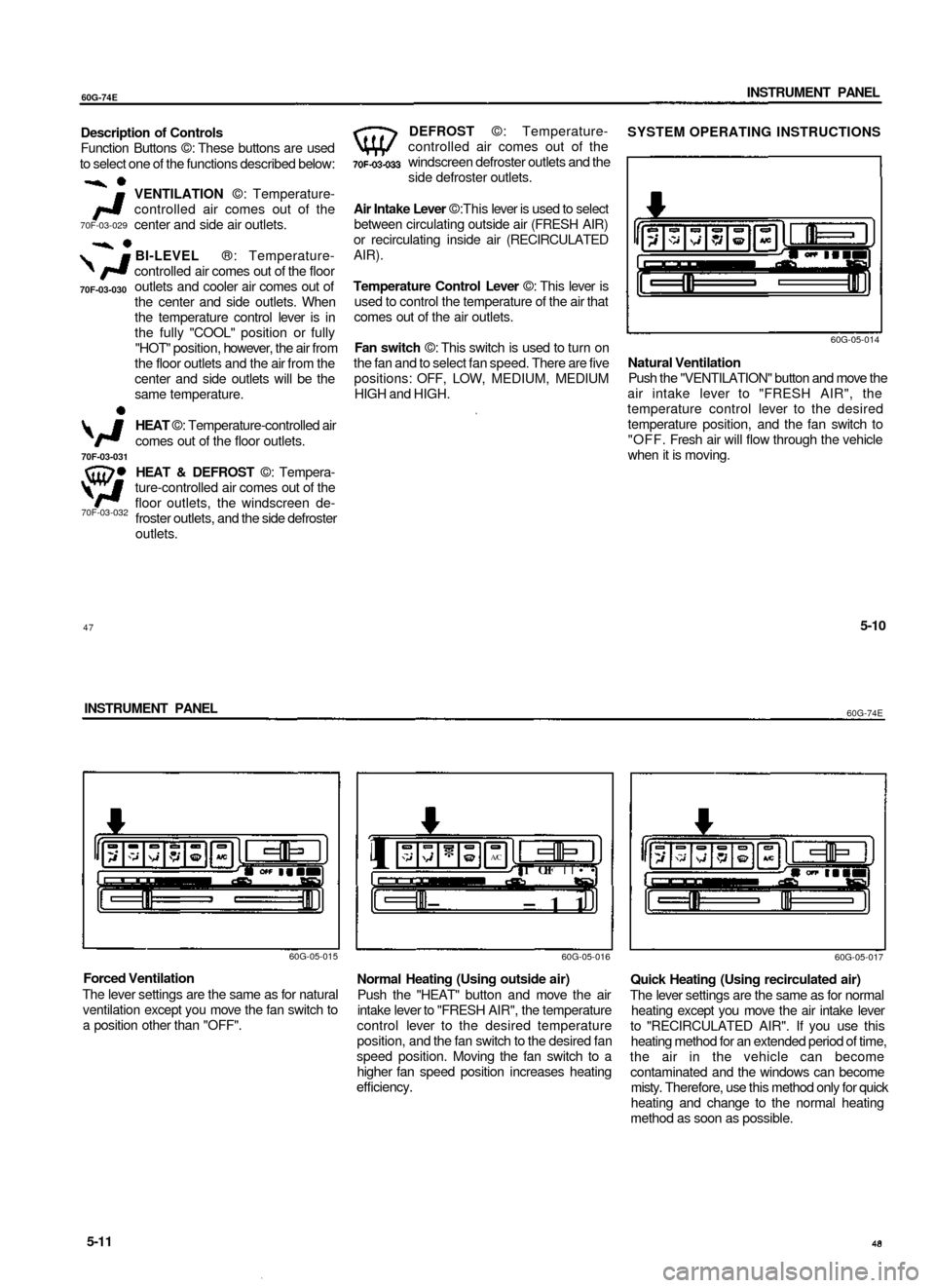
Description of Controls
Function Buttons ©: These buttons are used
to select one of the functions described below:
VENTILATION ©: Temperature-
controlled air comes out of the
center and side air outlets.
BI-LEVEL ®: Temperature-
controlled air comes out of the floor
outlets and cooler air comes out of
the center and side outlets. When
the temperature control lever is in
the fully "COOL" position or fully
"HOT" position, however, the air from
the floor outlets and the air from the
center and side outlets will be the
same temperature.
HEAT ©: Temperature-controlled air
comes out of the floor outlets.
HEAT & DEFROST ©: Tempera-
ture-controlled air comes out of the
floor outlets, the windscreen de-
froster outlets, and the side defroster
outlets.
DEFROST ©: Temperature-
controlled air comes out of the
windscreen defroster outlets and the
side defroster outlets.
Air Intake Lever ©:This lever is used to select
between circulating outside air (FRESH AIR)
or recirculating inside air (RECIRCULATED
AIR).
Temperature Control Lever ©: This lever is
used to control the temperature of the air that
comes out of the air outlets.
Fan switch ©: This switch is used to turn on
the fan and to select fan speed. There are five
positions: OFF, LOW, MEDIUM, MEDIUM
HIGH and HIGH.
SYSTEM OPERATING INSTRUCTIONS
60G-05-014
Natural Ventilation
Push the "VENTILATION" button and move the
air intake lever to "FRESH AIR", the
temperature control lever to the desired
temperature position, and the fan switch to
"OFF. Fresh air will flow through the vehicle
when it is moving.
70F-03-032
47
5-10
INSTRUMENT PANEL
60G-74E
60G-05-015
Forced Ventilation
The lever settings are the same as for natural
ventilation except you move the fan switch to
a position other than "OFF".
1
I
*
A/C
1
OFF
| | ••
= =11
60G-05-016
Normal Heating (Using outside air)
Push the "HEAT" button and move the air
intake lever to "FRESH AIR", the temperature
control lever to the desired temperature
position, and the fan switch to the desired fan
speed position. Moving the fan switch to a
higher fan speed position increases heating
efficiency.
60G-05-017
Quick Heating (Using recirculated air)
The lever settings are the same as for normal
heating except you move the air intake lever
to "RECIRCULATED AIR". If you use this
heating method for an extended period of time,
the air in the vehicle can become
contaminated and the windows can become
misty. Therefore, use this method only for quick
heating and change to the normal heating
method as soon as possible.
5-11
70F-03-031
70F-03-030
70F-03-029
Page 24 of 65
60G-74E
INSTRUMENT PANEL
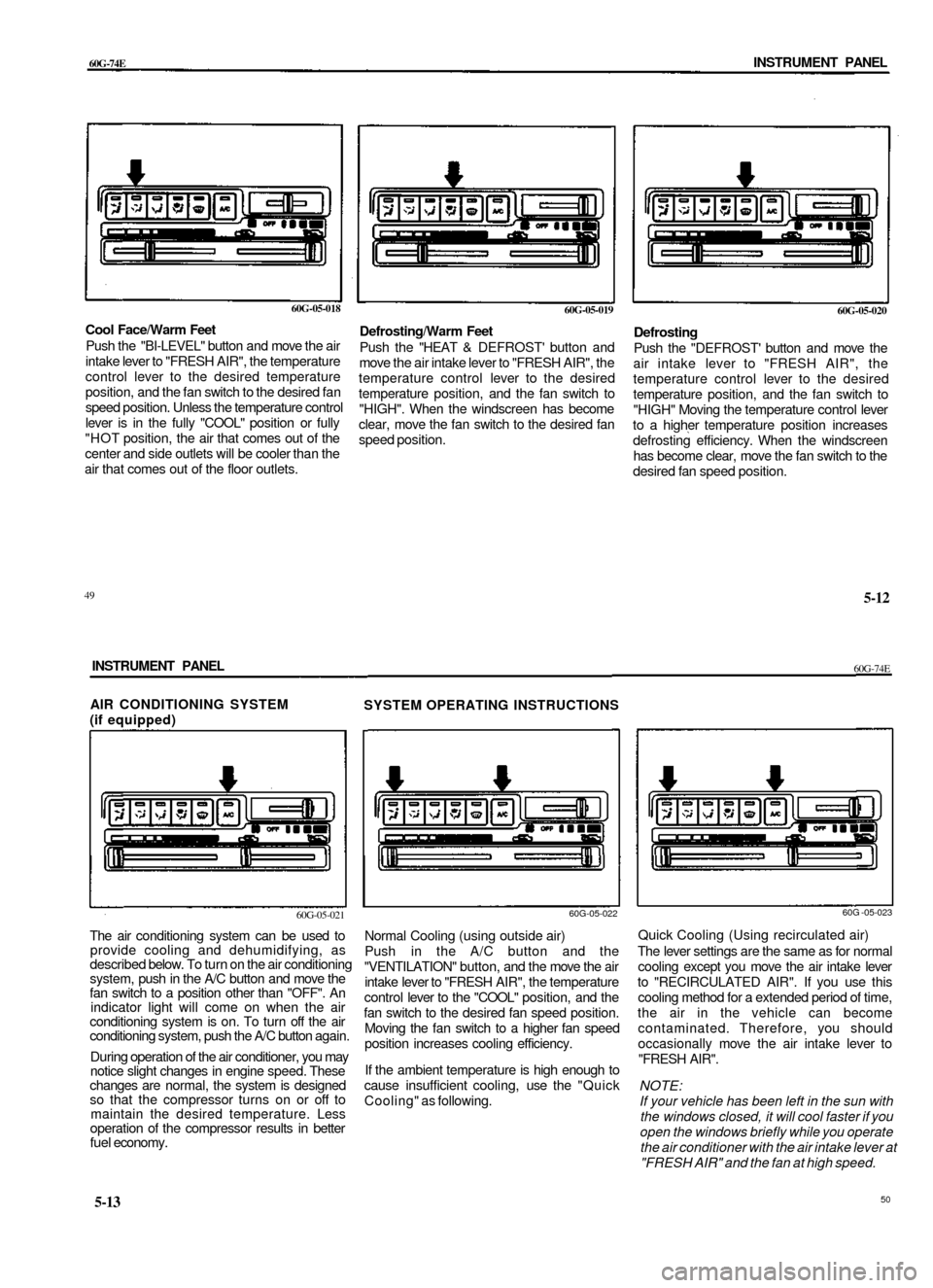
60G-05-018
Cool Face/Warm Feet
Push the "BI-LEVEL" button and move the air
intake lever to "FRESH AIR", the temperature
control lever to the desired temperature
position, and the fan switch to the desired fan
speed position. Unless the temperature control
lever is in the fully "COOL" position or fully
"HOT position, the air that comes out of the
center and side outlets will be cooler than the
air that comes out of the floor outlets.
60G-05-019
Defrosting/Warm Feet
Push the "HEAT & DEFROST' button and
move the air intake lever to "FRESH AIR", the
temperature control lever to the desired
temperature position, and the fan switch to
"HIGH". When the windscreen has become
clear, move the fan switch to the desired fan
speed position.
60G-05-020
Defrosting
Push the "DEFROST' button and move the
air intake lever to "FRESH AIR", the
temperature control lever to the desired
temperature position, and the fan switch to
"HIGH" Moving the temperature control lever
to a higher temperature position increases
defrosting efficiency. When the windscreen
has become clear, move the fan switch to the
desired fan speed position.
49
5-12
INSTRUMENT PANEL
60G-74E
AIR CONDITIONING SYSTEM
(if equipped)
SYSTEM OPERATING INSTRUCTIONS
60G-05-021
The air conditioning system can be used to
provide cooling and dehumidifying, as
described below. To turn on the air conditioning
system, push in the A/C button and move the
fan switch to a position other than "OFF". An
indicator light will come on when the air
conditioning system is on. To turn off the air
conditioning system, push the A/C button again.
During operation of the air conditioner, you may
notice slight changes in engine speed. These
changes are normal, the system is designed
so that the compressor turns on or off to
maintain the desired temperature. Less
operation of the compressor results in better
fuel economy.
60G-05-022
Normal Cooling (using outside air)
Push in the A/C button and the
"VENTILATION" button, and the move the air
intake lever to "FRESH AIR", the temperature
control lever to the "COOL" position, and the
fan switch to the desired fan speed position.
Moving the fan switch to a higher fan speed
position increases cooling efficiency.
If the ambient temperature is high enough to
cause insufficient cooling, use the "Quick
Cooling" as following.
60G -05-023
Quick Cooling (Using recirculated air)
The lever settings are the same as for normal
cooling except you move the air intake lever
to "RECIRCULATED AIR". If you use this
cooling method for a extended period of time,
the air in the vehicle can become
contaminated. Therefore, you should
occasionally move the air intake lever to
"FRESH AIR".
NOTE:
If your vehicle has been left in the sun with
the windows closed, it will cool faster if you
open the windows briefly while you operate
the air conditioner with the air intake lever at
"FRESH AIR" and the fan at high speed.
5-13
50
Page 25 of 65
60G-74E
INSTRUMENT PANEL
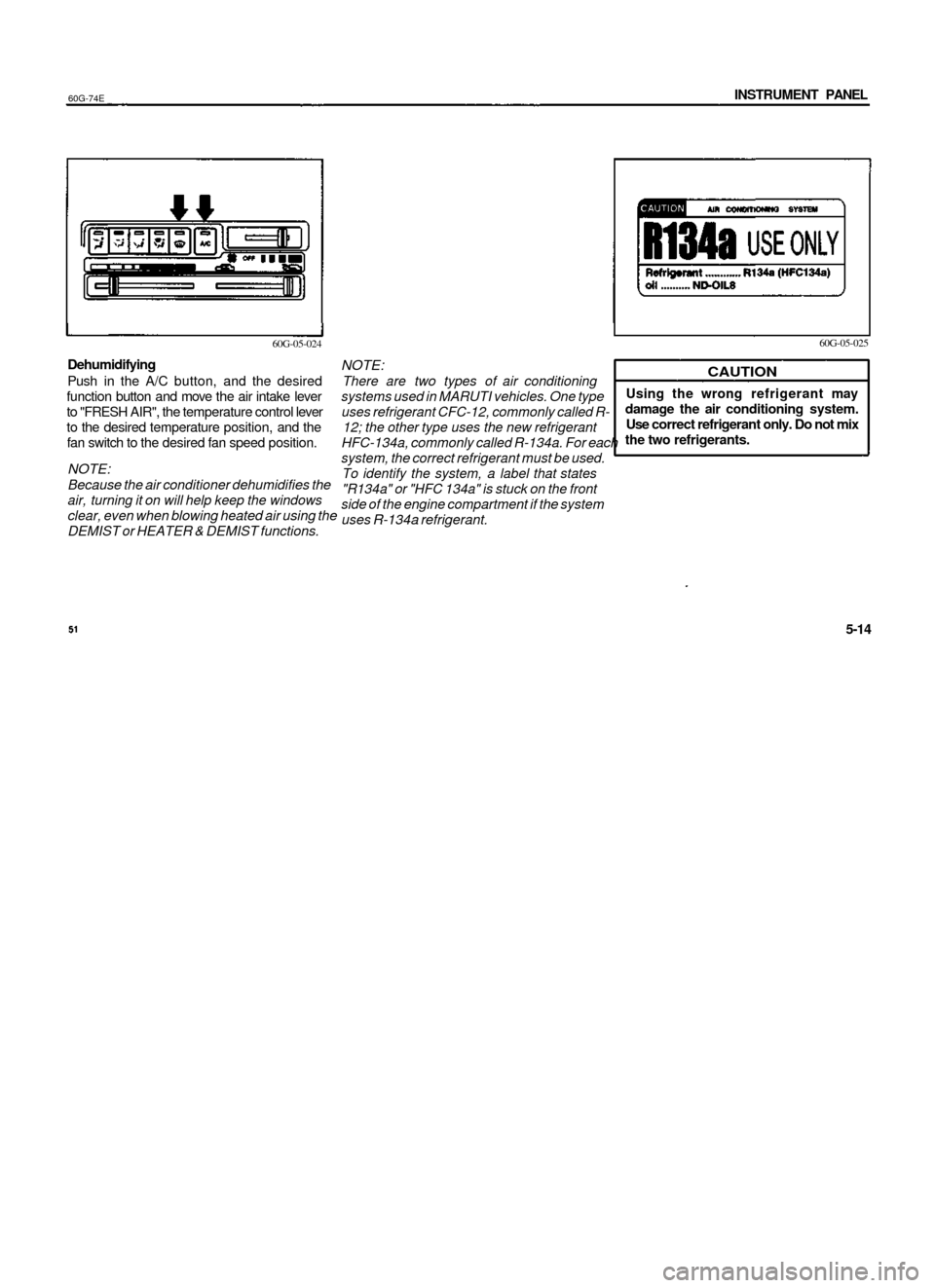
60G-05-024
Dehumidifying
Push in the A/C button, and the desired
function button and move the air intake lever
to "FRESH AIR", the temperature control lever
to the desired temperature position, and the
fan switch to the desired fan speed position.
NOTE:
Because the air conditioner dehumidifies the
air, turning it on will help keep the windows
clear, even when blowing heated air using the
DEMIST or HEATER & DEMIST functions.
60G-05-025
NOTE:
There are two types of air conditioning
systems used in MARUTI vehicles. One type
uses refrigerant CFC-12, commonly called R-
12; the other type uses the new refrigerant
HFC-134a, commonly called R-134a. For each
system, the correct refrigerant must be used.
To identify the system, a label that states
"R134a" or "HFC 134a" is stuck on the front
side of the engine compartment if the system
uses R-134a refrigerant.
CAUTION
Using the wrong refrigerant may
damage the air conditioning system.
Use correct refrigerant only. Do not mix
the two refrigerants.
60G-74E
5-14
OTHER CONTROLS AND EQUIPMENT
OTHER CONTROLS AND EQUIPMENT
Parking Brake Lever 6-1
Pedals 6-2
Gear Lever 6-2
Fuel Filler Cap 6-3
Folding Rear Seats 6-4
Sun Visor 6-5
Interior Light Switch 6-5
Assist Grips 6-5
Bonnet 6-6
Cup Holder (if equipped) 6-7
Tyre Changing Tools 6-7
Luggage Compartment Trim 6-8
Trunk (Boot) Light 6-8
Front Seat Back Pocket (if equipped) 6-9
Rear spoiler with Stop lamp (if equipped) 6-9
Alloy Wheels (if equipped) 6-9
Power Antenna (if equipped) 6-10
Leather Cover (if equipped) 6-10
High Mount Stop Lamp 6-10
53
Page 26 of 65
60G-74E
INSTRUMENT PANEL
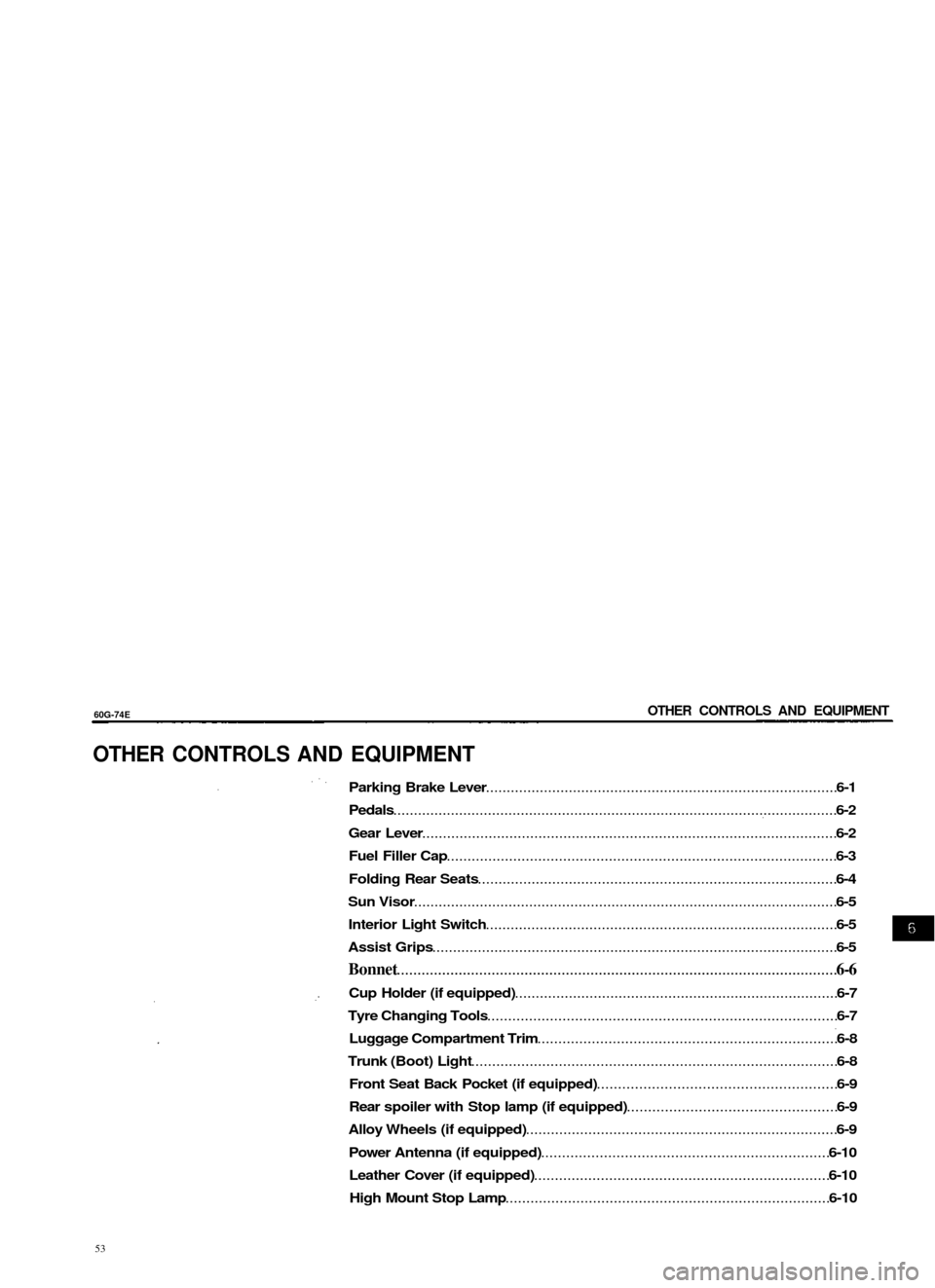
60G-05-024
Dehumidifying
Push in the A/C button, and the desired
function button and move the air intake lever
to "FRESH AIR", the temperature control lever
to the desired temperature position, and the
fan switch to the desired fan speed position.
NOTE:
Because the air conditioner dehumidifies the
air, turning it on will help keep the windows
clear, even when blowing heated air using the
DEMIST or HEATER & DEMIST functions.
60G-05-025
NOTE:
There are two types of air conditioning
systems used in MARUTI vehicles. One type
uses refrigerant CFC-12, commonly called R-
12; the other type uses the new refrigerant
HFC-134a, commonly called R-134a. For each
system, the correct refrigerant must be used.
To identify the system, a label that states
"R134a" or "HFC 134a" is stuck on the front
side of the engine compartment if the system
uses R-134a refrigerant.
CAUTION
Using the wrong refrigerant may
damage the air conditioning system.
Use correct refrigerant only. Do not mix
the two refrigerants.
60G-74E
5-14
OTHER CONTROLS AND EQUIPMENT
OTHER CONTROLS AND EQUIPMENT
Parking Brake Lever 6-1
Pedals 6-2
Gear Lever 6-2
Fuel Filler Cap 6-3
Folding Rear Seats 6-4
Sun Visor 6-5
Interior Light Switch 6-5
Assist Grips 6-5
Bonnet 6-6
Cup Holder (if equipped) 6-7
Tyre Changing Tools 6-7
Luggage Compartment Trim 6-8
Trunk (Boot) Light 6-8
Front Seat Back Pocket (if equipped) 6-9
Rear spoiler with Stop lamp (if equipped) 6-9
Alloy Wheels (if equipped) 6-9
Power Antenna (if equipped) 6-10
Leather Cover (if equipped) 6-10
High Mount Stop Lamp 6-10
53
Page 32 of 65

S0G-74E
OPERATING YOUR VEHICLE
OPERATING YOUR VEHICLE
Exhaust Gas Warning 7-1
Daily Inspection Checklist 7-1
Starting the Engine 7-2
Using the Transmission 7-3
Braking 7-4
Running-in 7-5
Catalytic Converter (if equipped) 7-6
Improving Fuel Economy 7-7
Trailer Towing 7-7
OPERATING YOUR VECHILE
60G-74E
EXHAUST GAS WARNING
DAILY INSPECTION CHECKLIST
60G-07-001E
Avoid breathing exhaust gases.
Exhaust gases contain carbon
monoxide, a potentially lethal gas that
is colourless and odourless. Since
carbon monoxide is difficult to detect
by itself, be sure to take the following
precautions to help prevent carbon
monoxide from entering your vehicle.
• Do not leave the engine running in
garages or other confined areas.
• Do not park with the engine running
for a long period of time, even in an
open area. If it is necessary to sit for
a short time in a parked vehicle <=>
with the engine running, make sure
the air intake lever is set to "FRESH
AIR" and the fan is at high speed.
To allow proper operation of your
vehicle's ventilation system, keep
the air inlet grille in front of the
windscreen clear of snow, leaves, or
other obstructions at all times.
Keep the exhaust tailpipe area clear
of snow and other material to help
reduce the buildup of exhaust gases
under the vehicle.This is particularly
important when parked in blizzard
conditions.
Have the exhaust system inspected
periodically for damage and leaks.
Any damage or leaks should be
repaired immediately.
7-1
70F-05-007
Before driving:
1) Make sure that windows, mirrors, lights,
and reflectors are clean and unobstructed.
2) Check the tyres.
3) Look for fluid and oil leaks.
NOTE:
It is normal for water to drip from the air
conditioning system after use.
4) Adjust the seat/head restraint.
5) Check the brake pedal and the parking
brake lever.
6) Adjust the mirrors.
7) Make sure that you and passengers have
properly fastened your seat belts.
8) Make sure that all warning lights come on
as the key is turned to the "ON" or "START'
position.
9) Check all gauges.
10) Make sure that the brake fluid level
warning light is off when the parking brake
is released with the ignition switch in "ON"
position.
66
65
Page 35 of 65

60G-74E
OPERATING YOUR VEHICLE
CATALYTIC CONVERTER
(if equipped)
70F-05-005
The purpose of the catalytic converter installed
on your vehicle is to convert exhaust pollutants
to harmless water vapour, carbon dioxide, and
nitrogen. Use of leaded fuel in vehicles
equipped with catalytic converters is
prohibited, because lead deactivates the
pollutant-reducing components of the catalyst
system.
It is very important to keep the engine properly
tuned. Engine misfiring, which can result from
an improperly tuned engine, may cause
overheating of the catalyst. This may result in
permanent heat damage to the catalyst and
other vehicle components.
CAUTION
To minimize the possibility of catalyst
or other vehicle damage:
• Maintain the engine in the proper
operating condition.
• In the event of an engine
malfunction, particularly one
involving engine misfire or other
apparent loss of performance, have
the vehicle serviced promptly.
• Do not turn off the engine or
interrupt the ignition when the
transmission is in gear and the
vehicle is in motion.
• Do not try to start the engine by
pushing or towing the vehicle, or
coasting down a hill.
• Do not idle the engine with any spark
plug wires disconnected or
removed, such as during diagnostic
testing.
• Do not idle the vehicle for prolonged
periods if idling seems rough or
there are other malfunctions.
• Do not allow the fuel tank to get near
the empty level.
60Q-07-002E
Be careful where you park and drive;
the catalytic converter and other
exhaust components can get very hot.
As with any vehicle, do not park or
operate this vehicle in areas where
combustible materials such as dry
grass or leaves can come in contact
with a hot exhaust system.
7-6
OPERATING YOUR VECHILE
60G-74E
IMPROVING FUEL ECONOMY
The following instructions will help you improve
fuel economy.
Avoid excessive idling:
If you are to wait for more than a minute while
you are parked, stop the engine and start it
again later. When warming up a cold engine,
allow the engine to idle until the temperature
gauge pointer comes up to the "C" position. In
this position, the engine is sufficiently warm
for starting off.
Avoid "fast" starts:
Fast starts away from lights or stop signs will
consume fuel unnecessarily and shorten
engine life. Start off slowly.
Avoid unnecessary stops:
Avoid unnecessary deceleration and stopping.
Try to maintain a slow, steady speed whenever
possible. Slowing down and then accelerating
again uses more fuel.
Keep a steady cruising speed:
Keep as constant a speed as road and traffic
conditions will permit.
Air Outlet side
(Facing up)
60G-09-010
Keep the air cleaner clean:
A dirty air cleaner will cause the carburation
system to supply too much fuel to the engine
for the amount of air being supplied. The result
is waste of fuel due to incomplete combustion.
Keep weight to a minimum:
The heavier the load, the more fuel the vehicle
consumes. Take out any luggage or cargo
when it is not necessary.
Keep tyre pressures correct:
Under-inflation of the tyres can waste fuel due
to increased running resistance of the tyres.
Keep your tyres inflated to the correct pressure
shown on the label on the driver's side door
or door lock pillar.
TRAILER TOWING
Your MARUTI was originally designed to carry
people and a normal amount of cargo, not to
tow a trailer. Maruti does not recommend you
use your vehicle to tow a trailer.Towing a trailer
can adversely affect handling, durability, and
fuel economy.
7-7
72
71