1999 SUZUKI BALENO Air
[x] Cancel search: AirPage 36 of 65
60G-74E
DRIVING TIPS AND SAFE DRIVING
DRIVING TIPS AND SAFE DRIVING
High Speed Driving 8-1
Driving on Hills 8-1
Driving on Slippery Roads 8-2
Driving on Wet Roads 8-2
Do's and Don'ts for Safe Driving 8-3
73
DRIVING TIPS AND SAFE DRIVING
60G-74E
70F-06-001
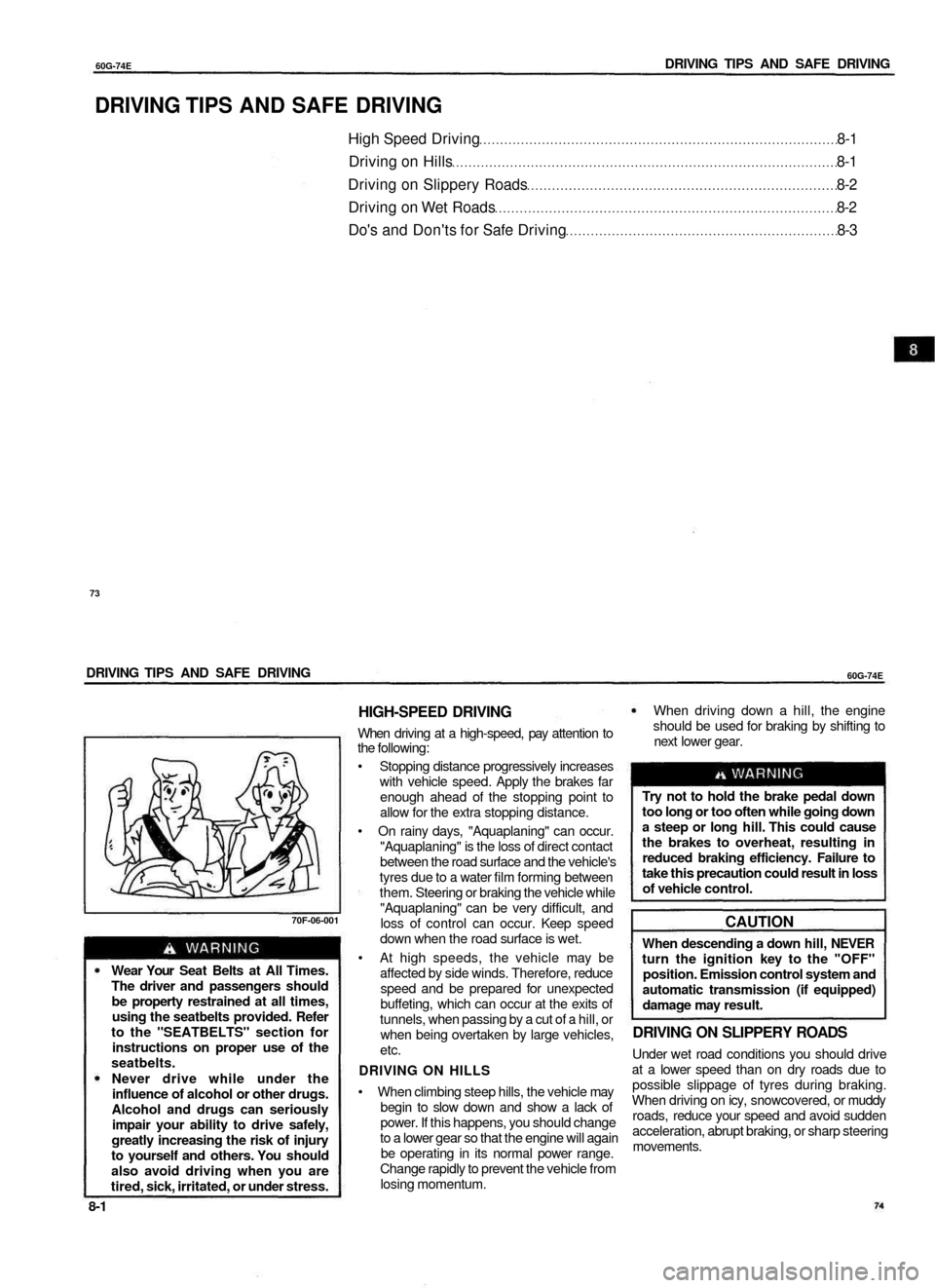
Wear Your Seat Belts at All Times.
The driver and passengers should
be property restrained at all times,
using the seatbelts provided. Refer
to the "SEATBELTS" section for
instructions on proper use of the
seatbelts.
Never drive while under the
influence of alcohol or other drugs.
Alcohol and drugs can seriously
impair your ability to drive safely,
greatly increasing the risk of injury
to yourself and others. You should
also avoid driving when you are
tired, sick, irritated, or under stress.
HIGH-SPEED DRIVING
When driving at a high-speed, pay attention to
the following:
• Stopping distance progressively increases
with vehicle speed. Apply the brakes far
enough ahead of the stopping point to
allow for the extra stopping distance.
• On rainy days, "Aquaplaning" can occur.
"Aquaplaning" is the loss of direct contact
between the road surface and the vehicle's
tyres due to a water film forming between
them. Steering or braking the vehicle while
"Aquaplaning" can be very difficult, and
loss of control can occur. Keep speed
down when the road surface is wet.
• At high speeds, the vehicle may be
affected by side winds. Therefore, reduce
speed and be prepared for unexpected
buffeting, which can occur at the exits of
tunnels, when passing by a cut of a hill, or
when being overtaken by large vehicles,
etc.
DRIVING ON HILLS
• When climbing steep hills, the vehicle may
begin to slow down and show a lack of
power. If this happens, you should change
to a lower gear so that the engine will again
be operating in its normal power range.
Change rapidly to prevent the vehicle from
losing momentum.
When driving down a hill, the engine
should be used for braking by shifting to
next lower gear.
Try not to hold the brake pedal down
too long or too often while going down
a steep or long hill. This could cause
the brakes to overheat, resulting in
reduced braking efficiency. Failure to
take this precaution could result in loss
of vehicle control.
CAUTION
When descending a down hill, NEVER
turn the ignition key to the "OFF"
position. Emission control system and
automatic transmission (if equipped)
damage may result.
DRIVING ON SLIPPERY ROADS
Under wet road conditions you should drive
at a lower speed than on dry roads due to
possible slippage of tyres during braking.
When driving on icy, snowcovered, or muddy
roads, reduce your speed and avoid sudden
acceleration, abrupt braking, or sharp steering
movements.
8-1
Page 41 of 65

60G-74E
INSPECTION AND MAINTENANCE
INSPECTION AND MAINTENANCE
Periodic Maintenance Schedule.. 9-2
Engine Oil and Filter 9-7
Gear OH 9-10
Engine Coolant 9-11
Windscreen Washer Fluid 9-13
Air Cleaner 9-13
Spark Plugs 9-14
Brakes 9-15
Steering 9-17
Power Steering (if equipped) 9-18
Clutch Pedal 9-18
Tyres... 9-19
Battery 9-22
Fuses 9-23
Bulb Replacement , 9-25
Wiper Blades 9-29
83
INSPECTION AND MAINTENANCE
60G-74E
70F-05-002
You should take extreme care when
working on your vehicle to prevent
accidental injury. Here are a few
precautions that you should be
especially careful to observe:
• Do not leave the engine running in
garages or other confined areas.
• When the engine Is running, keep
hands, clothing, tools, and other
objects away from the fan and water
pump belt. Even though the fan may
not be moving, it can automatically
turn on without warning. ^
When it is necessary to do service
work with the engine running, make
sure that the parking brake is applied
fully and the transmission is in
Neutral.
Do not touch ignition wires or other
ignition system parts when starting
the engine or when the engine is
running, or you could receive an
electric shock.
Be careful not to touch a hot engine,
exhaust manifold and pipes, muffler,
radiator and water hoses.
Do not allow smoking, sparks, or
flames around gasoline or the
battery. Flammable fumes are
present.
Do not get under your vehicle if it is
supported only with the portable
jack provided in your vehicle.
Be careful not to cause accidental
short circuits between the positive
and negative battery terminals.
Keep used oil, coolant, and other
fluids away from children and pets.
Dispose of used fluids properly;
never pour them on the ground, into
sewers, etc.
9-1
84
Page 43 of 65
60G-74E
INSPECTION AND MAINTENANCE
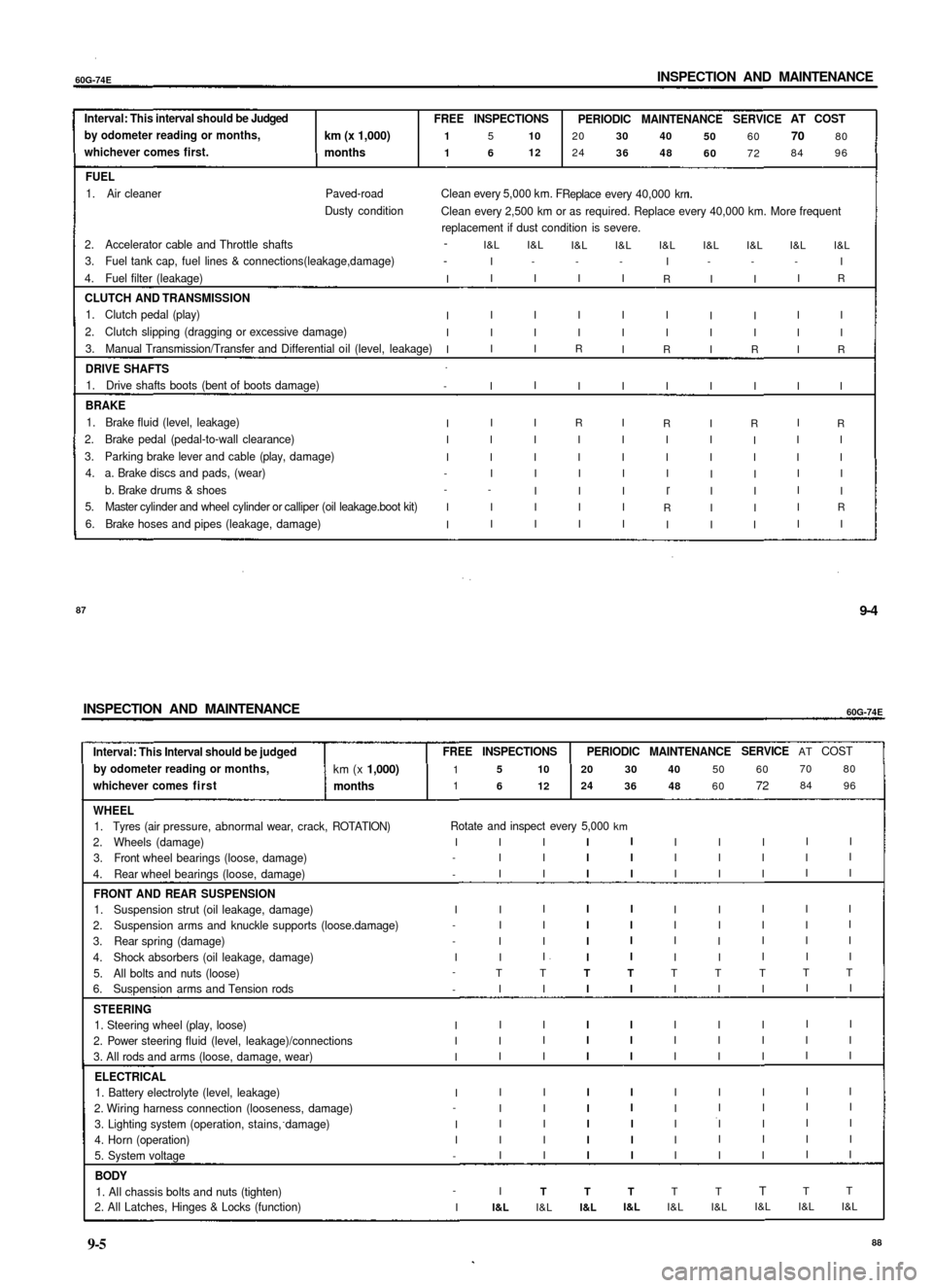
Interval: This interval should be Judged
by odometer reading or months,
whichever comes first.
km (x 1,000)
months
FUEL
1. Air cleaner Paved-road
Dusty condition
2. Accelerator cable and Throttle shafts
3. Fuel tank cap, fuel lines & connections(leakage,damage)
4. Fuel filter (leakage)
CLUTCH AND TRANSMISSION
1. Clutch pedal (play)
2. Clutch slipping (dragging or excessive damage)
3. Manual Transmission/Transfer and Differential oil (level, leakage)
DRIVE SHAFTS
1. Drive shafts boots (bent of boots damage)
BRAKE
1. Brake fluid (level, leakage)
2. Brake pedal (pedal-to-wall clearance)
3. Parking brake lever and cable (play, damage)
4. a. Brake discs and pads, (wear)
b. Brake drums & shoes
5. Master cylinder and wheel cylinder or calliper (oil leakage.boot kit)
6. Brake hoses and pipes (leakage, damage)
FREE
1
1
INSPECTIONS
5
6
10
12
Clean every 5,000 km. F
PERIODIC MAINTENANCE
20
24
30
36
40
48
Replace every 40,000 krr
50
60
SERVICE
60
72
AT
70
84
COST
80
96
Clean every 2,500 km or as required. Replace every 40,000 km. More frequent
replacement if dust condition is severe.
-
-
I
I
I
I
-
I
I
I
-
-
I
I
I&L
I
I
I
I
I
I
I
I
I
I
-
I
I
I&L
-
I
I
I
I
I
I
I
I
I
I
I
I
I&L
-
I
I
I
R
I
R
I
I
I
I
I
I
I&L
-
I
I
I
I
I
I
I
I
I
I
I
I
I&L
I
R
I
I
R
I
R
I
I
I
I
R
I
I&L
-
I
I
I
I
I
I
I
I
I
I
I
I
I&L
-
I
I
I
R
I
R
I
I
I
I
I
I
I&L
-
I
I
I
I
I
I
I
I
I
I
I
I
I&L
I
R
I
I
R
I
R
I
I
I
I
R
I
87
9-4
INSPECTION AND MAINTENANCE
60G-74E
Interval: This Interval should be judged
by odometer reading or months,
whichever comes first
km (x 1,000)
months
WHEEL
1. Tyres (air pressure, abnormal wear, crack, ROTATION)
2. Wheels (damage)
3. Front wheel bearings (loose, damage)
4. Rear wheel bearings (loose, damage)
FRONT AND REAR SUSPENSION
1. Suspension strut (oil leakage, damage)
2. Suspension arms and knuckle supports (loose.damage)
3. Rear spring (damage)
4. Shock absorbers (oil leakage, damage)
5. All bolts and nuts (loose)
6. Suspension arms and Tension rods
STEERING
1. Steering wheel (play, loose)
2. Power steering fluid (level, leakage)/connections
3. All rods and arms (loose, damage, wear)
ELECTRICAL
1. Battery electrolyte (level, leakage)
2. Wiring harness connection (looseness, damage)
3. Lighting system (operation, stains, damage)
4. Horn (operation)
5. System voltage
BODY
1. All chassis bolts and nuts (tighten)
2. All Latches, Hinges & Locks (function)
FREE
1
1
INSPECTIONS
5
6
Rotate and
I
-
-
I
-
-
I
-
-
I
I
I
I
-
I
I
-
-
I
I
I
I
I
I
I
I
T
I
I
I
I
I
I
I
I
I
I
I&L
10
12
PERIODIC
20
24
inspect every 5,000
I
I
I
I
I
I
I
T
I
I
I
I
I
I
I
I
I
T
I&L
I
I
I
I
I
I
I
T
I
I
I
I
I
I
I
I
I
T
I&L
30
36
km
I
I
I
I
I
I
I
T
I
I
I
I
I
I
I
I
I
T
I&L
MAINTENANCE
40
48
I
I
I
I
I
I
I
T
I
I
I
I
I
I
I
I
I
T
I&L
50
60
I
I
I
I
I
I
I
T
I
I
I
I
I
I
I
I
I
T
I&L
SERVICE
60
72
I
I
I
I
I
I
I
T
I
I
I
I
I
I
I
I
I
T
I&L
AT
70
84
I
I
I
I
I
I
I
T
I
I
I
I
I
I
I
I
I
T
I&L
COST
80
96
I
I
I
I
I
I
I
T
I
I
I
I
I
I
I
I
I
T
I&L
9-5
88
Page 44 of 65

60G-74E
INSPECTION AND MAINTENANCE
Interval: This Interval should be judged
by odometer reading or months,
whichever comes first.
km (x 1,000)
months
ROAD TEST
1. Operation of Brakes, Gear shifting & speedometer
2. Body and Chassis noise
AIR CONDITIONER (if equipped)
1. Check belt tension
2. Check Receiver Drier bubbles.
3. Tighten compressor mounting bolts
4. Check all hose joints, tighten if necessary
5. Check functioning of Recirc flap .*
6. Clean condenser with low pressure water
7. Check belt for frayed edges, change if necessary
8. Check all mounting bolts
FREE
1
1
I
I
I
I
—
I
I
_
-
-
INSPECTIONS
5
6
I
I
I
I
T
I
I
C
I
I
10
12
I
I
I
I
T
I
I
C
I
I
PERIODIC
20
24
I
I
I
I
T
I
I
C
I
I
30
36
I
I
I
I
T
I
I
C
I
I
MAINTENANCE
40
48
I
I
I
I
T
I
I
C
I
I
50
60
I
I
I
I
T
I
I
C
I
I
SERVICE
60
72
I
I
I
I
T
I
I
C
I
I
AT,
70
84
I
I
I
I
T
I
I
C
I
I
COST
80
96
I
I
I
I
T
I
I
C
I
I
The rear shock absorbers are filled with
high pressure gas. Never attempt to
disassemble it or throw it into a fire.
Avoid storing it near a heater or heating
device. When scrapping the absorber,
the gas must be released from the
absorber safely. Ask your dealer for
assistance.
89
9-6
INSPECTION AND MAINTENANCE
60G-74E
All maintenance should be carried
out with the Ignition switch in the
"OFF" position and the car parked
securely on the level ground unless
otherwise specified.
If you are In any way unsure of your
ability to undertake a task, then do
not start it but contact your Maruti
dealer to perform the work for you.
ENGINE OIL AND FILTER
Specified oil
Be sure that the engine oil you use comes
under the API classification of SF, SG or SH.
Select the appropriate oil viscosity according
to the above chart.
9-7
90
70F-07-004E
Page 47 of 65

60G-74E
INSPECTION AND MAINTENANCE
CAUTION
When adding or replacing coolant,
use a high quality ethylene glycol
antifreeze and anticorrosion (Non-
Amine type) diluted with distilled
water. If the lowest ambient
temperature in your area is expected
to be -15°C (5°F) or above, make the
antifreeze concentration of the
mixture you use at least 30% but no
more than 50%. If -16°C (3°F) or
below, make the concentration at
least 50%. If the 50% concentration
does not provide adequate
protection against freezing, follow
the instructions on the antifreeze
container to obtain the desired
freezing point.
When putting the cap on the
reservoir tank, line up the arrow on
the cap and the arrow on the tank,
or coolant can leak out.
70F-07-019E
Coolant Replacement
1) When the engine is cool, remove the
radiator cap by turning it slowly to the left
until a "stop" is felt. Do not press down
while turning the cap. Wait until any
pressure is released, then press down on
the cap and continue turning it
anticlockwise.
60G-09-039E
It is dangerous to remove the radiator
cap when the water temperature is
high, because scalding fluid and steam
may be blown out under pressure. Watt
until the coolant temperature has
lowered before removing the cap.
2) Remove the reservoir tank cap. Remove
the reservoir by lifting it up, and drain the
reservoir completely by pouring the
coolant in to a suitable container.
95
9-12
INSPECTION AND MAINTENANCE
60G-74E
WINDSCREEN WASHER FLUID
AIR CLEANER
60G-09-008
3) Loosen the drain plug attached to the
lower part of the radiator and drain the
coolant into a suitable container.
4) Tighten the drain plug on the radiator, fill
the radiator with coolant and install the
radiator cap.
5) Refit the reservoir and fill it with the correct
coolant to the "FULL" line. Refit the
reservoir tank cap, ensuring the arrows are
correctly aligned.
CAUTION
The coolant must be replaced with the
vehicle on level ground.
63B-09-001
Check that there is washer fluid in the tank.
Refill it if necessary. Use a good quality
windscreen washer fluid, diluted with water as
necessary.
Do not use "antifreeze" solution in the
windscreen washer reservoir.This can
severely impair visibility when sprayed
on the windscreen, and can also
damage your vehicle's paint.
CAUTION
Damage may result if the washer motor
is operated whilst the fluid or fluid
nozzles are frozen or with no fluid in
the washer tank.
6OG-09-009
If the air cleaner is clogged with dust, there
will be greater intake resistance, resulting in
decreased power output and increased fuel
consumption.
Take out the air cleaner element after
unhooking the clamps shown in the illustration.
Blow off dust on air cleaner element by
compressed air. If the air cleaner element
appears to be dirty, replace it with a new one.
9-13
96
Page 48 of 65

60G-74E
INSPECTION AND MAINTENANCE
SPARK PLUGS
60G-09-010E
CAUTION
The air cleaner element should be
replaced every 40,000 km. More
frequent replacement is necessary
when you drive under dusty conditions.
60G-09-011E
You should inspect spark plugs periodically
for carbon deposits. When carbon
accumulates on a spark plug, a strong spark
may not be produced. Remove carbon
deposits with a wire or pin and adjust the spark
plug gap.
60G-09-012E
CAUTION
When disconnecting the spark plug
cables, pull on the boot, not on the
cable itself. Pulling on the cable can
damage it.
When installing the spark plugs,
screw them in with your fingers to
avoid stripping the threads.Tighten
with a torque wrench to 2.0-3.0 kgm
(20.0-30.0 N-m, 15.0-22.0 Ib-ft). Do
not allow contaminants to enter the
engine through the spark plug holes
when the plugs are removed.
Never use spark plugs with the
wrong thread size or length.
97
9-14
INSPECTION AND MAINTENANCE
60G-74E
BRAKES
70F-07-026E
CAUTION
When replacing spark plugs, you
should use the brand and type
specified for your vehicle. For the
specified plugs, refer to the
"SPECIFICATIONS" section at the end
of this book.
60G-09-013E
NOTE:
If you experience some firing problem of spark
plugs, such as, hard engine-starting, misfire
etc., the cause may be located not only on
spark plugs but also on deteriorated ignition
wiring (generally, used for more than 80,000
km or five years). If spark plug replacement
does not solve the problem, have the ignition
wiring and other ignition system inspected by
your MARUTI dealer.
60Q-09-014E
Brake Fluid
Check the brake fluid level by looking at the
reservoir in the engine compartment. Check
that the fluid level is between the "MAX" and
"MIN" lines. If the brake fluid level is near the
"MIN" line, fill it up to the "MAX" line with SAE
J1703 or DOT-3 brake fluid.
Failure to follow the guidelines below
can result in personal injury or serious
damage to the brake system.
• If the brake fluid in the reservoir
drops below a certain level, the brake
warning light on the instrument
9-15
98
Page 50 of 65

60G-74E
INSPECTION AND MAINTENANCE
POWER STEERING (if equipped)
CLUTCH PEDAL
60G-09-017
Check the steering box case, vane pump and
hose connections for leaks or damage.
Power steering fluid
Check the fluid level by looking at the reservoir
in the engine compartment when the fluid is
cold (about room temperature).
Check that the fluid level is between the
"UPPER" and "LOWER" lines. If the fluid level
is near the "LOWER" line, fill it up to the
"UPPER" line with an automatic transmission
fluid equivalent to DEXRON»-IIE or
DEXRON'-III. Do not overfill.
63B-09-00SE
Power steering belt
The tension of the belt should be such that
there is a deflection of 8-10mm (0.31 -0.39 in.)
when you press your thumb midway between
the pulleys.
The belt should also be examined to ensure
that it is not damaged. If necessary, have the
belt adjusted or replaced by your MARUTI
dealer.
70F-07-034
Measure the clutch pedal piay by moving the
clutch pedal with your hand and measuring
the distance it moves until you feel slight
resistance. The play in the clutch pedal should
be between 15-20 mm (0.6 - 0.8 in). If the
play is more or less than the above, or clutch
dragging is felt with the pedal fully depressed,
have the clutch inspected by your MARUTI
dealer.
101
9-18
INSPECTION AND MAINTENANCE
60G-74E
TYRES
60G-09-018
The front and rear tyre pressure specifications
for your vehicle are listed on the Tyre Inflation
Pressure Label and in the "SPECIFICATIONS"
section at the end of this book. Both the front
and rear tyres should have the specified tyre
pressure.
Tyre Inspection
Inspect your vehicle's tyres periodically by
performing the following checks:
1) Measure the air pressure with a tyre
gauge. Adjust the pressure if necessary.
Air pressures should be checked
when the tyres are cold or you may
get inaccurate readings.
Check the inflation pressure from
time to time while inflating the tyre
gradually, until the specified
pressure is obtained.
Never underinf late or overinf late the
tyres.
Underinflation can cause unusual
handling characteristics or can
cause the rim to slip on the tyre
bead, resulting in an accident or
damage to the tyre or rim.
Overinflation can cause the tyre to
burst, resulting in personal injury.
Overinflation can also cause
unusual handling characteristics
which may result In an accident.
70F-07-037E
2) Check that the depth of the tread groove
is more than 1.6 mm (0.06 in). To help you
check this, the tyres have moulded in tread
wear indicators in the grooves. When the
indicators appear on the tread surface, the
remaining depth of the tread is 1.6 mm
(0.06 in) or less and the tyre should be
replaced.
3) Check for abnormal wear, cracks and
damage. Any tyres with cracks or other
damage should be replaced. If any tyres
show abnormal wear, have them inspected
by your MARUTI dealer.
9-19
102
Page 52 of 65

60G-74E
INSPECTION AND MAINTENANCE
BATTERY
60G-09-022E
When installing the cover, make sure that it is
positioned so that it does not cover or foul the
air valve.
60G-09-038
Batteries produce flammable hydrogen
gas. Keep flames and sparks away from
the battery or an explosion may occur.
Never smoke when working in the
vicinity of the battery .
When checking or servicing the battery,
disconnect the negative cable. Be
careful not to cause a short circuit by
allowing metal objects to contact the
battery posts and the vehicle at the
same time.
To avoid harm to yourself or damage
to your vehicle or battery, follow the
jump starting instructions in the
EMERGENCY SERVICE section of this
manual if it is necessary to jump start
your vehicle.
The level of the battery solution must be kept
between the "UPPER" and the "LOWER" level
lines at all times. If the level is found to be
below the "LOWER" level line, add distilled
water to the "UPPER" level line. You should
periodically check the battery, battery
terminals, and battery holddown bracket for
corrosion. Remove corrosion using a stiff
brush and ammonia mixed with water, or
baking soda mixed with water. After removing
corrosion, rinse with clean water.
If your vehicle is not going to be driven for a
month or longer, disconnect the cable from
the negative terminal of the battery to help
prevent discharge.
105
9-22
INSPECTION AND MAINTENANCE
60G-74E
FUSES
60G-09-024E
©. Main fuse
®. Primary fuse (Lights)
®. Primary fuse (IG)
©. Radiator fan motor fuse
©. Primary fuse (A/C, HTR)
This vehicle has three types of fuses, as
described below:
Main Fuse - The main fuse takes current
directly from the battery.
Primary Fuses - These fuses are between the
main fuse and individual fuses, and are for
electrical load groups.
Individual Fuses - These fuses are in the fuse
box and for individual electrical circuits.
MAIN FUSE / PRIMARY FUSES
80A
60A
60A
30A
60A
All Electric Load
HEAD-R, HEAD-L, TAIL/DOME,
STOP/HORN, HAZARD
CIGAR/RADIO, I.G. COIL/
METER, WIPER/WASHER,
REAR DEF, TURN/BACK,
HEATER RELAY.
RADIATOR FAN MOTOR
A/C, HTR
Main Fuse and Primary Fuses
The main fuse and primary fuses are located
in the engine compartment. If the main fuse
blows, no electrical component will function.
If a primary fuse blows, no electrical
component in the corresponding load group
will function. When replacing the main fuse or
a primary fuse, use a genuine MARUTI
replacement.
If the main fuse or a primary fuse blows,
be sure to have your vehicle inspected
by an authorized MARUTI dealer.
Always use a genuine MARUTI
replacement. Never use a substitute
such as a wire even for a temporary
repair, or extensive electrical damage
and a fire can result.
60G-09-025E
Fuse Box
The fuse boxes are located in the engine
compartment and under the driver's side of
the dashboard.
To remove the fuse box cover under the
dashboard pull off the cover.
9-23
106