6OG-74E
STEERING COLUMN CONTROLS
ACC
Accessories such as the radio can operate,
but the engine is off.
ON
This is the normal operating position. All
electrical systems are on.
START
This is the position for starting the engine using
the starter motor. The key should be released
from this position as soon as the engine starts.
Never remove the ignition key while
the vehicle is moving. The steering
wheel will lock and you will not be
able to steer the vehicle.
Do not leave children alone In a
parked vehicle. Unattended children
could cause accidental movement of
the vehicle, which could result in
severe personal Injury.
Always remove the key when parked
to prevent unintentional operation of
the vehicle and to improve security.
LIGHTING/TURN SIGNAL
CONTROL LEVER
CAUTION
Do not use the starter motor for
more than 15 seconds at a time. If
the engine does not start; wait 15
seconds before trying again. If the
engine does not start after several
attempts, check the fuel and ignition
systems or consult your MARUTI
dealer.
Do not leave the ignition switch in
the "ON" position if the engine is not
running as the battery will
discharge.
60G-04-003
This control lever is located on the outboard
side of the steering column. Operate the lever
as described below.
Lighting Operation
To turn the lights on or off, twist the knob on
the end of the lever. There are three positions:
in the "OFF" position all lights are off; in the
middle position the front parking lights, tail-
lights, registration plate light, and instrument
lights are on, but the headlights are off; in the
third position the headlights come on in
addition to the other lights.
33
4-2
STEERING COLUMN CONTROLS
60G-74E
With the headlights on, push the lever forward
to switch to the high beams (main beams) or
pull the lever toward you to switch to the low
beams. When the high beams (main beams)
are on, a light on the instrument panel will
come on. To flash the high beams (main
beams) pull the lever slightly towards you and
release it.
Lights "On" Reminder (if Equipped)
A buzzer/chime sounds to remind you to turn
off the lights if they are left on when the ignition
key is removed and the driver's door is opened.
Turn Signal Operation
With the ignition switch in the "ON" position,
move the lever up or down to activate the left
or right turn signals.
Normal Turn Signal
Move the lever clockwise until it clicks to signal
a right turn or anticlockwise to signal a left
turn. When the turn is completed, the signal
will cancel and the lever will return to its normal
position.
6OG-04-006
Lane Change Signal
Some times, such as when changing lanes,
the steering wheel is not turned far enough
to cancel the turn signal. For convenience,
you can flash the turn signal by moving the
lever part way and holding it there. The
lever will return to its normal position when
you release it.
4-3
34
60G-04-006
60G-04-005
60G-04-004E
60G-74E
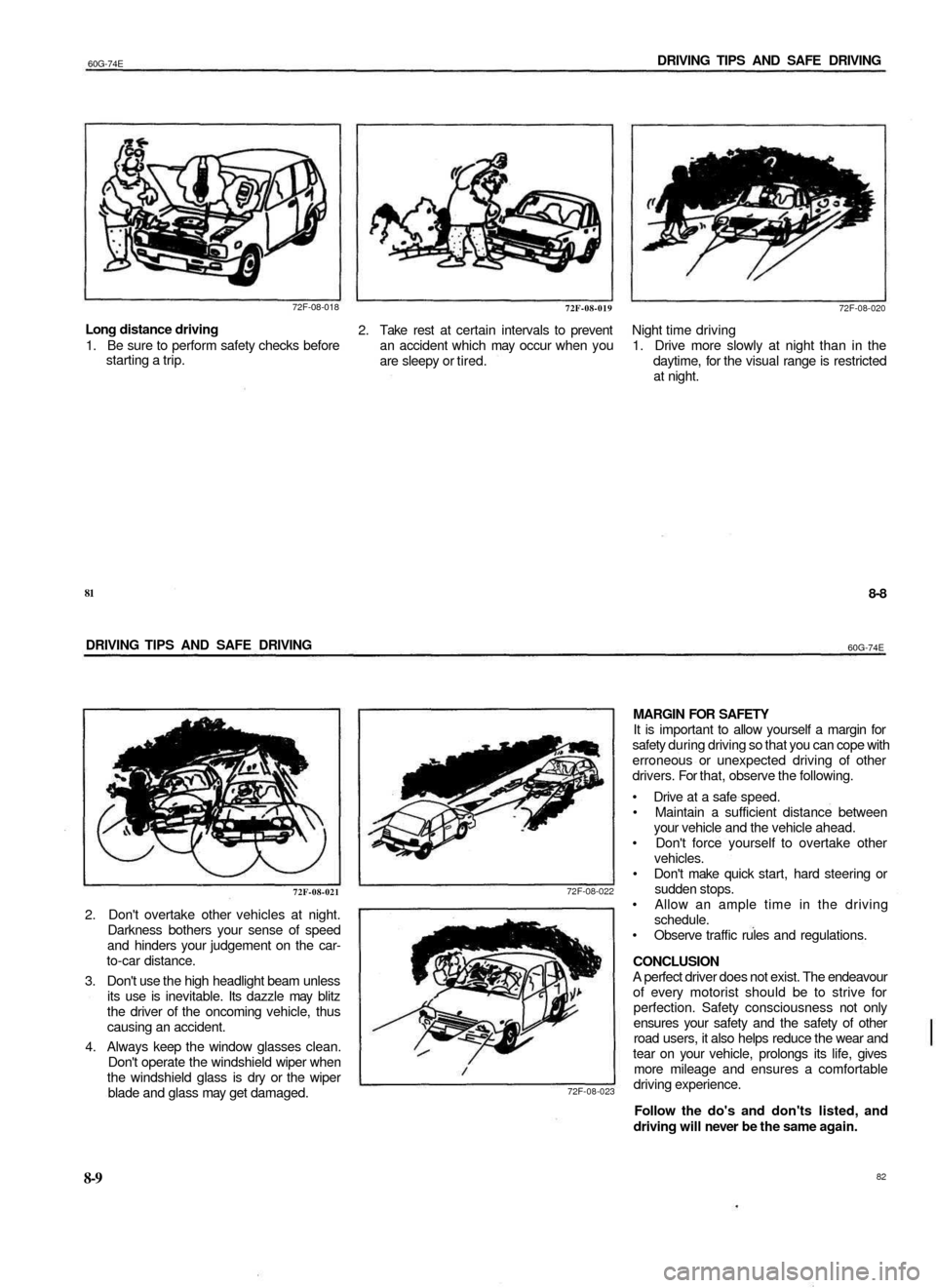
DRIVING TIPS AND SAFE DRIVING
72F-08-018
72F-08-019
Long distance driving
1. Be sure to perform safety checks before
starting a trip.
2. Take rest at certain intervals to prevent
an accident which may occur when you
are sleepy or tired.
72F-08-020
Night time driving
1. Drive more slowly at night than in the
daytime, for the visual range is restricted
at night.
81
8-8
DRIVING TIPS AND SAFE DRIVING
60G-74E
72F-08-021
2. Don't overtake other vehicles at night.
Darkness bothers your sense of speed
and hinders your judgement on the car-
to-car distance.
3. Don't use the high headlight beam unless
its use is inevitable. Its dazzle may blitz
the driver of the oncoming vehicle, thus
causing an accident.
4. Always keep the window glasses clean.
Don't operate the windshield wiper when
the windshield glass is dry or the wiper
blade and glass may get damaged.
72F-08-022
72F-08-023
MARGIN FOR SAFETY
It is important to allow yourself a margin for
safety during driving so that you can cope with
erroneous or unexpected driving of other
drivers. For that, observe the following.
• Drive at a safe speed.
• Maintain a sufficient distance between
your vehicle and the vehicle ahead.
• Don't force yourself to overtake other
vehicles.
• Don't make quick start, hard steering or
sudden stops.
• Allow an ample time in the driving
schedule.
• Observe traffic rules and regulations.
CONCLUSION
A perfect driver does not exist. The endeavour
of every motorist should be to strive for
perfection. Safety consciousness not only
ensures your safety and the safety of other
road users, it also helps reduce the wear and
tear on your vehicle, prolongs its life, gives
more mileage and ensures a comfortable
driving experience.
Follow the do's and don'ts listed, and
driving will never be the same again.
8-9
82