Page 241 of 376
yellowblue
5-19
Thermostat Housing
(3800 V6)
4. After the engine cools, open the coolant air bleed
valve or valves.
3100 V6 engine: There are two bleed valves. One is
located on the thermostat housing. The other is
located on the thermostat bypass tube.
3800 V6 engine: There is one bleed valve. It is
located on the thermostat housing.
5. Fill the radiator with the proper DEX-COOL�
coolant mixture, up to the base of the filler neck.
(See ªEngine Coolantº in the Index for more
information about the proper coolant mixture.)
If you see a stream of coolant coming from an air
bleed valve, close the valve. Otherwise, close the
valves after the radiator is filled.
6. Rinse or wipe any spilled coolant from the engine
and the compartment.
Page 242 of 376
yellowblue
5-20
7. If you have the 3800 V6 engine, replace the
3800 Series II V6 engine cover shield.
A. Remove the oil fill tube, with cap attached, from
the valve cover.
B. Insert the catch tab on the cover shield under the
bracket on the engine.
C. Place the hole in the cover shield over the hole in
the valve cover. Install oil fill tube and cap by
twisting clockwise.
D. If you have the supercharged engine, install the
nut in the center of the cover shield.8. Then fill the coolant recovery tank to the FULL mark.
9. Put the cap back on the coolant recovery tank, but
leave the radiator pressure cap off.
10. Start the engine and let it run until you can feel the
upper radiator hose getting hot. Watch out for the
engine cooling fans.
11. By this time, the coolant level inside the radiator
filler neck may be lower. If the level is lower, add
more of the proper DEX
-COOL� coolant mixture
through the filler neck until the level reaches the
base of the filler neck.
Page 243 of 376
yellowblue
5-21
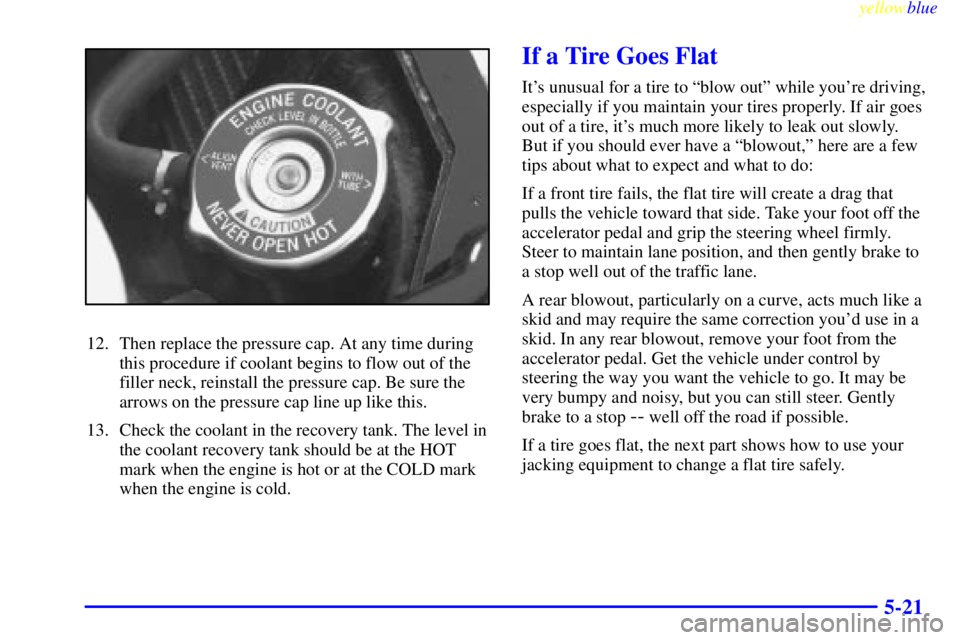
12. Then replace the pressure cap. At any time during
this procedure if coolant begins to flow out of the
filler neck, reinstall the pressure cap. Be sure the
arrows on the pressure cap line up like this.
13. Check the coolant in the recovery tank. The level in
the coolant recovery tank should be at the HOT
mark when the engine is hot or at the COLD mark
when the engine is cold.
If a Tire Goes Flat
It's unusual for a tire to ªblow outº while you're driving,
especially if you maintain your tires properly. If air goes
out of a tire, it's much more likely to leak out slowly.
But if you should ever have a ªblowout,º here are a few
tips about what to expect and what to do:
If a front tire fails, the flat tire will create a drag that
pulls the vehicle toward that side. Take your foot off the
accelerator pedal and grip the steering wheel firmly.
Steer to maintain lane position, and then gently brake to
a stop well out of the traffic lane.
A rear blowout, particularly on a curve, acts much like a
skid and may require the same correction you'd use in a
skid. In any rear blowout, remove your foot from the
accelerator pedal. Get the vehicle under control by
steering the way you want the vehicle to go. It may be
very bumpy and noisy, but you can still steer. Gently
brake to a stop
-- well off the road if possible.
If a tire goes flat, the next part shows how to use your
jacking equipment to change a flat tire safely.
Page 244 of 376
yellowblue
5-22
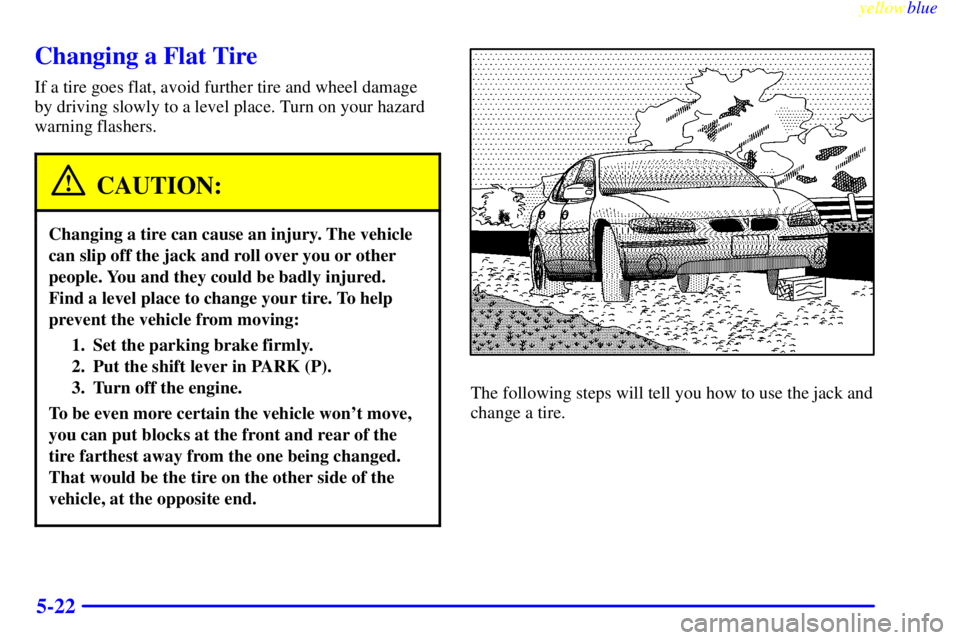
Changing a Flat Tire
If a tire goes flat, avoid further tire and wheel damage
by driving slowly to a level place. Turn on your hazard
warning flashers.
CAUTION:
Changing a tire can cause an injury. The vehicle
can slip off the jack and roll over you or other
people. You and they could be badly injured.
Find a level place to change your tire. To help
prevent the vehicle from moving:
1. Set the parking brake firmly.
2. Put the shift lever in PARK (P).
3. Turn off the engine.
To be even more certain the vehicle won't move,
you can put blocks at the front and rear of the
tire farthest away from the one being changed.
That would be the tire on the other side of the
vehicle, at the opposite end.
The following steps will tell you how to use the jack and
change a tire.
Page 255 of 376

yellowblue
5-33
NOTICE:
When the compact spare is installed, don't take
your vehicle through an automatic car wash with
guide rails. The compact spare can get caught on
the rails. That can damage the tire and wheel,
and maybe other parts of your vehicle.
Don't use your compact spare on other vehicles.
And don't mix your compact spare tire or wheel with
other wheels or tires. They won't fit. Keep your spare
tire and its wheel together.
NOTICE:
Tire chains won't fit your compact spare. Using
them can damage your vehicle and can damage
the chains too. Don't use tire chains on your
compact spare.
If You're Stuck: In Sand, Mud,
Ice or Snow
In order to free your vehicle when it is stuck, you will
need to spin the wheels, but you don't want to spin
your wheels too fast. The method known as ªrockingº
can help you get out when you're stuck, but you must
use caution.
CAUTION:
If you let your tires spin at high speed, they can
explode, and you or others could be injured. And,
the transaxle or other parts of the vehicle can
overheat. That could cause an engine
compartment fire or other damage. When you're
stuck, spin the wheels as little as possible. Don't
spin the wheels above 35 mph (55 km/h) as shown
on the speedometer.
Page 257 of 376

6-
yellowblue
6-1
Section 6 Service and Appearance Care
Here you will find information about the care of your vehicle. This section begins with service and fuel information,
and then it shows how to check important fluid and lubricant levels. There is also technical information about your
vehicle, and a part devoted to its appearance care.
6
-2 Service
6
-3 Fuel
6
-5 Fuels in Foreign Countries
6
-6 Filling Your Tank
6
-8 Filling a Portable Fuel Container
6
-8 Checking Things Under the Hood
6
-13 Engine Oil
6
-20 Engine Air Cleaner/Filter
6
-21 Supercharger Oil
6
-22 Automatic Transaxle Fluid
6
-26 Engine Coolant
6
-29 Power Steering Fluid
6
-31 Windshield Washer Fluid
6
-32 Brakes
6-35 Battery
6
-36 Bulb Replacement
6
-42 Windshield Wiper Blade Replacement
6
-43 Tires6
-51 Appearance Care
6
-51 Cleaning the Inside of Your Vehicle
6
-54 Care of Safety Belts
6
-55 Cleaning the Outside of Your Vehicle
6
-56 Cleaning Aluminum Wheels (If Equipped)
6
-56 Cleaning Tires
6
-57 Sheet Metal Damage
6
-57 Finish Damage
6
-57 Underbody Maintenance
6
-57 Chemical Paint Spotting
6
-58 GM Vehicle Care/Appearance Materials
6
-59 Vehicle Identification Number (VIN)
6
-59 Service Parts Identification Label
6
-60 Electrical System
6
-66 Replacement Bulbs
6
-66 Capacities and Specifications
6
-68 Air Conditioning Refrigerants
6
-68 Normal Maintenance Replacement Parts
Page 259 of 376
yellowblue
6-3
CAUTION:
You can be injured and your vehicle could be
damaged if you try to do service work on a
vehicle without knowing enough about it.
�Be sure you have sufficient knowledge,
experience, the proper replacement parts
and tools before you attempt any vehicle
maintenance task.
�Be sure to use the proper nuts, bolts and
other fasteners. ªEnglishº and ªmetricº
fasteners can be easily confused. If you use
the wrong fasteners, parts can later break
or fall off. You could be hurt.
Adding Equipment to the Outside of
Your Vehicle
Things you might add to the outside of your vehicle can
affect the airflow around it. This may cause wind noise
and affect windshield washer performance. Check with
your dealer before adding equipment to the outside of
your vehicle.
Fuel
The 8th digit of your vehicle identification number
(VIN) shows the code letter for your engine. You will
find the VIN at the top left of your instrument panel.
(See ªVehicle Identification Numberº in the Index.)
If you have the 3100 V6 engine (VIN Code M) or
3800 V6 engine (VIN Code K), use regular unleaded
gasoline rated at 87 octane or higher. If you're using fuel
rated at the recommended octane or higher and you hear
heavy knocking, your engine needs service. But don't
worry if you hear a little pinging noise when you're
accelerating or driving up a hill. That's normal, and you
don't have to buy a higher octane fuel to get rid of
pinging. It's the heavy, constant knock that means you
have a problem.
If you have the 3800 Supercharged V6 engine (VIN
Code 1), use premium unleaded gasoline rated at
91 octane or higher. With the 3800 Supercharged
engine, in an emergency, you may be able to use a lower
octane
-- as low as 87 -- if heavy knocking does
not occur. If you are using 91 or higher octane unleaded
gasoline and you hear heavy knocking, your engine
needs service.
Page 260 of 376

yellowblue
6-4
It is recommended that the gasoline meet specifications
which have been developed by the American
Automobile Manufacturers Association (AAMA) and
endorsed by the Canadian Motor Vehicle Manufacturers
Association for better vehicle performance and engine
protection. Gasolines meeting the AAMA specification
could provide improved driveability and emission
control system performance compared to other
gasolines. For more information, write to: American
Automobile Manufacturer's Association, 7430 Second
Ave, Suite 300, Detroit MI 48202.
Be sure the posted octane for premium is at least 91 (at
least 89 for middle grade and 87 for regular). If the
octane is less than 87, you may get a heavy knocking
noise when you drive. If it's bad enough, it can damage
your engine.
If your vehicle is certified to meet California Emission
Standards (indicated on the underhood emission control
label), it is designed to operate on fuels that meet
California specifications. If such fuels are not available
in states adopting California emissions standards, your vehicle will operate satisfactorily on fuels meeting
federal specifications, but emission control system
performance may be affected. The malfunction indicator
lamp on your instrument panel may turn on and/or your
vehicle may fail a smog
-check test. (See ªMalfunction
Indicator Lampº in the Index.) If this occurs, return to
your authorized Pontiac dealer for diagnosis to
determine the cause of failure. In the event it is
determined that the cause of the condition is the type of
fuels used, repairs may not be covered by your warranty.
Some gasolines that are not reformulated for low
emissions may contain an octane
-enhancing additive
called methylcyclopentadienyl manganese tricarbonyl
(MMT); ask your service station operator whether or not
the fuel contains MMT. General Motors does not
recommend the use of such gasolines. If fuels containing
MMT are used, spark plug life may be reduced and your
emission control system performance may be affected.
The malfunction indicator lamp on your instrument
panel may turn on. If this occurs, return to your
authorized Pontiac dealer for service.