Page 222 of 376
yellowblue
4-40
But if you ever have to park your rig on a hill, here's
how to do it:
1. Apply your regular brakes, but don't shift into
PARK (P) yet.
2. Have someone place chocks under the trailer wheels.
3. When the wheel chocks are in place, release the
regular brakes until the chocks absorb the load.
4. Reapply the regular brakes. Then apply your parking
brake, and then shift to PARK (P).
5. Release the regular brakes.
When You Are Ready to Leave After
Parking on a Hill
1. Apply your regular brakes and hold the pedal down
while you:
�Start your engine;
�Shift into a gear; and
�Release the parking brake.
2. Let up on the brake pedal.
3. Drive slowly until the trailer is clear of the chocks.
4. Stop and have someone pick up and store the chocks.
Maintenance When Trailer Towing
Your vehicle will need service more often when you're
pulling a trailer. See the Maintenance Schedule for more
on this. Things that are especially important in trailer
operation are automatic transaxle fluid (don't overfill),
engine oil, drive belts, cooling system and brake system.
Each of these is covered in this manual, and the Index
will help you find them quickly. If you're trailering, it's
a good idea to review this information before you start
your trip.
Check periodically to see that all hitch nuts and bolts
are tight.
Engine Cooling When Trailer Towing
Your cooling system may temporarily overheat during
severe operating conditions. See ªEngine Overheatingº
in the Index.
Page 223 of 376
5-
yellowblue
5-1
Section 5 Problems on the Road
Here you'll find what to do about some problems that can occur on the road.
5
-2 Hazard Warning Flashers
5
-2 Other Warning Devices
5
-3 Jump Starting
5
-8 Towing Your Vehicle
5
-9 Engine Overheating5
-12 Cooling System
5
-21 If A Tire Goes Flat
5
-22 Changing a Flat Tire
5
-32 Compact Spare Tire
5
-33 If You're Stuck in Sand, Mud, Ice or Snow
Page 226 of 376

yellowblue
5-4
2. Get the vehicles close enough so the jumper cables
can reach, but be sure the vehicles aren't touching
each other. If they are, it could cause a ground
connection you don't want. You wouldn't be able to
start your vehicle, and the bad grounding could
damage the electrical systems.
To avoid the possibility of the vehicles rolling, set
the parking brake firmly on both vehicles involved in
the jump starting procedure. Put an automatic
transaxle in PARK (P) before setting the
parking brake.
3. Turn off the ignition on both vehicles. Turn off the
radio and all lamps that aren't needed. This will
avoid sparks and help save both batteries. And it
could save your radio!
NOTICE:
If you leave your radio on, it could be badly
damaged. The repairs wouldn't be covered by
your warranty.
CAUTION:
An electric fan can start up even when the engine
is not running and can injure you. Keep hands,
clothing and tools away from any underhood
electric fan.
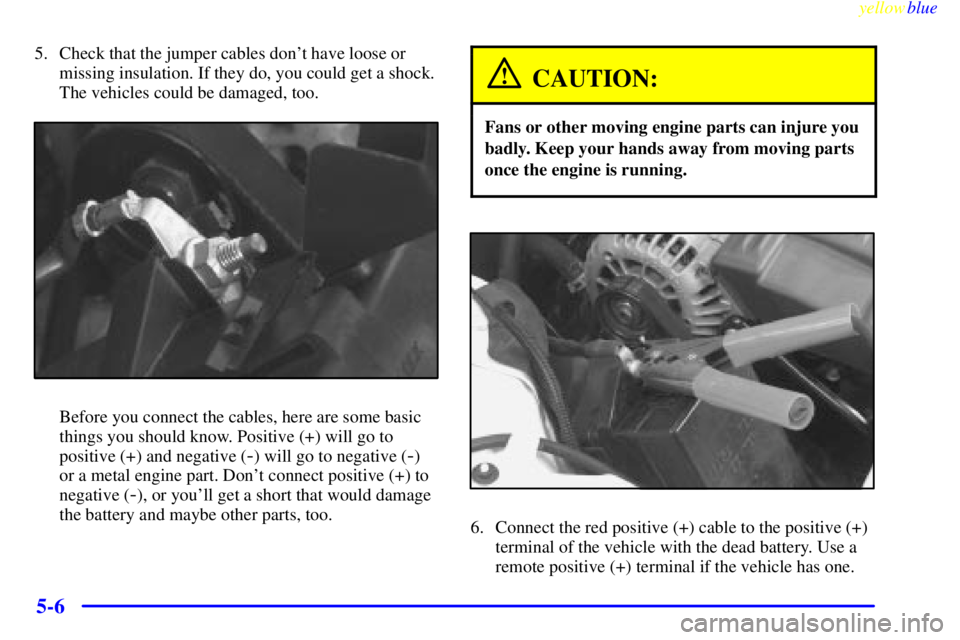
4. Find the positive (+) and negative (-) terminals on
each battery. Your vehicle has a remote positive (+)
jump starting terminal. The terminal is on the same
side of the engine compartment as your battery. You
should always use the remote positive (+) terminal
instead of the positive (+) terminal on your battery.
Page 228 of 376
yellowblue
5-6
5. Check that the jumper cables don't have loose or
missing insulation. If they do, you could get a shock.
The vehicles could be damaged, too.
Before you connect the cables, here are some basic
things you should know. Positive (+) will go to
positive (+) and negative (
-) will go to negative (-)
or a metal engine part. Don't connect positive (+) to
negative (
-), or you'll get a short that would damage
the battery and maybe other parts, too.
CAUTION:
Fans or other moving engine parts can injure you
badly. Keep your hands away from moving parts
once the engine is running.
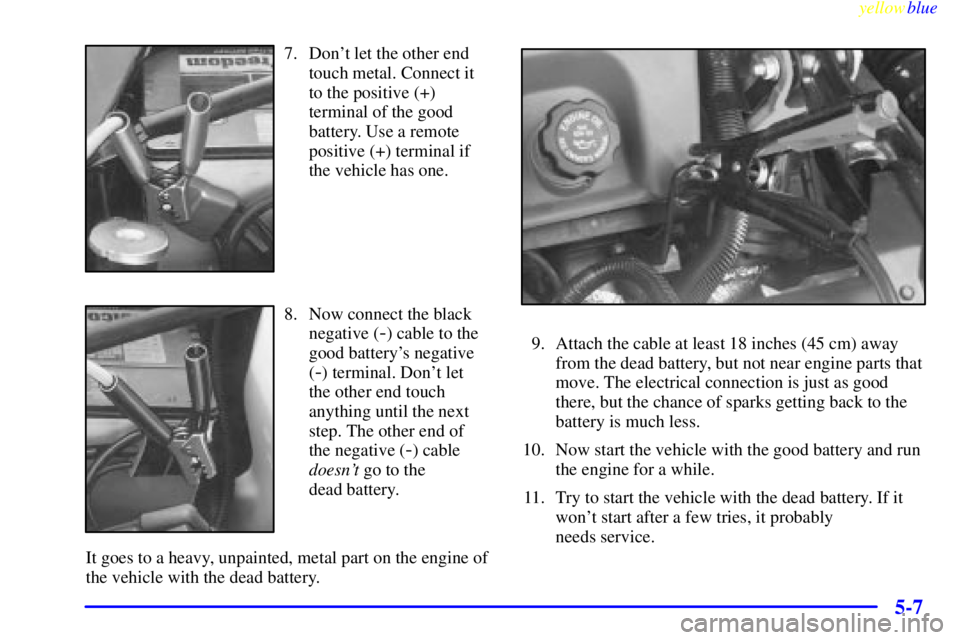
6. Connect the red positive (+) cable to the positive (+)
terminal of the vehicle with the dead battery. Use a
remote positive (+) terminal if the vehicle has one.
Page 229 of 376
yellowblue
5-7
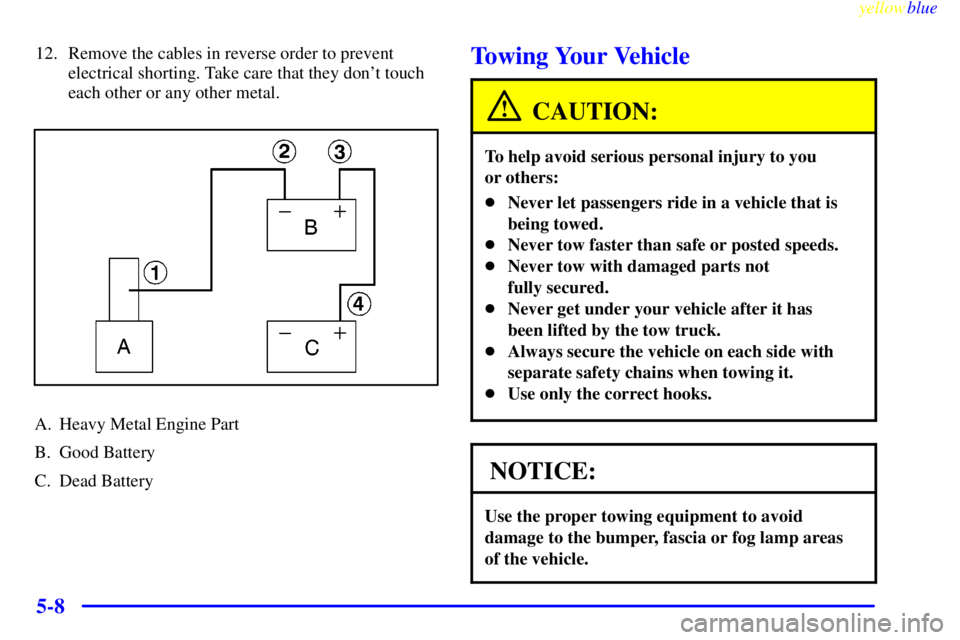
7. Don't let the other end
touch metal. Connect it
to the positive (+)
terminal of the good
battery. Use a remote
positive (+) terminal if
the vehicle has one.
8. Now connect the black
negative (
-) cable to the
good battery's negative
(
-) terminal. Don't let
the other end touch
anything until the next
step. The other end of
the negative (
-) cable
doesn't go to the
dead battery.
It goes to a heavy, unpainted, metal part on the engine of
the vehicle with the dead battery.
9. Attach the cable at least 18 inches (45 cm) away
from the dead battery, but not near engine parts that
move. The electrical connection is just as good
there, but the chance of sparks getting back to the
battery is much less.
10. Now start the vehicle with the good battery and run
the engine for a while.
11. Try to start the vehicle with the dead battery. If it
won't start after a few tries, it probably
needs service.
Page 230 of 376
yellowblue
5-8
12. Remove the cables in reverse order to prevent
electrical shorting. Take care that they don't touch
each other or any other metal.
A. Heavy Metal Engine Part
B. Good Battery
C. Dead Battery
Towing Your Vehicle
CAUTION:
To help avoid serious personal injury to you
or others:
�Never let passengers ride in a vehicle that is
being towed.
�Never tow faster than safe or posted speeds.
�Never tow with damaged parts not
fully secured.
�Never get under your vehicle after it has
been lifted by the tow truck.
�Always secure the vehicle on each side with
separate safety chains when towing it.
�Use only the correct hooks.
NOTICE:
Use the proper towing equipment to avoid
damage to the bumper, fascia or fog lamp areas
of the vehicle.
Page 231 of 376
yellowblue
5-9
With current trends in automotive styles and design, it is
essential that the correct towing equipment is used to
tow a vehicle. Your vehicle can be towed with wheel lift
or car carrier equipment. Don't have your vehicle towed
on the drive wheels, unless you must. If the vehicle must
be towed on the drive wheels, do not tow the vehicle
more than 500 cumulative miles (800 km) or exceed
50 mph (80 km/h). If these limitations must be
exceeded, then the drive wheels have to be supported
on a dolly.
Consult your dealer or a professional towing service if
you need to have your vehicle towed. See ªRoadside
Assistanceº in the Index.
Engine Overheating
You will find a coolant temperature gage and a warning
light about a hot engine on your instrument panel. See
ªEngine Coolant Temperature Gageº and ªEngine
Coolant Temperature Lightº in the Index. You also have
a low coolant light on your instrument panel. See ªLow
Coolant Lightº in the Index.
Overheated Engine Protection Operating
Mode (3100 V6 Engine Only)
This emergency operating mode allows your vehicle to
be driven to a safe place in an emergency situation.
Should an overheated engine condition exist, an
overheat protection mode which alternates firing groups
of three cylinders helps prevent engine damage. In this
mode, you will notice a significant loss in power and
engine performance. The low coolant light may come on
and the temperature gage will indicate an overheat
condition exists. Towing a trailer in the overheat
protection mode should be avoided.
NOTICE:
After driving in the overheated engine protection
operating mode, to avoid engine damage, allow
the engine to cool before attempting any repair.
The engine oil will be severely degraded. Repair
the cause of coolant loss and change the oil.
See ªEngine Oilº in the Index.
Page 232 of 376
yellowblue
5-10 If Steam Is Coming From Your Engine
CAUTION:
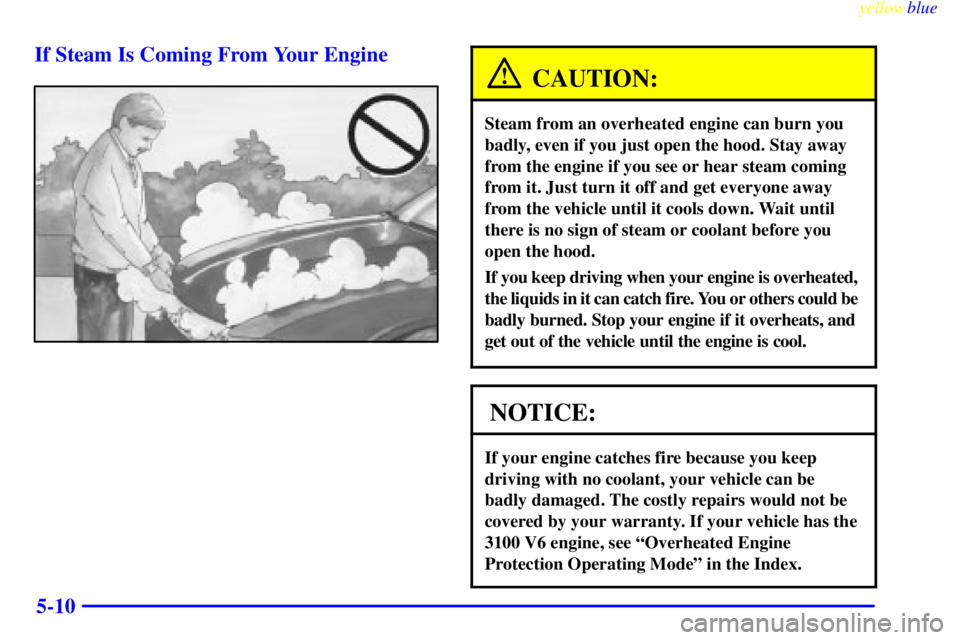
Steam from an overheated engine can burn you
badly, even if you just open the hood. Stay away
from the engine if you see or hear steam coming
from it. Just turn it off and get everyone away
from the vehicle until it cools down. Wait until
there is no sign of steam or coolant before you
open the hood.
If you keep driving when your engine is overheated,
the liquids in it can catch fire. You or others could be
badly burned. Stop your engine if it overheats, and
get out of the vehicle until the engine is cool.
NOTICE:
If your engine catches fire because you keep
driving with no coolant, your vehicle can be
badly damaged. The costly repairs would not be
covered by your warranty. If your vehicle has the
3100 V6 engine, see ªOverheated Engine
Protection Operating Modeº in the Index.