1999 NISSAN PRIMERA radiator
[x] Cancel search: radiatorPage 120 of 2267
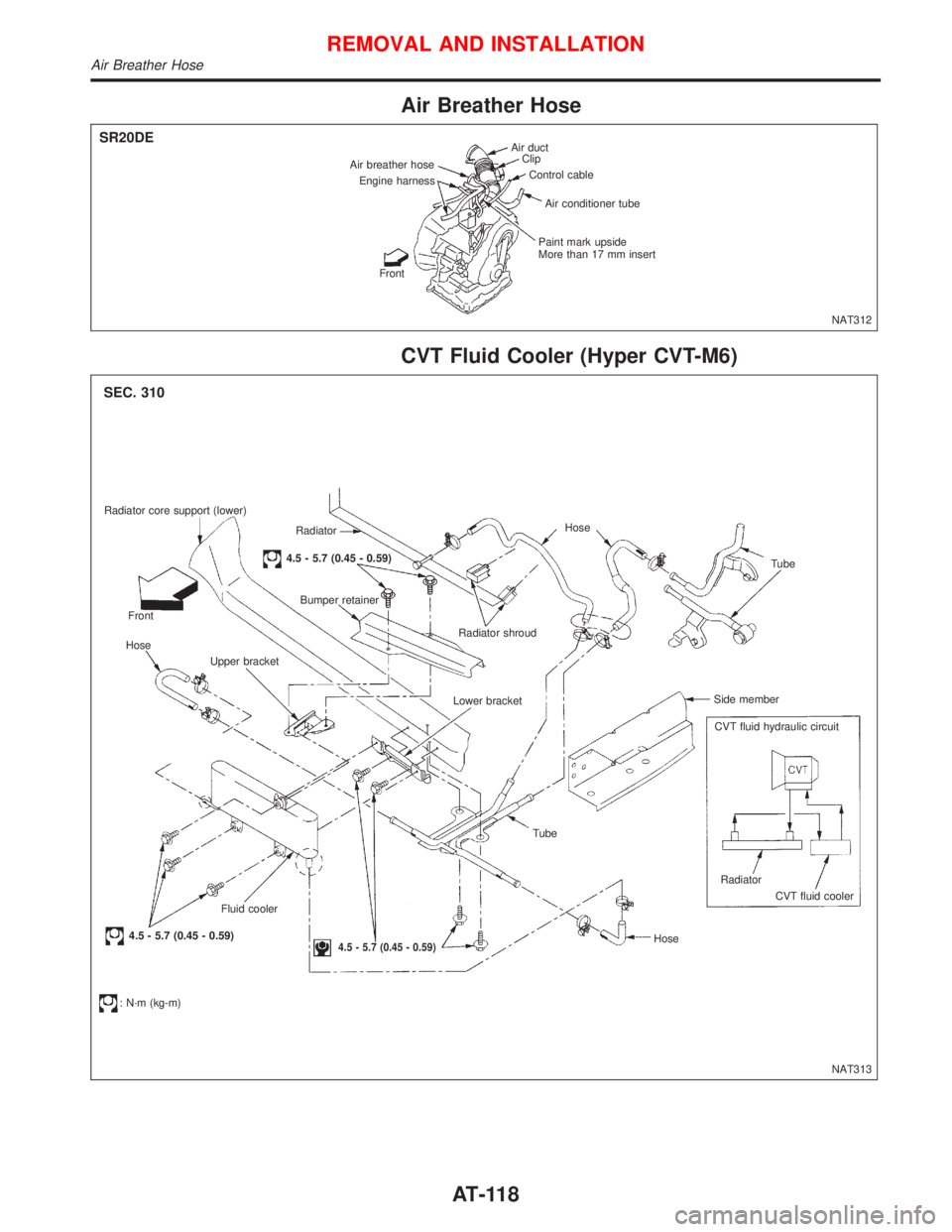
Air Breather Hose
CVT Fluid Cooler (Hyper CVT-M6)
Air duct
Clip
Control cable
Air conditioner tube
Paint mark upside
More than 17 mm insert
Front Engine harness Air breather hose
NAT312
SR20DE
Radiator core support (lower)
Radiator
4.5 - 5.7 (0.45 - 0.59)
Bumper retainer
Front
Hose
Upper bracket
Fluid cooler
4.5 - 5.7 (0.45 - 0.59)
: N´m (kg-m)
4.5 - 5.7 (0.45 - 0.59)
Tube
HoseRadiator
CVT fluid cooler CVT fluid hydraulic circuit Side memberTube Hose
Radiator shroud
Lower bracket
NAT313
SEC. 310
REMOVAL AND INSTALLATION
Air Breather Hose
AT-118
Page 219 of 2267
Body Front End
lWhen removing or installing hood, place a cloth or other padding on the front fender panels and cowl
top. This prevents vehicle body from being scratched.
lBumper fascia is made of plastic. Do not use excessive force and be sure to keep oil away from it.
lHood adjustment: Adjust at hinge portion.
lHood lock adjustment: After adjusting, check hood lock control operation. Apply a coat of grease to hood
locks engaging mechanism.
lHood opener: Do not attempt to bend cable forcibly. Doing so increases effort required to unlock hood.
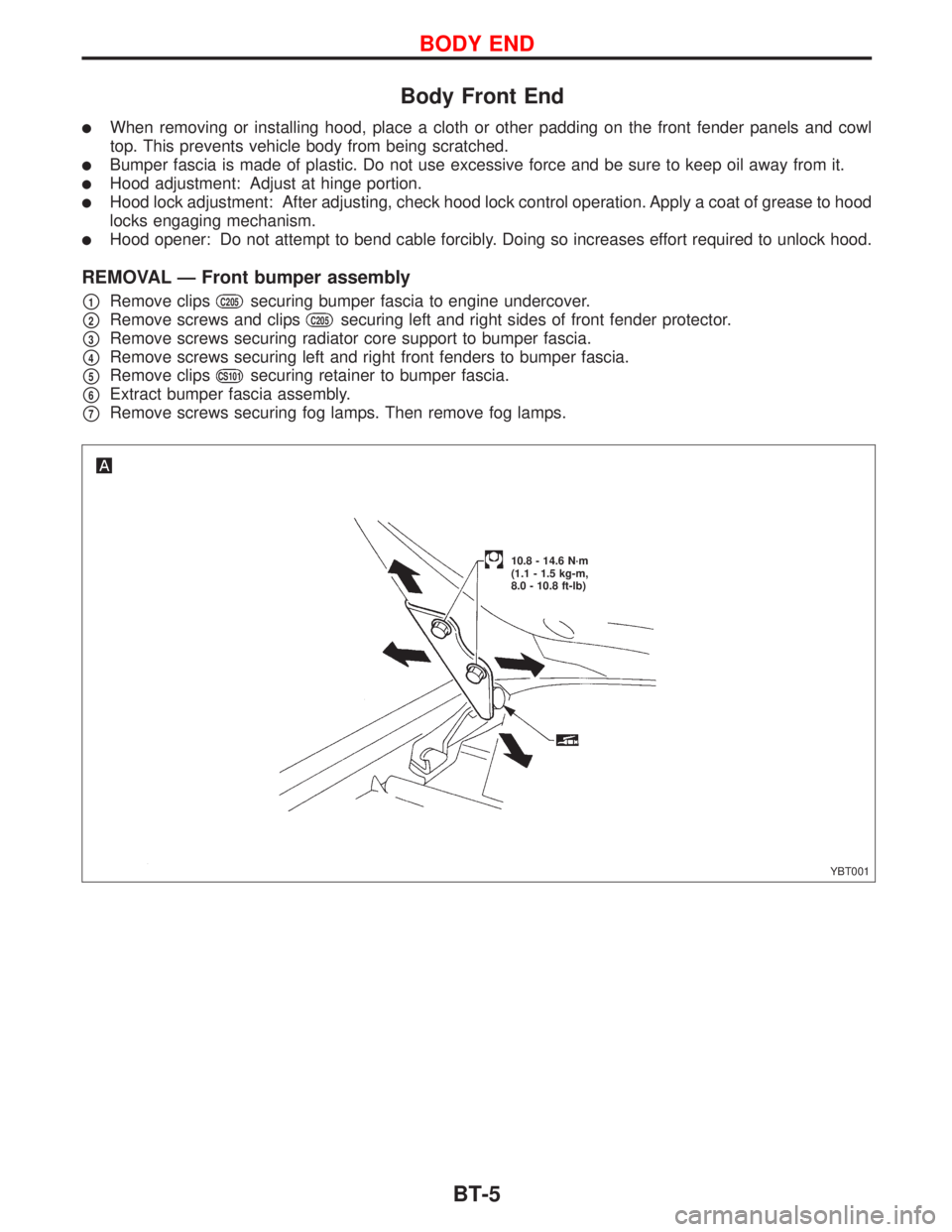
REMOVAL Ð Front bumper assembly
p1Remove clipsC205securing bumper fascia to engine undercover.
p2Remove screws and clipsC205securing left and right sides of front fender protector.
p3Remove screws securing radiator core support to bumper fascia.
p4Remove screws securing left and right front fenders to bumper fascia.
p5Remove clipsCS101securing retainer to bumper fascia.
p6Extract bumper fascia assembly.
p7Remove screws securing fog lamps. Then remove fog lamps.
YBT001
10.8 - 14.6 N´m
(1.1 - 1.5 kg-m,
8.0 - 10.8 ft-lb)
BODY END
BT-5
Page 247 of 2267
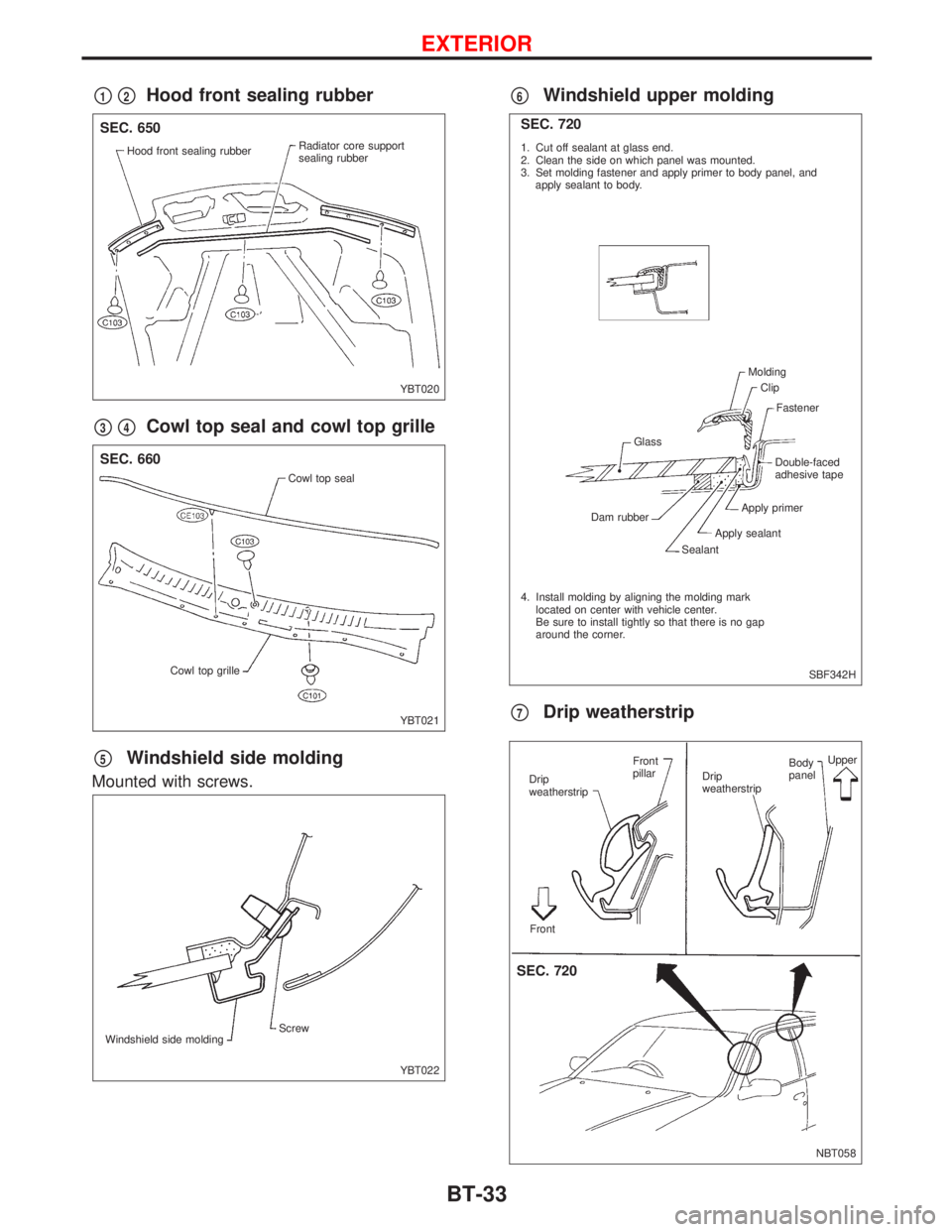
p1p2Hood front sealing rubber
p3p4Cowl top seal and cowl top grille
p5Windshield side molding
Mounted with screws.
p6Windshield upper molding
p7Drip weatherstrip
YBT020 Hood front sealing rubber
SEC. 650
Radiator core support
sealing rubber
YBT021
SEC. 660
Cowl top seal
Cowl top grille
YBT022 Windshield side moldingScrew
SBF342H
SEC. 720
1. Cut off sealant at glass end.
2. Clean the side on which panel was mounted.
3. Set molding fastener and apply primer to body panel, and
apply sealant to body.
Molding
Clip
Fastener
Double-faced
adhesive tape
Apply primer
Apply sealant
Sealant Dam rubberGlass
4. Install molding by aligning the molding mark
located on center with vehicle center.
Be sure to install tightly so that there is no gap
around the corner.
NBT058 Drip
weatherstripFront
pillar
Drip
weatherstripBody
panelUpper
SEC. 720
Front
EXTERIOR
BT-33
Page 275 of 2267
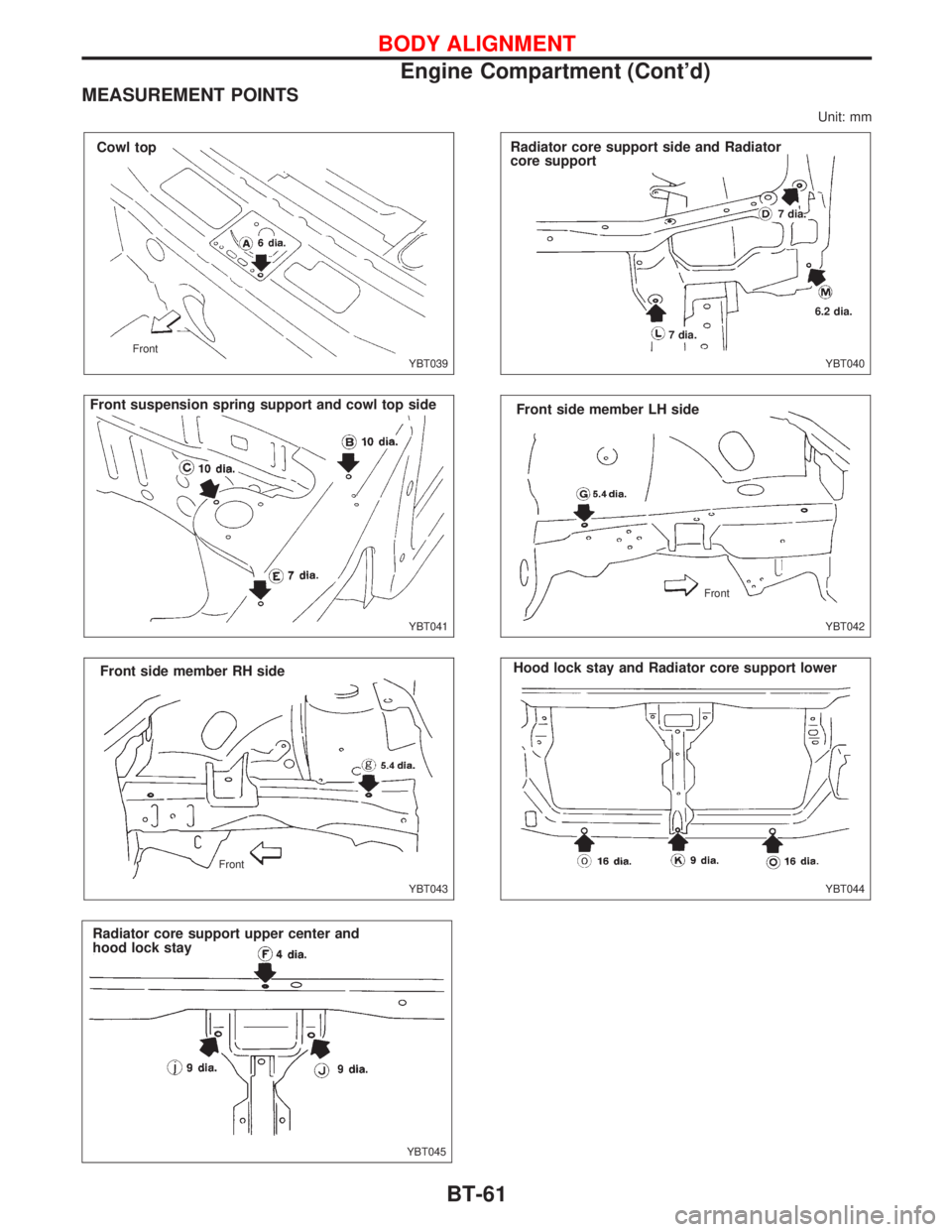
MEASUREMENT POINTS
Unit: mm
YBT039 Front
Cowl top
YBT041
.Front suspension spring support and cowl top side
.YBT043
Front side member RH side
Front
YBT045
Radiator core support upper center and
hood lock stay
YBT040
Radiator core support side and Radiator
core support
7 dia.
6.2 dia.
7 dia.
YBT042 Front
Front side member LH side
YBT044
Hood lock stay and Radiator core support lower
BODY ALIGNMENT
Engine Compartment (Cont'd)
BT-61
Page 336 of 2267
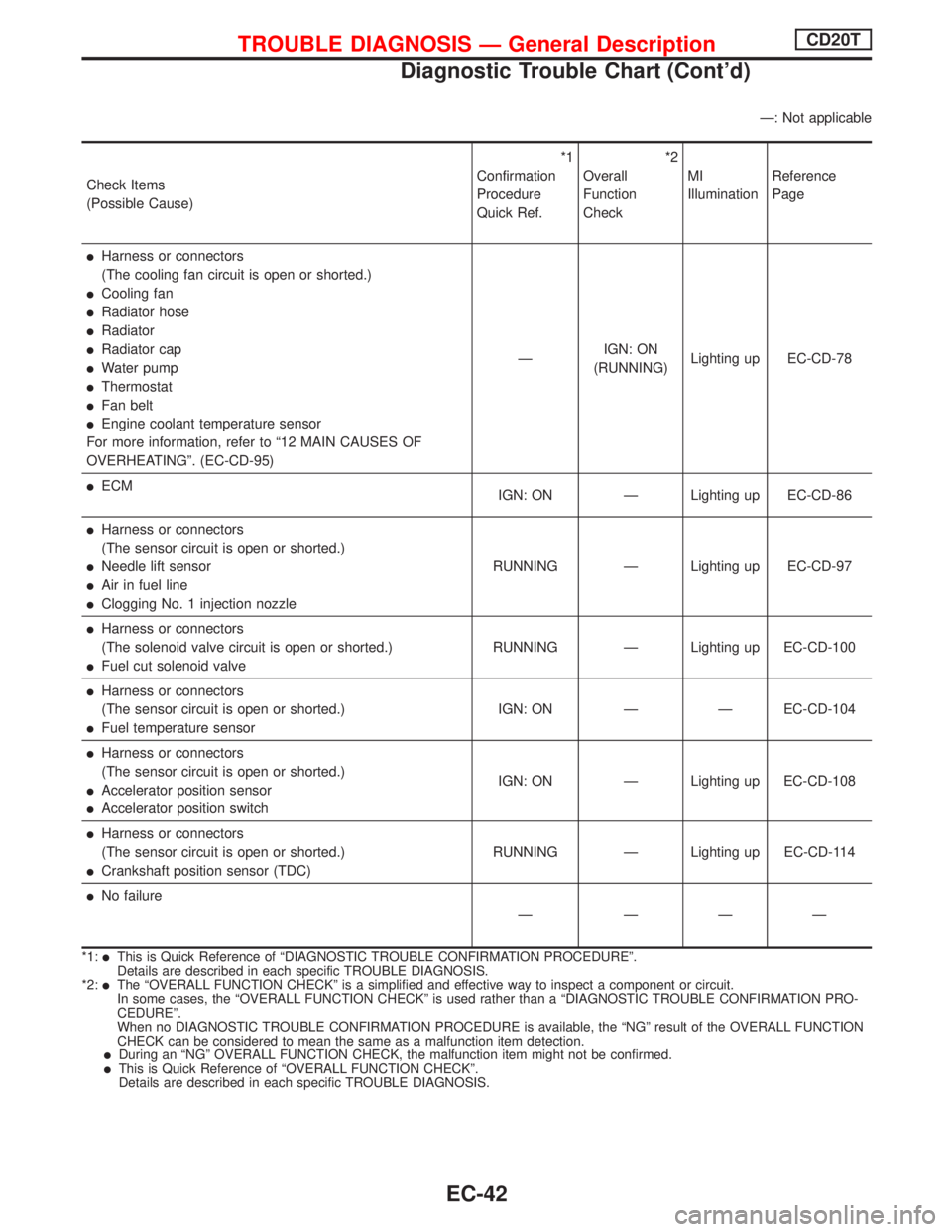
Ð: Not applicable
Check Items
(Possible Cause)*1
Confirmation
Procedure
Quick Ref.*2
Overall
Function
CheckMI
IlluminationReference
Page
lHarness or connectors
(The cooling fan circuit is open or shorted.)
lCooling fan
lRadiator hose
lRadiator
lRadiator cap
lWater pump
lThermostat
lFan belt
lEngine coolant temperature sensor
For more information, refer to ª12 MAIN CAUSES OF
OVERHEATINGº. (EC-CD-95)ÐIGN: ON
(RUNNING)Lighting up EC-CD-78
lECM
IGN: ON Ð Lighting up EC-CD-86
lHarness or connectors
(The sensor circuit is open or shorted.)
lNeedle lift sensor
lAir in fuel line
lClogging No. 1 injection nozzleRUNNING Ð Lighting up EC-CD-97
lHarness or connectors
(The solenoid valve circuit is open or shorted.)
lFuel cut solenoid valveRUNNING Ð Lighting up EC-CD-100
lHarness or connectors
(The sensor circuit is open or shorted.)
lFuel temperature sensorIGN: ON Ð Ð EC-CD-104
lHarness or connectors
(The sensor circuit is open or shorted.)
lAccelerator position sensor
lAccelerator position switchIGN: ON Ð Lighting up EC-CD-108
lHarness or connectors
(The sensor circuit is open or shorted.)
lCrankshaft position sensor (TDC)RUNNING Ð Lighting up EC-CD-114
lNo failure
Ð ÐÐÐ
*1:lThis is Quick Reference of ªDIAGNOSTIC TROUBLE CONFIRMATION PROCEDUREº.
Details are described in each specific TROUBLE DIAGNOSIS.
*2:
lThe ªOVERALL FUNCTION CHECKº is a simplified and effective way to inspect a component or circuit.
In some cases, the ªOVERALL FUNCTION CHECKº is used rather than a ªDIAGNOSTIC TROUBLE CONFIRMATION PRO-
CEDUREº.
When no DIAGNOSTIC TROUBLE CONFIRMATION PROCEDURE is available, the ªNGº result of the OVERALL FUNCTION
CHECK can be considered to mean the same as a malfunction item detection.
lDuring an ªNGº OVERALL FUNCTION CHECK, the malfunction item might not be confirmed.lThis is Quick Reference of ªOVERALL FUNCTION CHECKº.
Details are described in each specific TROUBLE DIAGNOSIS.
TROUBLE DIAGNOSIS Ð General DescriptionCD20T
Diagnostic Trouble Chart (Cont'd)
EC-42
Page 381 of 2267
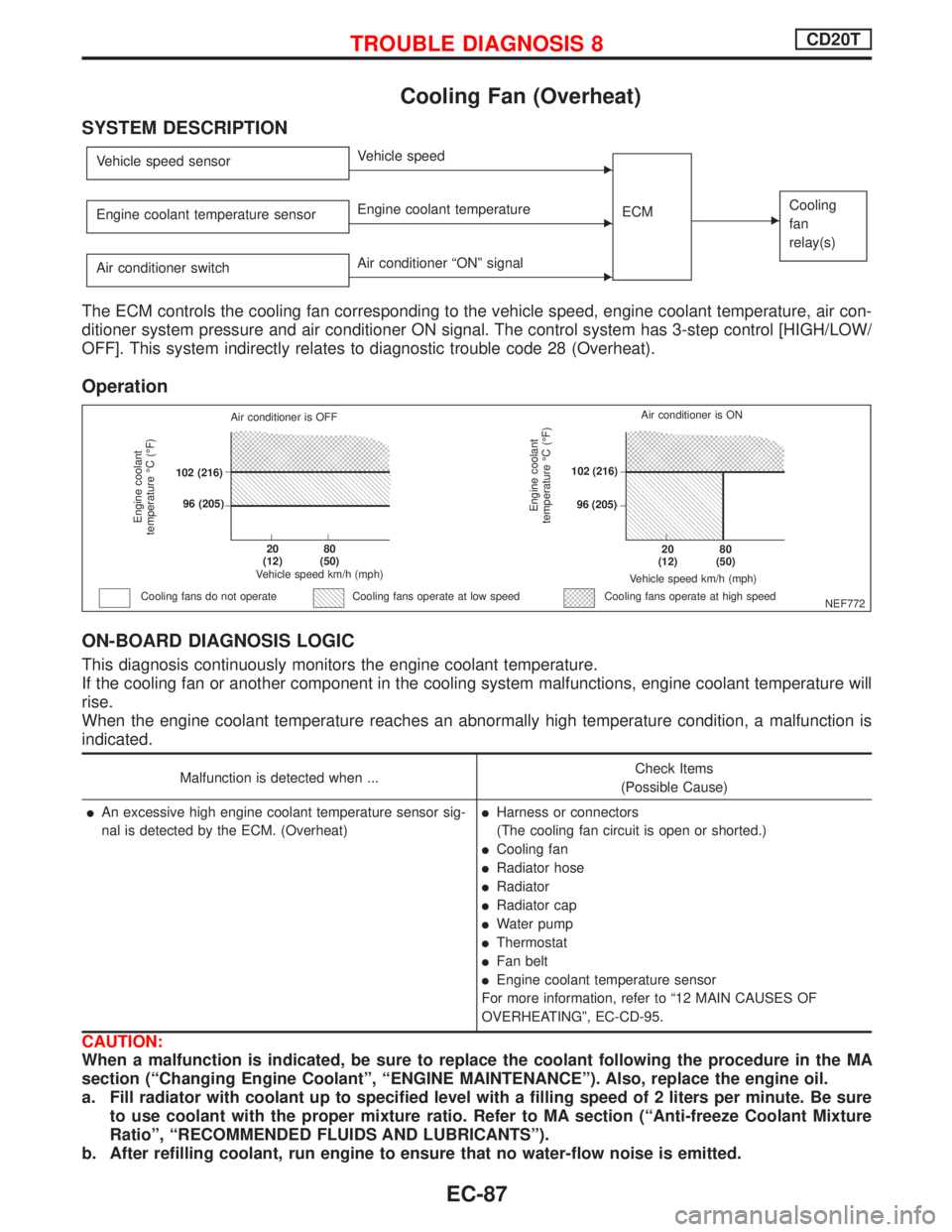
Cooling Fan (Overheat)
SYSTEM DESCRIPTION
Vehicle speed sensorEVehicle speed
ECM
ECooling
fan
relay(s)Engine coolant temperature sensorEEngine coolant temperature
Air conditioner switch
EAir conditioner ªONº signal
The ECM controls the cooling fan corresponding to the vehicle speed, engine coolant temperature, air con-
ditioner system pressure and air conditioner ON signal. The control system has 3-step control [HIGH/LOW/
OFF]. This system indirectly relates to diagnostic trouble code 28 (Overheat).
Operation
ON-BOARD DIAGNOSIS LOGIC
This diagnosis continuously monitors the engine coolant temperature.
If the cooling fan or another component in the cooling system malfunctions, engine coolant temperature will
rise.
When the engine coolant temperature reaches an abnormally high temperature condition, a malfunction is
indicated.
Malfunction is detected when ...Check Items
(Possible Cause)
lAn excessive high engine coolant temperature sensor sig-
nal is detected by the ECM. (Overheat)lHarness or connectors
(The cooling fan circuit is open or shorted.)
lCooling fan
lRadiator hose
lRadiator
lRadiator cap
lWater pump
lThermostat
lFan belt
lEngine coolant temperature sensor
For more information, refer to ª12 MAIN CAUSES OF
OVERHEATINGº, EC-CD-95.
CAUTION:
When a malfunction is indicated, be sure to replace the coolant following the procedure in the MA
section (ªChanging Engine Coolantº, ªENGINE MAINTENANCEº). Also, replace the engine oil.
a. Fill radiator with coolant up to specified level with a filling speed of 2 liters per minute. Be sure
to use coolant with the proper mixture ratio. Refer to MA section (ªAnti-freeze Coolant Mixture
Ratioº, ªRECOMMENDED FLUIDS AND LUBRICANTSº).
b. After refilling coolant, run engine to ensure that no water-flow noise is emitted.
NEF772
Engine coolant
temperature ÉC (ÉF)
Air conditioner is OFF
.102 (216)
.96 (205)
.20
(12).80
(50)
Vehicle speed km/h (mph)
Cooling fans do not operateCooling fans operate at high speed
Engine coolant
temperature ÉC (ÉF)
Vehicle speed km/h (mph)
.20
(12).80
(50)
.102 (216)
.96 (205)Air conditioner is ON
Cooling fans operate at low speed
TROUBLE DIAGNOSIS 8CD20T
EC-87
Page 382 of 2267
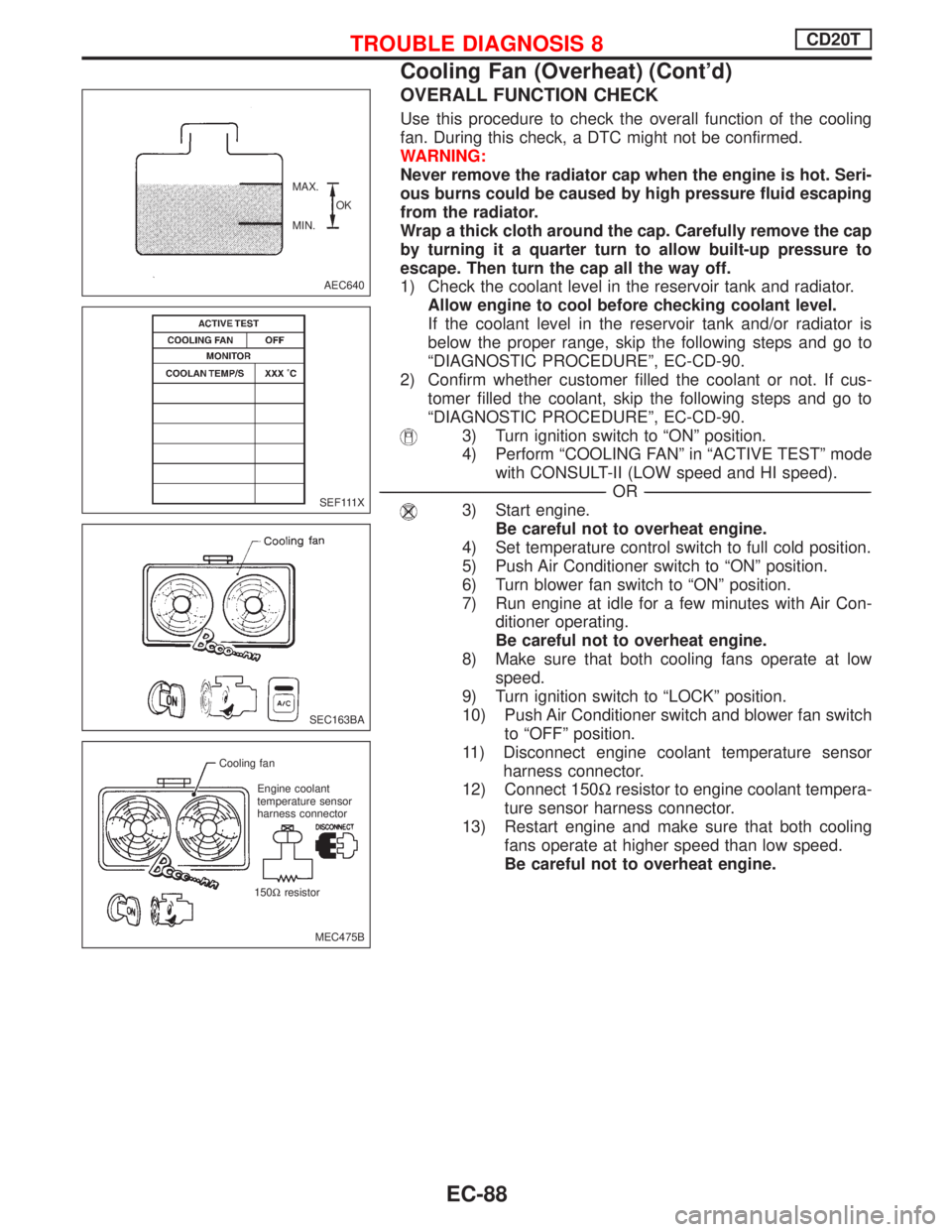
OVERALL FUNCTION CHECK
Use this procedure to check the overall function of the cooling
fan. During this check, a DTC might not be confirmed.
WARNING:
Never remove the radiator cap when the engine is hot. Seri-
ous burns could be caused by high pressure fluid escaping
from the radiator.
Wrap a thick cloth around the cap. Carefully remove the cap
by turning it a quarter turn to allow built-up pressure to
escape. Then turn the cap all the way off.
1) Check the coolant level in the reservoir tank and radiator.
Allow engine to cool before checking coolant level.
If the coolant level in the reservoir tank and/or radiator is
below the proper range, skip the following steps and go to
ªDIAGNOSTIC PROCEDUREº, EC-CD-90.
2) Confirm whether customer filled the coolant or not. If cus-
tomer filled the coolant, skip the following steps and go to
ªDIAGNOSTIC PROCEDUREº, EC-CD-90.
3) Turn ignition switch to ªONº position.
4) Perform ªCOOLING FANº in ªACTIVE TESTº mode
with CONSULT-II (LOW speed and HI speed).
--------------------------------------------------------------------------------------------------------------------------------------------------------------------------------------------------------------------------------------------------------------OR--------------------------------------------------------------------------------------------------------------------------------------------------------------------------------------------------------------------------------------------------------------
3) Start engine.
Be careful not to overheat engine.
4) Set temperature control switch to full cold position.
5) Push Air Conditioner switch to ªONº position.
6) Turn blower fan switch to ªONº position.
7) Run engine at idle for a few minutes with Air Con-
ditioner operating.
Be careful not to overheat engine.
8) Make sure that both cooling fans operate at low
speed.
9) Turn ignition switch to ªLOCKº position.
10) Push Air Conditioner switch and blower fan switch
to ªOFFº position.
11) Disconnect engine coolant temperature sensor
harness connector.
12) Connect 150Wresistor to engine coolant tempera-
ture sensor harness connector.
13) Restart engine and make sure that both cooling
fans operate at higher speed than low speed.
Be careful not to overheat engine.
AEC640 MAX.
MIN.OK
SEF111X
SEC163BA
MEC475B Cooling fan
Engine coolant
temperature sensor
harness connector
150Wresistor
TROUBLE DIAGNOSIS 8CD20T
Cooling Fan (Overheat) (Cont'd)
EC-88
Page 385 of 2267
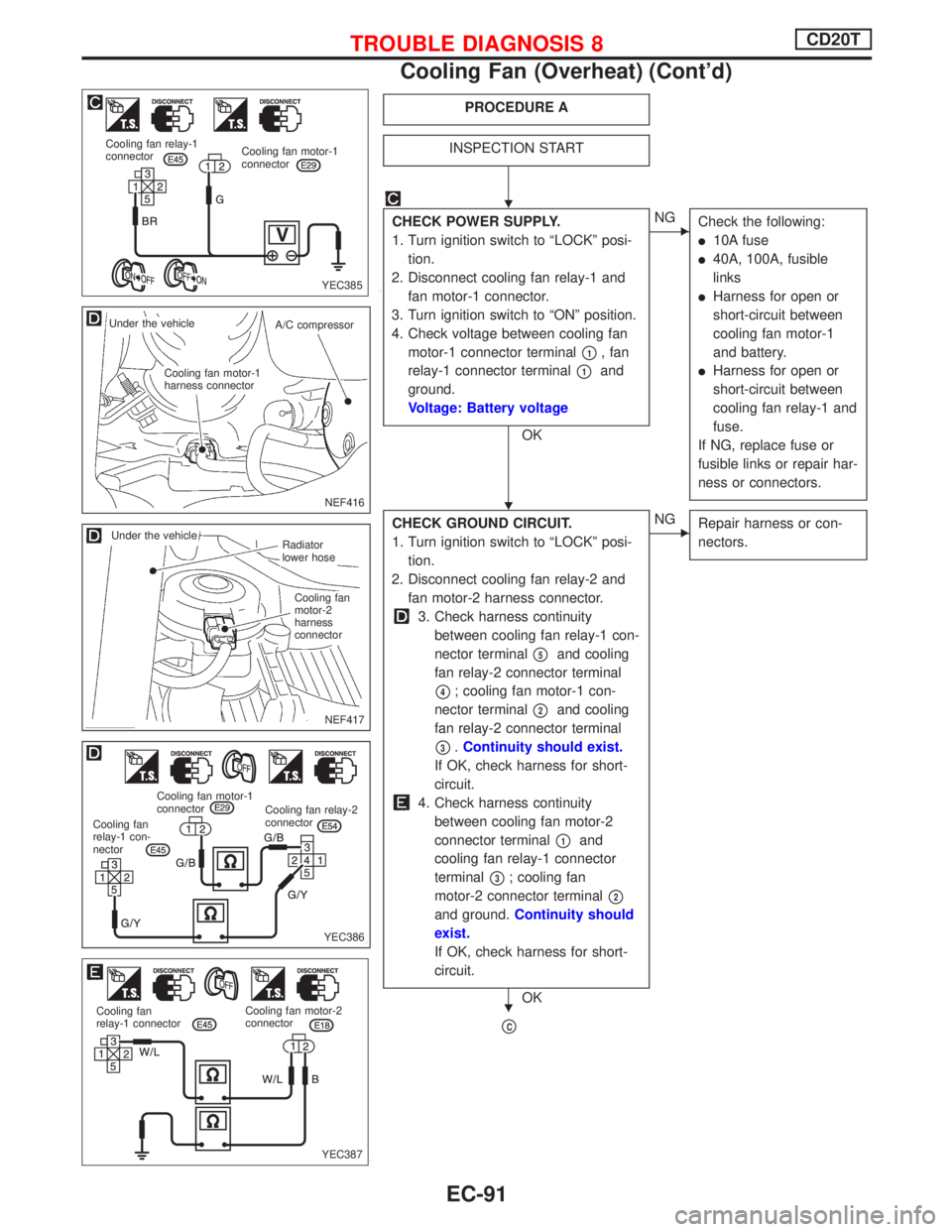
PROCEDURE A
INSPECTION START
CHECK POWER SUPPLY.
1. Turn ignition switch to ªLOCKº posi-
tion.
2. Disconnect cooling fan relay-1 and
fan motor-1 connector.
3. Turn ignition switch to ªONº position.
4. Check voltage between cooling fan
motor-1 connector terminal
p1, fan
relay-1 connector terminal
p1and
ground.
Voltage: Battery voltage
OK
ENG
Check the following:
l10A fuse
l40A, 100A, fusible
links
lHarness for open or
short-circuit between
cooling fan motor-1
and battery.
lHarness for open or
short-circuit between
cooling fan relay-1 and
fuse.
If NG, replace fuse or
fusible links or repair har-
ness or connectors.
CHECK GROUND CIRCUIT.
1. Turn ignition switch to ªLOCKº posi-
tion.
2. Disconnect cooling fan relay-2 and
fan motor-2 harness connector.
3. Check harness continuity
between cooling fan relay-1 con-
nector terminal
p5and cooling
fan relay-2 connector terminal
p4; cooling fan motor-1 con-
nector terminal
p2and cooling
fan relay-2 connector terminal
p3.Continuity should exist.
If OK, check harness for short-
circuit.
4. Check harness continuity
between cooling fan motor-2
connector terminal
p1and
cooling fan relay-1 connector
terminal
p3; cooling fan
motor-2 connector terminal
p2
and ground.Continuity should
exist.
If OK, check harness for short-
circuit.
OK
ENG
Repair harness or con-
nectors.
pC
YEC385 Cooling fan relay-1
connectorCooling fan motor-1
connector
NEF416
.Under the vehicle
A/C compressor
.Cooling fan motor-1
harness connector
NEF417
.Radiator
lower hose
.Cooling fan
motor-2
harness
connector
.Under the vehicle
YEC386
Cooling fan relay-2
connector Cooling fan motor-1
connector
Cooling fan
relay-1 con-
nector
YEC387 Cooling fan
relay-1 connectorCooling fan motor-2
connector
H
H
H
TROUBLE DIAGNOSIS 8CD20T
Cooling Fan (Overheat) (Cont'd)
EC-91