Page 19 of 558

GENERAL – Precautions Before Service00-16
SERVICING THE ELECTRICAL SYSTEM
Before replacing a component related to the electrical system
and before undertaking any repair procedures involving the
electrical system, be sure to first disconnect the negative
(–) cable from the battery in order to avoid damage caused
by short-circuiting.
Caution
Before connecting or disconnecting the negative (–) cable,
be sure to turn off the ignition switch and the lighting
switch.
(If this is not done, there is the possibility of
semiconductor parts being damaged.)
APPLICATION OF ANTI-CORROSION AGENTS
AND UNDERCOATS
If oil or grease gets onto the oxygen sensor, it will cause
a drop in the performance of the sensor.
Cover the oxygen sensor with a protective cover when applying
anti-corrosion agents and undercoats.
PRE-INSPECTION CONDITION
“Pre-inspection condition” refers to the condition that the
vehicle must be in before proper engine inspection can be
carried out. If you see the words “Set the vehicle to the
pre-inspection condition.” in this manual, it means to set the
vehicle to the following condition.
�Engine coolant temperature: 80–90�C
�Lamps, electric cooling fan and all accessories: OFF
�M/T: Neutral
VEHICLE WASHING
If high-pressure car-washing equipment or steam car-washing
equipment is used to wash the vehicle, be sure to note the
following information in order to avoid damage to plastic
components, etc.
�Spray nozzle distance: Approx. 40 cm or more
�Spray pressure: 3,900 kPa or less
�Spray temperature: 82�C or less
�Time of concentrated spray to one point: within 30 sec.
Approx.
40 cm
Page 27 of 558
ENGINE – General Information11-2
GENERAL INFORMATION
DescriptionsSpecifications
TypeIn-line OHV, SOHC
Number of cylinders4
Combustion chamberPentroof + curved top piston type
Total displacement dm31,997
Cylinder bore mm85.0
Piston stroke mm88.0
Compression ratio8.8
Valve timingIntake valveOpens (BTDC)21°
Closes (ABDC)59°
Exhaust valveOpens (BBDC)58°
Closes (ATDC)18°
Lubrication systemPressure feed, full-flow filtration
Oil pump typeInvolute gear type
Page 29 of 558

ENGINE – Specifications11-4
ItemsLimit Standard value
Intake oversize rework dimensions of valve
guide hole mm
0.3 O.S.35.30 – 35.33–
guide hole mm0.6 O.S.35.60 – 35.63–
Exhaust oversize rework dimensions of
valve guide hole mm
0.3 O.S.33.30 – 33.33–
valve guide hole mm0.6 O.S.33.60 – 33.63–
Front case and oil pan
Oil pump side clearance mmDrive gear0.08 – 0.14–
Driven gear0.06 – 0.12–
Oil pressure at curb idle speed kPa [Oil temperature is 75 to 90°C]78 or more–
Piston and connecting rod
Piston outer diameter mm85.0–
Piston ring side clearance mmNo. 1 ring0.04 – 0.075–
No. 2 ring0.02 – 0.06–
Piston ring end gap mmNo. 1 ring0.25 – 0.350.8
No. 2 ring0.40 – 0.550.8
Oil ring0.10 – 0.401.0
Piston pin outer diameter mm21.0–
Piston pin press-in load N (Room temperature)7,350 – 17,200–
Crankshaft pin oil clearance mm0.02 – 0.050.1
Connecting rod big end side clearance mm0.10 – 0.250.4
Crankshaft and flywheel
Crankshaft end play mm0.05 – 0.250.40
Crankshaft journal outer diameter mm57.0–
Crankshaft pin outer diameter mm44.0–
Crankshaft journal oil clearance mm0.02 – 0.040.1
Bearing cap bolt shank length mm–Maximum 71.1
Piston to cylinder clearance mm0.02 – 0.04–
Cylinder block grinding limit of gasket surface mm
Total resurfacing depth of both cylinder head and cylinder block–0.2
Cylinder block overall height mm284–
Cylinder block inner diameter mm85.0–
Cylinder block cylinder mm0.01–
Turbocharger
Waste gate actuator operation check kPa100113.3
Page 33 of 558
ENGINE – Specifications11-8
ItemsNm
Front case and oil pan
Drain plug39
Oil pan7
Oil screen19
Buffle plate22
Oil pressure switch10
Oil cooler by-pass valve54
Relief plug44
Plug24
Front case24
Oil pump cover (Screw)10
Oil pump cover (Bolt)16
Piston and connecting rods
Connecting rod nut20 + 90° to 94°
Crankshaft and flywheel
Flywheel bolt132
Rear plate11
Bell housing cover9
Oil seal case11
Beam bearing cap bolt25 + 90°
Check valve32
Throttle body
Throttle position sensor3.5
Idle speed control body assembly3.5
Turbocharger
Waste gate actuator11
Page 34 of 558

ENGINE – Specifications11-9
NEW TIGHTENING METHOD – BY USE OF BOLTS TO BE TIGHTENED IN
PLASTIC AREA
A new type of bolts, to be tightened in plastic area, is currently used some parts of the engine. The
tightening method for the bolts is different from the conventional one. Be sure to observe the method
described in the text when tightening the bolts.
Service limits are provided for the bolts. Make sure that the service limits described in the text are strictly
observed.
�Areas where the bolts are in use:
(1) Cylinder head bolts
(2) Main bearing cap bolts
(3) Connecting rod cap bolts
�Tightening method
After tightening the bolts to the specified torque, tighten them another 90° or 180° (twice 90°). The
tightening method varies on different areas. Observe the tightening method described in the text.
SEALANTS
ItemSpecified sealantQuantity
Engine support bracket bolt3MTM AAD Part No. 8672 or equivalentAs required
Semi-circular packing3MTM AAD Part No. 8672 or equivalentAs required
Rocker cover3MTM AAD Part No. 8672 or equivalentAs required
Oil return pipe gasket3MTM AAD Part No. 8731 or equivalentAs required
Thermostat housingMitsubishi Genuine Part No. MD970389 or
equivalentAs required
Water outlet fittingMitsubishi Genuine Part No. MD970389 or
equivalentAs required
Engine coolant temperature gauge unit3MTM AAD Part No. 8672 or equivalentAs required
Engine coolant temperature sensor3MTM AAD Part No. 8731 or equivalentAs required
Cam position sensor supportMitsubishi Genuine Part No. MD970389 or
equivalentAs required
Oil pressure switch3MTM AAD Part No. 8672 or equivalentAs required
Oil panMitsubishi Genuine Part No. MD970389 or
equivalentAs required
Oil seal caseMitsubishi Genuine Part No. MD970389 or
equivalentAs required
Page 53 of 558
ENGINE – Fuel and Emission Control Parts11-28
INSTALLATION SERVICE POINTS
�A�INJECTORS INSTALLATION
(1) Before installing an injector, the rubber O-ring must be
lubricated with a drop of clean engine oil to aid in
installation.
(2) Install injector top end. Be careful not to damage O-ring
during installation.
�B�FUEL PRESSURE REGULATOR INSTALLATION
(1) Apply a small amount of new engine oil to the O-ring.
Insert the fuel pressure regulator into the delivery pipe
being careful not to damage the O-ring.
Caution
Be sure not to let engine oil get into the delivery
pipe.
(2) Check that the fuel pressure regulator turns smoothly.
If it does not turn smoothly, the O-ring may be trapped.
Remove the fuel pressure regulator and check the O-ring
for damage, and then re-insert it into the delivery pipe
and check once again.
�C�GASKET INSTALLATION
Position the projection as shown in the illustration.
1EN0388
Grommet
O-ring
Projection
Page 66 of 558

ENGINE – Rocker Arms and Camshaft11-41
(4) Removal the lash adjuster from the container. Then, push
down the steel ball gently and push the plunger to eliminate
diesel fuel from the pressure chamber.
Caution
Make sure the oil hole in the side of the body is pointing
toward container A. Do not point the oil hole at yourself
or other people.
(5) Place the lash adjuster in container B. Then, gently push
down the internal steel ball using wire (0.5 mm in diameter)
or special tool MD998442 and move the plunger through
5 to 10 strokes until it slides smoothly. This operation
will clean the lash adjuster’s pressure chamber.
Caution
The steel ball spring is extremely weak, so the lash
adjuster’s functionality may be lost if the air bleed
wire is pushed in hard.
(6) Remove the lash adjuster from the container. Then, push
down the steel ball gently and push the plunger to eliminate
diesel fuel from the pressure chamber.
Caution
Make sure the oil hole in the side of the body is pointing
toward container A. Do not point the oil hole at yourself
or other people.
(7) Place the lash adjuster in container C. Then, gently push
down the internal steel ball using wire (0.5 mm in diameter)
or special tool MD998442.
Caution
Do not use container C for cleaning. If cleaning is
performed in container C, foreign matter could enter
the pressure chamber when chamber is filled with
diesel fuel.
(8) Stand the lash adjuster with its plunger at the top, then
push the plunger downward firmly until it moves through
its greatest possible stroke. Return the plunger slowly,
then release the steel ball and allow the pressure chamber
to fill with diesel fuel.
MD998442
Diesel fuel
MD998442Diesel fuel
MD998442
Diesel fuel
MD998442
Diesel fuel
MD998442Diesel fuel
Page 76 of 558
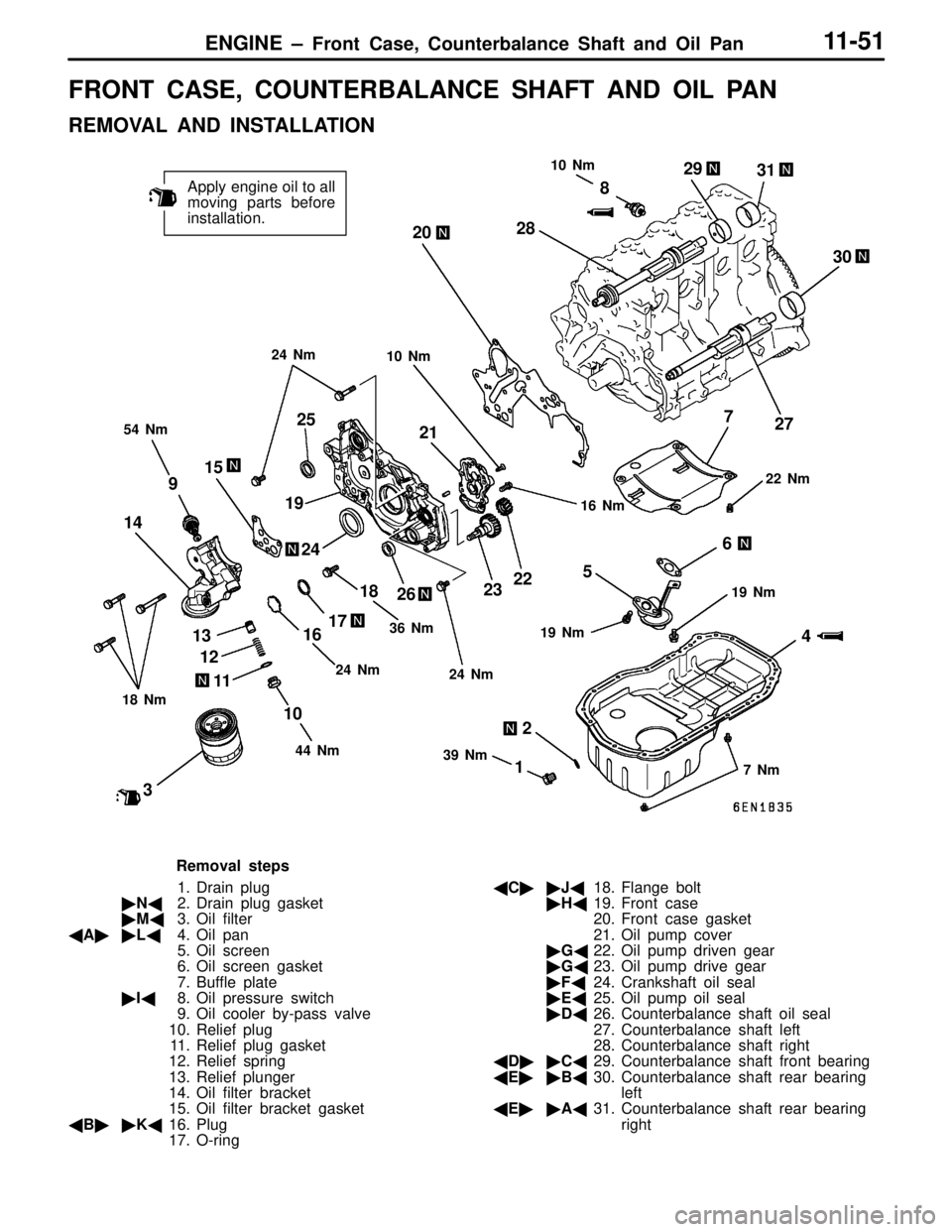
ENGINE – Front Case, Counterbalance Shaft and Oil Pan11-51
FRONT CASE, COUNTERBALANCE SHAFT AND OIL PAN
REMOVAL AND INSTALLATION
16 Nm 10 Nm
39 Nm22 Nm
Apply engine oil to all
moving parts before
installation.
12
34 567 8
9
10 11 12 13 1415
161718 1920
21
22
23 24 25
2627 2829
30
36 Nm
24 Nm 24 Nm19 Nm
44 Nm 18 Nm24 Nm
54 Nm10 Nm
19 Nm
7 Nm
31
Removal steps
1. Drain plug
�N�2. Drain plug gasket
�M�3. Oil filter
�A��L�4. Oil pan
5. Oil screen
6. Oil screen gasket
7. Buffle plate
�I�8. Oil pressure switch
9. Oil cooler by-pass valve
10. Relief plug
11. Relief plug gasket
12. Relief spring
13. Relief plunger
14. Oil filter bracket
15. Oil filter bracket gasket
�B��K�16. Plug
17. O-ring�C��J�18. Flange bolt
�H�19. Front case
20. Front case gasket
21. Oil pump cover
�G�22. Oil pump driven gear
�G�23. Oil pump drive gear
�F�24. Crankshaft oil seal
�E�25. Oil pump oil seal
�D�26. Counterbalance shaft oil seal
27. Counterbalance shaft left
28. Counterbalance shaft right
�D��C�29. Counterbalance shaft front bearing
�E��B�30. Counterbalance shaft rear bearing
left
�E��A�31. Counterbalance shaft rear bearing
right


