Page 80 of 558
ENGINE – Front Case, Counterbalance Shaft and Oil Pan11-55
�G�OIL PUMP DRIVEN GEAR / OIL PUMP DRIVE
GEAR INSTALLATION
Apply engine oil amply to the gears and line up the alignment
marks.
�H�FRONT CASE ASSEMBLY INSTALLATION
(1) Set the special tool on the front end of crankshaft and
apply a thin coat of engine oil to the outer circumference
of the special tool to install the front case.
(2) Install the front case assembly through a new front case
gasket and temporarily tighten the flange bolts (other
than those for tightening the filter bracket).
�I�SEALANT APPLICATION TO OIL PRESSURE
SWITCH
Coat the threads of switch with sealant and install the switch
using the special tool.
Specified sealant: 3M
TM AAD Part No. 8672 or equivalent
Caution
(1) Keep the end of the thread portion clear or sealant.
(2) Avoid an overtightening.
�J�FLANGE BOLT INSTALLATION
(1) Insert a Phillips screwdriver into a hole in the left side
of the cylinder block to lock the silent shaft.
6EN0564
Page 115 of 558

MPI – General13-3
MPI System Diagram
�1 Injector
�2 ISC servo
�3 Fuel pressure control valve
�4 Waste gate solenoid valve
�5 Secondary air control solenoid valve
�Control relay
�Fuel pump relay
�A/C relay
�Ignition coil
�Exhaust temperature warning lamp
�Engine warning lamp
�Diagnosis output
�Alternator G terminal
�Fan motor relay
�Tachometer
�Fuel pump relay No.2 �1 Oxygen sensor
�2 Air flow sensor
�3 Intake air temperature sensor
�4 Throttle position sensor
�5 Idle switch
�6 Camshaft position sensor
�7 Crank angle sensor
�8 Barometric pressure sensor
�9 High temperature sensor
�10 Engine coolant temperature sensor
�11 Detonation sensor
�Power supply voltage
�Ignition switch-IG
�Ignition switch-ST
�Vehicle speed sensor
�A/C switch
�Power steering fluid pressure switch
�Alternator FR signalEngine ECU
�1 Oxygen sensor
�2 Air flow sensor�3
Intake air tem-
perature sensor
�4,
�5
�6 Camshaft position
sensor
�7 Crank angle sensor �8 Barometric
pressure sensor
�9 High temperature
sensor �10 Coolant temperature sensor
�11 Detonation sensor�1 Injector �2 ISC servo
�3 Fuel pressure
control valve
�4 Waste gate
solenoid valve �5 Secondary air
control solenoid
valveCanister
Check valveFrom
fuel
tank
Throttle position
sensor (with a
built-in
idle
switch)
Secondary
air valve
AirTo fuel
tankFuel
pressure
regulatorFrom
fuel
pump
Waste gate
actuator
Catalytic converter
Page 116 of 558
MPI – Service Specifications / Sealant13-4
SERVICE SPECIFICATIONS
ItemsSpecifications
Basic ignition timing �BTDC5 ± 3
Basic idle speed rpm850 ± 50
Throttle position sensor adjusting voltage mV400 – 1,000
Throttle position sensor resistance kΩ3.5 – 6.5
ISC servo coil resistance (at 20�C) Ω28 – 33
Intake air temperature sensor resistance kΩAt 20�C2.3 – 3.0
At 80�C0.30 – 0.42
Coolant temperature sensor resistance kΩAt 20�C2.1 – 2.7
At 80�C0.26 – 0.36
Fuel pressure kPaWhen vacuum hose is connected230
When vacuum hose is disconnected289 – 309
Injector coil resistance Ω2 – 3
Amount of injector fuel leak drop/min1 or less
Oxygen sensor output voltage V0.6 – 1.0
Fuel pressure control valve coil resistance (at 20�C) Ω28 – 36
SEALANT
ItemSpecified sealantRemark
Engine coolant temperature sensor
threaded portion3M Nut Locking Part No.4171 or equivalentDrying sealant
Page 118 of 558

MPI – Troubleshooting13-6
TROUBLESHOOTING
DIAGNOSIS TROUBLESHOOTING FLOW
Refer to GROUP 00 – How to Use Troubleshooting/Inspection
Service Points.
DIAGNOSIS FUNCTION
ENGINE WARNING LAMP (CHECK ENGINE LAMP)
If an abnormality occurs in any of the following items related
to the Multipoint Fuel Injection (MPI) system, the engine
warning lamp will illuminate.
If the lamp remains illuminated or if the lamp illuminates while
the engine is running, check the diagnosis code output.
Engine warning lamp inspection items
Engine-ECU
Air flow sensor
Intake air temperature sensor
Throttle position sensor
Engine coolant temperature sensor
Crank angle sensor
Camshaft position sensor
Barometric pressure sensor
Detonation sensor
Injector
Ignition coil, power transister unit
METHOD OF READING AND ERASING DIAGNOSIS
CODES
Refer to GROUP 00 – How to Use Troubleshooting/Inspection
Service Points.
INSPECTION USING MUT-II DATA LIST AND
ACTUATOR TESTING
1. Carry out inspection by connecting the MUT-II.
If there is an abnormality, check and repair the chassis
harnesses and components.
2. After repairing, check that the abnormal input and output
have returned to normal as a result of the repairs.
3. Erase the diagnosis code memory.
4. Remove the MUT-II and carry out a road test to confirm
that the problem has disappeared.
Engine warning lamp
(check engine lamp)
Page 119 of 558

MPI – Troubleshooting13-7
FAIL-SAFE FUNCTION REFERENCE TABLE
When the main sensor malfunctions are detected by the diagnosis function, the vehicle is controlled
by means of the pre-set control logic to maintain safe conditions for driving.
Malfunctioning itemControl contents during malfunction
Air flow sensor1. Uses the throttle position sensor signal and engine speed signal (crank angle sensor
signal) to take reading of the basic injector drive time and basic ignition timing from
the pre-set mapping.
2. Fixes the ISC servo in the appointed position so idle control is not performed.
Intake air temperature
sensorControls as if the intake air temperature is 25�C.
Throttle position
sensorNo increase in fuel injection amount during acceleration due to the throttle position sensor
signal.
Engine coolant
temperature sensor1. Controls as if the engine coolant temperature is 80�C.
(This condition is maintained until the ignition switch is turned off even when the
sensor signal returns normal.)
2. Lets the fan motor (radiator and condenser) run at high speed.
Camshaft position
sensorInjects fuel to all cylinders simultaneously for 4 seconds.
(However, after the ignition switch is turned to ON, the No. 1 cylinder top dead centre is not
detected at all.)
Barometric pressure
sensorControls as if the barometric pressure is 101 kPa.
Detonation sensorSwitches the ignition timing from ignition timing for super petrol to ignition timing for standard
petrol.
Ignition coil, power
transistor unitCuts off the fuel supply to cylinders with an abnormal ignition.
Alternator FR terminalDoes not control the output of the alternator according to an electrical load. (works as a
normal alternator)
Page 120 of 558
MPI – Troubleshooting13-8
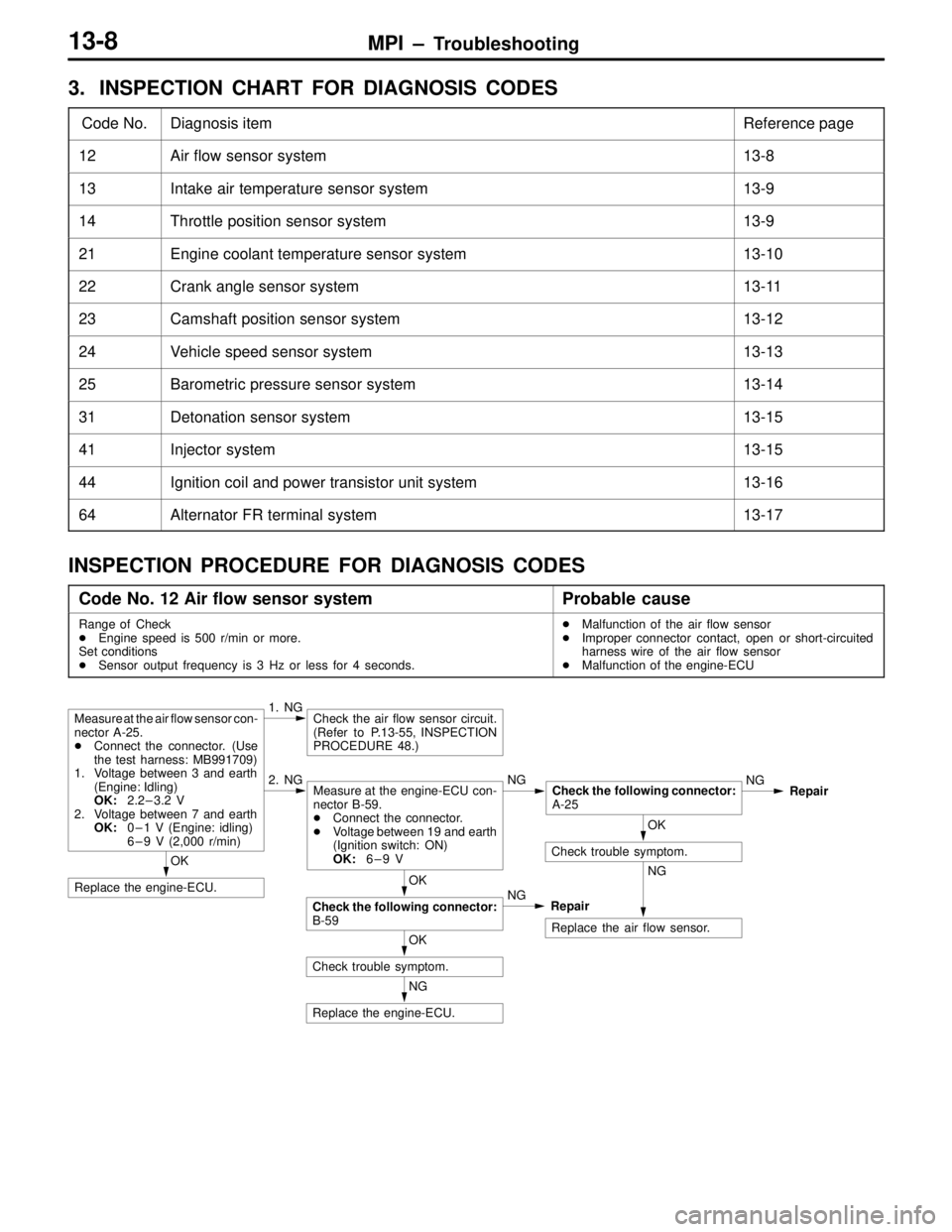
3. INSPECTION CHART FOR DIAGNOSIS CODES
Code No.Diagnosis itemReference page
12Air flow sensor system13-8
13Intake air temperature sensor system13-9
14Throttle position sensor system13-9
21Engine coolant temperature sensor system13-10
22Crank angle sensor system13-11
23Camshaft position sensor system13-12
24Vehicle speed sensor system13-13
25Barometric pressure sensor system13-14
31Detonation sensor system13-15
41Injector system13-15
44Ignition coil and power transistor unit system13-16
64Alternator FR terminal system13-17
INSPECTION PROCEDURE FOR DIAGNOSIS CODES
Code No. 12 Air flow sensor systemProbable cause
Range of Check
�Engine speed is 500 r/min or more.
Set conditions
�Sensor output frequency is 3 Hz or less for 4 seconds.�Malfunction of the air flow sensor
�Improper connector contact, open or short-circuited
harness wire of the air flow sensor
�Malfunction of the engine-ECU
Measure at the air flow sensor con-
nector A-25.
�Connect the connector. (Use
the test harness: MB991709)
1. Voltage between 3 and earth
(Engine: Idling)
OK:2.2–3.2 V
2. Voltage between 7 and earth
OK:0–1 V (Engine: idling)
6–9 V (2,000 r/min)
OK
Replace the engine-ECU.1. NG
Check the air flow sensor circuit.
(Refer to P.13-55, INSPECTION
PROCEDURE 48.)
2. NG
Measure at the engine-ECU con-
nector B-59.
�Connect the connector.
�Voltage between 19 and earth
(Ignition switch: ON)
OK:6–9 V
OK
Check the following connector:
B-59
OK
Check trouble symptom.
NG
Replace the engine-ECU.NG
Check the following connector:
A-25NG
Repair
OK
Check trouble symptom.
NG
NG
Repair
Replace the air flow sensor.
Page 128 of 558

MPI – Troubleshooting13-16
Code No. 44 Ignition coil and power transistor unit systemProbable cause
Range of Check
�Engine speed is approx. 50–4,000 r/min
�Engine is not cranking.
Set conditions
�Abnormal rotation due to misfire is detected by crank angle sensor (Either one
of coils fails).�Malfunction of the ignition coil
�Improper connector contact, open or short-circuited
harness wire of the ignition primary circuit
�Malfunction of the engine-ECU
OK
OK
Check trouble symptom.
Measure at the ignition coil connectors
A-110, A-111
�Disconnect the connector, and
measure at the harness.
1. Voltage between 1 and earth
(Ignition switch: ON)
OK: System voltage
2. Voltage between 3 and earth
(Engine: Cranking)
OK: 0.5–4.0 V
3. Continuity between the 2 and earth
OK: Continuity1. NGCheck the following connectors:
B-65, B-76OKCheck trouble symptom.
NG
Check the harness wire between the
ignition coil and ignition switch connec-
tor, and repair if necessary.
2. NGCheck the following connector: B-59NG
Repair
NG
Check the harness wire between the
engine-ECU and ignition coil connector.OKReplace the engine-ECU.
NG
Repair
3. NG
Check the harness wire between the
ignition coil connector and earth, and
repair if necessary.
Check the following connectors:
A-110, A-111NG
Repair
Check trouble symptom.
NG
Check the following items.
�Check the spark plugs, spark plug
cables.
�Check the compression pressure.
NG
Repair
Check the ignition coil. (Refer to
GROUP 16 – IGNITION SYSTEM.)NG
Replace
OK
OK
Page 134 of 558
MPI – Troubleshooting13-22
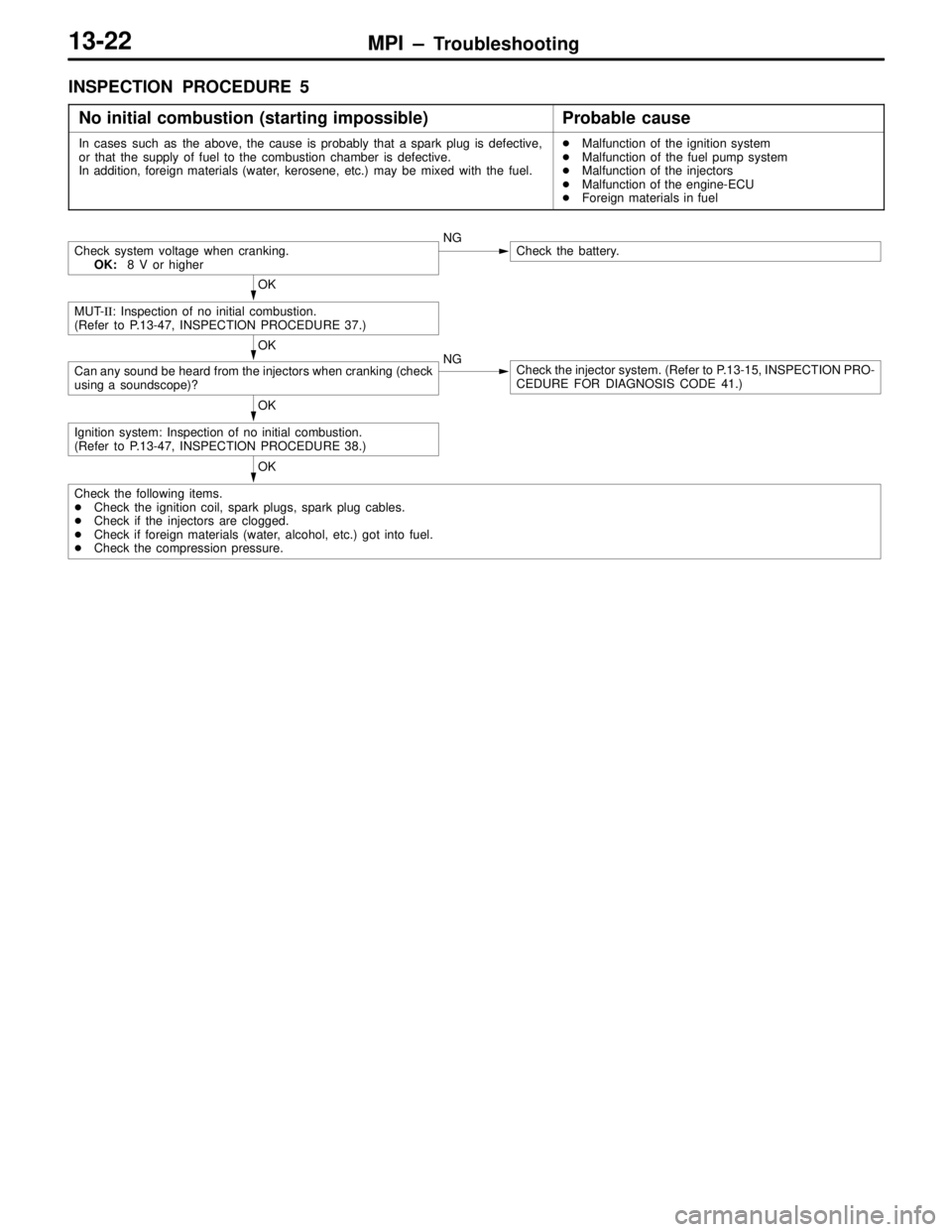
INSPECTION PROCEDURE 5
No initial combustion (starting impossible)
Probable cause
In cases such as the above, the cause is probably that a spark plug is defective,
or that the supply of fuel to the combustion chamber is defective.
In addition, foreign materials (water, kerosene, etc.) may be mixed with the fuel.�Malfunction of the ignition system
�Malfunction of the fuel pump system
�Malfunction of the injectors
�Malfunction of the engine-ECU
�Foreign materials in fuel
Check system voltage when cranking.
OK:8 V or higherNGCheck the battery.
OK
MUT-II: Inspection of no initial combustion.
(Refer to P.13-47, INSPECTION PROCEDURE 37.)
OK
Can any sound be heard from the injectors when cranking (check
using a soundscope)?NGCheck the injector system. (Refer to P.13-15, INSPECTION PRO-
CEDURE FOR DIAGNOSIS CODE 41.)
OK
Ignition system: Inspection of no initial combustion.
(Refer to P.13-47, INSPECTION PROCEDURE 38.)
OK
Check the following items.
�Check the ignition coil, spark plugs, spark plug cables.
�Check if the injectors are clogged.
�Check if foreign materials (water, alcohol, etc.) got into fuel.
�Check the compression pressure.

