1999 LAND ROVER DISCOVERY battery
[x] Cancel search: batteryPage 1302 of 1529

BODY CONTROL UNIT
DESCRIPTION AND OPERATION 86-3-15
Electric seats
The BCU controls the logical operation of the electrically operated front seats. Two modes of operation are available:
+ SEATS, DESCRIPTION AND OPERATION, Description - electric seats.
lElectric seat adjustment is enabled if the ignition is on or the driver's door is opened for a short time period.
lElectric seat adjustment is enabled if the ignition is on and the driver's door is closed.
The seats are operated by four electric motors which control the seat cushion rear up/ down, the seat cushion front
up/ down, seat cushion forward/ rearward and seat squab recline. The electrically powered lumbar adjustment in each
seat is operated by a single motorised air pump and a solenoid located on the seat squab frame. The air pump inflates
a cushion in the seat squab and the solenoid operates a valve to deflate the cushion. The seat squab and cushion
may also contain heater elements to provide heated seat operation.
The switches for electrically operated seats are located either side of the centre console.
Direction indicators and hazard warning lamps
The direction indicator lamps are operated from a three position direction indicator switch on the left hand, steering
column stalk. The BCU only allows the lamps to work as direction indicators when the ignition switch is in position II.
The BCU also controls the lamps to operate as hazard warning lamps and as a visual warning for the anti-theft system,
in which cases all lamps flash simultaneously irrespective of the ignition switch position.
System control of the direction indicators and hazard warning lamps is provided by the BCU operating with the IDM
and two electronic relays located in the passenger compartment fuse box. The IDM and relays are integral parts of
the passenger compartment fuse box and cannot be serviced individually. The serial data bus is used for
communication of status and operation requests between the BCU, IDM and instrument pack.
The hazard warning lamps are operated from a latching pushbutton switch located on the fascia.
All direction indicator/ hazard warning lamp bulbs are rated at 5 Watts.
Headlamps
The BCU contains a feature which allow the vehicle headlamps to be turned on when the remote transmitter is
pressed (courtesy headlamps).
For markets with daylight running lamps, the BCU controls the logical operation of the daylight running lamps. Options
are daylight running lamps are on if the main beam headlamps are off, or the daylight running lamps are on with main
and dipped beam off and the gearbox not in Park.
Front fog lamps
For markets with front fog lamps fitted, the BCU controls the operation of the front fog lamps. Options can be selected
so that the fog lamps will operate with or without the headlamps on main beam.
Instrument pack
The BCU communicates with the instrument pack via a serial data bus.
+ INSTRUMENTS, DESCRIPTION AND OPERATION, Description.
lThe instrument pack provides the BCU and IDM with details of vehicle speed.
lSignals are provided from the IDM to the instrument pack and BCU when the direction indicator lamps are active.
lFor certain markets, the BCU provides a signal to the instrument pack for indicating when the transfer box is in
neutral.
lThe IDM can signal the instrument pack to illuminate a trailer warning lamp. This operates when the IDM senses
that the current drawn by the indicator circuit exceeds a preset threshold.
lThe odometer reading displayed on the instrument pack LCD screen is also stored in non volatile memory in the
BCU. Whenever the ignition is turned from position I to position II, the instrument pack and the BCU compare
their stored values.
lThe gear selector position is displayed on the instrument pack LCD screen under the direction of the BCU.
Starting
The starting system comprises a starter motor and solenoid located at the rear right hand side of the engine. A starter
relay controlled by the BCU is used to supply battery power for starter solenoid operation. The starter motor receives
its feed directly from the battery.
Page 1303 of 1529

BODY CONTROL UNIT
86-3-16 DESCRIPTION AND OPERATION
Cruise control
The BCU processes several signals used for cruise control:
lWhen the brake pedal is pressed, a low voltage brake lamp signal is sent via the BCU to the cruise control ECU.
lThe gear position switch sends an input via the BCU to the cruise control ECU if the selector lever is in Park,
Neutral or Reverse.
lA voltage supply is fed from the BCU to the cruise control SET+ switch.
lA voltage supply is fed from the BCU to the cruise control RES switch.
On vehicles with automatic transmission, if the BCU receives an input from the gear position switch or the brake pedal
switch, the BCU sends a signal to the cruise control ECU to cancel or inhibit cruise control operation.
+ ENGINE MANAGEMENT SYSTEM - Td5, DESCRIPTION AND OPERATION, Description.
+ ENGINE MANAGEMENT SYSTEM - V8, DESCRIPTION AND OPERATION, Description - cruise control.
Shift interlock (where fitted)
On automatic gearbox models, the BCU and IDM combine with an interlock relay located in the passenger
compartment fuse box to operate a shift interlock solenoid, so that the gear selector lever cannot be moved out of
Park until certain logical conditions have been satisfied. Operation of the interlock may be affected, if the battery
becomes discharged.
+ AUTOMATIC GEARBOX - ZF4HP22 - 24, DESCRIPTION AND OPERATION, Description.
Ignition key interlock (where fitted)
On automatic gearbox models, the ignition key interlock solenoid prevents removal of the ignition key from the ignition
switch when the transmission gear selector is not in the Park position. The logic control operation for this is performed
by the BCU.
Transfer box interlock (where fitted)
On automatic gearbox models, a transfer box interlock solenoid is controlled by the IDM to prevent transfer box shift
lever being moved out of high or low range unless certain conditions have been satisfied. The IDM controls the
operation of the transfer box relay which is located in the passenger compartment fuse box.
+ TRANSFER BOX - LT230SE, DESCRIPTION AND OPERATION, Description.
Gear position switch
A gear position switch is located on the automatic gearbox and is used to inform the BCU of the gear selector lever
position. The BCU has four sensing inputs from the gear position switch contacts W, X, Y, Z, which are used to
determine the gearbox drive status at any particular instance. The BCU gives an output corresponding to the gearbox
status derived from the gear position switch inputs. The logic states defining the gear selector positions are listed in
the table below, where Z1, Z2, Z3 and Z4 represent intermediate states which exist as the selector lever position is
changed:
Gear position Switch contacts
WX Y Z
P (Park) 1 0 0 0
Z11100
R (Reverse) 0 1 0 0
Z11100
N (Neutral) 1 1 1 0
Z21010
D (Drive) 1 0 1 1
Z31111
30111
Z40011
20001
Z40011
10010
Page 1306 of 1529

BODY CONTROL UNIT
DESCRIPTION AND OPERATION 86-3-19
Operation
For IDM inputs which are also inputs for BCU functions, the delay before the BCU recognises the change in input
status is less than 250 ms. The BCU uses a debounce algorithm to ignore changes in input having a duration less
than 100 ms with the exception of automatic gearbox W, X, Y, Z inputs, which have a debounce period of 33 ms.
Transit mode
To prevent excessive battery drain during transit to overseas markets, the vehicle is placed in a transit mode.
To exit the transit mode, simultaneously hold down the heated rear window switch and the rear fog lamp switch, turn
the ignition switch from 0 to II and, after a minimum of 2 seconds, release the switches.
Transit mode can be entered using TestBook. When TestBook communicates with the BCU for diagnostics related to
BCU operation, it first checks that the vehicle is not in transit mode.
Anti-theft system
The BCU uses the driver's door key lock and unlock switches to activate and deactivate the security system. The
driver's door lock is also used for entering the EKA.
+ ALARM SYSTEM AND HORN, DESCRIPTION AND OPERATION, Description.
Immobilisation
For immobilisation, the BCU disables the starter motor relay. When the engine is cranking, the ECM looks for a coded
signal from the BCU. If the signal is not received within one second of cranking, the fuel supply to the engine is
stopped and the injectors are disabled. This also prevents unburnt fuel from entering the catalyst.
If the BCU is disconnected, the engine starter motor will remain isolated by the starter motor relay and the ECM will
remain immobilised. The main wiring for the system is contained within the main harness which is relatively
inaccessible, so preventing intruders from disabling the system by cutting the wires for the immobilisation system.
Once the immobiliser has been activated, destruction of the trigger device or the wiring to it will not disarm the system.
The RF transmitter communicates to the BCU via the RF receiver using a 70 bit code. Pressing the unlock button on
the transmitter will re-mobilise the vehicle. The RF transponder is integrated into the metal key assembly, inserting
the key into the ignition switch will induce a signal in the exciter coil to re-mobilise the vehicle.
Anti-theft alarm
The alarm system provides a warning of unauthorised access to the vehicle and includes perimetric and volumetric
monitoring under the control of the BCU.
The perimetric protection system detects opening of all doors, tail door and bonnet and will also detect the operation
of the ignition key switch. The following conditions must be satisfied before the BCU will operate all of the functions
of perimetric protection:
lAll doors and hinged panels are in the closed position.
lIgnition key out of the ignition switch.
lInertia switch is not tripped.
If all conditions are not satisfied the BCU will enter a mislock condition.
The volumetric sensor uses two ultrasonic sensors mounted in the headlining to detect movement within the vehicle.
The alarm will trigger when the sensor signals the BCU for 200 ms or greater. Within a single setting period the alarm
system will allow a maximum of 10 triggers as a result of any combination of sensor inputs. It is possible to lock the
vehicle without enabling the volumetric alarm by using the key. The same conditions needed to satisfy enabling of the
perimetric protection system is also needed to enable volumetric protection.
When the alarm system is set the BCU checks the status of all the inputs from the door and bonnet switches to ensure
the integrity of the vehicle before setting the alarm system into operational mode. In some markets, when the alarm
is set the BCU sends a signal to the IDM which will cause the direction indicators to flash three times for a duration of
3 seconds.
If the sensors are triggered the BCU will activate an alarm sounder to provide an audible warning of a theft attempt.
The activation period of the alarm sounder is 25 to 30 seconds. The duty cycle of the alarm sounder is 50:50 ± 10%.
Page 1307 of 1529

BODY CONTROL UNIT
86-3-20 DESCRIPTION AND OPERATION
In some markets, when the alarm is triggered the BCU also activates the direction indicators, in phase with the audible
warning, to provide an optical warning of a theft attempt. The activation period of the optical alarm is 25 to 30 seconds.
The duty cycle of the optical warning is 50:50 ± 10%.
The alarm system relies upon the vehicle battery for power. However, the BCU remembers the status of the security
system if it loses battery supply. If the security system was in a set condition when battery supply was lost the BCU
will trigger the alarm and initiate a visual warning by flashing the hazard lamps when the battery voltage is restored.
On vehicles with a BBUS fitted, the BBUS will sound if the battery is disconnected while the alarm system is set.
Door switches
The BCU uses the door latch switches to indicate if a door is open or closed. The BCU provides power to all door latch
switches; the switches are in the 'normally open' condition when the doors are shut. When a door is opened, the door
switch contacts are closed and the circuit is earthed, signalling a change in state to the BCU. All doors except the
driver's doors are connected in parallel, so the BCU will recognise a passenger door has been opened but will not be
able to distinguish which one. The driver's door has a dedicated signal line which enables the BCU to detect if the
driver's door has been opened or closed.
Door lock actuators
The CDL system has the facility to enable superlocking. All door lock actuators are controlled by the BCU via the IDM.
The driver's door is controlled separately from all other doors, enabling functions like single point entry and key
access.
Driver's door key lock and unlock switches
The BCU uses the driver's door key lock and unlock switches to activate and deactivate the security system. The
driver's door lock is also used for entering the EKA code.
Two separate switches are incorporated into the key lock assembly of the driver's door. The switches are normally
open and the BCU provides a separate power supply to each. The BCU is signalled when a circuit is earthed enabling
it to determine the direction in which the lock has been turned.
Bonnet switch
The bonnet switch is powered from the BCU and is used as a logical input for operation of the security system. The
switch is normally open with the bonnet closed, when the bonnet is opened the switch contacts close to complete a
circuit to earth and signal the change in state to the BCU.
Key-in sensor
When the ignition key is inserted into the lock barrel the key-in sensor contacts close and supply a signal to the BCU.
The BCU monitors the ignition switch for a change in state and triggers the alarm if it receives an ignition signal before
it receives an alarm disarm signal.
Another feed to the ignition switch is provided by the BCU to provide switch illumination.
A key-in warning can be enabled or disabled. When the key-in warning is enabled, an audible warning is generated
if the ignition key is in and the driver's door is opened.
Passive coil
The passive coil is located around the ignition key barrel. When the BCU detects that the ignition key has been turned
to the crank position, the vehicle's immobilisation system is activated and a signal is sent to the passive coil at a
frequency of 125 kHz. The magnetic field generated in the coil is induced in the remote transmitter to trigger a re-
mobilisation signal.
BBUS/ alarm sounder/ vehicle horn
The BBUS is an audible warning device which operates under the control of the BCU if the anti-theft system is
activated or the vehicle battery is disconnected. The unit contains its own internal battery power source which is
charged via a feed from the passenger compartment fuse box. The BBUS will not sound if the battery is disconnected
while the security system has not been set.
Some markets utilise an alarm sounder which operates independently or in conjunction with the vehicle horn if the
anti-theft system is triggered.
Page 1318 of 1529

BODY CONTROL UNIT
DESCRIPTION AND OPERATION 86-3-31
Gear position indicator illumination
On automatic gearbox models, two variations of illumination for the gear position indicators on the selector lever can
be programmed into the BCU. In option 1, illumination is provided when the ignition is on. In option 2, illumination is
enabled when the ignition is on and the side lamps are off.
Starter relay
The BCU checks the status of the following inputs and internal BCU conditions to determine whether or not to provide
an output to enable the starter relay:
lAutostart inhibit (vehicles with automatic gearbox only).
lSecurity start inhibit (immobilisation check).
lEngine running (link to instrument pack).
lEEPROM locked (internal check).
lIDM and BCU matched.
When the BCU receives a crank signal from the ignition switch, an earth path is completed to the starter relay coil,
provided that the security system has been de-activated. If the ECM has not received a valid unlock/ remobilise signal,
the starter relay will be disengaged and the engine stopped. The BCU also receives an engine running signal from
the instrument pack, so that if the ignition key is turned to the crank position while the engine is running, the starter
motor relay will not be engaged.
If the logic conditions are correct to allow starter operation, the completion of the earth path from the starter relay coil
to the BCU energises the coil and the relay contacts close to supply battery power to the starter motor.
When the ignition switch is released from the crank position, the power supply feed from the ignition switch to the
starter relay coil is interrupted and the relay contacts open to prevent further battery feed to the starter motor.
If a communications link failure is experienced, the BCU will be prevented from detecting the 'engine running'
condition and the BCU will default to assume that the engine is not running.
Cruise control
The Neutral/ Reverse/ Park/ Brake selected output is used by the cruise control system. The BCU checks for the
following inputs:
lIgnition on.
lGearbox state.
lBrake switch activated.
For vehicles with manual transmission, Neutral/ Reverse/ Park/ Brake selected output is on if the ignition is on and
brake switch activated is on. Otherwise, the Neutral/ Reverse/ Park/ Brake selected output is off.
For vehicles with automatic transmission, the Neutral/ Reverse/ Park/ Brake selected output is on if the ignition is on
and brake switch activated is on, or if the ignition is on and 'gearbox state' is in Neutral, Park or Reverse. Otherwise
Neutral/ Reverse/ Park/ Brake selected output is off.
Shift interlock (where fitted)
On automatic gearbox models, the BCU and IDM combine to operate a shift interlock solenoid, so that the gear
selector lever can only be moved when certain logical conditions have been satisfied. Operation of the interlock may
be affected, if the battery becomes discharged.
+ AUTOMATIC GEARBOX - ZF4HP22 - 24, DESCRIPTION AND OPERATION, Description.
When the gear selector lever is in the Park position and the ignition is off, an interlock solenoid is de-energised, locking
the gear selector lever in the Park position.
The gear selector lever can only be moved from the Park position when the ignition is switched on and the brake pedal
is depressed. When these conditions are satisfied, the brake pedal switch signal is received by the BCU which then
signals the IDM to energise the interlock relay. When the interlock relay is energised, the interlock solenoid is
operated, unlocking the gear selector lever.
When the brake pedal is released, the feed to the BCU is removed and the shift interlock solenoid is de-energised.
The locking mechanism controlled by the solenoid will lock the gear selector lever once it is returned to the Park
position.
Page 1320 of 1529

BODY CONTROL UNIT
DESCRIPTION AND OPERATION 86-3-33
In the event of a communications link failure occurring while the transfer box enable is on, the output will be switched
off.
Gear position switch
On automatic gearbox models, the BCU provides an output which supplies power to the automatic gearbox gear
position switch. The BCU checks for the following inputs before it supplies power:
lIgnition on.
lAuxiliary.
When the ignition is on, the feed to the gear position switch is on. When the ignition is off and auxiliary is off for more
than 30 seconds, feed to the gear position switch is off.
+ AUTOMATIC GEARBOX - ZF4HP22 - 24, DESCRIPTION AND OPERATION, Description.
Fuel flap release
The fuel flap release solenoid only operates when the ignition switch is switched off, the anti-theft system is not
activated and the fuel flap release switch is pressed. If the BCU detects that these conditions have been satisfied, it
provides a path to earth for the fuel flap solenoid, so allowing the fuel flap to be opened.
To decide the correct conditions for providing a fuel flap enable output, the BCU checks the following input conditions:
lIgnition state.
lPerimetric alarm state.
If the battery state is not normal, the electric fuel flap enable is switched off.
Audible warnings
The BCU can request the instrument pack to generate an audible warning in response to logic conditions which have
been detected by the BCU and which need to be drawn to the driver's attention.
+ INSTRUMENTS, DESCRIPTION AND OPERATION, Description.
Seat belt warning
The BCU can be programmed to include seat belt warning using one of four options:
lOption 1 – warning on for 6 seconds.
lOption 2 – warning on for 6 seconds or until the seat belt is fastened.
lOption 3 – warning on for 6 seconds unless the seat belt is fastened.
lOption 4 – no warning.
The BCU checks the status of the following inputs:
lIgnition on.
lSeat belt fastened.
Depending on the logic conditions of the inputs, the BCU provides the following outputs:
lAudible warning No.1 requested.
lSeat belt not fastened warning on instrument pack (via datalink to the instrument pack).
When programmed for option 1 operation, audible warning No. 1 is requested when the ignition switch is turned from
off to position II. The audible warning remains active for 6 seconds and a warning lamp on the instrument pack is
illuminated for the same duration.
When programmed for option 2 operation, audible warning No. 1 is requested when the ignition switch is turned from
off to position II. The audible warning remains active for 6 seconds or until the seat belt fastened signal is on and a
warning lamp on the instrument pack is illuminated for the same duration.
When programmed for option 3 operation, audible warning No. 1 is requested when the ignition switch is turned from
off to position II. The audible warning remains active for 6 seconds if the seat belt fastened signal is off; a warning
lamp on the instrument pack is illuminated for the same duration.
In the event of a communications link failure occurring, the audible and visual warning requests are not sent to the
instrument pack.
Page 1322 of 1529
BODY CONTROL UNIT
REPAIRS 86-3-35
REPAIRS
Body control unit (BCU)
$% 86.55.75
Remove
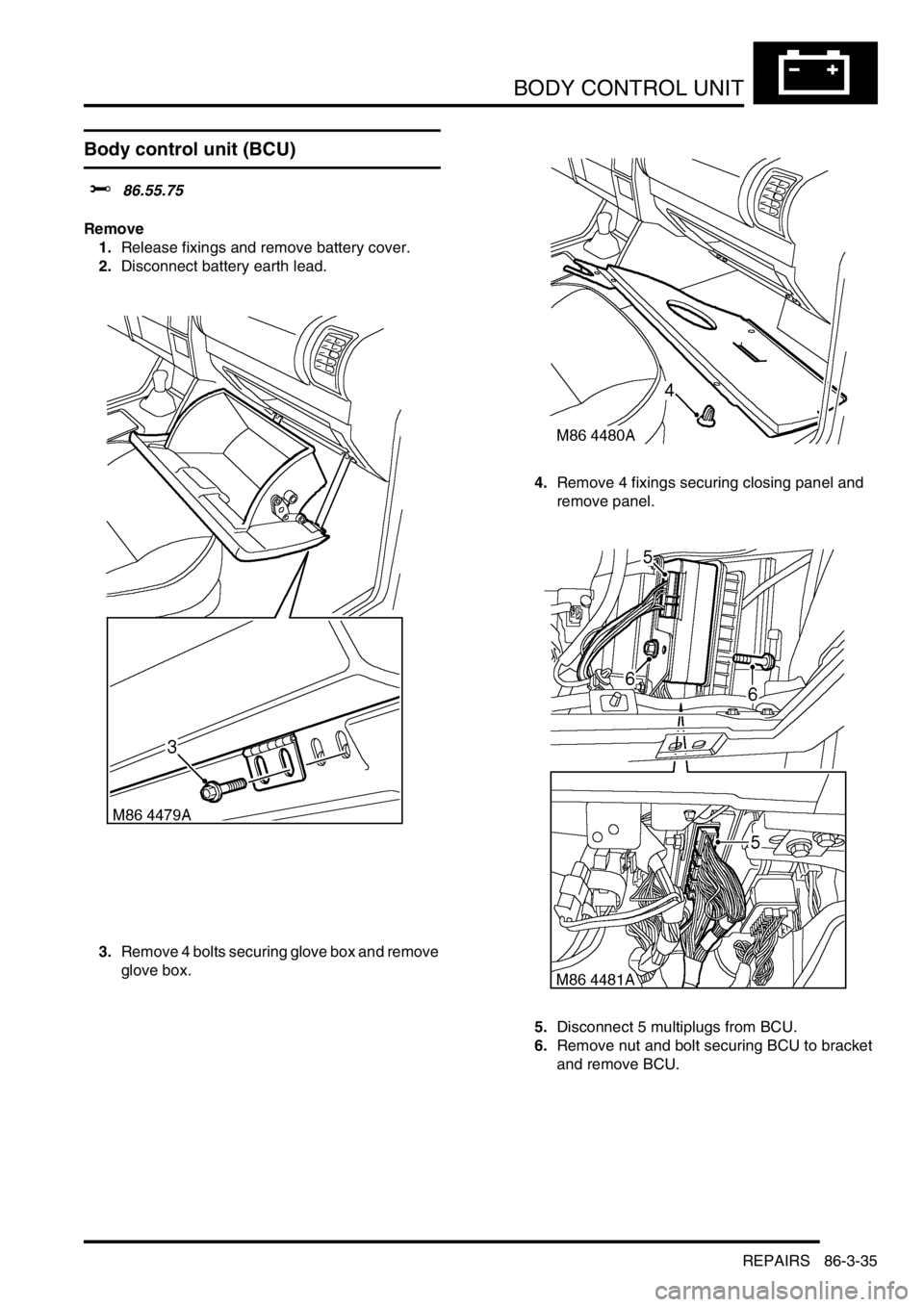
1.Release fixings and remove battery cover.
2.Disconnect battery earth lead.
3.Remove 4 bolts securing glove box and remove
glove box. 4.Remove 4 fixings securing closing panel and
remove panel.
5.Disconnect 5 multiplugs from BCU.
6.Remove nut and bolt securing BCU to bracket
and remove BCU.
Page 1323 of 1529
BODY CONTROL UNIT
86-3-36 REPAIRS
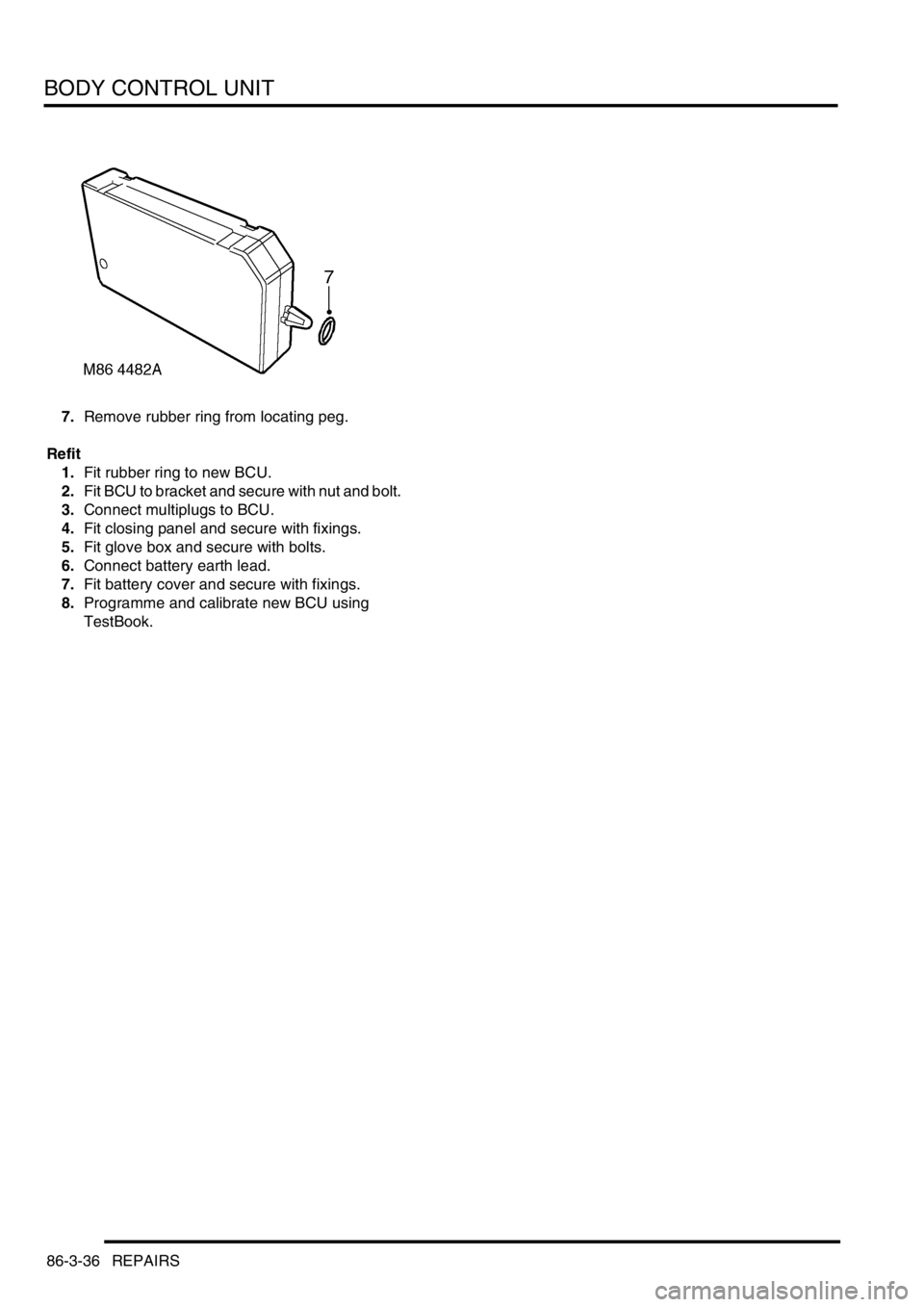
7.Remove rubber ring from locating peg.
Refit
1.Fit rubber ring to new BCU.
2.Fit BCU to bracket and secure with nut and bolt.
3.Connect multiplugs to BCU.
4.Fit closing panel and secure with fixings.
5.Fit glove box and secure with bolts.
6.Connect battery earth lead.
7.Fit battery cover and secure with fixings.
8.Programme and calibrate new BCU using
TestBook.