1999 LAND ROVER DISCOVERY battery
[x] Cancel search: batteryPage 1177 of 1529
HEATING AND VENTILATION
80-20REPAIRS
Servo - air temperature control
$% 80.10.42
Remove
1.Disconnect battery earth lead.
2. Driver side: Remove heater assembly.
+ HEATING AND VENTILATION,
REPAIRS, Heater assembly - models with
air conditioning.
3. Passenger side: Remove blower assembly.
+ HEATING AND VENTILATION,
REPAIRS, Blower assembly.
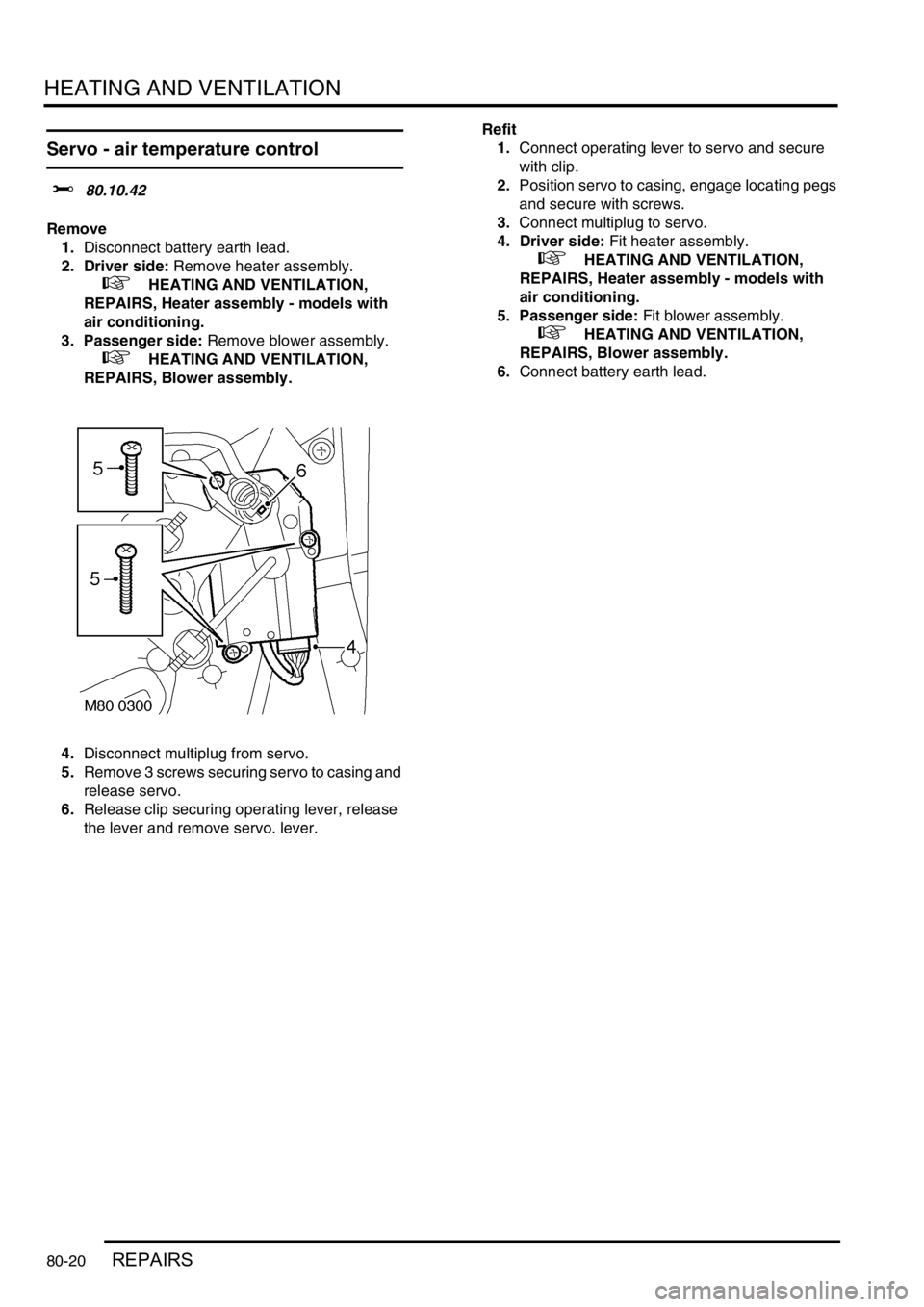
4.Disconnect multiplug from servo.
5.Remove 3 screws securing servo to casing and
release servo.
6.Release clip securing operating lever, release
the lever and remove servo. lever. Refit
1.Connect operating lever to servo and secure
with clip.
2.Position servo to casing, engage locating pegs
and secure with screws.
3.Connect multiplug to servo.
4. Driver side: Fit heater assembly.
+ HEATING AND VENTILATION,
REPAIRS, Heater assembly - models with
air conditioning.
5. Passenger side: Fit blower assembly.
+ HEATING AND VENTILATION,
REPAIRS, Blower assembly.
6.Connect battery earth lead.
Page 1183 of 1529
HEATING AND VENTILATION
80-26REPAIRS
Blower assembly
$% 80.20.12
Remove
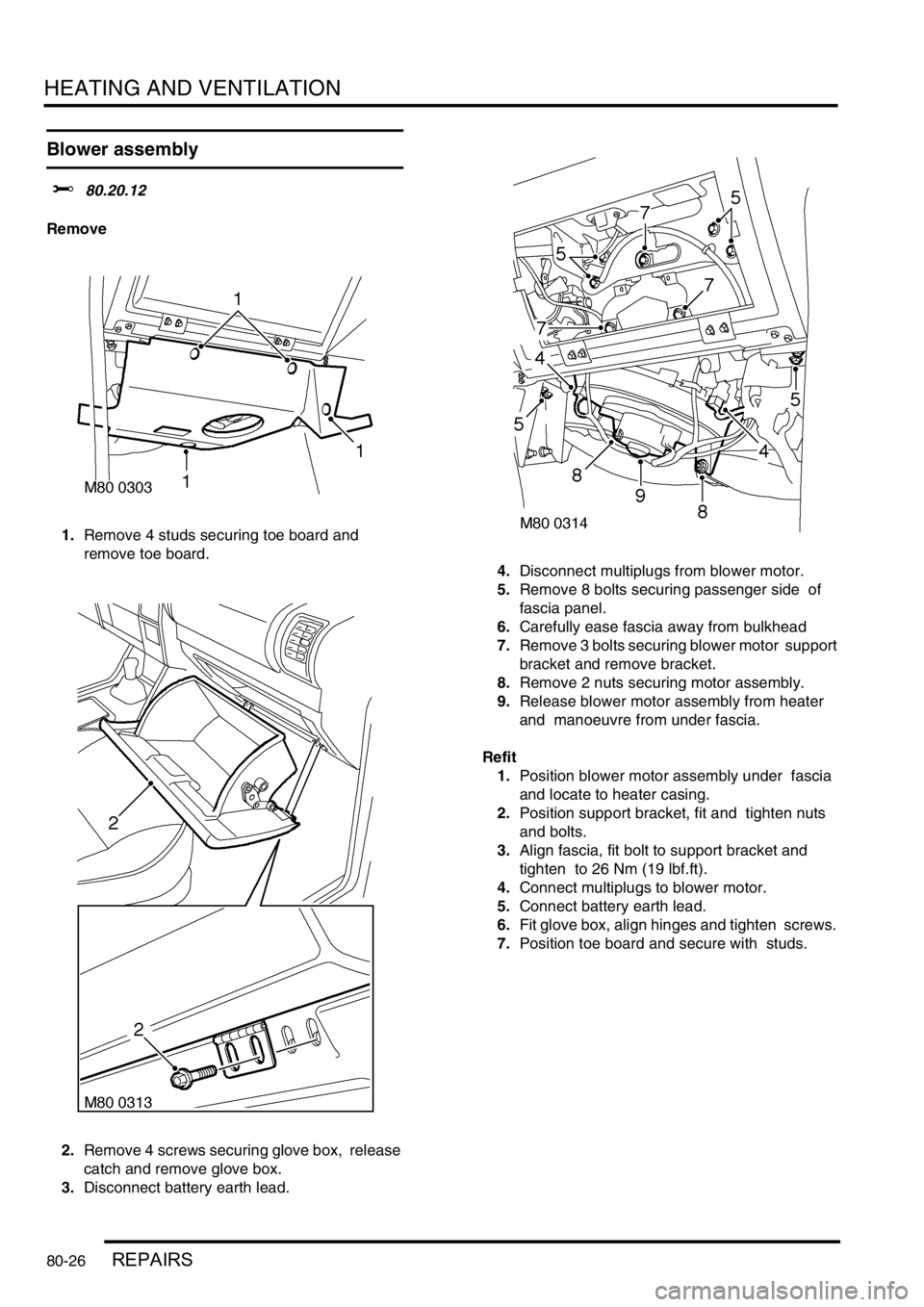
1.Remove 4 studs securing toe board and
remove toe board.
2.Remove 4 screws securing glove box, release
catch and remove glove box.
3.Disconnect battery earth lead.4.Disconnect multiplugs from blower motor.
5.Remove 8 bolts securing passenger side of
fascia panel.
6.Carefully ease fascia away from bulkhead
7.Remove 3 bolts securing blower motor support
bracket and remove bracket.
8.Remove 2 nuts securing motor assembly.
9.Release blower motor assembly from heater
and manoeuvre from under fascia.
Refit
1.Position blower motor assembly under fascia
and locate to heater casing.
2.Position support bracket, fit and tighten nuts
and bolts.
3.Align fascia, fit bolt to support bracket and
tighten to 26 Nm (19 lbf.ft).
4.Connect multiplugs to blower motor.
5.Connect battery earth lead.
6.Fit glove box, align hinges and tighten screws.
7.Position toe board and secure with studs.
Page 1188 of 1529
HEATING AND VENTILATION
REPAIRS 80-31
Fuel burning heater - (FBH) - Td5
$% 80.40.01.99
Remove
1.Release fixings and remove battery cover.
2.Disconnect battery earth lead.
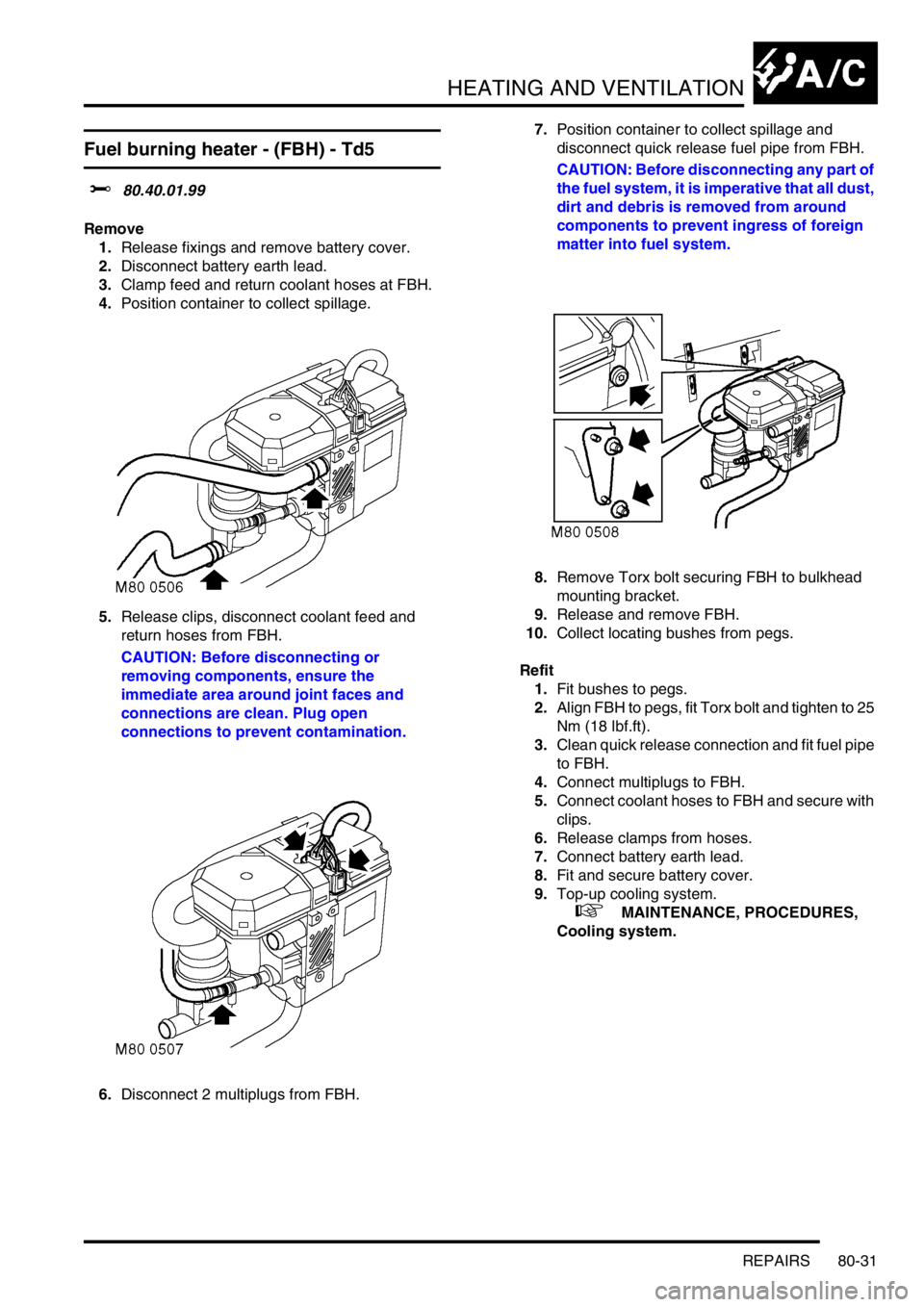
3.Clamp feed and return coolant hoses at FBH.
4.Position container to collect spillage.
5.Release clips, disconnect coolant feed and
return hoses from FBH.
CAUTION: Before disconnecting or
removing components, ensure the
immediate area around joint faces and
connections are clean. Plug open
connections to prevent contamination.
6.Disconnect 2 multiplugs from FBH.7.Position container to collect spillage and
disconnect quick release fuel pipe from FBH.
CAUTION: Before disconnecting any part of
the fuel system, it is imperative that all dust,
dirt and debris is removed from around
components to prevent ingress of foreign
matter into fuel system.
8.Remove Torx bolt securing FBH to bulkhead
mounting bracket.
9.Release and remove FBH.
10.Collect locating bushes from pegs.
Refit
1.Fit bushes to pegs.
2.Align FBH to pegs, fit Torx bolt and tighten to 25
Nm (18 lbf.ft).
3.Clean quick release connection and fit fuel pipe
to FBH.
4.Connect multiplugs to FBH.
5.Connect coolant hoses to FBH and secure with
clips.
6.Release clamps from hoses.
7.Connect battery earth lead.
8.Fit and secure battery cover.
9.Top-up cooling system.
+ MAINTENANCE, PROCEDURES,
Cooling system.
Page 1200 of 1529
AIR CONDITIONING
DESCRIPTION AND OPERATION 82-11
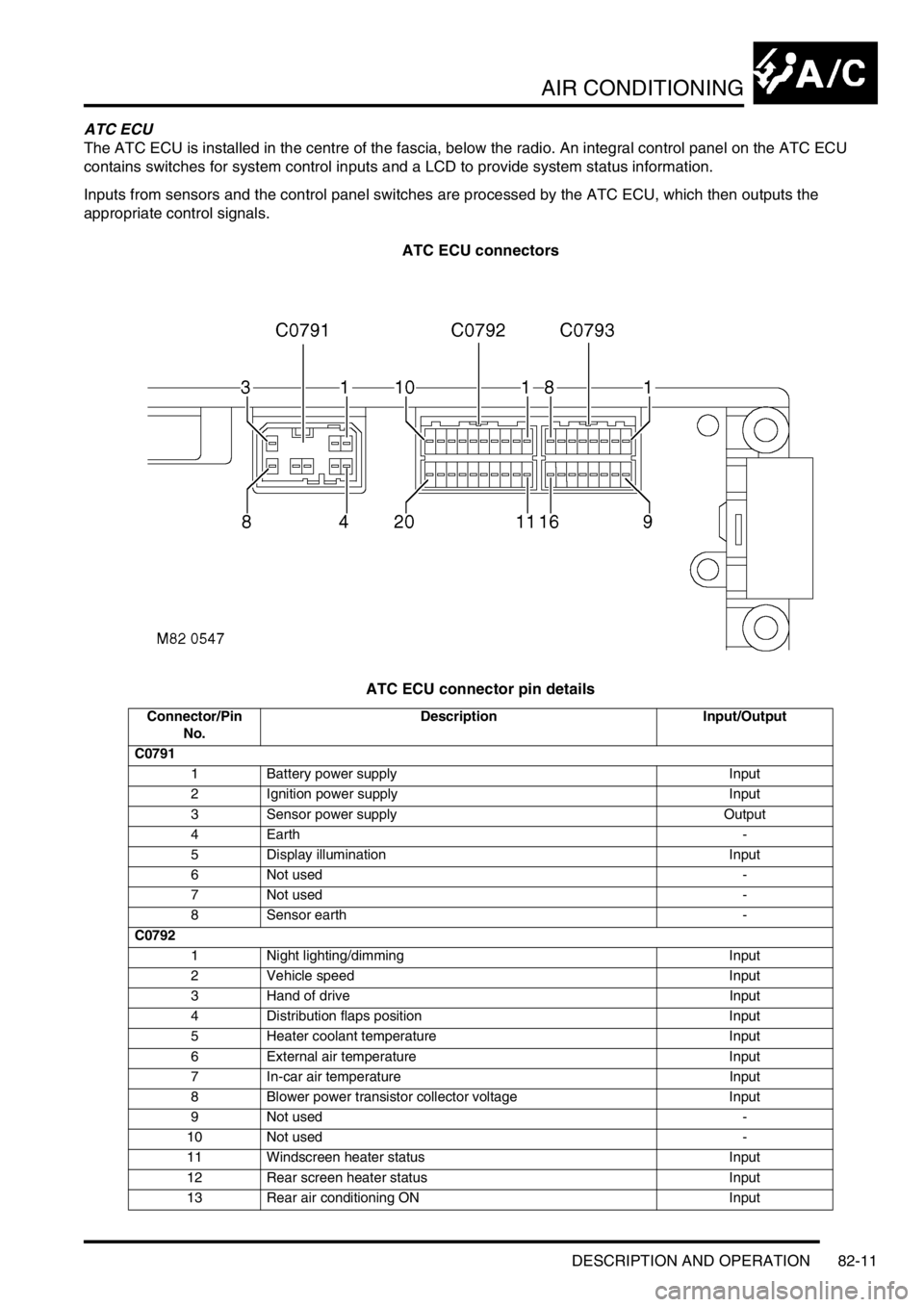
ATC ECU
The ATC ECU is installed in the centre of the fascia, below the radio. An integral control panel on the ATC ECU
contains switches for system control inputs and a LCD to provide system status information.
Inputs from sensors and the control panel switches are processed by the ATC ECU, which then outputs the
appropriate control signals.
ATC ECU connectors
ATC ECU connector pin details
Connector/Pin
No.Description Input/Output
C0791
1 Battery power supply Input
2 Ignition power supply Input
3 Sensor power supply Output
4Earth -
5 Display illumination Input
6 Not used -
7 Not used -
8 Sensor earth -
C0792
1 Night lighting/dimming Input
2 Vehicle speed Input
3 Hand of drive Input
4 Distribution flaps position Input
5 Heater coolant temperature Input
6 External air temperature Input
7 In-car air temperature Input
8 Blower power transistor collector voltage Input
9 Not used -
10 Not used -
11 Windscreen heater status Input
12 Rear screen heater status Input
13 Rear air conditioning ON Input
Page 1207 of 1529

AIR CONDITIONING
82-18DESCRIPTION AND OPERATION
Air distribution control
To control the air distribution within the cabin the ATC ECU signals the servo motor controlling the distribution flaps
in the heater assembly to move to the flaps to the appropriate position.
In the automatic and economy modes, if the LH or RH temperature selections are set to LO or HI, air distribution is
fixed as follows:
lIf one is set to LO and one is set to a specific temperature, to face level only.
lIf one is set to HI and one is set to a specific temperature, to footwells only.
lIf one is set to LO and one is set to HI, to face level and footwells.
When specific LH and RH temperature selections are set, air distribution is determined from the target air outlet
temperatures. For higher target air outlet temperatures, air distribution is set to footwells only. For lower target air
outlet temperatures, air distribution is set to face level only. For intermediate target air outlet temperatures, air
distribution is set to face level and footwells. When the air distribution is set to face level and footwells, the ATC ECU
varies the bias between the footwells and the face level outlets, in three stages, to provide a gradual transition of air
distribution from footwells only to face level only. The three stages of bias are also employed when the air distribution
is manually selected to face level and footwells.
During warm-up, the air distribution changes to face level and footwells for a period, then reverts to footwells only.
The period of air distribution at face level and footwells can be cancelled by pressing and holding the on/off and defrost
mode switches, then turning the ignition switch from off to on. Pressing and holding the AUTO and defrost switches,
then turning the ignition switch from off to on, restores the period of air distribution at face level and footwells.
Compressor control
To engage the compressor clutch, the ATC ECU outputs a compressor clutch request to the ECM, which then
energises the A/C compressor clutch relay. Compressor operation is governed by the evaporator outlet air
temperature, at one of two settings, dependent on the amount of cooling required. When more cooling is required, the
compressor clutch request is output if evaporator outlet air temperature increases to 4 °C (39 °F) and cancelled when
it decreases to 3 °C (37 °F). When less cooling is required, the compressor clutch request is output if evaporator outlet
air temperature increases to 11 °C (52 °F) and cancelled when it decreases to 10 °C (50 °F).
Engine cooling fan control
While the A/C system is on, operation of the electric engine cooling fan, to assist refrigerant condenser operation, is
determined by a combination of vehicle speed and external air temperature. When cooling fan operation is required,
the ATC ECU outputs a cooling fan request to the ECM, which then energises the cooling fan relay. The cooling fan
request is output if vehicle speed is 80 km/h or less while the external air temperature is 28 °C (82 °F) or more. The
request is cancelled, and the cooling fan switched off, if either the vehicle speed increases to 100 km/h, or the external
air temperature decreases to 25 °C (77 °F).
Default settings
If the battery power supply to the ATC ECU is disrupted for any reason, e.g. battery disconnected, the system reverts
to default settings when the battery power supply is restored. Default settings are:
lTemperature indications in °C (in some markets a conversion connector is fitted to the ATC ECU to change the
default temperature scale to °F).
lLH and RH outlet temperatures of 22 °C (72 °F).
laudible warning switched on.
lWarm-up air distribution (to face level and footwells) function switched on.
lIf the system is first switched on using the A/C on/off switch, the automatic mode is engaged, regardless of the
settings in use when the battery was disconnected.
Page 1214 of 1529

AIR CONDITIONING
DESCRIPTION AND OPERATION 82-25
Blower
The blower controls the volume of air being supplied to the distribution outlets. The blower is an open hub, centrifugal
fan powered by an electric motor. A dust filter is installed over the fan inlet. The blower switch on the control panel
and the resistor pack control the operation of the blower, which can be selected to run at one of four speeds.
Resistor pack
The resistor pack supplies reduced voltages to the blower motor for blower speeds 1, 2 and 3. For blower speed 4,
the resistor pack is bypassed and battery voltage drives the motor at full speed. The pack is installed in the air outlet
from the blower fan, so that any heat generated is dissipated by the air flow.
Distribution system
Air ducts
Ducts connected to the rear evaporator/blower motor assembly distribute air to five vent assemblies in the roof.
Vent assemblies
The vent assemblies allow occupants to control the flow and direction of air. Each vent assembly incorporates a
thumbwheel to regulate flow and moveable vanes to control direction.
Rear control system
The control system operates the blower to control the operation of the rear A/C. The control system consists of two
control switches and a rear blower relay.
Control switches
A rear A/C switch and a blower speed switch are installed on a control panel in the roof lining. The A/C switch is a
latching pushswitch with an amber indicator lamp which illuminates when rear A/C is selected on. The blower speed
switch is a slide switch with a positive detent at each of four speed positions (there is no off position).
Rear blower relay
The rear blower relay controls the electrical supply to the blower.
Page 1215 of 1529

AIR CONDITIONING
82-26DESCRIPTION AND OPERATION
Operation
The rear A/C only operates if the front A/C is on to pump refrigerant through the rear evaporator/blower assembly.
When the rear A/C switch is selected on, the indicator lamp in the switch illuminates and the rear blower relay is
energised. The rear blower relay switches battery power to the blower motor, which runs at the speed selected on the
blower speed switch.
The air from the blower passes through the evaporator matrix, which absorbs heat from the air. The cooled air is then
supplied to the roof vents through the distribution ducts. The heat absorbed by the refrigerant in the evaporator is
sensed by the thermostatic expansion valve. The thermostatic expansion valve then opens and regulates the flow of
refrigerant through the evaporator in proportion to the amount of heat being absorbed from the air.
When the rear A/C switch is selected off, the blower stops. The thermostatic expansion valve senses the subsequent
decrease in temperature of the refrigerant in the evaporator. The thermostatic expansion valve then closes and stops
the flow of refrigerant, except for a minimal bleed flow.
Page 1244 of 1529
WIPERS AND WASHERS
DESCRIPTION AND OPERATION 84-9
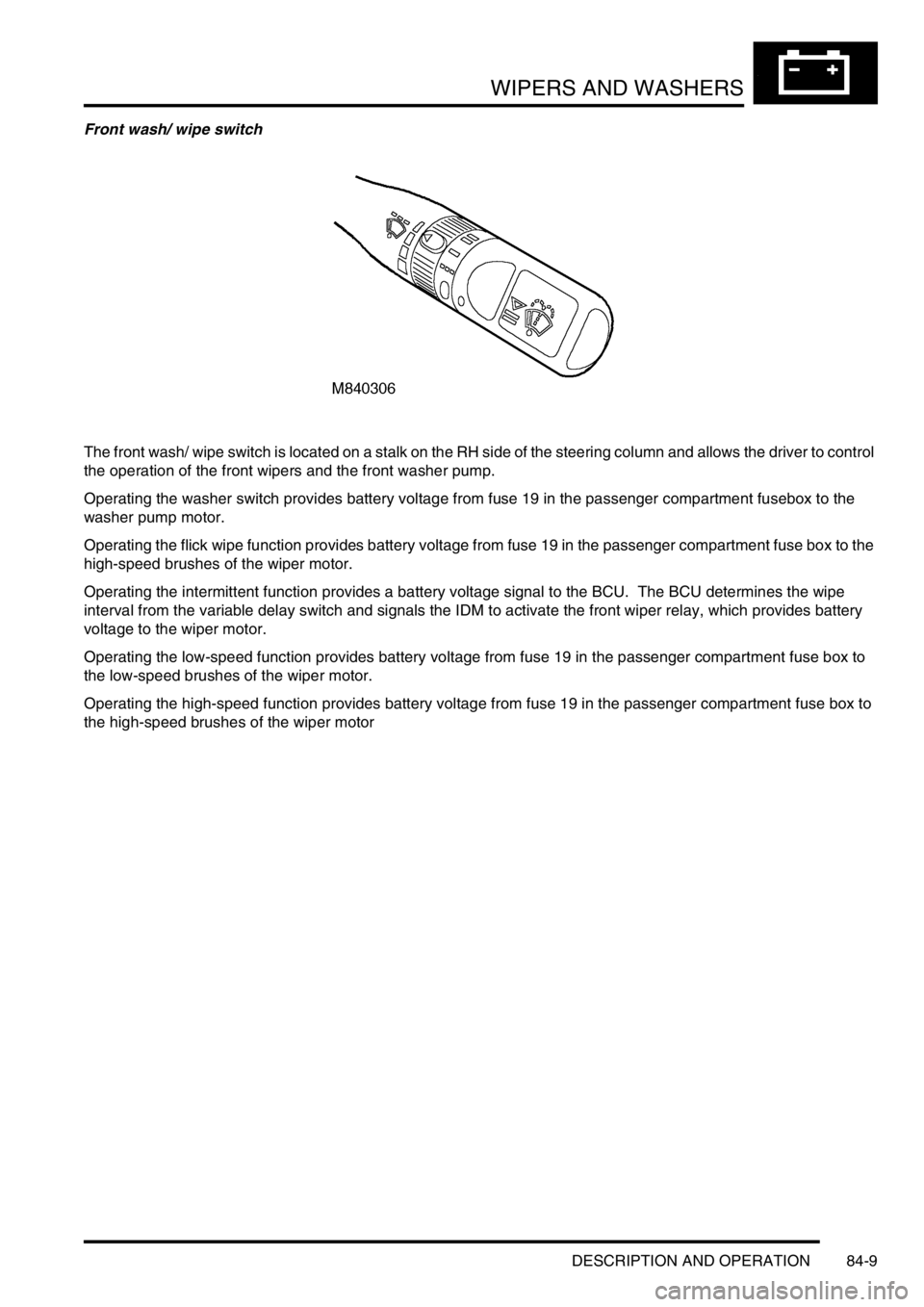
Front wash/ wipe switch
The front wash/ wipe switch is located on a stalk on the RH side of the steering column and allows the driver to control
the operation of the front wipers and the front washer pump.
Operating the washer switch provides battery voltage from fuse 19 in the passenger compartment fusebox to the
washer pump motor.
Operating the flick wipe function provides battery voltage from fuse 19 in the passenger compartment fuse box to the
high-speed brushes of the wiper motor.
Operating the intermittent function provides a battery voltage signal to the BCU. The BCU determines the wipe
interval from the variable delay switch and signals the IDM to activate the front wiper relay, which provides battery
voltage to the wiper motor.
Operating the low-speed function provides battery voltage from fuse 19 in the passenger compartment fuse box to
the low-speed brushes of the wiper motor.
Operating the high-speed function provides battery voltage from fuse 19 in the passenger compartment fuse box to
the high-speed brushes of the wiper motor