1999 DODGE RAM clock
[x] Cancel search: clockPage 824 of 1691

pointer is at one o'clock position. Push in on knob slightly and
continue rotating knob to its full clockwise stop. Place knob pointer
at a position about .32" (8 mm) beyond end of Red stripe. Release
knob. If knob is pointing at about .32" (8 mm) beyond end of Red
stripe, go to next step. If knob is not pointing at about .32" (8 mm)
beyond end of Red stripe, go back to step 2) and repeat adjustment
procedure.
4) Rotate temperature control knob counterclockwise so that
knob pointer is at 12 o'clock position. Push temperature control knob
straight into heater control panel until perimeter of knob (not knob
pointer) is flush with base of heater control panel.
5) Rotate temperature control knob to its full clockwise
stop. Release knob. Knob pointer should be aimed at end of Red stripe.
If knob is pointed at end of Red stripe, go to next step. If knob is
not pointed at end of Red stripe, go back to step 2) and repeat
adjustment procedure.
6) Rotate temperature control knob to its full
counterclockwise stop. Release knob. If knob springs back, self-
adjuster clip securing temperature control cable to blend-air door
lever is improperly installed. See TEMPERATURE CONTROL CABLE R & I
under REMOVAL & INSTALLATION. If knob does not springs back,
temperature control cable adjustment is complete.
TROUBLE SHOOTING
HEATER PERFORMANCE
Check cooling system. Check serpentine drive belt tension.
Check radiator and radiator fan operation. Ensure that accessory
vacuum supply line is connected at power brake booster (Dakota) or
engine vacuum source (except Dakota).
TESTING
WARNING: To avoid injury from accidental air bag deployment, read and
carefully follow all SERVICE PRECAUTIONS and DISABLING &
ACTIVATING AIR BAG SYSTEM procedures in AIR BAG SYSTEM SAFETY
article.
BLOWER MOTOR RELAYS
1) Blower motor relay is located in Power Distribution Center
(PDC). On Ram Van/Wagon, high speed blower motor relay is located in
engine compartment (on side of heater assembly). On all models,
disconnect negative battery cable. Remove blower motor relay. Using an
ohmmeter, check for continuity between terminals No. 87A and 30 of
relay. See Fig. 1. If continuity does not exist, replace relay. If
continuity exists, go to next step.
2) Using an ohmmeter, check for continuity between terminals
No. 30 and 87 of relay. If continuity exists, replace relay. If
continuity does not exist, go to next step.
3) Measure resistance between terminals No. 85 and 86 of
relay. Reading should be 70-80 ohms. If reading is not as specified,
replace relay. If reading is as specified, go to next step.
4) Using jumper wires, connect battery voltage to terminal
No. 86 and ground terminal No. 85. See Fig. 1. Check that continuity
exists between terminals No. 30 and 87. Check that continuity does not
exist between terminals No. 87A and 30. If continuity is not as
specified, replace blower motor relay. If continuity is as specified,
relay is okay.
Page 850 of 1691
 Switch ................... Cruise Control Systems\
Engine Performance
Shift Int")
Brake On/Off (BOO) Switch ................... Cruise Control Systems\
Engine Performance
Shift Interlock Systems
Buzzer Module ...................................... Warning Systems
Camshaft Position (CMP) Sensor .................. Engine Performance\
Central Control Module ........................... Anti-Theft System
Clockspring ............................... Air Bag Restraint System
Cruise Control Systems
Steering Column Switches
Clutch Pedal Position Switch .............................. Starters
Clutch Start Switch ....................................... Starters
Combination Meter ......................... Analog Instrument Panels
Constant Control Relay Module (CCRM) ............ Engine Performance\
Electric Cooling Fans
Convenience Center .............................. Power Distribution
Illumination/Interior Lights
Convertible Top Motor ........................ Power Convertible Top
Convertible Top Switch ....................... Power Convertible Top
Crankshaft Position (CKP) Sensor ................ Engine Performance\
Cruise Control Module ....................... Cruise Control Systems
Cruise Control Switch ....................... Cruise Control Systems
Condenser Fan Relay(s) ....................... Electric Cooling Fans\
Data Link Connector (DLC) ....................... Engine Performance\
Daytime Running Lights Module ............... Daytime Running Lights
Exterior Lights
Defogger Relay ................................ Rear Window Defogger
Diagnostic Energy Reserve Module (DERM) ... Air Bag Restraint System\
Discriminating Sensor (Air Bag) ........... Air Bag Restraint System\
Distributor ..................................... Engine Performance
Door Lock Actuators ............................... Power Door Locks
Remote Keyless Entry
Door Lock Relay(s) ................................ Power Door Locks\
Electrochromic Mirror ................................ Power Mirrors
Electronic Level Control (ELC)
Height Sensor .............................. Electronic Suspension
Electronic Level Control (ELC) Module ........ Electronic Suspension\
Engine Coolant Temperature (ECT)
Sending Unit ............................ Analog Instrument Panels
Engine Coolant Temperature (ECT) Sensor ......... Engine Performance\
Engine Control Module ........................... Engine Performance
Generators & Regulators
Starters
ETACS ECU .......................................... Warning Systems
Power Windows
Remote Keyless Entry
Evaporative (EVAP) Emissions Canister ........... Engine Performance\
EVAP Canister Purge Solenoid .................... Engine Performance
EVAP Canister Vent Solenoid ..................... Engine Performance
Exhaust Gas Recirculation (EGR) Valve ........... Engine Performance\
Fuel Tank Vacuum Sensor ......................... Engine Performance
Fog Lights ....................................... Headlight Systems
Daytime Running Lights
Fog Light Relay .................................. Headlight Systems
Daytime Running Lights
Fuel Door Release Solenoid ................. Power Fuel Door Release
Fuel Gauge Sending Unit ................... Analog Instrument Panels
Fuel Injectors .................................. Engine Performance
Fuel Pump ....................................... Engine Performance
Fuel Pump Relay ................................. Engine Performance
Power Distribution
Fuse/Relay Block ................................ Power Distribution
Fusible Links ................................... Power Distribution
Generators & Regulators
Page 852 of 1691

Parking Brake Switch ...................... Analog Instrument Panels
Park Lights ........................................ Exterior Lights
Park/Neutral Position Switch .............................. Starters
Engine Performance
Anti-Theft System
Body Control Module
Perimeter Lighting Control Relay ................... Exterior Lights
Power Amplifier ..................................... Power Antennas
Power Antenna Module ................................ Power Antennas
Power Antenna Motor ................................. Power Antennas
Power Distribution Center ....................... Power Distribution
Generators & Regulators
Starters
Power Door Lock Motors ............................ Power Door Locks
Power Mirror Motors .................................. Power Mirrors
Memory Systems
Power Sliding Door Controller .............. Power Sliding Side Door
Power Seat Motors ...................................... Power Seats
Memory Systems
Power Steering Pressure Switch .................. Engine Performance
Power Top Motor .............................. Power Convertible Top
Power Top Relay(s) ........................... Power Convertible Top\
Powertrain Control Module ....................... Engine Performance
Analog Instrument Panels
Cruise Control Systems
Data Link Connectors
Generators & Regulators
Starters
Power Window Motors .................................. Power Windows
Power Window Relay(s) ................................ Power Windows\
Radiator Fan Motor(s) ........................ Electric Cooling Fans\
Radiator Fan Relay(s) ........................... Engine Performance\
Electric Cooling Fans
Rainsense Module .............................. Wiper/Washer Systems
Raise Relay .................................. Power Convertible Top
Remote Anti-Theft Personality (RAP) Module ....... Anti-Theft System\
Starters
Warning Systems
Seat Belt Pretensioners ................... Air Bag Restraint System
Seat Belt Retractor Solenoid .................... Passive Restraints
Seat Belt Switch .......................... Air Bag Restraint System
Passive Restraints
Shift Interlock Solenoid ................... Shift Interlock Systems
Shift Lock Actuator ........................ Shift Interlock Systems
Side Marker Lights ................................. Exterior Lights
SIR Coil Assembly (Clockspring) ........... Air Bag Restraint System\
Slip Ring (Clockspring) ................... Air Bag Restraint System\
Steering Column Switches
SRS Control Module ........................ Air Bag Restraint System
Starter Motor ............................................. Starters
Starter Interrupt Relay ................................... Starters
Starter Solenoid .......................................... Starters
Starter Relay ............................................. Starters
Steering Wheel Position Sensor .................... Anti-Lock Brakes
Stoplights ......................................... Exterior Lights
Stoplight Switch ................................ Engine Performance
Cruise Control Systems
Anti-Lock Brakes
Sun Roof ECU ........................................ Power Sun Roof
Sun Roof Motor ...................................... Power Sun Roof
Sun Roof Position Sensor ............................ Power Sun Roof
Taillights ......................................... Exterior Lights
Throttle Position (TP) Sensor ................... Engine Performance\
Page 898 of 1691

F1 - Not Used
F2 - 30 Amp (Lt. Green)
Blower Motor
CB1 - 30 Amp (Circuit Breaker)
Power Windows
CB2 - 30 Amp (Circuit Breaker)
Power Seats
1 - 20 Amp (Yellow)
Power Outlet
2 - Not Used
3 - Not Used
4 - Not Used
5 - 20 Amp (Yellow)
Cigar Lighter
6 - 20 Amp (Yellow)
Turn Signal Flasher
7 - 15 Amp (Lt. Blue)
Radio
8 - 20 Amp (Yellow)
Windshield Wipers
9 - 10 Amp (Red)
Fuel Pump Relay, A/C Compressor Clutch Relay
Automatic Shutdown Relay, Transmission Overdrive
Solenoid, EGR Solenoid, Powertrain Control Module (PCM)
Ignition Module
High Pressure Fuel Shut-Off Solenoid Relay (CNG Models Only)
EGR Solenoid (CNG Models Only)
10 - Not Used
Vehicle Speed Control
11 - 10 Amp (Red)
Buzzer, Overhead Console
12 - 15 Amp (Lt. Blue)
Airbag Diagnostic Module, Cluster, Message Center,
13 - 5 Amp (Tan)
Illumination
14 - 20 Amp (Yellow)
RWAL and ABS Module
15 - 15 Amp (Lt. Blue)
Automatic Day/Night Mirror, Back-up Lights,
Daytime Running Lamps
16 - 15 Amp (Lt. Blue)
Airbag Diagnostic Module
17 - 15 Amp (Lt. Blue)
Ignition Off Draw, Radio and Clock Memory
18 - 15 Amp (Lt. Blue)
Parking Lamps
19 - 20 Amp (Yellow)
Power Door Locks
20 - 15 Amp (Lt. Blue)
Stop Lamps
POWER DISTRIBUTION CENTER
Page 934 of 1691

Apply light coat of engine oil on NEW .060" (1.5 mm) thick Copper
sealing washer. Install NEW Copper sealing washer on spray tip of fuel
injector. Engine oil is used to aid holding sealing washer in place.
Install new "O" ring on fuel injector. Apply small amount of engine
oil to "O" ring.
2) Ensure fuel inlet hole on side of fuel injector is
positioned toward injector connector tube. Install injector into
cylinder head bore using care not to allow injector tip to touch sides
of bore. Press fuel injector into cylinder head with finger pressure
only. Install fuel injector hold down clamp into shouldered bolt while
aligning slot in top of injector into groove in bottom of clamp.
Tighten opposite clamp bolt to specification. See TORQUE
SPECIFICATIONS.
3) Apply small amount of clean engine oil to NEW "O" ring.
Install "O" ring to fuel injector connector tube. Using finger
pressure only, press injector connector tube into cylinder head.
Connect and tighten high pressure fuel lines to specification. See
TORQUE SPECIFICATIONS.
NOTE: Fuel line fitting torque is important. Mating surfaces will
not seal if fuel line fitting is under or over-torqued.
4) To install remaining components, reverse removal
procedure. Tighten bolts to specification. See TORQUE SPECIFICATIONS.
Bleed high-pressure fuel lines. See FUEL LINE BLEEDING under FUEL
SYSTEM.
FUEL INJECTION PUMP
CAUTION: High-pressure fuel lines must be clamped securely and routed
so they do not contact each other or any other components. DO
NOT weld or substitute high-pressure fuel lines. High
-pressure lines are same length and proper high-pressure fuel
line must be installed in specified area for proper engine
operation.
Removal
1) Disconnect negative battery cables. Clean fuel lines at
cylinder head and injection pump. Clean fuel injection pump and fuel
lines at side of pump. Disconnect 9-pin electrical connector at Fuel
Pump Control Module (FPCM). Place a rag around overflow valve to catch\
excess fuel. Remove overflow valve and disconnect fuel return line.
Remove banjo bolts and fuel supply line at side of injection pump and
top of fuel filter housing.
2) Remove all high pressure fuel lines, intake air tube,
accelerator pedal position sensor, air intake housing, engine oil
dipstick tube, wiring clips, electrical connectors at intake heaters,
and engine lifting bracket. Unscrew plastic access cap at front gear
cover. Remove injection pump gear-to-injection pump shaft nut and
washer.
3) Engine may be rotated by removing dust plug from
transmission adapter plate and installing Engine Barring Tool (Snap-On
SP371) in transmission adapter plate. See Fig. 9. Rotate engine until
keyway is at 12 o'clock position.
Page 935 of 1691
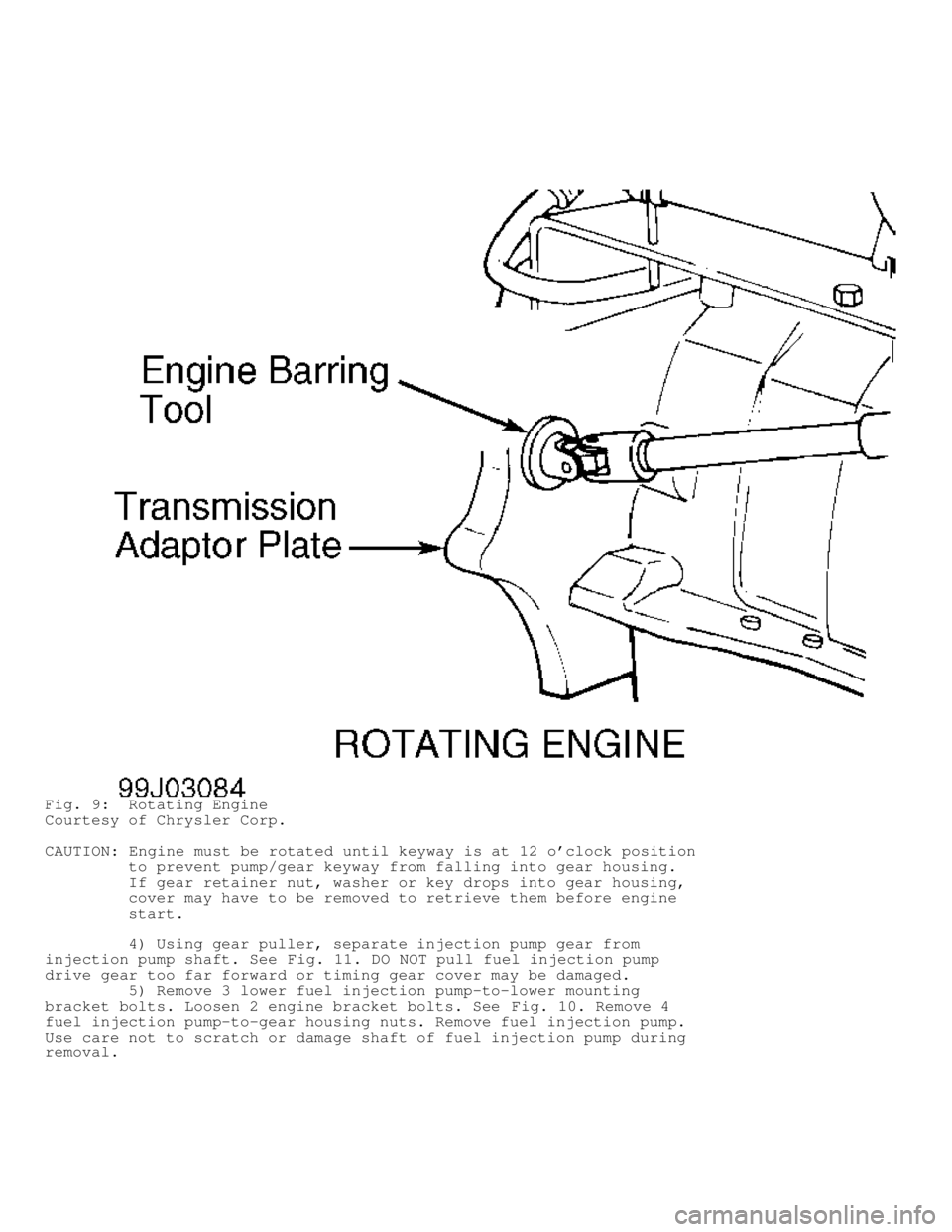
Fig. 9: Rotating Engine
Courtesy of Chrysler Corp.
CAUTION: Engine must be rotated until keyway is at 12 o'clock position
to prevent pump/gear keyway from falling into gear housing.
If gear retainer nut, washer or key drops into gear housing,
cover may have to be removed to retrieve them before engine
start.
4) Using gear puller, separate injection pump gear from
injection pump shaft. See Fig. 11. DO NOT pull fuel injection pump
drive gear too far forward or timing gear cover may be damaged.
5) Remove 3 lower fuel injection pump-to-lower mounting
bracket bolts. Loosen 2 engine bracket bolts. See Fig. 10. Remove 4
fuel injection pump-to-gear housing nuts. Remove fuel injection pump.
Use care not to scratch or damage shaft of fuel injection pump during
removal.
Page 944 of 1691

Procedure For Programming PCM & Clearing DTCs From ABS & SRS
Modules
Connect scan tool to Data Link Connector (DLC). DLC is
located under left side of instrument panel. Using scan tool, enter
correct VIN and mileage into PCM. Using scan tool manufacturer's
instructions, clear DTCs from ABS and SRS modules.
Procedure For Updating Secret Key Data
1) Connect scan tool to Data Link Connector (DLC). DLC is
located under left side of instrument panel.
2) Go to ENGINE and then MISC menus on scan tool. Place the
SKIM in SECURED ACCESS MODE by using the appropriate Personal
Identification Number (PIN) for this vehicle. PIN may be obtained from\
the owner, vehicle's invoice, or from the manufacturer. Select UPDATE
THE SECRET KEY DATA. The data will be transferred from Smart Key
Immobilizer Module (SKIM) to the PCM, allowing the vehicle to start.
NOTE: On Ram Van and Ram Wagon, if 3 attempts are made to enter the
SECURED ACCESS MODE using the incorrect Personal
Identification Number (PIN), the SECURED ACCESS MODE will be
locked out for one hour. To exit this locked out mode, leave
ignition switch in the ON position for one hour with all
accessories turned off. It may be necessary to monitor
battery state and connect a battery charger if necessary.
ENGINE SENSORS & SWITCHES
BATTERY TEMPERATURE SENSOR
Removal & Installation
Battery temperature sensor is snapped into center of battery
tray, directly below the battery. Remove battery. Disconnect
electrical connector for battery temperature sensor. Pry battery
temperature sensor straight upward from battery tray. To install,
reverse removal procedure.
BRAKE SWITCH
NOTE: Brake switch may also be referred to as brakelight switch or
stoplight switch.
Removal (Dakota, Durango & Ram Pickup)
1) Brake switch is located near top of brake pedal. Remove
lower instrument panel cover for access to brake switch if necessary.
Disconnect electrical connector from brake switch. Depress and hold
brake pedal downward.
2) Rotate brake switch counterclockwise approximately 30
degrees so alignment tab on brake switch aligns with opening on
mounting bracket. Pull brake switch rearward from mounting bracket.
NOTE: Before installing brake switch, plunger on brake switch must
be pulled outward to fully extended position and then pushed
inward 4 detent positions to ensure proper brake switch
adjustment.
Installation
1) Pull plunger on brake switch outward to the fully extended
position. Push plunger on brake switch inward 4 detent positions. The
brake switch will click at each detent position when pushing plunger
inward.
2) Install electrical connector on brake switch. Depress
brake pedal as far as possible. Install brake switch in mounting
Page 945 of 1691

bracket. Ensure alignment tab on brake switch aligns with opening on
mounting bracket.
CAUTION: When adjusting brake switch, DO NOT pull brake pedal back
toward brake switch with excessive pressure, or brake switch
may be damaged.
3) When brake switch is fully installed in mounting bracket,
rotate brake switch clockwise approximately 30 degrees. To ensure
proper brake switch adjustment, gently pull brake pedal back toward
brake switch as far as possible. DO NOT apply excessive pressure on
brake pedal and brake switch.
Removal (Ram Van & Ram Wagon)
1) Brake switch is located near top of brake pedal. Remove
lower steering column cover. Remove data link connector, hood release
lever and parking brake lever from lower instrument panel cover.
2) Remove lower instrument panel cover for access to brake
switch. Depress and hold brake pedal downward. Rotate brake switch
counterclockwise approximately 1/16 turn to so locking collar on brake
switch aligns with opening on mounting bracket. Pull brake switch
rearward from mounting bracket. Disconnect electrical connector from
brake switch.
NOTE: Before installing brake switch, plunger on brake switch must
be pulled outward to fully extended position and then pushed
inward 4 detent positions to ensure proper brake switch
adjustment.
Installation
1) Pull plunger on brake switch outward to the fully extended
position. Push plunger on brake switch inward 4 detent positions. The
brake switch will click at each detent position when pushing plunger
inward.
2) Install electrical connector on brake switch. Depress
brake pedal as far as possible. Install brake switch in mounting
bracket. Ensure locking collar on brake switch aligns with opening on
mounting bracket.
CAUTION: When adjusting brake switch, DO NOT pull brake pedal back
toward brake switch with excessive pressure, or brake switch
may be damaged.
3) When brake switch is fully installed in mounting bracket,
rotate brake switch clockwise approximately 1/16 turn. To ensure
proper brake switch adjustment, gently pull brake pedal back toward
brake switch as far as possible. DO NOT apply excessive pressure on
brake pedal and brake switch.
CAMSHAFT POSITION SENSOR
Removal & Installation
See CAMSHAFT POSITION SENSOR under IGNITION SYSTEM.
CRANKSHAFT POSITION SENSOR
Removal & Installation
See CRANKSHAFT POSITION SENSOR under IGNITION SYSTEM.
DOWNSTREAM OXYGEN SENSOR
NOTE: Downstream oxygen sensor may also be referred to as post
-catalyst oxygen sensor.