1999 DODGE RAM width
[x] Cancel search: widthPage 1481 of 1691
Fuel pump is a positive displacement, immersible pump with a
permanent magnet electric motor. Fuel is drawn in through a separate
filter/strainer at bottom of fuel pump and pushed through filter to
fuel outlet line (to fuel injectors). Voltage to operate pump is
supplied from fuel pump relay. On some models, fuel pump relay is
activated by ASD relay.
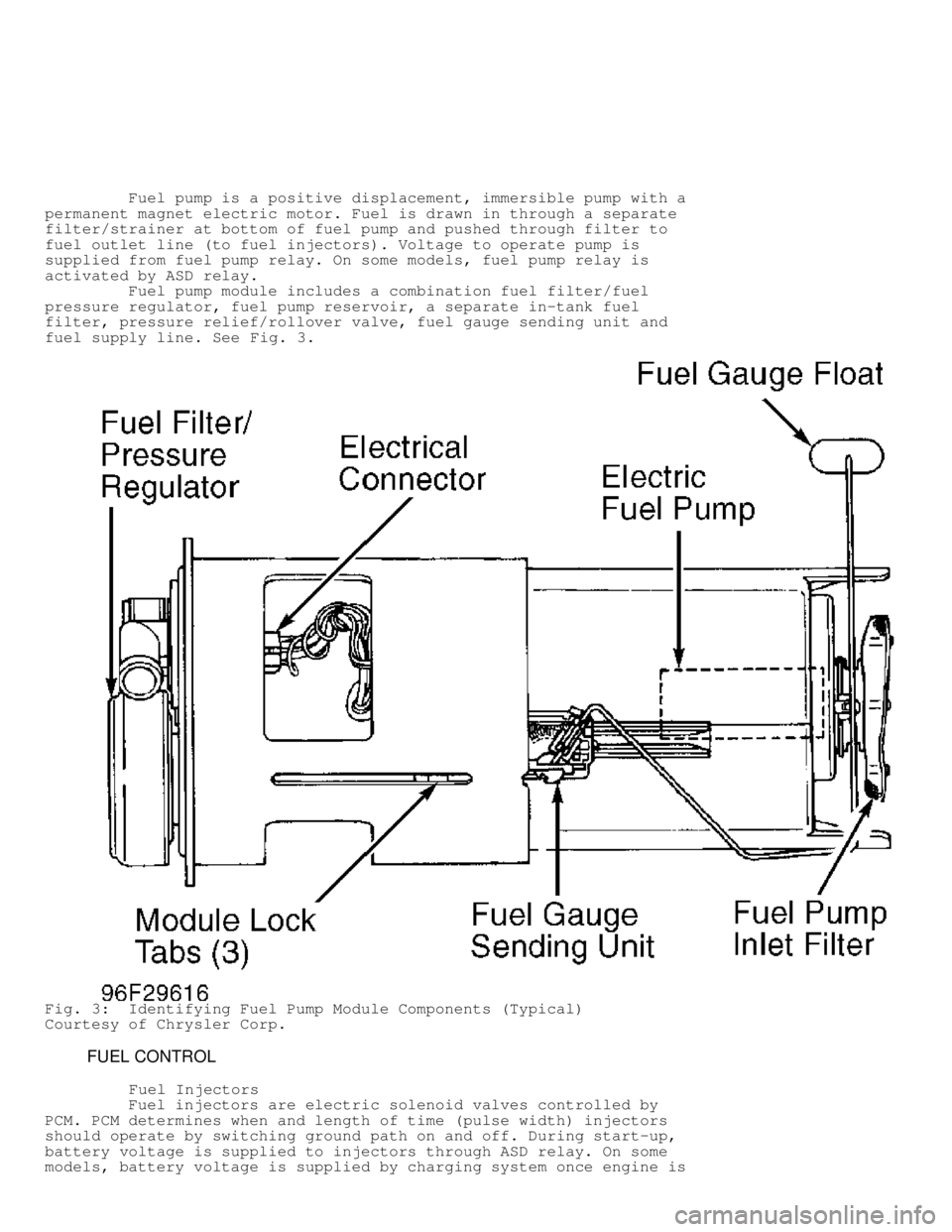
Fuel pump module includes a combination fuel filter/fuel
pressure regulator, fuel pump reservoir, a separate in-tank fuel
filter, pressure relief/rollover valve, fuel gauge sending unit and
fuel supply line. See Fig. 3.
Fig. 3: Identifying Fuel Pump Module Components (Typical)
Courtesy of Chrysler Corp.
FUEL CONTROL
Fuel Injectors
Fuel injectors are electric solenoid valves controlled by
PCM. PCM determines when and length of time (pulse width) injectors
should operate by switching ground path on and off. During start-up,
battery voltage is supplied to injectors through ASD relay. On some
models, battery voltage is supplied by charging system once engine is
Page 1482 of 1691

operating. When ground is supplied to injector by PCM, armature and
pintle inside injector move a short distance against spring and open a
small orifice. Since fuel is under high pressure, a fine spray is
developed.
Modes Of Operation
As input signals to PCM change, PCM adjusts its response to
output devices. Modes of operation come in 2 types, open loop and
closed loop. In open loop mode, PCM is not using input from HO2S and
is responding to preset programming to determine injector pulse width
and ignition timing. In closed loop mode, PCM adjusts ignition timing
and uses input from HO2S to fine tune injector pulse width.
The following inputs may be used to determine PCM mode:
* A/C Control Positions
* A/C Switch
* Battery Voltage
* Brake Switch
* Camshaft Position (CMP) Sensor
* Crankshaft Position (CKP) Sensor
* Engine Coolant Temperature (ECT) Sensor
* Engine Speed (RPM)
* Heated Oxygen Sensor (HO2S)
* Intake Air Temperature (IAT) Sensor
* Manifold Absolute Pressure (MAP) Sensor
* Park/Neutral (P/N) Switch
* Starter Relay
* Throttle Position (TP) Sensor
* Vehicle Speed Sensor (VSS)
From these inputs, PCM determines which mode vehicle is in
and responds appropriately. Not all inputs are used in all modes or by
all models. Modes of operation are:
* Ignition Switch On (Engine Not Running) - This is an open
loop mode. PCM pre-positions IAC motor based on ECT sensor
input. PCM determines atmospheric pressure from MAP sensor
and determines basic fuel strategy. PCM modifies fuel
strategy according to IAT sensor, ECT sensor and TP sensor
inputs. PCM activates ASD relay, which in turn activates fuel
pump for only 2 seconds unless engine is cranked. PCM also
energizes HO2S heater element for approximately 2 seconds
unless engine is cranked.
* Engine Start-Up - This is an open loop mode. When starter is
engaged, PCM receives input from battery voltage, ignition
switch, CKP sensor, CMP sensor, ECT sensor, IAT sensor, MAP
sensor and TP sensor. Based on these inputs, voltage is
applied to fuel injectors with PCM controlling injection
sequence, rate, and pulse width. PCM provides ground for
injectors to fire in proper order.
PCM determines proper ignition timing according to input
received from CKP sensor. If PCM does not receive CKP sensor signal
within 3 seconds after engine begins cranking, fuel injection system
is shut down and a Diagnostic Trouble Code (FTC) is set in PCM memory.\
* Engine Warm-Up - This is an open loop mode. PCM determines
injector pulse width using input information from battery
voltage, CKP sensor, CMP sensor, ECT sensor, IAT sensor, MAP
sensor and TP sensor. PCM also monitors A/C request and P/N
switch (A/T only) for fuel calculation. PCM controls engine
idle speed through IAC motor. PCM controls ignition timing
based on CKP sensor input.
Page 1483 of 1691
\
through A/C clutch relay. When engine reaches operating temperature,
vehicle will go into idle mode and PCM will begin monitori")
PCM also operates A/C compressor clutch (if A/C is requested)\
through A/C clutch relay. When engine reaches operating temperature,
vehicle will go into idle mode and PCM will begin monitoring HO2S
input and go into closed loop operation.
* Idle - When engine is at operating temperature, this is a
closed loop mode. In idle mode, PCM now adds HO2S signal to
array of inputs used in ENGINE WARM-UP mode. PCM maintains
correct air/fuel ratio by adjusting injector pulse width and
ignition timing. PCM also controls A/C clutch operation (if
A/C is requested).
* Cruise - When engine is at operating temperature, this is a
closed loop mode. Using information from A/C switch, battery
voltage, CKP sensor, ECT sensor, IAT sensor, MAP sensor and
CMP sensor. PCM also monitors A/C request and P/N switch (A/T
only), TP sensor and VSS signals for fuel calculation. PCM
monitors HO2S and adjusts air/fuel ratio as needed. PCM
controls engine idle speed through IAC motor. PCM controls
spark advance as necessary.
* Acceleration - This is an open loop mode. When PCM
recognizes an abrupt increase in throttle position or
manifold pressure as a demand for increased engine output, it
increases injector pulse width in response to increased fuel
demand. HO2S signals are ignored.
* Deceleration - This is an open loop mode when engine is at
operating temperature and under deceleration. When PCM
receives inputs signaling a closed throttle and an abrupt
decrease in manifold pressure, it reduces injector pulse
width to lean air/fuel mixture. Under certain RPM and closed
throttle position conditions, HO2S signals are ignored and
PCM cuts off fuel injection until idle speed is reached. PCM
also drives IAC motor for smooth transition to idle mode.
* Wide Open Throttle - This is an open loop mode. When PCM
senses wide open throttle, it grounds fuel injectors in
sequence, it ignores HO2S input and it controls pulse width
to supply a pre-determined amount of additional fuel. PCM
also adjusts spark advance and disengages A/C clutch for
approximately 15 seconds.
* Ignition Switch Off - This is an open loop mode. PCM drives
IAC motor into position in anticipation of next start-up. All
outputs are turned off, no inputs are monitored and PCM shuts
down.
Sequential Fuel Injection (SFI)
Individual, electrically pulsed injectors (one per cylinder)
are located in intake manifold runners. These injectors are next to
intake valves in intake manifold. PCM controls injection timing based
on crankshaft position signal input. PCM regulates air/fuel mixture by
length of time injector stays open (pulse width) based on inputs from
HO2S, ECT sensor, MAP and other sensors.
IDLE SPEED
NOTE: DO NOT attempt to correct a high idle speed condition by
turning factory sealed throttle body throttle plate set
screw. This will not change idle speed of warm engine, but
may cause cold start problems due to restricted airflow.
Idle Air Control (IAC) Motor
IAC motor adjusts idle speed to compensate for engine load
and ambient temperature by adjusting amount of air flowing through by-
pass in back of throttle body. PCM uses ECT sensor, VSS, TP sensor and
Page 1484 of 1691

various switch input operations to adjust IAC motor to obtain optimum
idle conditions. Deceleration stall is prevented by increasing airflow
when throttle is closed suddenly.
IGNITION SYSTEM
NOTE: Pickup equipped with 8.0L engine uses Distributorless
Ignition system (DIS). All other models use a Hall Effect
ignition system.
The PCM completely controls ignition system. During
crank/start mode, PCM will set a fixed amount of spark advance for an
efficient engine start. Amount of spark advance or retard is
determined by inputs that PCM receives from ECT sensor, engine vacuum
and engine RPM. During engine operation, PCM can supply an infinite
number of advance curves to ensure proper engine operation.
DISTRIBUTORLESS IGNITION SYSTEM (DIS)
DIS eliminates mechanical ignition components that can wear
out. PCM has complete ignition control and uses a coil pack, CMP
sensor and CKP sensor to control ignition timing. CMP sensor reads
slots in cam timing sprocket. PCM uses this information along with
information from CKP sensor to determine if fuel injectors and
ignition coils are properly sequenced for correct cylinders.
Basic timing is determined by CKP sensor position and is not
adjustable. One complete engine revolution may be required for PCM to
determine crankshaft position during cranking.
Molded ignition coils are used. Each coil fires 2 paired
spark plugs at the same time. One cylinder is on compression stroke
and other cylinder is on exhaust stroke.
HALL EFFECT IGNITION SYSTEM
This system is equipped with a Hall Effect distributor. See
Fig. 1 . Shutter(s) attached to distributor shaft rotate through
distributor Hall Effect switch, also referred to as a CMP sensor,
which contains a distributor pick-up (a Hall Effect device and
magnet). As shutter blade(s) pass through pick-up, magnetic field is
interrupted and voltage is toggled between high and low. PCM uses this
cylinder position data from CMP sensor, along with engine speed (RPM)
and CKP sensor data, to control ignition timing and injector pulse
width to maintain optimum driveability.
EMISSION SYSTEMS
Vehicles are equipped with different combinations of emission
system components. Not all components are used on all models. To
determine component usage on a specific model, see EMISSION
APPLICATIONS - TRUCKS article.
AIR INJECTION SYSTEM
This system adds a controlled amount of air to exhaust gases,
through air relief valve and check valves, to assist oxidation of
hydrocarbons and carbon monoxide in exhaust stream. Air is injected at
catalytic converters.
CRANKCASE VENTILATION (CCV) SYSTEM
CCV system performs same function as a conventional Positive
Page 1539 of 1691

The noid light is an excellent "quick and dirty" tool. It can
usually be hooked to a fuel injector harness fast and the flashing
light is easy to understand. It is a dependable way to identify a no-
pulse situation.
However, a noid light can be very deceptive in two cases:
* If the wrong one is used for the circuit being tested.
Beware: Just because a connector on a noid light fits the
harness does not mean it is the right one.
* If an injector driver is weak or a minor voltage drop is
present.
Use the Right Noid Light
In the following text we will look at what can happen if the
wrong noid light is used, why there are different types of noid lights
(besides differences with connectors), how to identify the types of
noid lights, and how to know the right type to use.
First, let's discuss what can happen if the incorrect type of
noid light is used. You might see:
* A dimly flashing light when it should be normal.
* A normal flashing light when it should be dim.
A noid light will flash dim if used on a lower voltage
circuit than it was designed for. A normally operating circuit would
appear underpowered, which could be misinterpreted as the cause of a
fuel starvation problem.
Here are the two circuit types that could cause this problem:
* Circuits with external injector resistors. Used predominately
on some Asian & European systems, they are used to reduce the
available voltage to an injector in order to limit the
current flow. This lower voltage can cause a dim flash on a
noid light designed for full voltage.
* Circuits with current controlled injector drivers (e.g. "Peak
and Hold"). Basically, this type of driver allows a quick
burst of voltage/current to flow and then throttles it back
significantly for the remainder of the pulse width duration.
If a noid light was designed for the other type of driver
(voltage controlled, e.g. "Saturated"), it will appear dim
because it is expecting full voltage/current to flow for the
entire duration of the pulse width.
Let's move to the other situation where a noid light flashes
normally when it should be dim. This could occur if a more sensitive
noid light is used on a higher voltage/amperage circuit that was
weakened enough to cause problems (but not outright broken). A circuit\
with an actual problem would thus appear normal.
Let's look at why. A noid light does not come close to
consuming as much amperage as an injector solenoid. If there is a
partial driver failure or a minor voltage drop in the injector
circuit, there can be adequate amperage to fully operate the noid
light BUT NOT ENOUGH TO OPERATE THE INJECTOR.
If this is not clear, picture a battery with a lot of
corrosion on the terminals. Say there is enough corrosion that the
starter motor will not operate; it only clicks. Now imagine turning on
the headlights (with the ignition in the RUN position). You find they
light normally and are fully bright. This is the same idea as noid
light: There is a problem, but enough amp flow exists to operate the
headlights ("noid light"), but not the starter motor ("injector").
How do you identify and avoid all these situations? By using
the correct type of noid light. This requires that you understanding
Page 1541 of 1691

full load. The Kent-Moore J-39021 is such a tool, though there are
others. The Kent-Moore costs around $240 at the time of this writing
and works on many different manufacturer's systems.
The second method is to use a lab scope. Remember, a lab
scope allows you to see the regular operation of a circuit in real
time. If an injector is having an short or intermittent short, the lab
scope will show it.
Checking Available Voltage At the Injector
Verifying a fuel injector has the proper voltage to operate
correctly is good diagnostic technique. Finding an open circuit on the
feed circuit like a broken wire or connector is an accurate check with
a DVOM. Unfortunately, finding an intermittent or excessive resistance
problem with a DVOM is unreliable.
Let's explore this drawback. Remember that a voltage drop due
to excessive resistance will only occur when a circuit is operating?
Since the injector circuit is only operating for a few milliseconds at
a time, a DVOM will only see a potential fault for a few milliseconds.
The remaining 90+% of the time the unloaded injector circuit will show
normal battery voltage.
Since DVOMs update their display roughly two to five times a
second, all measurements in between are averaged. Because a potential
voltage drop is visible for such a small amount of time, it gets
"averaged out", causing you to miss it.
Only a DVOM that has a "min-max" function that checks EVERY
MILLISECOND will catch this fault consistently (if used in that mode).\
The Fluke 87 among others has this capability.
A "min-max" DVOM with a lower frequency of checking (100
millisecond) can miss the fault because it will probably check when
the injector is not on. This is especially true with current
controlled driver circuits. The Fluke 88, among others fall into this
category.
Outside of using a Fluke 87 (or equivalent) in the 1 mS "min-\
max" mode, the only way to catch a voltage drop fault is with a lab
scope. You will be able to see a voltage drop as it happens.
One final note. It is important to be aware that an injector
circuit with a solenoid resistor will always show a voltage drop when
the circuit is energized. This is somewhat obvious and normal; it is a
designed-in voltage drop. What can be unexpected is what we already
covered--a voltage drop disappears when the circuit is unloaded. The
unloaded injector circuit will show normal battery voltage at the
injector. Remember this and do not get confused.
Checking Injector On-Time With Built-In Function
Several DVOMs have a feature that allows them to measure
injector on-time (mS pulse width). While they are accurate and fast to\
hookup, they have three limitations you should be aware of:
* They only work on voltage controlled injector drivers (e.g
"Saturated Switch"), NOT on current controlled injector
drivers (e.g. "Peak & Hold").
* A few unusual conditions can cause inaccurate readings.
* Varying engine speeds can result in inaccurate readings.
Regarding the first limitation, DVOMs need a well-defined
injector pulse in order to determine when the injector turns ON and
OFF. Voltage controlled drivers provide this because of their simple
switch-like operation. They completely close the circuit for the
entire duration of the pulse. This is easy for the DVOM to interpret.
The other type of driver, the current controlled type, start
off well by completely closing the circuit (until the injector pintle
opens), but then they throttle back the voltage/current for the
duration of the pulse. The DVOM understands the beginning of the pulse
Page 1543 of 1691

severe weakness that we will look at later). If an injector has a
fault where it occasionally skips a pulse, the meter registers it and
the reading changes accordingly.
Let's go back to figuring out dwell/duty readings by using
injector on-time specification. This is not generally practical, but
we will cover it for completeness. You NEED to know three things:
* Injector mS on-time specification.
* Engine RPM when specification is valid.
* How many times the injectors fire per crankshaft revolution.
The first two are self-explanatory. The last one may require
some research into whether it is a bank-fire type that injects every
360
of crankshaft rotation, a bank-fire that injects every 720, or
an SFI that injects every 720. Many manufacturers do not release this
data so you may have to figure it out yourself with a frequency meter.
Here are the four complete steps to convert millisecond on-
time:
1) Determine the injector pulse width and RPM it was obtained
at. Let's say the specification is for one millisecond of on-time at a
hot idle of 600 RPM.
2) Determine injector firing method for the complete 4 stroke
cycle. Let's say this is a 360
bank-fired, meaning an injector fires
each and every crankshaft revolution.
3) Determine how many times the injector will fire at the
specified engine speed (600 RPM) in a fixed time period. We will use
100 milliseconds because it is easy to use.
Six hundred crankshaft Revolutions Per Minute (RPM) divided
by 60 seconds equals 10 revolutions per second.
Multiplying 10 times .100 yields one; the crankshaft turns
one time in 100 milliseconds. With exactly one crankshaft rotation in
100 milliseconds, we know that the injector fires exactly one time.
4) Determine the ratio of injector on-time vs. off-time in
the fixed time period, then figure duty cycle and/or dwell. The
injector fires one time for a total of one millisecond in any given
100 millisecond period.
One hundred minus one equals 99. We have a 99% duty cycle. If
we wanted to know the dwell (on 6 cylinder scale), multiple 99% times
.6; this equals 59.4
dwell.
Weaknesses of Dwell/Duty Meter
The weaknesses are significant. First, there is no one-to-one
correspondence to actual mS on-time. No manufacturer releases
dwell/duty data, and it is time-consuming to convert the mS on-time
readings. Besides, there can be a large degree of error because the
conversion forces you to assume that the injector(s) are always firing\
at the same rate for the same period of time. This can be a dangerous
assumption.
Second, all level of detail is lost in the averaging process.
This is the primary weakness. You cannot see the details you need to
make a confident diagnosis.
Here is one example. Imagine a vehicle that has a faulty
injector driver that occasionally skips an injector pulse. Every
skipped pulse means that that cylinder does not fire, thus unburned O2
gets pushed into the exhaust and passes the O2 sensor. The O2 sensor
indicates lean, so the computer fattens up the mixture to compensate
for the supposed "lean" condition.
A connected dwell/duty meter would see the fattened pulse
width but would also see the skipped pulses. It would tally both and
likely come back with a reading that indicated the "pulse width" was
within specification because the rich mixture and missing pulses
offset each other.
This situation is not a far-fetched scenario. Some early GM
Page 1545 of 1691
times by increasing injector pulse width accordingly.
NOTE: Never apply battery voltage directly across a low resistance
injector. This will cause injector damage from solenoid coil
overheating.
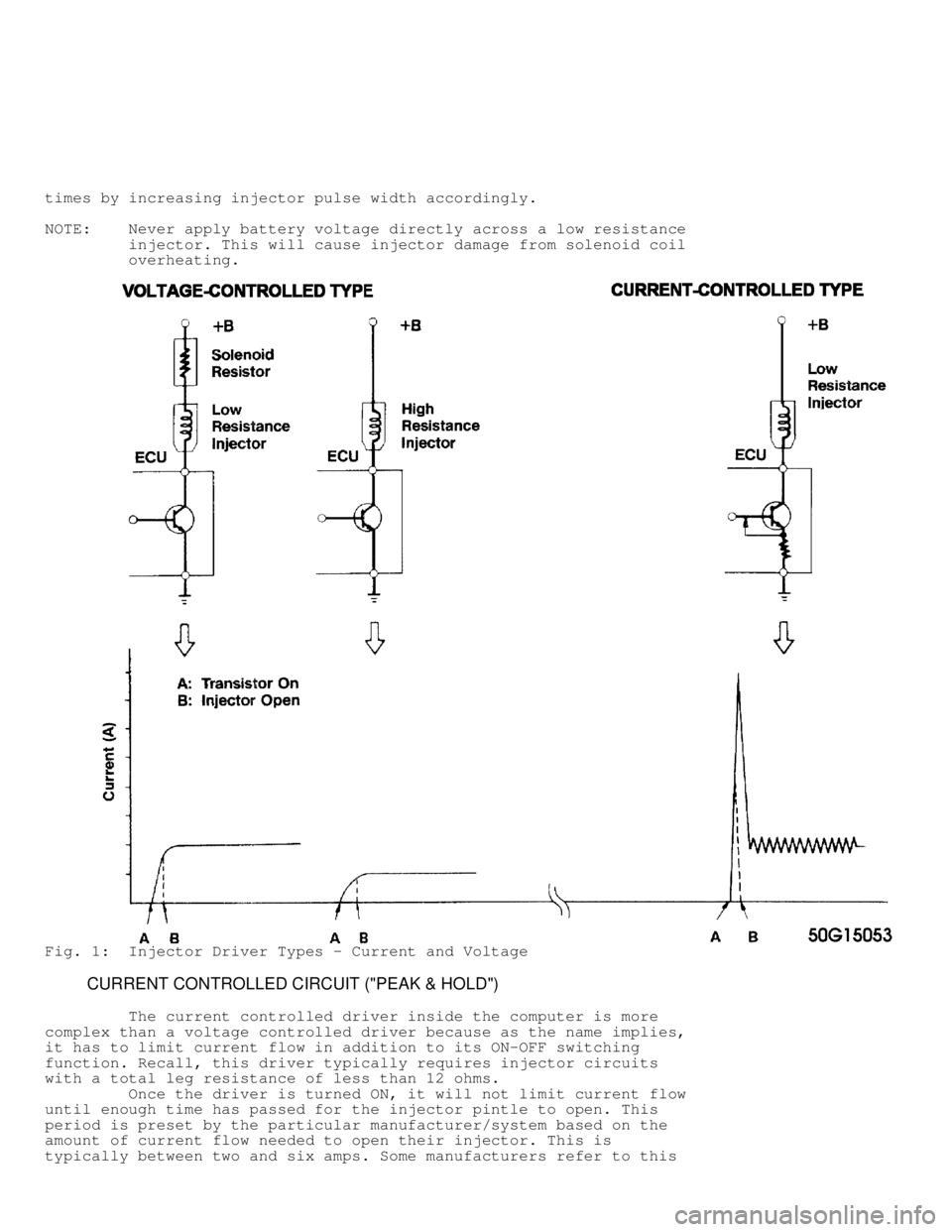
Fig. 1: Injector Driver Types - Current and Voltage
CURRENT CONTROLLED CIRCUIT ("PEAK & HOLD")
The current controlled driver inside the computer is more
complex than a voltage controlled driver because as the name implies,
it has to limit current flow in addition to its ON-OFF switching
function. Recall, this driver typically requires injector circuits
with a total leg resistance of less than 12 ohms.
Once the driver is turned ON, it will not limit current flow
until enough time has passed for the injector pintle to open. This
period is preset by the particular manufacturer/system based on the
amount of current flow needed to open their injector. This is
typically between two and six amps. Some manufacturers refer to this