1999 DODGE NEON tow
[x] Cancel search: towPage 154 of 1200
ABS FUSES
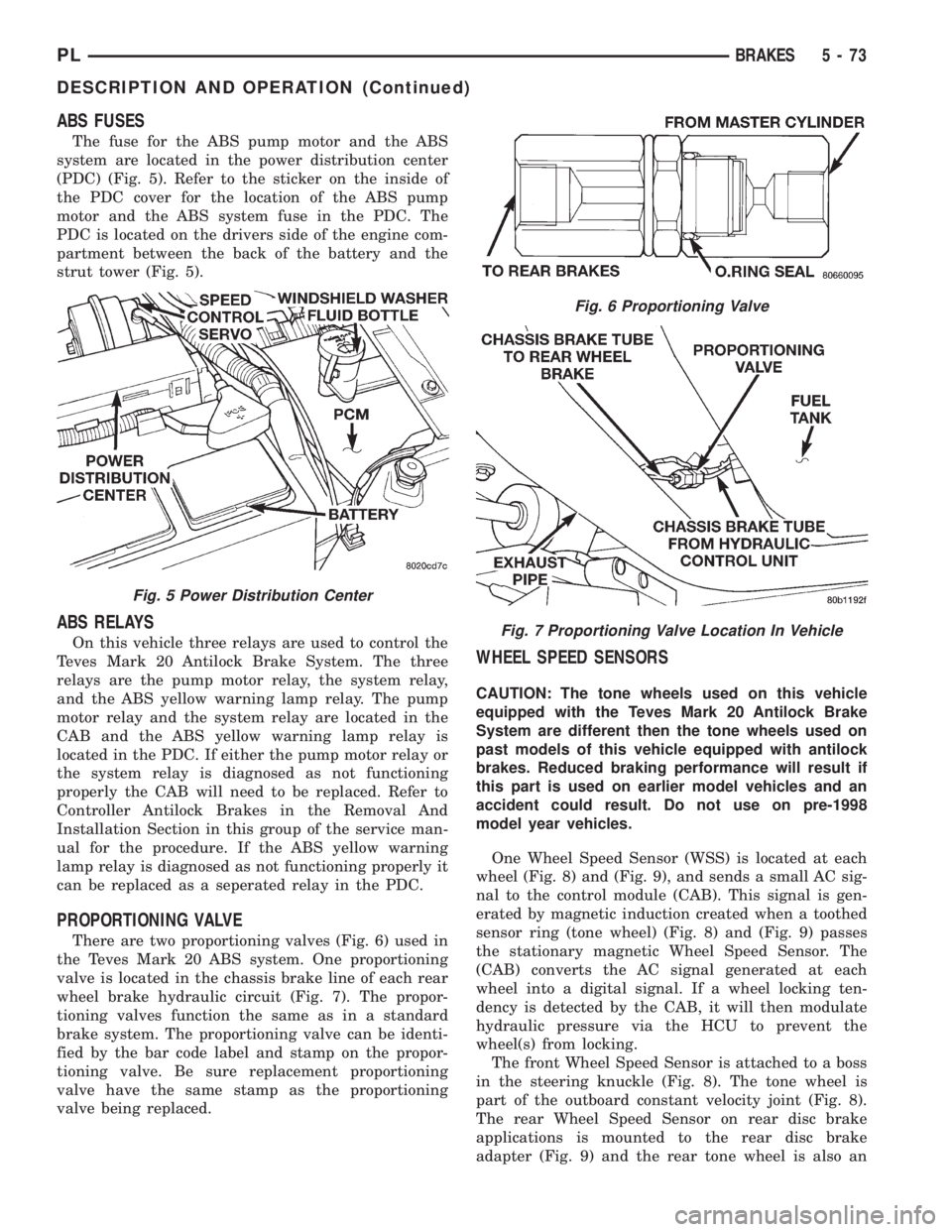
The fuse for the ABS pump motor and the ABS
system are located in the power distribution center
(PDC) (Fig. 5). Refer to the sticker on the inside of
the PDC cover for the location of the ABS pump
motor and the ABS system fuse in the PDC. The
PDC is located on the drivers side of the engine com-
partment between the back of the battery and the
strut tower (Fig. 5).
ABS RELAYS
On this vehicle three relays are used to control the
Teves Mark 20 Antilock Brake System. The three
relays are the pump motor relay, the system relay,
and the ABS yellow warning lamp relay. The pump
motor relay and the system relay are located in the
CAB and the ABS yellow warning lamp relay is
located in the PDC. If either the pump motor relay or
the system relay is diagnosed as not functioning
properly the CAB will need to be replaced. Refer to
Controller Antilock Brakes in the Removal And
Installation Section in this group of the service man-
ual for the procedure. If the ABS yellow warning
lamp relay is diagnosed as not functioning properly it
can be replaced as a seperated relay in the PDC.
PROPORTIONING VALVE
There are two proportioning valves (Fig. 6) used in
the Teves Mark 20 ABS system. One proportioning
valve is located in the chassis brake line of each rear
wheel brake hydraulic circuit (Fig. 7). The propor-
tioning valves function the same as in a standard
brake system. The proportioning valve can be identi-
fied by the bar code label and stamp on the propor-
tioning valve. Be sure replacement proportioning
valve have the same stamp as the proportioning
valve being replaced.
WHEEL SPEED SENSORS
CAUTION: The tone wheels used on this vehicle
equipped with the Teves Mark 20 Antilock Brake
System are different then the tone wheels used on
past models of this vehicle equipped with antilock
brakes. Reduced braking performance will result if
this part is used on earlier model vehicles and an
accident could result. Do not use on pre-1998
model year vehicles.
One Wheel Speed Sensor (WSS) is located at each
wheel (Fig. 8) and (Fig. 9), and sends a small AC sig-
nal to the control module (CAB). This signal is gen-
erated by magnetic induction created when a toothed
sensor ring (tone wheel) (Fig. 8) and (Fig. 9) passes
the stationary magnetic Wheel Speed Sensor. The
(CAB) converts the AC signal generated at each
wheel into a digital signal. If a wheel locking ten-
dency is detected by the CAB, it will then modulate
hydraulic pressure via the HCU to prevent the
wheel(s) from locking.
The front Wheel Speed Sensor is attached to a boss
in the steering knuckle (Fig. 8). The tone wheel is
part of the outboard constant velocity joint (Fig. 8).
The rear Wheel Speed Sensor on rear disc brake
applications is mounted to the rear disc brake
adapter (Fig. 9) and the rear tone wheel is also an
Fig. 5 Power Distribution Center
Fig. 6 Proportioning Valve
Fig. 7 Proportioning Valve Location In Vehicle
PLBRAKES 5 - 73
DESCRIPTION AND OPERATION (Continued)
Page 165 of 1200
INSTALL
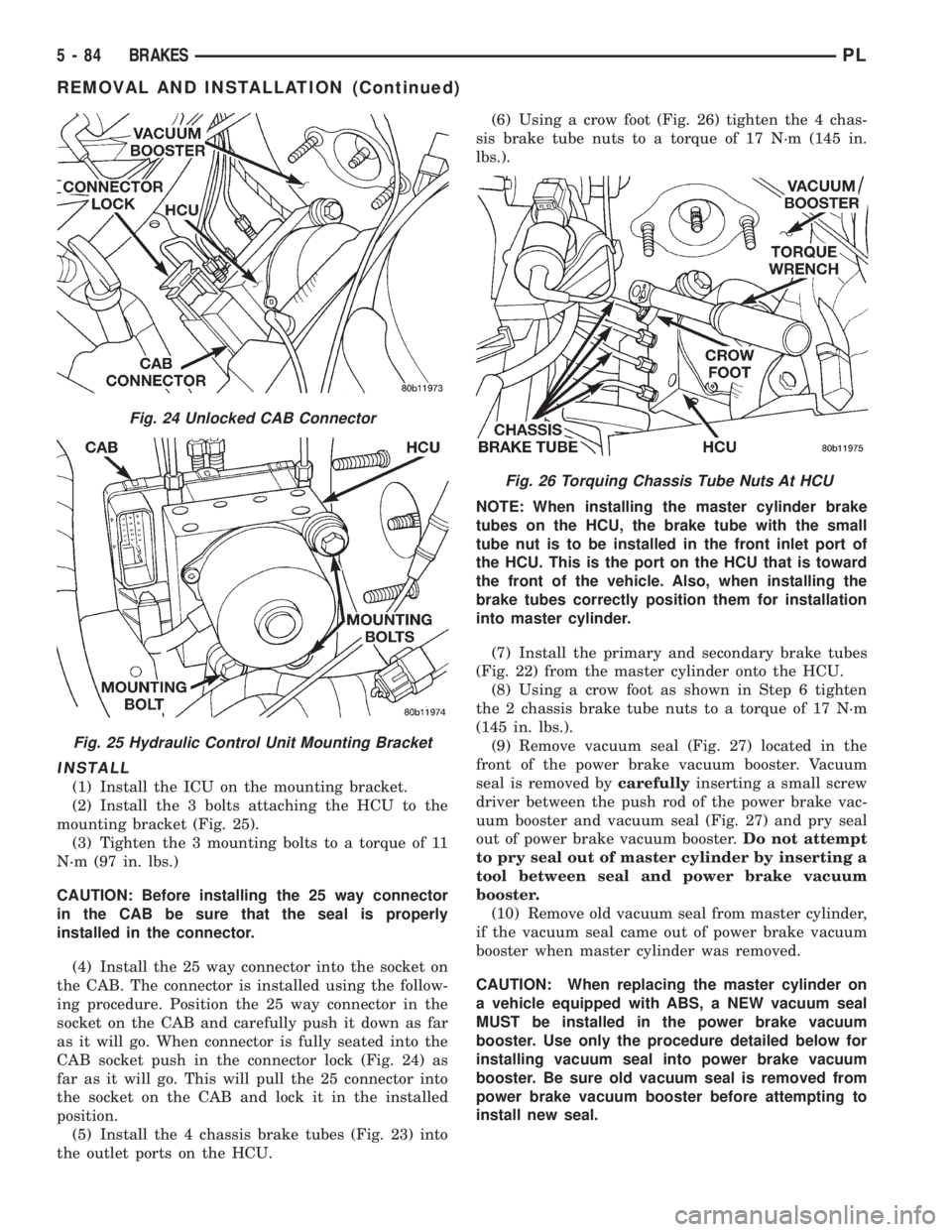
(1) Install the ICU on the mounting bracket.
(2) Install the 3 bolts attaching the HCU to the
mounting bracket (Fig. 25).
(3) Tighten the 3 mounting bolts to a torque of 11
N´m (97 in. lbs.)
CAUTION: Before installing the 25 way connector
in the CAB be sure that the seal is properly
installed in the connector.
(4) Install the 25 way connector into the socket on
the CAB. The connector is installed using the follow-
ing procedure. Position the 25 way connector in the
socket on the CAB and carefully push it down as far
as it will go. When connector is fully seated into the
CAB socket push in the connector lock (Fig. 24) as
far as it will go. This will pull the 25 connector into
the socket on the CAB and lock it in the installed
position.
(5) Install the 4 chassis brake tubes (Fig. 23) into
the outlet ports on the HCU.(6) Using a crow foot (Fig. 26) tighten the 4 chas-
sis brake tube nuts to a torque of 17 N´m (145 in.
lbs.).
NOTE: When installing the master cylinder brake
tubes on the HCU, the brake tube with the small
tube nut is to be installed in the front inlet port of
the HCU. This is the port on the HCU that is toward
the front of the vehicle. Also, when installing the
brake tubes correctly position them for installation
into master cylinder.
(7) Install the primary and secondary brake tubes
(Fig. 22) from the master cylinder onto the HCU.
(8) Using a crow foot as shown in Step 6 tighten
the 2 chassis brake tube nuts to a torque of 17 N´m
(145 in. lbs.).
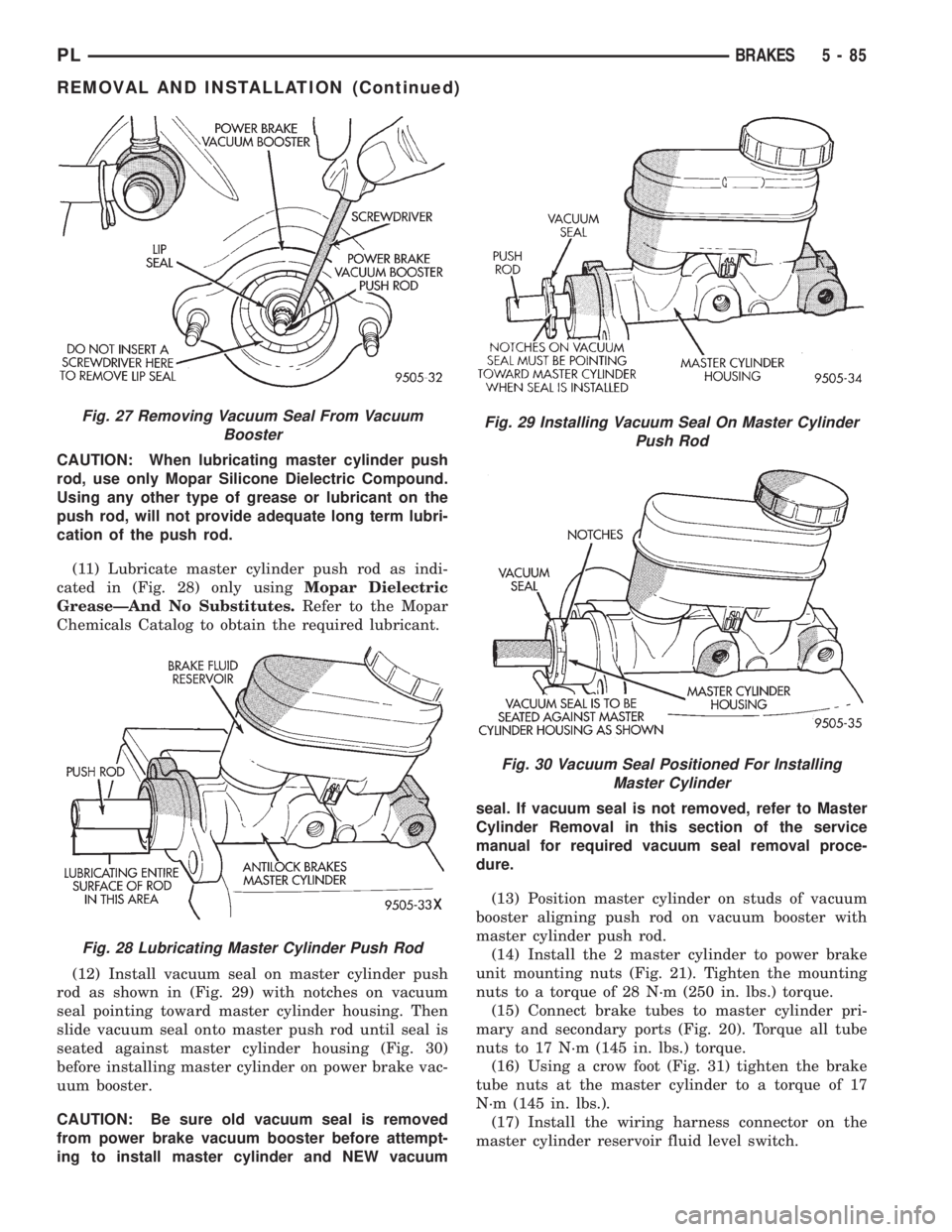
(9) Remove vacuum seal (Fig. 27) located in the
front of the power brake vacuum booster. Vacuum
seal is removed bycarefullyinserting a small screw
driver between the push rod of the power brake vac-
uum booster and vacuum seal (Fig. 27) and pry seal
out of power brake vacuum booster.Do not attempt
to pry seal out of master cylinder by inserting a
tool between seal and power brake vacuum
booster.
(10) Remove old vacuum seal from master cylinder,
if the vacuum seal came out of power brake vacuum
booster when master cylinder was removed.
CAUTION: When replacing the master cylinder on
a vehicle equipped with ABS, a NEW vacuum seal
MUST be installed in the power brake vacuum
booster. Use only the procedure detailed below for
installing vacuum seal into power brake vacuum
booster. Be sure old vacuum seal is removed from
power brake vacuum booster before attempting to
install new seal.
Fig. 24 Unlocked CAB Connector
Fig. 25 Hydraulic Control Unit Mounting Bracket
Fig. 26 Torquing Chassis Tube Nuts At HCU
5 - 84 BRAKESPL
REMOVAL AND INSTALLATION (Continued)
Page 166 of 1200
CAUTION: When lubricating master cylinder push
rod, use only Mopar Silicone Dielectric Compound.
Using any other type of grease or lubricant on the
push rod, will not provide adequate long term lubri-
cation of the push rod.
(11) Lubricate master cylinder push rod as indi-
cated in (Fig. 28) only usingMopar Dielectric
GreaseÐAnd No Substitutes.Refer to the Mopar
Chemicals Catalog to obtain the required lubricant.
(12) Install vacuum seal on master cylinder push
rod as shown in (Fig. 29) with notches on vacuum
seal pointing toward master cylinder housing. Then
slide vacuum seal onto master push rod until seal is
seated against master cylinder housing (Fig. 30)
before installing master cylinder on power brake vac-
uum booster.
CAUTION: Be sure old vacuum seal is removed
from power brake vacuum booster before attempt-
ing to install master cylinder and NEW vacuumseal. If vacuum seal is not removed, refer to Master
Cylinder Removal in this section of the service
manual for required vacuum seal removal proce-
dure.
(13) Position master cylinder on studs of vacuum
booster aligning push rod on vacuum booster with
master cylinder push rod.
(14) Install the 2 master cylinder to power brake
unit mounting nuts (Fig. 21). Tighten the mounting
nuts to a torque of 28 N´m (250 in. lbs.) torque.
(15) Connect brake tubes to master cylinder pri-
mary and secondary ports (Fig. 20). Torque all tube
nuts to 17 N´m (145 in. lbs.) torque.
(16) Using a crow foot (Fig. 31) tighten the brake
tube nuts at the master cylinder to a torque of 17
N´m (145 in. lbs.).
(17) Install the wiring harness connector on the
master cylinder reservoir fluid level switch.
Fig. 27 Removing Vacuum Seal From Vacuum
Booster
Fig. 28 Lubricating Master Cylinder Push Rod
Fig. 29 Installing Vacuum Seal On Master Cylinder
Push Rod
Fig. 30 Vacuum Seal Positioned For Installing
Master Cylinder
PLBRAKES 5 - 85
REMOVAL AND INSTALLATION (Continued)
Page 178 of 1200
(4) Guide cable through slot in transaxle and dis-
connect cable from release lever.
(5) Disconnect clutch cable up-stop/spacer with
cable strand from clutch pedal.
NOTE: Depressing the clutch pedal provides
access to the clutch cable strand. Disconnect the
cable up-stop/spacer from the pedal pivot pin by
removing the snap ring at the top of the clutch
pedal. Wedge a flat±blade pry tool between the pin
and the retaining tab. While holding the tab slightly
separated from the pin, pull the up-stop/spacer off
the pedal. Now remove the cable end from the up-
stop/spacer.
CAUTION: Do not pull on the clutch cable to
remove it from the dash panel. Damage to the cable
self-adjuster may occur.
(6) Remove the cable from the cable routing tube
and clutch bracket.
INSTALLATION
(1) Insert the self±adjuster mechanism end of the
clutch cable through the cable routing tube and into
the bracket.
(2) Be sure the self±adjuster is firmly seated
against the clutch bracket to ensure proper adjuster
mechanism function.
(3) Connect the clutch cable to the up-stop/spacer.
(4) Connect the up-stop/spacer to the clutch pedal.
(5) Install snap ring to hold up-stop spacer in
place.
(6) Perform the Adjuster Mechanism Function
Check before finishing installation.
ADJUSTER MECHANISM FUNCTION CHECK
(1) With slight pressure, pull the clutch release
lever end of the cable to draw the cable taut. Push
the clutch cable housing toward the dash panel (With
less than 25 lbs. of effort, the cable housing should
move 30-50mm.). This indicates proper adjuster
mechanism function. If the cable does not adjust,
determine if the mechanism is properly seated on the
bracket tube.
(2) If the adjust mechanism functions properly,
guide the cable through the slot in the transaxle
housing. Connect cable to release lever, seating the
cupped washer securely on lever tangs.
(3) Pull back on clutch cable housing and insert
into transaxle housing (Fig. 2).
(4) Reinstall cable inspection cover and PDC.
Check clutch pedal position switch operation.
CLUTCH PEDAL POSITION SWITCH
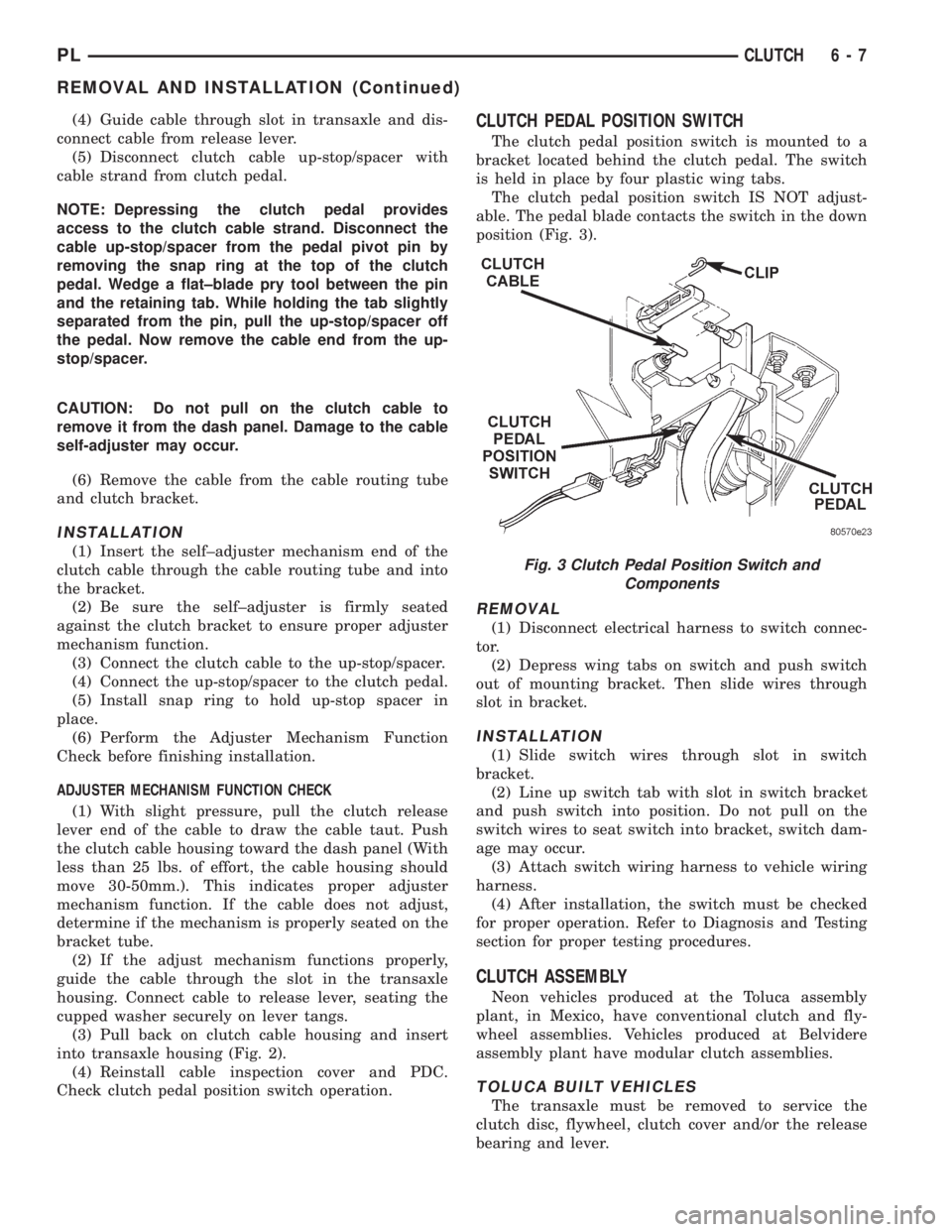
The clutch pedal position switch is mounted to a
bracket located behind the clutch pedal. The switch
is held in place by four plastic wing tabs.
The clutch pedal position switch IS NOT adjust-
able. The pedal blade contacts the switch in the down
position (Fig. 3).
REMOVAL
(1) Disconnect electrical harness to switch connec-
tor.
(2) Depress wing tabs on switch and push switch
out of mounting bracket. Then slide wires through
slot in bracket.
INSTALLATION
(1) Slide switch wires through slot in switch
bracket.
(2) Line up switch tab with slot in switch bracket
and push switch into position. Do not pull on the
switch wires to seat switch into bracket, switch dam-
age may occur.
(3) Attach switch wiring harness to vehicle wiring
harness.
(4) After installation, the switch must be checked
for proper operation. Refer to Diagnosis and Testing
section for proper testing procedures.
CLUTCH ASSEMBLY
Neon vehicles produced at the Toluca assembly
plant, in Mexico, have conventional clutch and fly-
wheel assemblies. Vehicles produced at Belvidere
assembly plant have modular clutch assemblies.
TOLUCA BUILT VEHICLES
The transaxle must be removed to service the
clutch disc, flywheel, clutch cover and/or the release
bearing and lever.
Fig. 3 Clutch Pedal Position Switch and
Components
PLCLUTCH 6 - 7
REMOVAL AND INSTALLATION (Continued)
Page 181 of 1200
INSTALLATION
(1) The pivot ball pocket in the fork is Teflon
coated and should be installed WITHOUT any lubri-
cant such as grease. Using grease will break down
the Teflon coating. Be sure the ball stud and fork
pocket are clean of contamination and dirt.
(2) Assemble the fork to the bearing. The small
pegs on the bearing must go over the fork arms.
(3) Slide the bearing and fork assembly onto the
input shaft bearing retainer, as a unit.
(4) Snap the clutch fork onto the pivot ball.
(5) Reinstall transaxle assembly. Refer to Group
21, Transaxle for further information.
CLEANING AND INSPECTION
CLUTCH CONTAMINATION
Fluid contamination is a frequent cause of clutch
malfunctions. Oil, grease, water, or other fluids on
the clutch contact surfaces will cause faulty opera-
tion.
During inspection, note if any components are con-
taminated. Look for evidence of oil, grease, or water/
road splash on clutch components.
OIL CONTAMINATION
Oil contamination indicates a leak at the rear main
seal and/or transaxle input shaft. Oil leaks produce a
residue of oil on the transaxle housing interior, clutch
cover and flywheel. Heat buildup caused by slippage
can bake the oil residue onto the components. This
glaze-like residue ranges in color from amber to
black.
GREASE CONTAMINATION
Grease contamination is usually a product of over-
lubrication. During clutch service, apply only a small
amount of grease to the input shaft splines. Excess
grease may be thrown off during operation, contami-
nating the disc.
ROAD SPLASH/WATER CONTAMINATION
Road splash contamination is usually caused by
driving the vehicle through deep water puddles.
Water can be forced into the clutch housing, causing
clutch components to become contaminated. Facing of
disc will absorb moisture and bond to the flywheel
and/or, pressure plate, if vehicle is allowed to stand
for some time before use. If this condition occurs,
replacement of clutch assembly may be required.
Drive the vehicle until normal clutch operating tem-
perature has been obtained. This will dry off disc
assembly, pressure plate, and flywheel.
CLEANING PRECAUTIONS
Condensation from steam vapors tend to accumu-
late on the internal clutch mechanism when the vehi-
cle is steam cleaned. Facing of disc will absorb
moisture and will bond to flywheel and/or pressure
plate, if vehicle is allowed to stand for some time
before use. If this condition occurs, it may require
replacement of clutch assembly. After cleaning, drive
the vehicle to its normal clutch operating tempera-
ture. This will dry off disc assembly, pressure plate,
and flywheel.
ADJUSTMENTS
CLUTCH CABLE
The manual transaxle clutch release system has a
unique self-adjusting mechanism to compensate for
clutch disc wear. This adjuster mechanism is located
within the clutch cable assembly. The preload spring
maintains tension on the cable. This tension keeps
the clutch release bearing continuously loaded
against the fingers of the clutch cover assembly.
ADJUSTER MECHANISM FUNCTION CHECK
(1) With slight pressure, pull the clutch release
lever end of the cable to draw the cable taut. Push
the clutch cable housing toward the dash panel. With
less than 25 lbs. of effort the cable housing should
move 30-50mm. This indicates proper adjuster mech-
anism function. If the cable does not adjust, deter-
mine if the mechanism is properly seated on the
bracket.
(2) If the adjust mechanism functions properly,
guide the cable through the slot in the transaxle
housing. Connect cable to release lever, seating the
cupped washer securely on lever tangs.
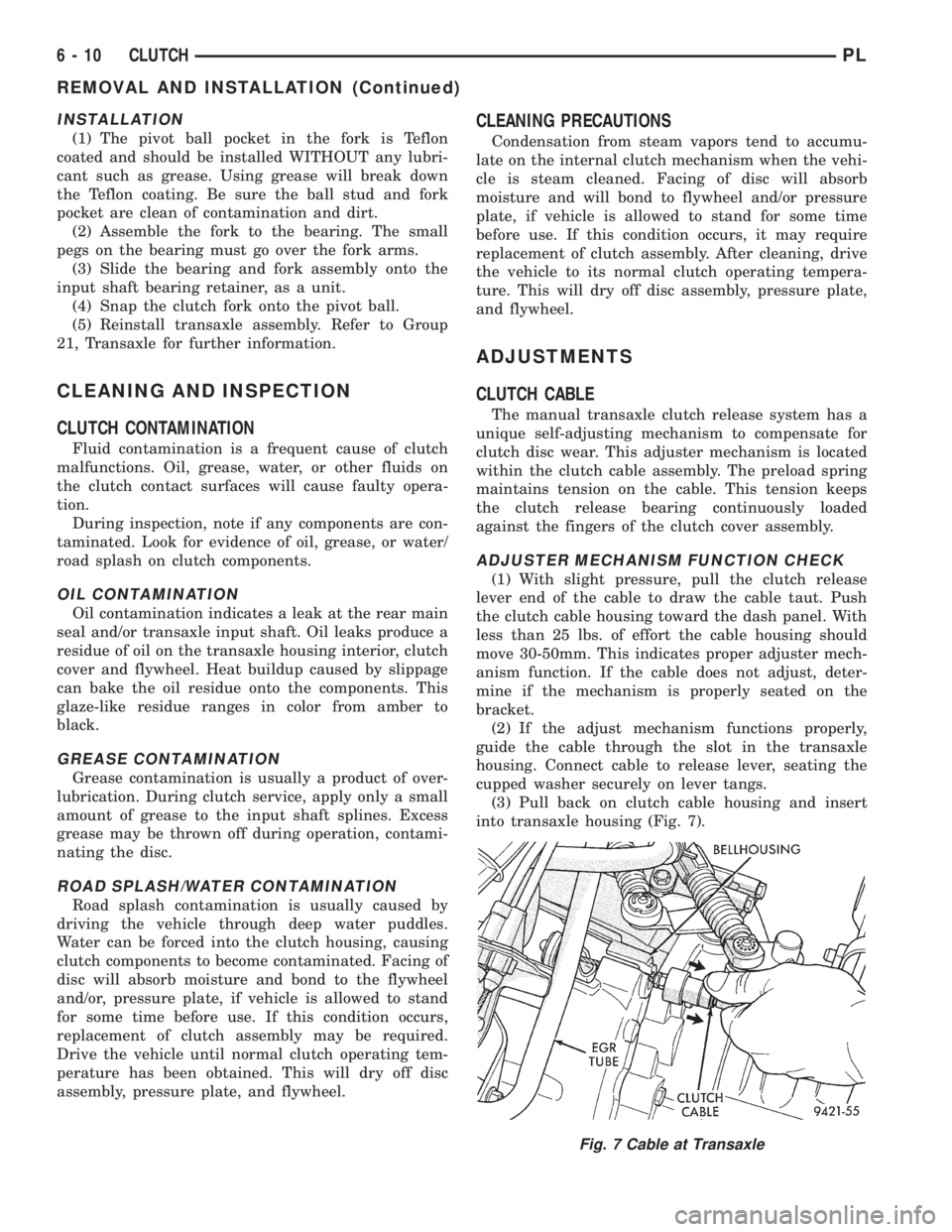
(3) Pull back on clutch cable housing and insert
into transaxle housing (Fig. 7).
Fig. 7 Cable at Transaxle
6 - 10 CLUTCHPL
REMOVAL AND INSTALLATION (Continued)
Page 190 of 1200
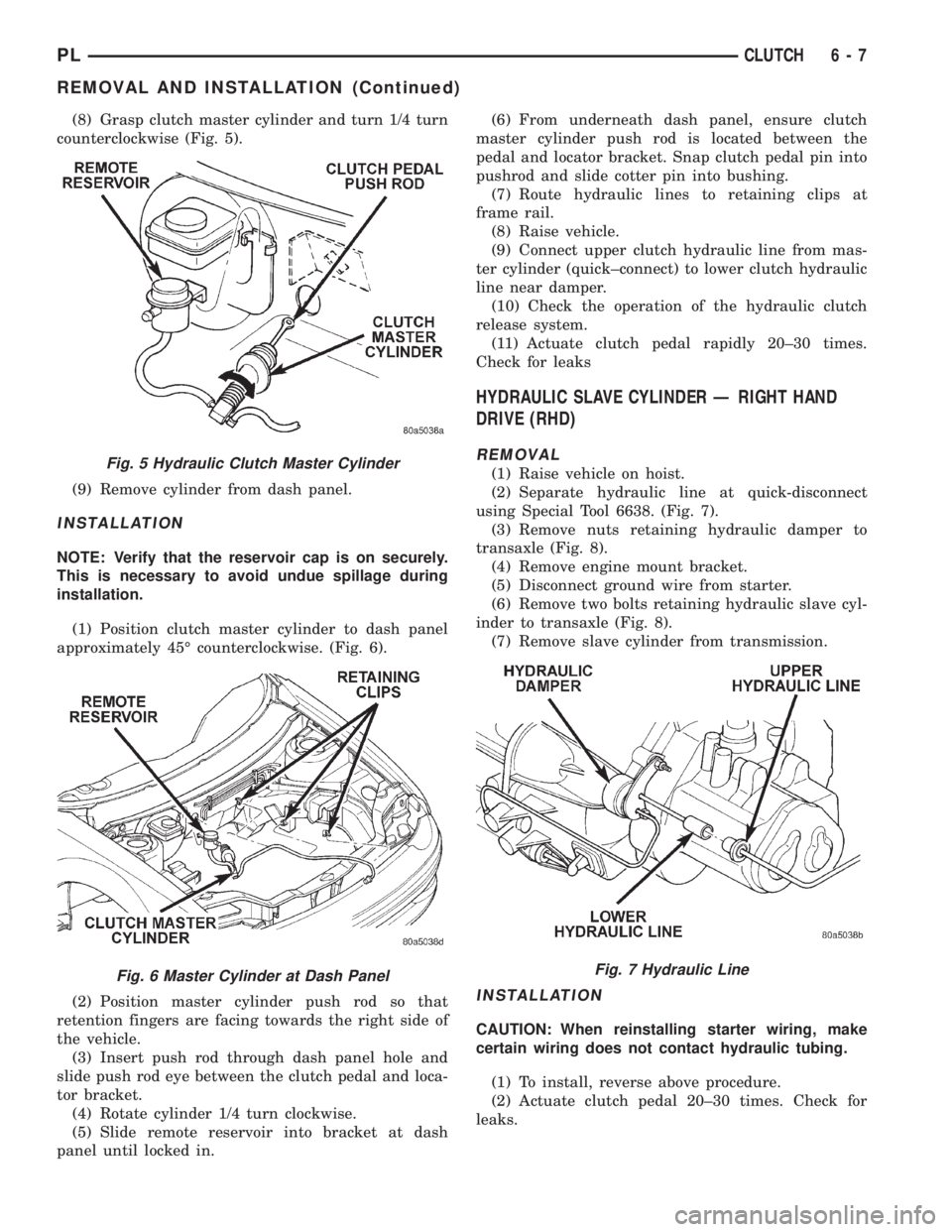
(8) Grasp clutch master cylinder and turn 1/4 turn
counterclockwise (Fig. 5).
(9) Remove cylinder from dash panel.
INSTALLATION
NOTE: Verify that the reservoir cap is on securely.
This is necessary to avoid undue spillage during
installation.
(1) Position clutch master cylinder to dash panel
approximately 45É counterclockwise. (Fig. 6).
(2) Position master cylinder push rod so that
retention fingers are facing towards the right side of
the vehicle.
(3) Insert push rod through dash panel hole and
slide push rod eye between the clutch pedal and loca-
tor bracket.
(4) Rotate cylinder 1/4 turn clockwise.
(5) Slide remote reservoir into bracket at dash
panel until locked in.(6) From underneath dash panel, ensure clutch
master cylinder push rod is located between the
pedal and locator bracket. Snap clutch pedal pin into
pushrod and slide cotter pin into bushing.
(7) Route hydraulic lines to retaining clips at
frame rail.
(8) Raise vehicle.
(9) Connect upper clutch hydraulic line from mas-
ter cylinder (quick±connect) to lower clutch hydraulic
line near damper.
(10) Check the operation of the hydraulic clutch
release system.
(11) Actuate clutch pedal rapidly 20±30 times.
Check for leaks
HYDRAULIC SLAVE CYLINDER Ð RIGHT HAND
DRIVE (RHD)
REMOVAL
(1) Raise vehicle on hoist.
(2) Separate hydraulic line at quick-disconnect
using Special Tool 6638. (Fig. 7).
(3) Remove nuts retaining hydraulic damper to
transaxle (Fig. 8).
(4) Remove engine mount bracket.
(5) Disconnect ground wire from starter.
(6) Remove two bolts retaining hydraulic slave cyl-
inder to transaxle (Fig. 8).
(7) Remove slave cylinder from transmission.
INSTALLATION
CAUTION: When reinstalling starter wiring, make
certain wiring does not contact hydraulic tubing.
(1) To install, reverse above procedure.
(2) Actuate clutch pedal 20±30 times. Check for
leaks.
Fig. 5 Hydraulic Clutch Master Cylinder
Fig. 6 Master Cylinder at Dash PanelFig. 7 Hydraulic Line
PLCLUTCH 6 - 7
REMOVAL AND INSTALLATION (Continued)
Page 198 of 1200
SELECTION AND ADDITIVES
The use of aluminum cylinder heads, intake mani-
folds DOHC, and water pumps requires special corro-
sion protection. MopartAntifreeze or the equivalent
is recommended for best engine cooling without cor-
rosion. When mixed only to a freeze point of -37ÉC
(-35ÉF) to -59ÉC (-50ÉF). If it looses color or becomes
contaminated, drain, flush, and replace with fresh
properly mixed solution.
COOLING SYSTEM PRESSURE CAP
The cooling system is equipped with a pressure cap
that releases built up pressure, maintaining a range
of 97-124 kPa (14-18 psi).
The cooling system will operate at higher than
atmospheric pressure. The higher pressure raises the
coolant boiling point thus, allowing increased radia-
tor cooling capacity.
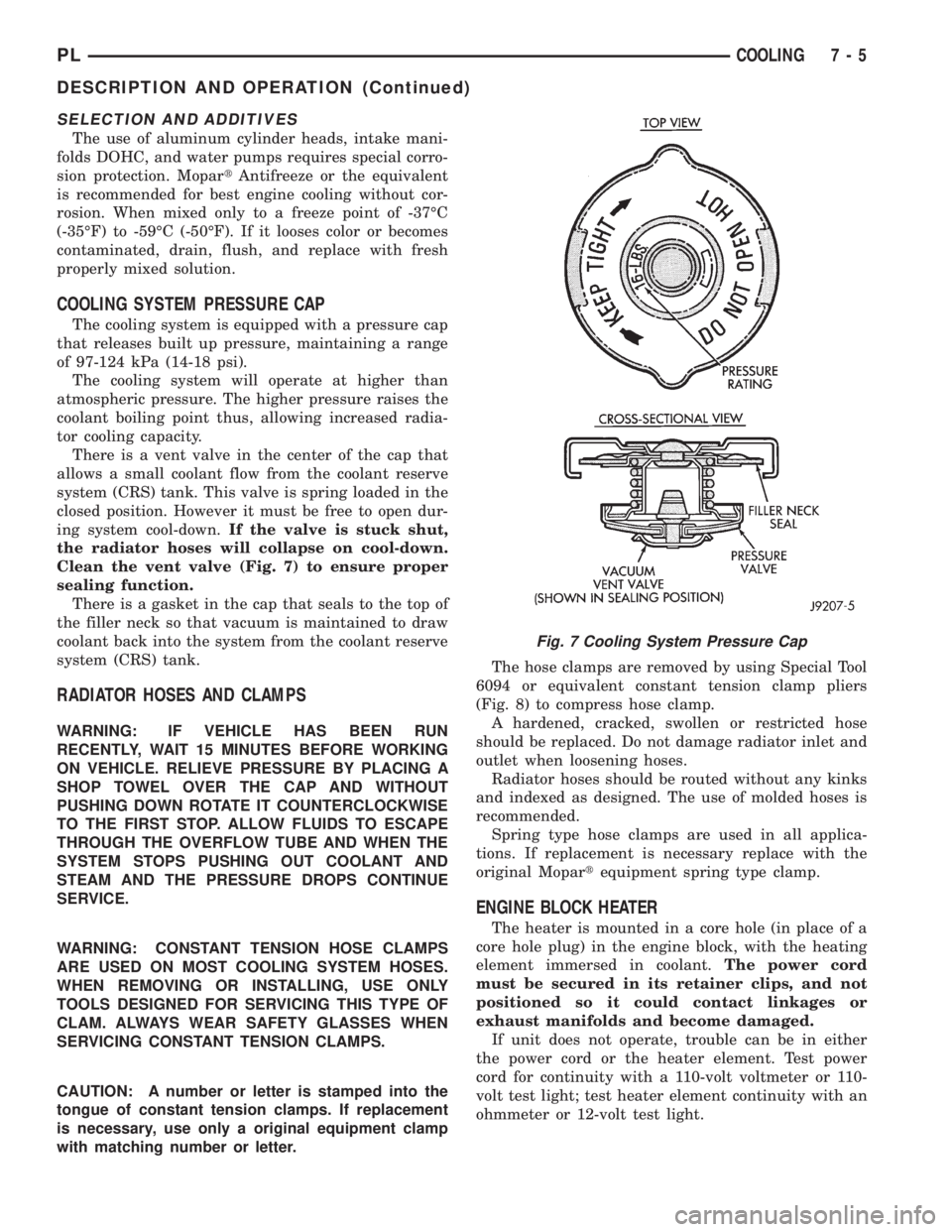
There is a vent valve in the center of the cap that
allows a small coolant flow from the coolant reserve
system (CRS) tank. This valve is spring loaded in the
closed position. However it must be free to open dur-
ing system cool-down.If the valve is stuck shut,
the radiator hoses will collapse on cool-down.
Clean the vent valve (Fig. 7) to ensure proper
sealing function.
There is a gasket in the cap that seals to the top of
the filler neck so that vacuum is maintained to draw
coolant back into the system from the coolant reserve
system (CRS) tank.
RADIATOR HOSES AND CLAMPS
WARNING: IF VEHICLE HAS BEEN RUN
RECENTLY, WAIT 15 MINUTES BEFORE WORKING
ON VEHICLE. RELIEVE PRESSURE BY PLACING A
SHOP TOWEL OVER THE CAP AND WITHOUT
PUSHING DOWN ROTATE IT COUNTERCLOCKWISE
TO THE FIRST STOP. ALLOW FLUIDS TO ESCAPE
THROUGH THE OVERFLOW TUBE AND WHEN THE
SYSTEM STOPS PUSHING OUT COOLANT AND
STEAM AND THE PRESSURE DROPS CONTINUE
SERVICE.
WARNING: CONSTANT TENSION HOSE CLAMPS
ARE USED ON MOST COOLING SYSTEM HOSES.
WHEN REMOVING OR INSTALLING, USE ONLY
TOOLS DESIGNED FOR SERVICING THIS TYPE OF
CLAM. ALWAYS WEAR SAFETY GLASSES WHEN
SERVICING CONSTANT TENSION CLAMPS.
CAUTION: A number or letter is stamped into the
tongue of constant tension clamps. If replacement
is necessary, use only a original equipment clamp
with matching number or letter.The hose clamps are removed by using Special Tool
6094 or equivalent constant tension clamp pliers
(Fig. 8) to compress hose clamp.
A hardened, cracked, swollen or restricted hose
should be replaced. Do not damage radiator inlet and
outlet when loosening hoses.
Radiator hoses should be routed without any kinks
and indexed as designed. The use of molded hoses is
recommended.
Spring type hose clamps are used in all applica-
tions. If replacement is necessary replace with the
original Mopartequipment spring type clamp.
ENGINE BLOCK HEATER
The heater is mounted in a core hole (in place of a
core hole plug) in the engine block, with the heating
element immersed in coolant.The power cord
must be secured in its retainer clips, and not
positioned so it could contact linkages or
exhaust manifolds and become damaged.
If unit does not operate, trouble can be in either
the power cord or the heater element. Test power
cord for continuity with a 110-volt voltmeter or 110-
volt test light; test heater element continuity with an
ohmmeter or 12-volt test light.
Fig. 7 Cooling System Pressure Cap
PLCOOLING 7 - 5
DESCRIPTION AND OPERATION (Continued)
Page 200 of 1200

DIAGNOSIS AND TESTING
COOLING SYSTEM DIAGNOSIS
CONDITION POSSIBLE CAUSE CORRECTION
TEMPERATURE GAUGE READS
LOW1. Has a Diagnostic Trouble Code
(DTC) been set indicating a stuck
open engine thermostat?1. Refer to On Board Diagnostic in
Group 25. Replace thermostat if
necessary. If a (DTC) has not been
set, the problem may be with the
temperature gauge.
2. Is the temperature gauge (if
equipped) connected to the
temperature gauge coolant sensor
on the engine?2. Check the connector at the
engine coolant sensor. Refer to
Group 8E. Repair as necessary.
3. Is the temperature gauge (if
equipped) operating OK?3. Check Gauge operation. Refer to
Group 8E. Repair as necessary.
4. Coolant level low during cold
ambient temperature, accompanied
by poor heater performance.4. Check coolant level in the coolant
overflow/reserve tank and the
radiator. Inspect the system for
leaks. Repair as necessary. Refer to
WARNINGS outlined in this section
before removing pressure cap.
TEMPERATURE GAUGE READS
HIGH OR ENGINE COOLANT
WARNING LAMP ILLUMINATES.
COOLANT MAY OR MAY NOT BE
LOST FROM SYSTEM.1. Trailer being towed, a steep hill
being climbed, vehicle being
operated in slow moving traffic, or
engine idling during high ambient
(outside) temperatures with air
conditioning on. High altitudes
Could aggravate these conditions.1. This may be a temporary
condition and repair is not
necessary. Turn off the air
conditioning and drive the vehicle
without any of the previous
conditions. Observe the temperature
gauge the gauge should return to
the normal range. If the gauge does
not return to the normal range,
determine the cause of the
overheating and repair. Refer to
POSSIBLE CAUSES in this section.
2. Is temperature gauge (if
equipped) reading correctly?2. Check gauge. Refer to Group 8E.
Repair as necessary.
3. Is temperature warning lamp (if
equipped) illuminating
unnecessarily?3. Check warning lamp operation.
Refer to Group 8E. Repair as
necessary.
4. Coolant low in overflow/reserve
tank and radiator?4. Check for coolant leaks and
repair as necessary. Refer to
checking cooling system for leaks in
this group.
5. Pressure cap not installed tightly.
If cap is loose, boiling point of
coolant will be lowered. Also refer
to the following step 6.5. Tighten cap.
6. Poor seals at radiator cap. 6. (a) Check condition of cap and
cap seals. Refer to Radiator cap
Inspection. Replace cap if
necessary.
6. (b) Check condition of filler neck.
If neck is bent or damaged, replace
neck.
PLCOOLING 7 - 7