1999 DODGE NEON engine
[x] Cancel search: enginePage 184 of 1200
CLUTCH
CONTENTS
page page
GENERAL INFORMATION
CLUTCH COMPONENTS Ð RIGHT HAND
DRIVE (RHD)........................ 1
CLUTCH DISC AND COVER APPLICATION Ð
RIGHT HAND DRIVE (RHD)............. 1
CLUTCH REPLACEMENT Ð RIGHT HAND
DRIVE (RHD)........................ 1
DESCRIPTION AND OPERATION
CLUTCH PEDAL POSITION SWITCH Ð RIGHT
HAND DRIVE (RHD)................... 2
HYDRAULIC CLUTCH SYSTEM Ð RIGHT
HAND DRIVE (RHD)................... 2
DIAGNOSIS AND TESTING
CLASH±INTO±REVERSE COMPLAINTS...... 6CLUTCH DIAGNOSIS Ð RIGHT HAND DRIVE
(RHD).............................. 2
REMOVAL AND INSTALLATION
CLUTCH ASSEMBLY Ð RIGHT HAND DRIVE
(RHD).............................. 8
CLUTCH MASTER CYLINDER Ð RIGHT HAND
DRIVE (RHD)........................ 6
CLUTCH PEDAL POSITION SWITCH Ð RIGHT
HAND DRIVE (RHD)................... 8
HYDRAULIC SLAVE CYLINDER Ð RIGHT
HAND DRIVE (RHD)................... 7
SPECIFICATIONS
NV T350 (A-578) CLUTCH TIGHTENING
REFERENCE.......................... 9
GENERAL INFORMATION
CLUTCH COMPONENTS Ð RIGHT HAND DRIVE
(RHD)
The modular clutch assembly used in this vehicle
consists of a single, dry-type clutch disc and a dia-
phragm style clutch cover.
The clutch disc has cushion springs riveted to the
disc hub assembly. The clutch disc facings are riveted
to the cushion springs. The facings are made from a
non-asbestos material.
The clutch cover pressure plate assembly is a dia-
phragm type unit with a one-piece diaphragm spring
with multiple release fingers. The pressure plate
release fingers are preset during manufacture and
are not adjustable.
A sleeve-type release bearing is used to engage and
disengage the clutch cover pressure plate. The bear-
ing is prelubed during manufacture and is a sealed
unit.
The release bearing is operated by a pivoting
release fork in the clutch housing. The fork pivots on
a ball stud within the housing. The release fork is
actuated by a hydraulic clutch system.
The hydraulic clutch automatically adjusts for any
slack in the mechanism. This compensates for clutch
disc wear. The system requires no maintenance or
lubrication.
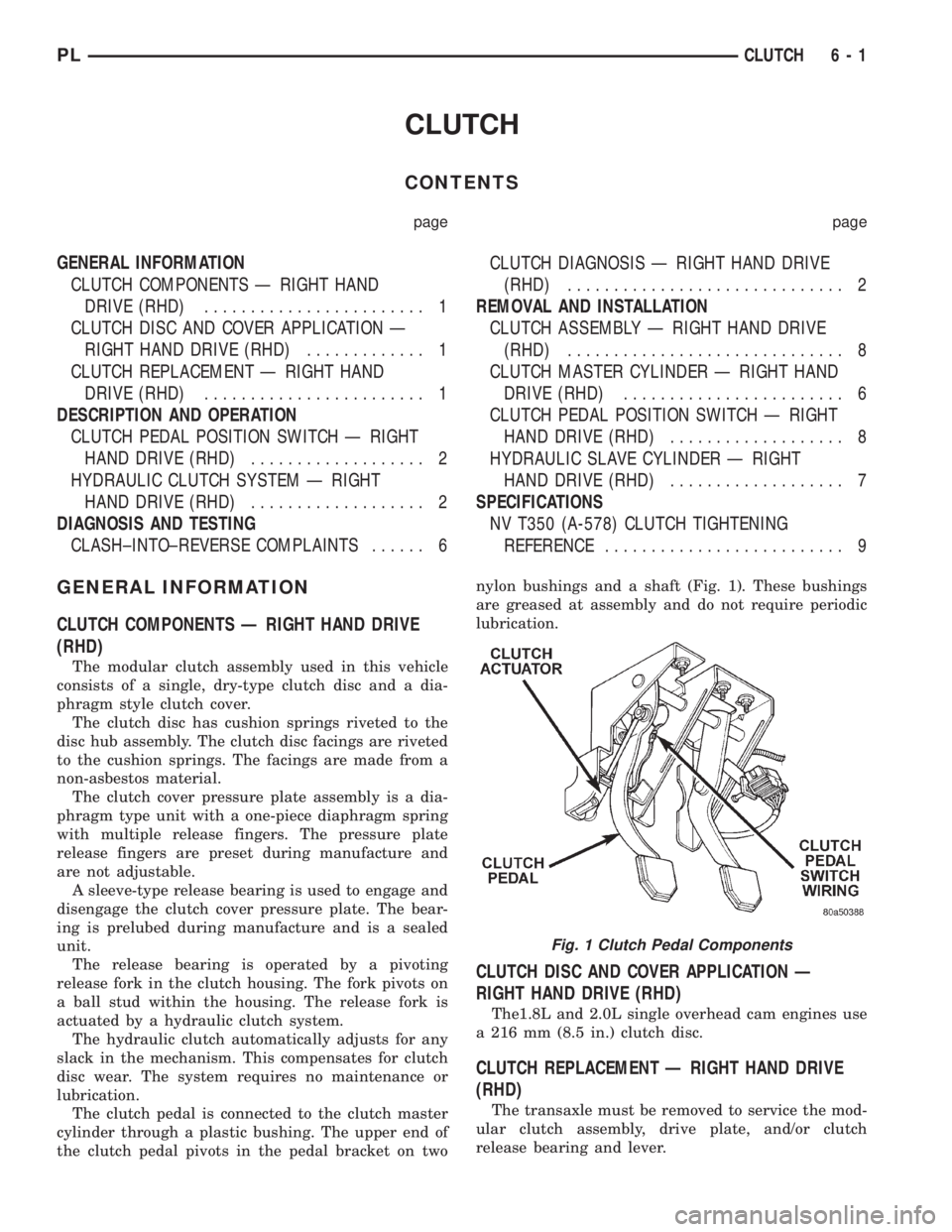
The clutch pedal is connected to the clutch master
cylinder through a plastic bushing. The upper end of
the clutch pedal pivots in the pedal bracket on twonylon bushings and a shaft (Fig. 1). These bushings
are greased at assembly and do not require periodic
lubrication.
CLUTCH DISC AND COVER APPLICATION Ð
RIGHT HAND DRIVE (RHD)
The1.8L and 2.0L single overhead cam engines use
a 216 mm (8.5 in.) clutch disc.
CLUTCH REPLACEMENT Ð RIGHT HAND DRIVE
(RHD)
The transaxle must be removed to service the mod-
ular clutch assembly, drive plate, and/or clutch
release bearing and lever.
Fig. 1 Clutch Pedal Components
PLCLUTCH 6 - 1
Page 186 of 1200
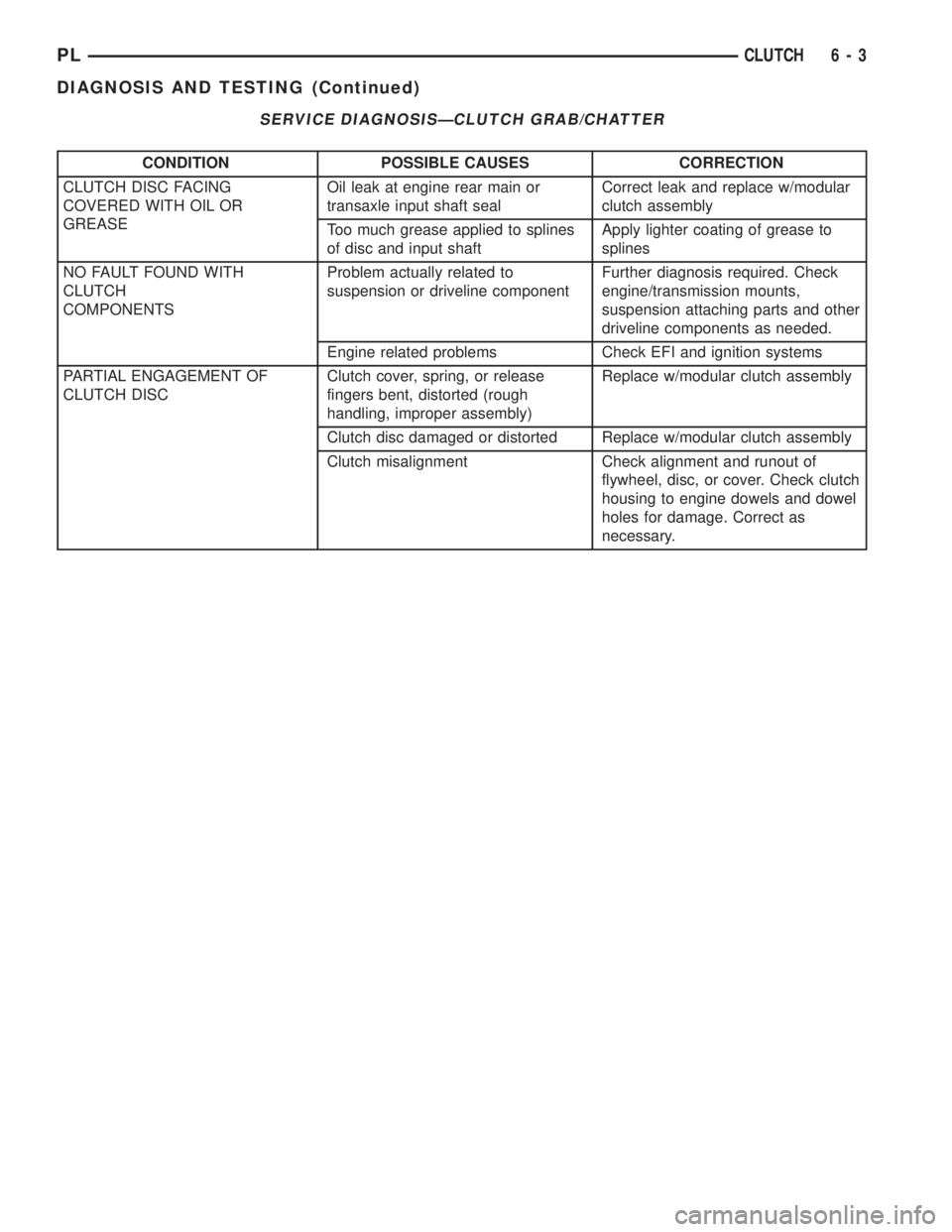
SERVICE DIAGNOSISÐCLUTCH GRAB/CHATTER
CONDITION POSSIBLE CAUSES CORRECTION
CLUTCH DISC FACING
COVERED WITH OIL OR
GREASEOil leak at engine rear main or
transaxle input shaft sealCorrect leak and replace w/modular
clutch assembly
Too much grease applied to splines
of disc and input shaftApply lighter coating of grease to
splines
NO FAULT FOUND WITH
CLUTCH
COMPONENTSProblem actually related to
suspension or driveline componentFurther diagnosis required. Check
engine/transmission mounts,
suspension attaching parts and other
driveline components as needed.
Engine related problems Check EFI and ignition systems
PARTIAL ENGAGEMENT OF
CLUTCH DISCClutch cover, spring, or release
fingers bent, distorted (rough
handling, improper assembly)Replace w/modular clutch assembly
Clutch disc damaged or distorted Replace w/modular clutch assembly
Clutch misalignment Check alignment and runout of
flywheel, disc, or cover. Check clutch
housing to engine dowels and dowel
holes for damage. Correct as
necessary.
PLCLUTCH 6 - 3
DIAGNOSIS AND TESTING (Continued)
Page 190 of 1200
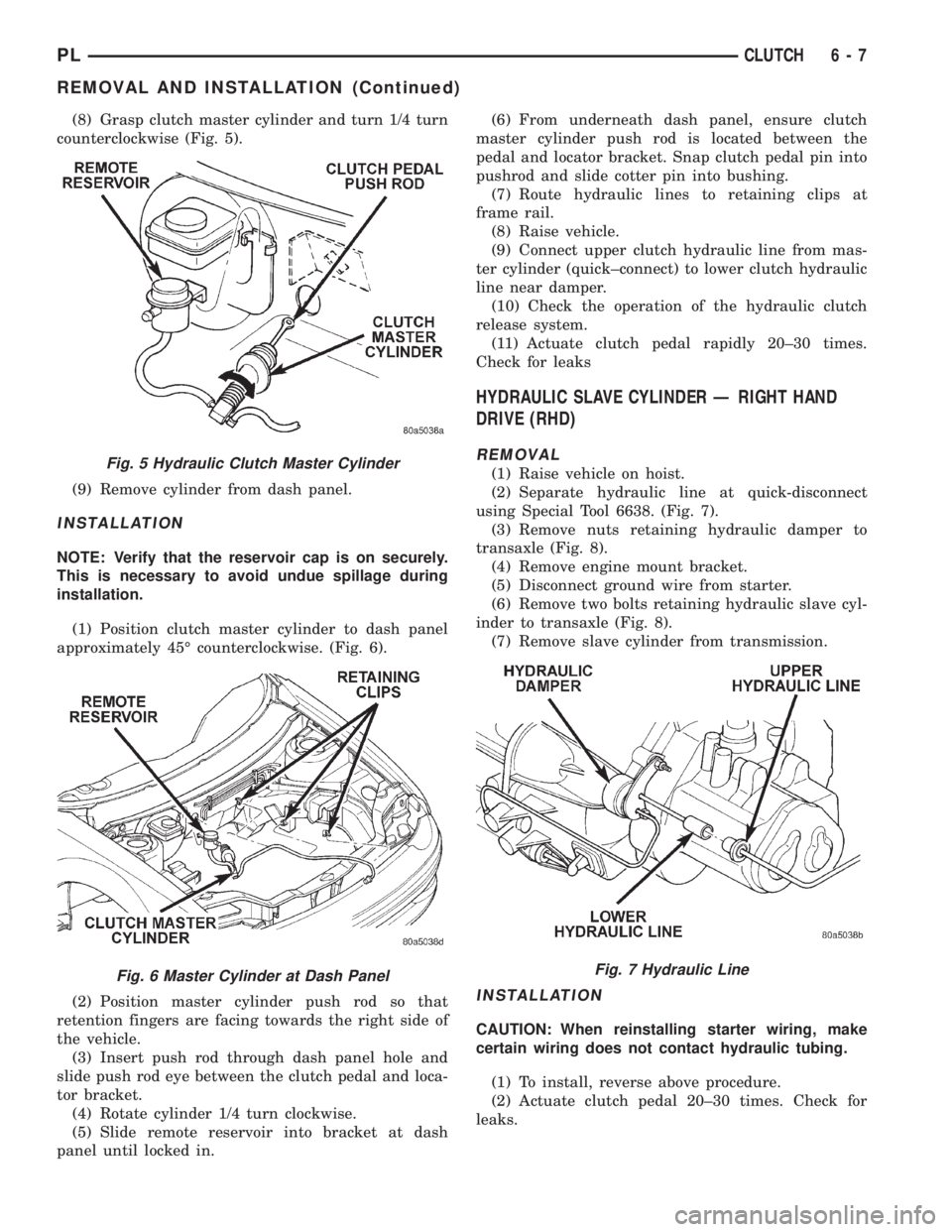
(8) Grasp clutch master cylinder and turn 1/4 turn
counterclockwise (Fig. 5).
(9) Remove cylinder from dash panel.
INSTALLATION
NOTE: Verify that the reservoir cap is on securely.
This is necessary to avoid undue spillage during
installation.
(1) Position clutch master cylinder to dash panel
approximately 45É counterclockwise. (Fig. 6).
(2) Position master cylinder push rod so that
retention fingers are facing towards the right side of
the vehicle.
(3) Insert push rod through dash panel hole and
slide push rod eye between the clutch pedal and loca-
tor bracket.
(4) Rotate cylinder 1/4 turn clockwise.
(5) Slide remote reservoir into bracket at dash
panel until locked in.(6) From underneath dash panel, ensure clutch
master cylinder push rod is located between the
pedal and locator bracket. Snap clutch pedal pin into
pushrod and slide cotter pin into bushing.
(7) Route hydraulic lines to retaining clips at
frame rail.
(8) Raise vehicle.
(9) Connect upper clutch hydraulic line from mas-
ter cylinder (quick±connect) to lower clutch hydraulic
line near damper.
(10) Check the operation of the hydraulic clutch
release system.
(11) Actuate clutch pedal rapidly 20±30 times.
Check for leaks
HYDRAULIC SLAVE CYLINDER Ð RIGHT HAND
DRIVE (RHD)
REMOVAL
(1) Raise vehicle on hoist.
(2) Separate hydraulic line at quick-disconnect
using Special Tool 6638. (Fig. 7).
(3) Remove nuts retaining hydraulic damper to
transaxle (Fig. 8).
(4) Remove engine mount bracket.
(5) Disconnect ground wire from starter.
(6) Remove two bolts retaining hydraulic slave cyl-
inder to transaxle (Fig. 8).
(7) Remove slave cylinder from transmission.
INSTALLATION
CAUTION: When reinstalling starter wiring, make
certain wiring does not contact hydraulic tubing.
(1) To install, reverse above procedure.
(2) Actuate clutch pedal 20±30 times. Check for
leaks.
Fig. 5 Hydraulic Clutch Master Cylinder
Fig. 6 Master Cylinder at Dash PanelFig. 7 Hydraulic Line
PLCLUTCH 6 - 7
REMOVAL AND INSTALLATION (Continued)
Page 191 of 1200
CLUTCH PEDAL POSITION SWITCH Ð RIGHT
HAND DRIVE (RHD)
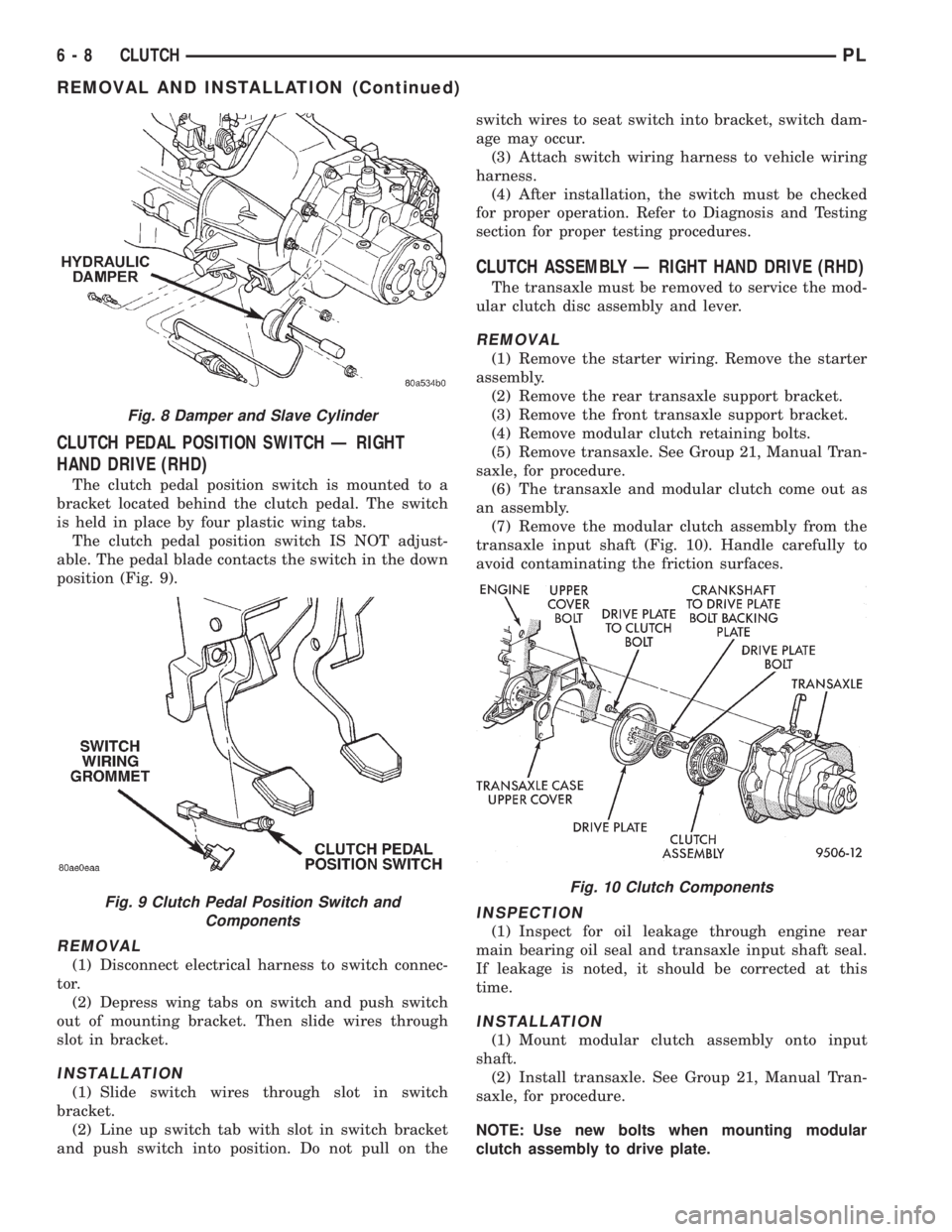
The clutch pedal position switch is mounted to a
bracket located behind the clutch pedal. The switch
is held in place by four plastic wing tabs.
The clutch pedal position switch IS NOT adjust-
able. The pedal blade contacts the switch in the down
position (Fig. 9).
REMOVAL
(1) Disconnect electrical harness to switch connec-
tor.
(2) Depress wing tabs on switch and push switch
out of mounting bracket. Then slide wires through
slot in bracket.
INSTALLATION
(1) Slide switch wires through slot in switch
bracket.
(2) Line up switch tab with slot in switch bracket
and push switch into position. Do not pull on theswitch wires to seat switch into bracket, switch dam-
age may occur.
(3) Attach switch wiring harness to vehicle wiring
harness.
(4) After installation, the switch must be checked
for proper operation. Refer to Diagnosis and Testing
section for proper testing procedures.
CLUTCH ASSEMBLY Ð RIGHT HAND DRIVE (RHD)
The transaxle must be removed to service the mod-
ular clutch disc assembly and lever.
REMOVAL
(1) Remove the starter wiring. Remove the starter
assembly.
(2) Remove the rear transaxle support bracket.
(3) Remove the front transaxle support bracket.
(4) Remove modular clutch retaining bolts.
(5) Remove transaxle. See Group 21, Manual Tran-
saxle, for procedure.
(6) The transaxle and modular clutch come out as
an assembly.
(7) Remove the modular clutch assembly from the
transaxle input shaft (Fig. 10). Handle carefully to
avoid contaminating the friction surfaces.
INSPECTION
(1) Inspect for oil leakage through engine rear
main bearing oil seal and transaxle input shaft seal.
If leakage is noted, it should be corrected at this
time.
INSTALLATION
(1) Mount modular clutch assembly onto input
shaft.
(2) Install transaxle. See Group 21, Manual Tran-
saxle, for procedure.
NOTE: Use new bolts when mounting modular
clutch assembly to drive plate.
Fig. 8 Damper and Slave Cylinder
Fig. 9 Clutch Pedal Position Switch and
ComponentsFig. 10 Clutch Components
6 - 8 CLUTCHPL
REMOVAL AND INSTALLATION (Continued)
Page 194 of 1200
COOLING
CONTENTS
page page
GENERAL INFORMATION
ACCESSORY DRIVE BELTS................ 2
AUTOMATIC TRANSMISSION OIL COOLER.... 3
COOLANT RECOVERY SYSTEM (CRS)....... 2
COOLANT.............................. 3
COOLING SYSTEM PRESSURE CAP......... 3
COOLING SYSTEM....................... 1
ENGINE BLOCK HEATER.................. 3
ENGINE THERMOSTAT.................... 3
RADIATOR............................. 3
WATER PUMP.......................... 3
DESCRIPTION AND OPERATION
COOLANT PERFORMANCE................. 4
COOLING SYSTEM PRESSURE CAP......... 5
ENGINE BLOCK HEATER.................. 5
ENGINE THERMOSTAT.................... 4
RADIATOR HOSES AND CLAMPS........... 5
WATER PUMP.......................... 6
DIAGNOSIS AND TESTING
ACCESSORY DRIVEBELT DIAGNOSIS....... 13
COOLING SYSTEM DIAGNOSIS............. 7
COOLING SYSTEM FLOW CHECK.......... 14
DEAERATION.......................... 15
ELECTRIC FAN MOTOR TEST.............. 14
ENGINE THERMOSTAT TESTING........... 13
LOW COOLANT LEVEL AERATION.......... 15
PRESSURE CAP TO FILLER NECK SEAL
PRESSURE RELIEF CHECK.............. 15
PRESSURE TESTING COOLING SYSTEM
PRESSURE CAP...................... 15
RADIATOR FAN CONTROL................ 14
TEMPERATURE GAUGE INDICATION........ 16
TESTING COOLING SYSTEM FOR LEAKS.... 14WATER PUMP DIAGNOSIS............... 14
SERVICE PROCEDURES
COOLANT LEVEL CHECKÐROUTINE........ 16
COOLANT LEVELÐSERVICING............ 16
COOLANTÐADDING ADDITIONAL......... 16
COOLING SYSTEMÐDRAINING............ 16
COOLING SYSTEMÐREFILLING........... 17
REMOVAL AND INSTALLATION
ACCESSORY DRIVE BELTS............... 21
ENGINE BLOCK HEATER................. 21
ENGINE THERMOSTAT................... 18
RADIATOR DRAINCOCK.................. 20
RADIATOR FANS AND MOTOR............ 20
RADIATOR............................ 19
WATER PUMP INLET TUBE............... 18
WATER PUMP......................... 17
CLEANING AND INSPECTION
ACCESSORY DRIVE BELT INSPECTION...... 22
CHEMICAL CLEANING................... 23
CLEANING COOLING SYSTEM............. 22
COOLING SYSTEM CAP.................. 22
RADIATOR FLUSHING................... 23
REVERSE FLUSHING.................... 23
WATER PUMP......................... 21
ADJUSTMENTS
BELT TENSION GAUGE METHOD........... 24
PROPER BELT TENSION................. 23
SPECIFICATIONS
COOLING SYSTEM CAPACITY............. 24
TORQUE.............................. 24
SPECIAL TOOLS
COOLING............................. 24
GENERAL INFORMATION
COOLING SYSTEM
The cooling system consists of an engine cooling
module, thermostat, coolant, and a water pump to
circulate the coolant. The engine cooling module may
consist of a radiator, electric fan motor, fan, shroud,
coolant reserve system, transmission oil cooler, hoses,
clamps, air condition condenser and transmission oil lines.
²When the Engine is cold: The thermostat is
closed; the cooling system has no flow through the
radiator. The coolant flows through the engine,
heater system and bypass.
²When the Engine is warm: Thermostat is open;
the cooling system has flow through radiator, engine,
heater system and bypass.
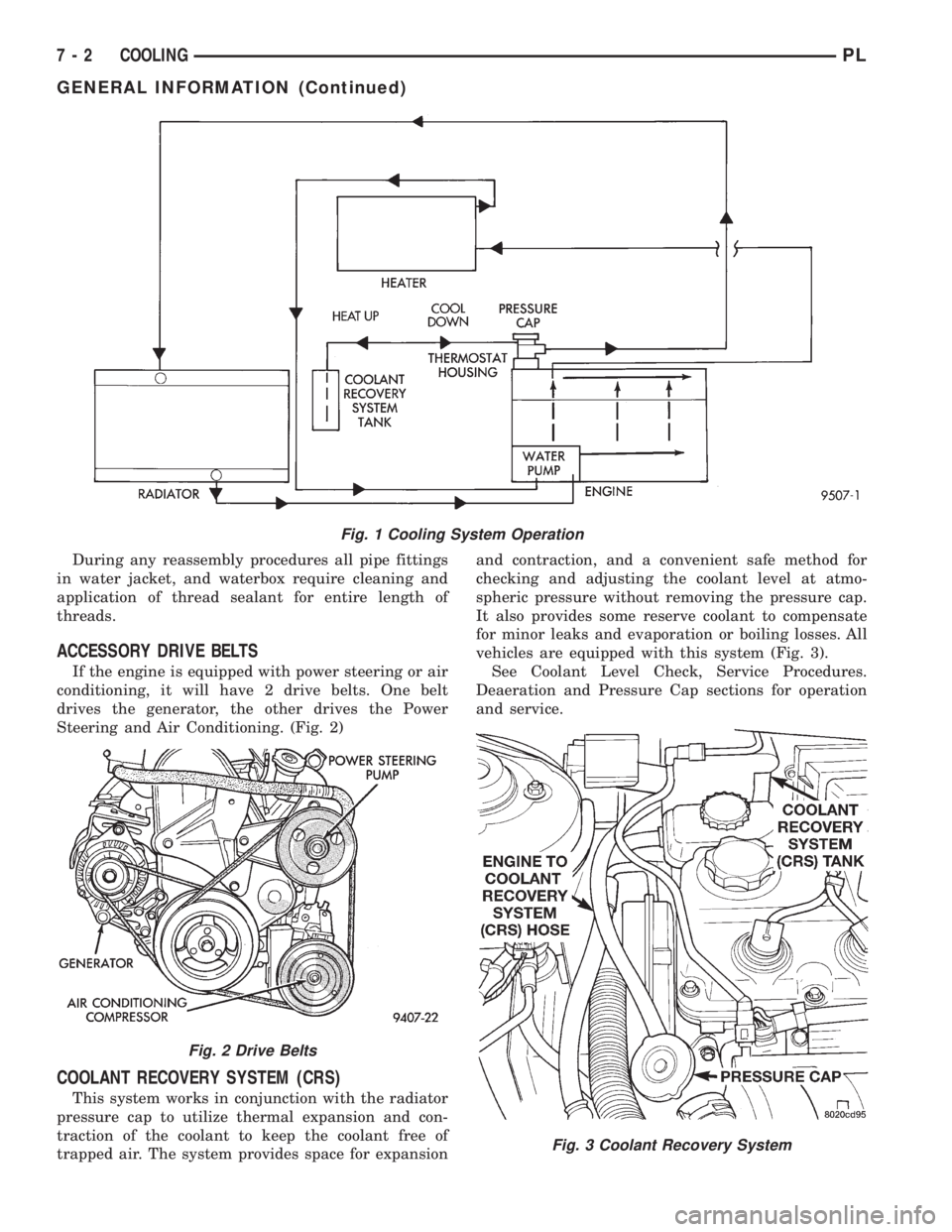
Coolant flow circuit for the 2.0L engine is shown in
(Fig. 1).
PLCOOLING 7 - 1
Page 195 of 1200
During any reassembly procedures all pipe fittings
in water jacket, and waterbox require cleaning and
application of thread sealant for entire length of
threads.
ACCESSORY DRIVE BELTS
If the engine is equipped with power steering or air
conditioning, it will have 2 drive belts. One belt
drives the generator, the other drives the Power
Steering and Air Conditioning. (Fig. 2)
COOLANT RECOVERY SYSTEM (CRS)
This system works in conjunction with the radiator
pressure cap to utilize thermal expansion and con-
traction of the coolant to keep the coolant free of
trapped air. The system provides space for expansionand contraction, and a convenient safe method for
checking and adjusting the coolant level at atmo-
spheric pressure without removing the pressure cap.
It also provides some reserve coolant to compensate
for minor leaks and evaporation or boiling losses. All
vehicles are equipped with this system (Fig. 3).
See Coolant Level Check, Service Procedures.
Deaeration and Pressure Cap sections for operation
and service.
Fig. 1 Cooling System Operation
Fig. 2 Drive Belts
Fig. 3 Coolant Recovery System
7 - 2 COOLINGPL
GENERAL INFORMATION (Continued)
Page 196 of 1200
ENGINE THERMOSTAT
The engine thermostat is located on the front of
the engine (radiator side) in the thermostat housing/
engine outlet connector. The thermostat has an air
bleed (vent) located in the flange and a O-ring for
sealing incorporate on it. There is a relief in the ther-
mostat housing/outlet connector for the O-ring.
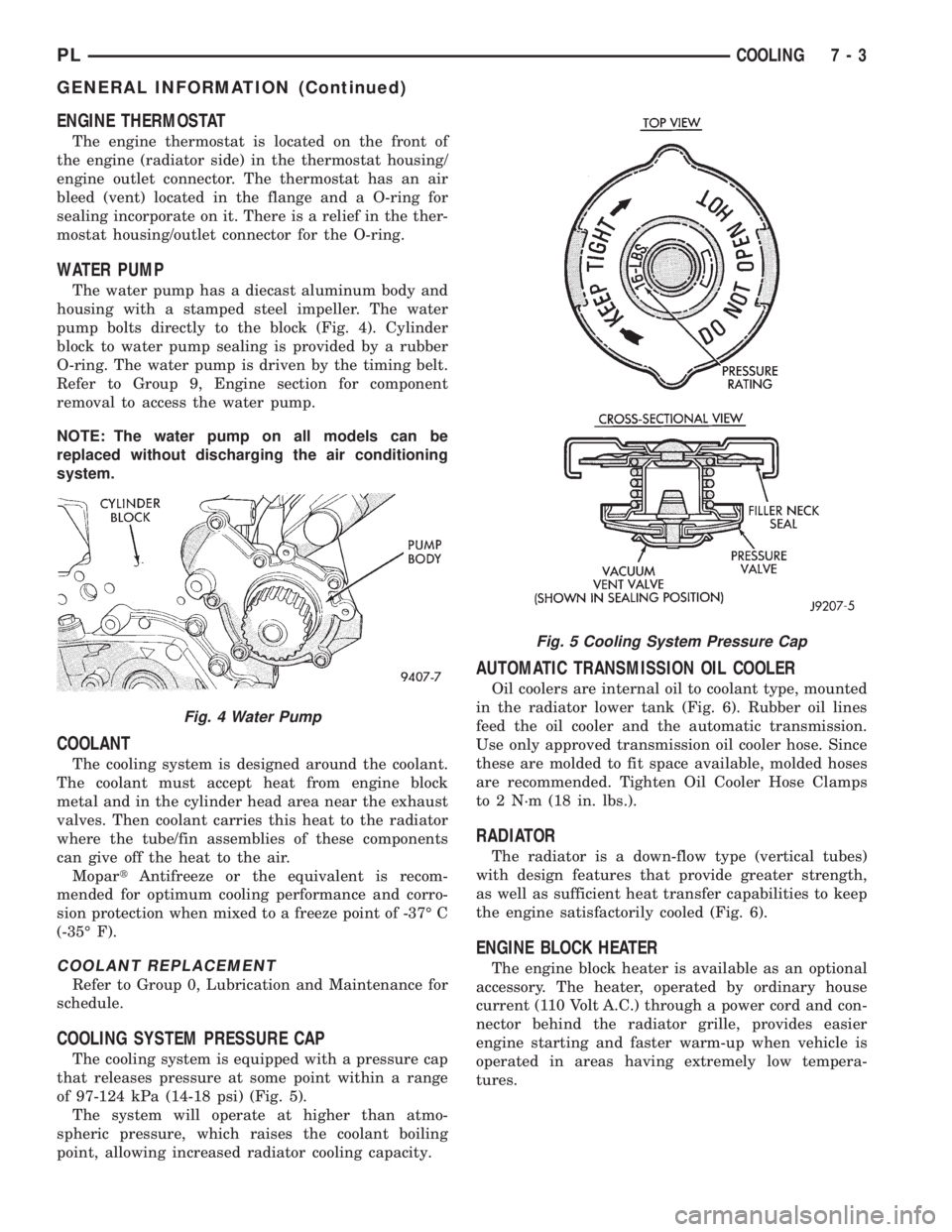
WATER PUMP
The water pump has a diecast aluminum body and
housing with a stamped steel impeller. The water
pump bolts directly to the block (Fig. 4). Cylinder
block to water pump sealing is provided by a rubber
O-ring. The water pump is driven by the timing belt.
Refer to Group 9, Engine section for component
removal to access the water pump.
NOTE: The water pump on all models can be
replaced without discharging the air conditioning
system.
COOLANT
The cooling system is designed around the coolant.
The coolant must accept heat from engine block
metal and in the cylinder head area near the exhaust
valves. Then coolant carries this heat to the radiator
where the tube/fin assemblies of these components
can give off the heat to the air.
MopartAntifreeze or the equivalent is recom-
mended for optimum cooling performance and corro-
sion protection when mixed to a freeze point of -37É C
(-35É F).
COOLANT REPLACEMENT
Refer to Group 0, Lubrication and Maintenance for
schedule.
COOLING SYSTEM PRESSURE CAP
The cooling system is equipped with a pressure cap
that releases pressure at some point within a range
of 97-124 kPa (14-18 psi) (Fig. 5).
The system will operate at higher than atmo-
spheric pressure, which raises the coolant boiling
point, allowing increased radiator cooling capacity.
AUTOMATIC TRANSMISSION OIL COOLER
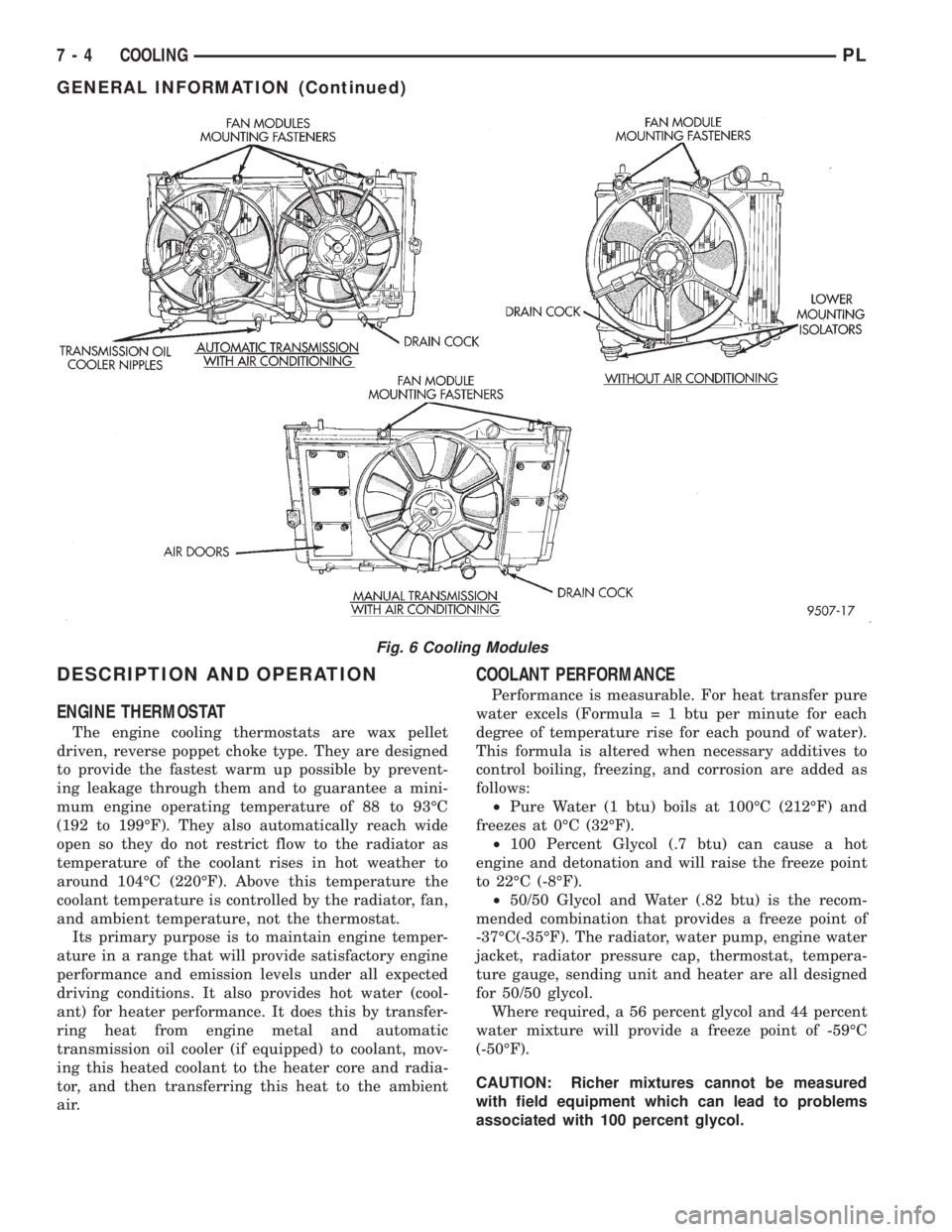
Oil coolers are internal oil to coolant type, mounted
in the radiator lower tank (Fig. 6). Rubber oil lines
feed the oil cooler and the automatic transmission.
Use only approved transmission oil cooler hose. Since
these are molded to fit space available, molded hoses
are recommended. Tighten Oil Cooler Hose Clamps
to 2 N´m (18 in. lbs.).
RADIATOR
The radiator is a down-flow type (vertical tubes)
with design features that provide greater strength,
as well as sufficient heat transfer capabilities to keep
the engine satisfactorily cooled (Fig. 6).
ENGINE BLOCK HEATER
The engine block heater is available as an optional
accessory. The heater, operated by ordinary house
current (110 Volt A.C.) through a power cord and con-
nector behind the radiator grille, provides easier
engine starting and faster warm-up when vehicle is
operated in areas having extremely low tempera-
tures.
Fig. 4 Water Pump
Fig. 5 Cooling System Pressure Cap
PLCOOLING 7 - 3
GENERAL INFORMATION (Continued)
Page 197 of 1200
DESCRIPTION AND OPERATION
ENGINE THERMOSTAT
The engine cooling thermostats are wax pellet
driven, reverse poppet choke type. They are designed
to provide the fastest warm up possible by prevent-
ing leakage through them and to guarantee a mini-
mum engine operating temperature of 88 to 93ÉC
(192 to 199ÉF). They also automatically reach wide
open so they do not restrict flow to the radiator as
temperature of the coolant rises in hot weather to
around 104ÉC (220ÉF). Above this temperature the
coolant temperature is controlled by the radiator, fan,
and ambient temperature, not the thermostat.
Its primary purpose is to maintain engine temper-
ature in a range that will provide satisfactory engine
performance and emission levels under all expected
driving conditions. It also provides hot water (cool-
ant) for heater performance. It does this by transfer-
ring heat from engine metal and automatic
transmission oil cooler (if equipped) to coolant, mov-
ing this heated coolant to the heater core and radia-
tor, and then transferring this heat to the ambient
air.
COOLANT PERFORMANCE
Performance is measurable. For heat transfer pure
water excels (Formula = 1 btu per minute for each
degree of temperature rise for each pound of water).
This formula is altered when necessary additives to
control boiling, freezing, and corrosion are added as
follows:
²Pure Water (1 btu) boils at 100ÉC (212ÉF) and
freezes at 0ÉC (32ÉF).
²100 Percent Glycol (.7 btu) can cause a hot
engine and detonation and will raise the freeze point
to 22ÉC (-8ÉF).
²50/50 Glycol and Water (.82 btu) is the recom-
mended combination that provides a freeze point of
-37ÉC(-35ÉF). The radiator, water pump, engine water
jacket, radiator pressure cap, thermostat, tempera-
ture gauge, sending unit and heater are all designed
for 50/50 glycol.
Where required, a 56 percent glycol and 44 percent
water mixture will provide a freeze point of -59ÉC
(-50ÉF).
CAUTION: Richer mixtures cannot be measured
with field equipment which can lead to problems
associated with 100 percent glycol.
Fig. 6 Cooling Modules
7 - 4 COOLINGPL
GENERAL INFORMATION (Continued)