Page 4 of 64
4
Vehicle suspension
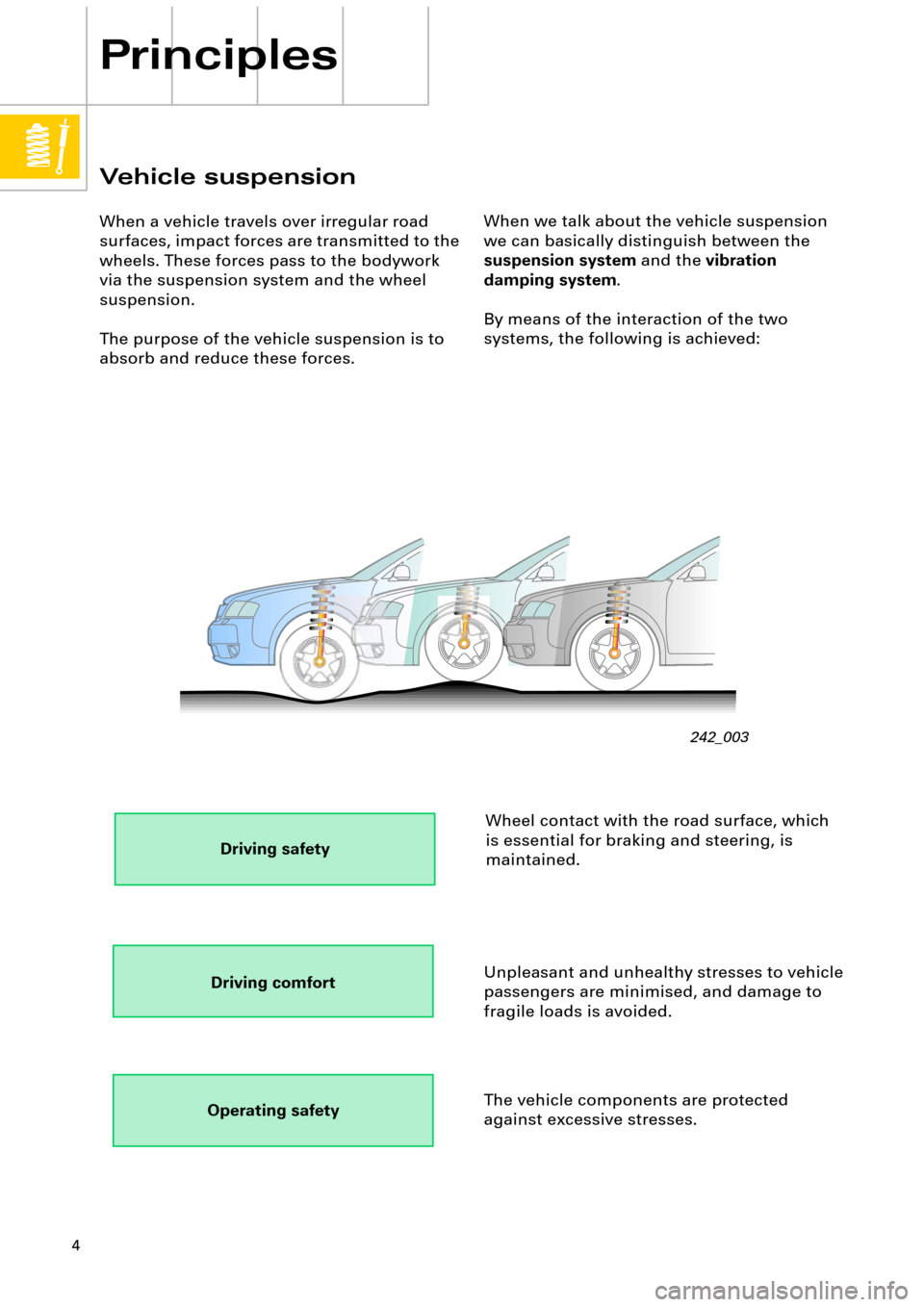
When a vehicle travels over irregular road
surfaces, impact forces are transmitted to the
wheels. These forces pass to the bodywork
via the suspension system and the wheel
suspension.
The purpose of the vehicle suspension is to
absorb and reduce these forces.
Principles
Wheel contact with the road surface, which
is essential for braking and steering, is
maintained.
The vehicle components are protected
against excessive stresses. Unpleasant and unhealthy stresses to vehicle
passengers are minimised, and damage to
fragile loads is avoided.
242_003
Driving safety
Operating safety
Driving comfort
When we talk about the vehicle suspension
we can basically distinguish between the
suspension system
and the
vibration
damping system
.
By means of the interaction of the two
systems, the following is achieved:
Page 6 of 64
6
Principles
The suspension system
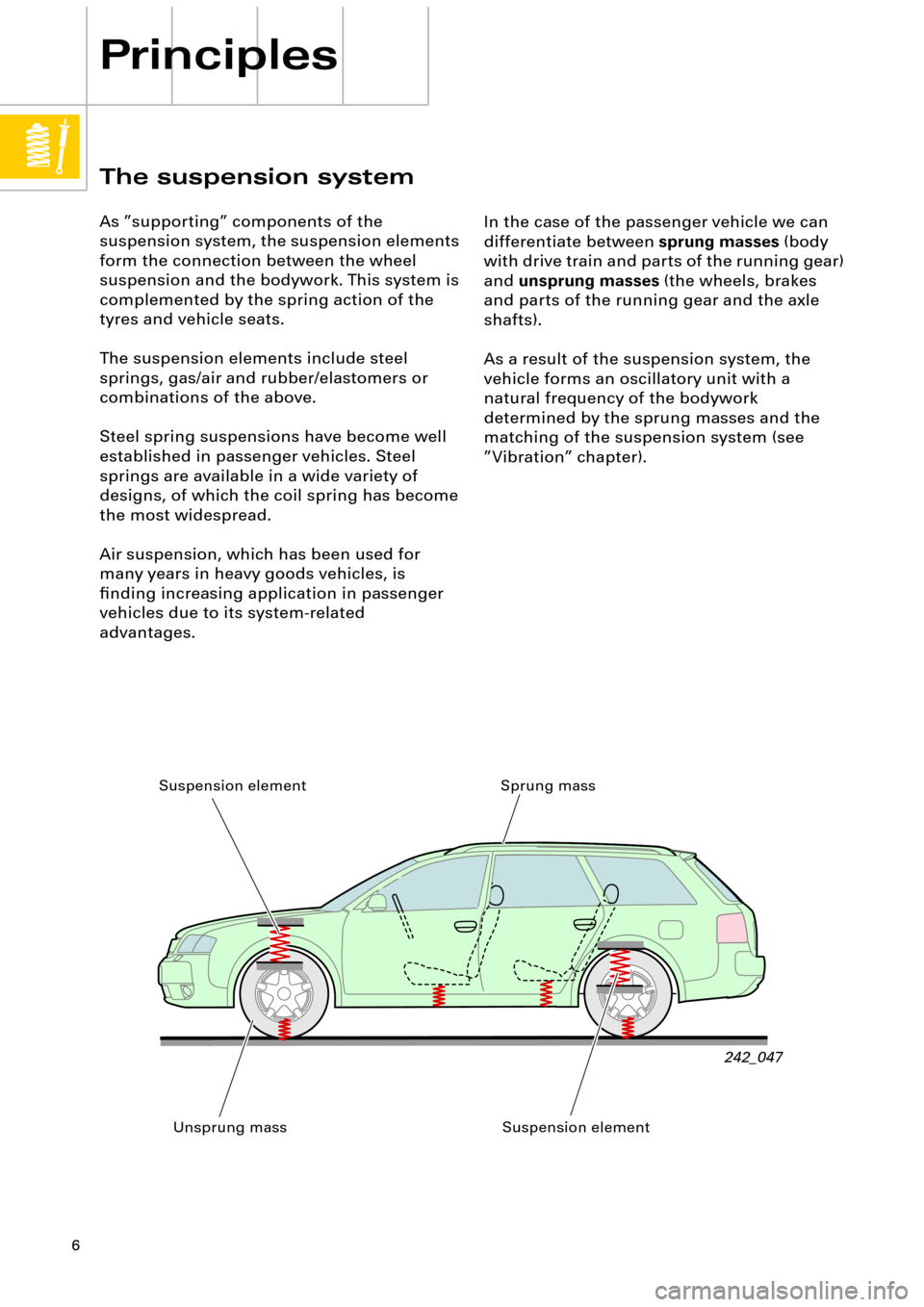
As ÓsupportingÓ components of the
suspension system, the suspension elements
form the connection between the wheel
suspension and the bodywork. This system is
complemented by the spring action of the
tyres and vehicle seats.
The suspension elements include steel
springs, gas/air and rubber/elastomers or
combinations of the above.
Steel spring suspensions have become well
established in passenger vehicles. Steel
springs are available in a wide variety of
designs, of which the coil spring has become
the most widespread.
Air suspension, which has been used for
many years in heavy goods vehicles, is
Þnding increasing application in passenger
vehicles due to its system-related
advantages.
242_047
In the case of the passenger vehicle we can
differentiate between
sprung masses
(body
with drive train and parts of the running gear)
and
unsprung masses
(the wheels, brakes
and parts of the running gear and the axle
shafts).
As a result of the suspension system, the
vehicle forms an oscillatory unit with a
natural frequency of the bodywork
determined by the sprung masses and the
matching of the suspension system (see
ÓVibrationÓ chapter).
Sprung mass
Unsprung mass Suspension element
Suspension element
Page 7 of 64
7
The unsprung masses
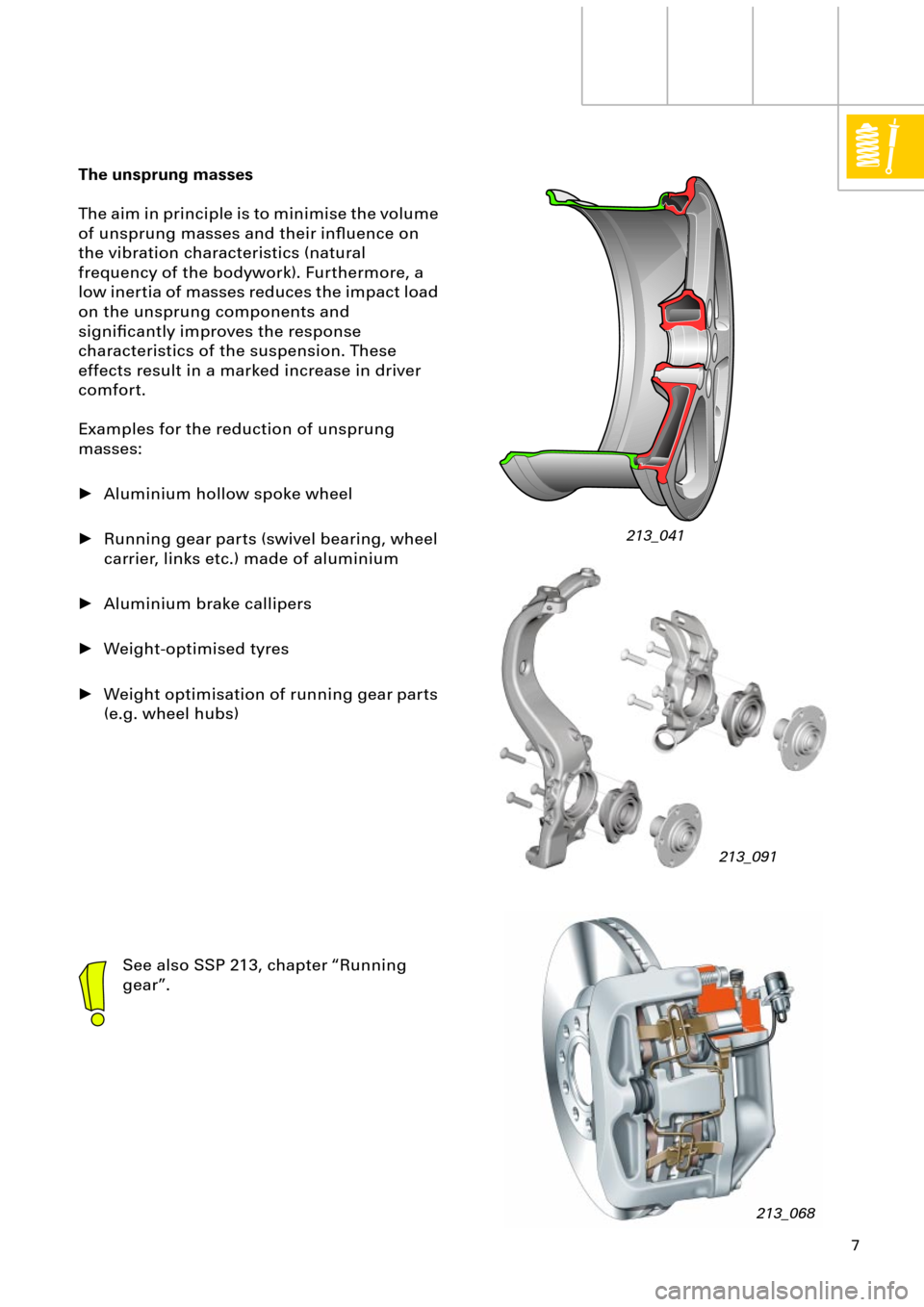
The aim in principle is to minimise the volume
of unsprung masses and their inßuence on
the vibration characteristics (natural
frequency of the bodywork). Furthermore, a
low inertia of masses reduces the impact load
on the unsprung components and
signiÞcantly improves the response
characteristics of the suspension. These
effects result in a marked increase in driver
comfort.
Examples for the reduction of unsprung
masses:
¥ Aluminium hollow spoke wheel
¥ Running gear parts (swivel bearing, wheel
carrier, links etc.) made of aluminium
¥ Aluminium brake callipers
¥ Weight-optimised tyres
¥ Weight optimisation of running gear parts
(e.g. wheel hubs)
213_091
213_068
See also SSP 213, chapter ÒRunning
gearÓ.
213_041
Page 15 of 64
15
DeÞnitions:
The
un-laden position
...
... is the compression exerted onto the wheels
when the vehicle is ready for the road (fuel
tank completely Þlled, spare wheel and
vehicle tools present).
The
design position
...
... is deÞned as the un-laden position plus the
additional load of three persons, each
weighing 68 kg.
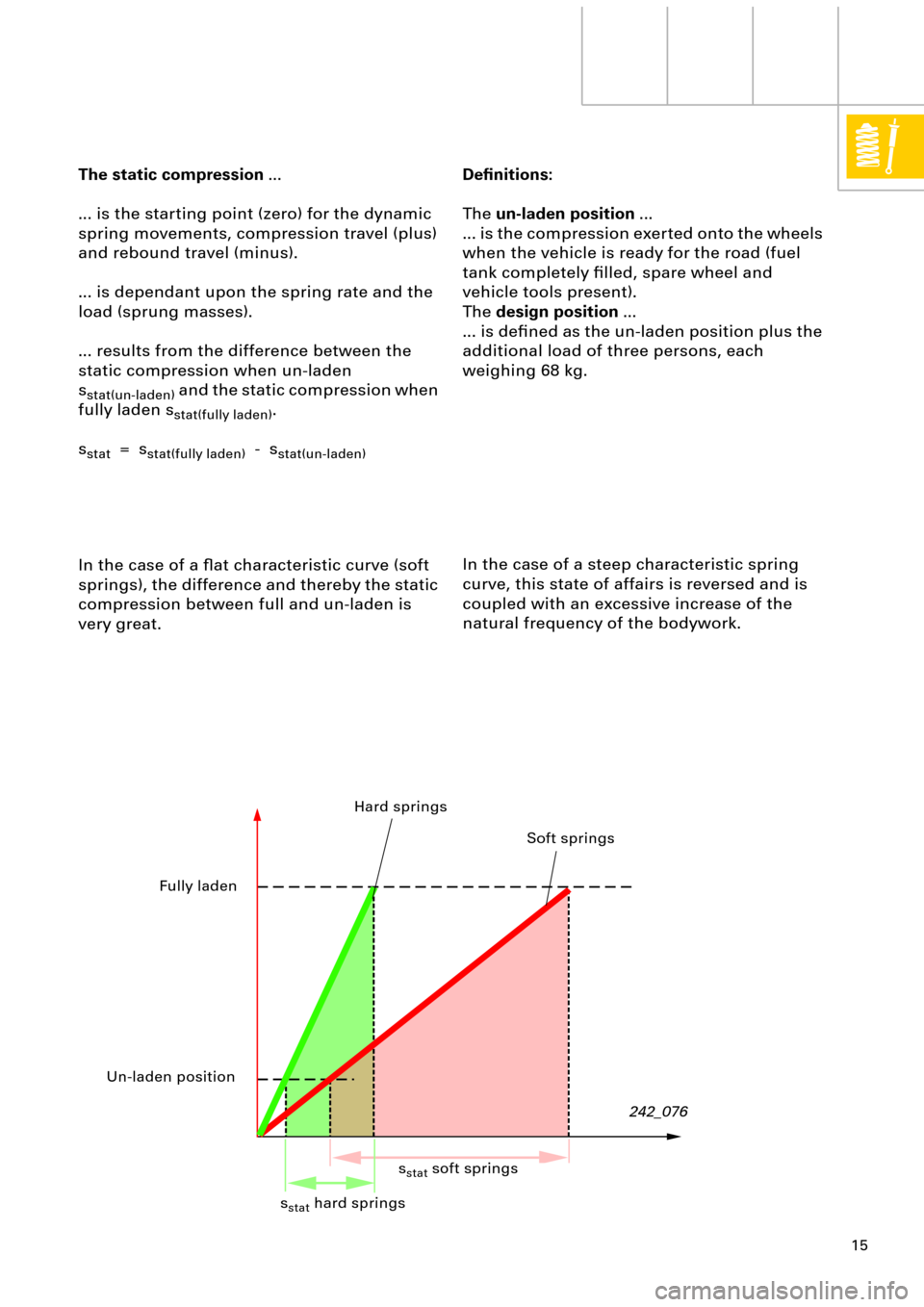
The static compression
...
... is the starting point (zero) for the dynamic
spring movements, compression travel (plus)
and rebound travel (minus).
... is dependant upon the spring rate and the
load (sprung masses).
... results from the difference between the
static compression when un-laden
s
stat(un-laden)
and the static compression when
fully laden s
stat(fully laden)
.
s
stat
= s
stat(fully laden)
- s
stat(un-laden)
In the case of a ßat characteristic curve (soft
springs), the difference and thereby the static
compression between full and un-laden is
very great.
242_076
In the case of a steep characteristic spring
curve, this state of affairs is reversed and is
coupled with an excessive increase of the
natural frequency of the bodywork.
Fully laden
Un-laden position
Hard springs
Soft springs
s
stat
soft springs
s
stat
hard springs
Page 16 of 64
16
Principles of air suspension
Self-levelling air
suspension
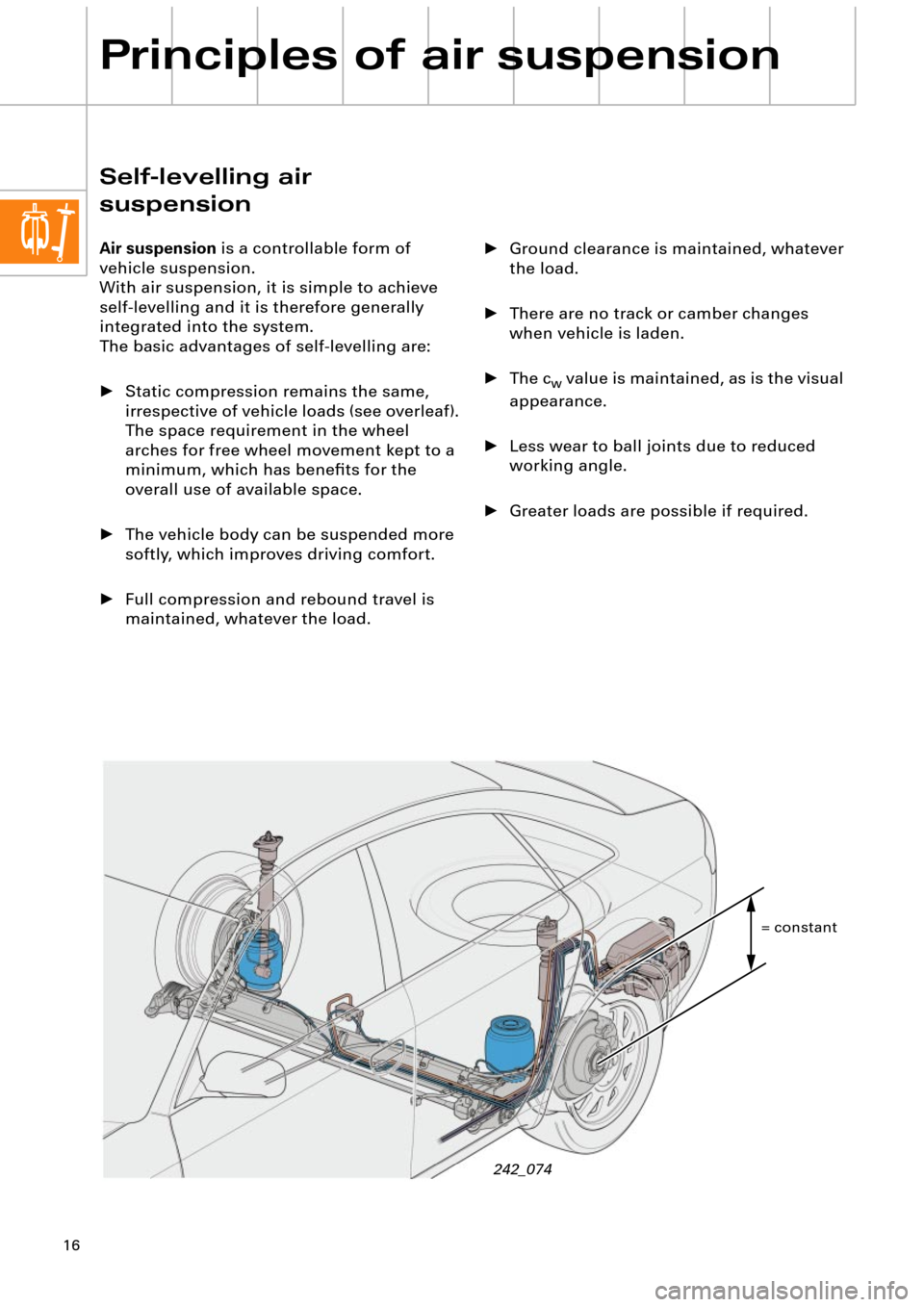
Air suspension is a controllable form of
vehicle suspension.
With air suspension, it is simple to achieve
self-levelling and it is therefore generally
integrated into the system.
The basic advantages of self-levelling are:
¥ Static compression remains the same,
irrespective of vehicle loads (see overleaf).
The space requirement in the wheel
arches for free wheel movement kept to a
minimum, which has beneÞts for the
overall use of available space.
¥ The vehicle body can be suspended more
softly, which improves driving comfort.
¥ Full compression and rebound travel is
maintained, whatever the load.
242_074
¥ Ground clearance is maintained, whatever
the load.
¥ There are no track or camber changes
when vehicle is laden.
¥ The c
w value is maintained, as is the visual
appearance.
¥ Less wear to ball joints due to reduced
working angle.
¥ Greater loads are possible if required.
= constant
Page 17 of 64
17
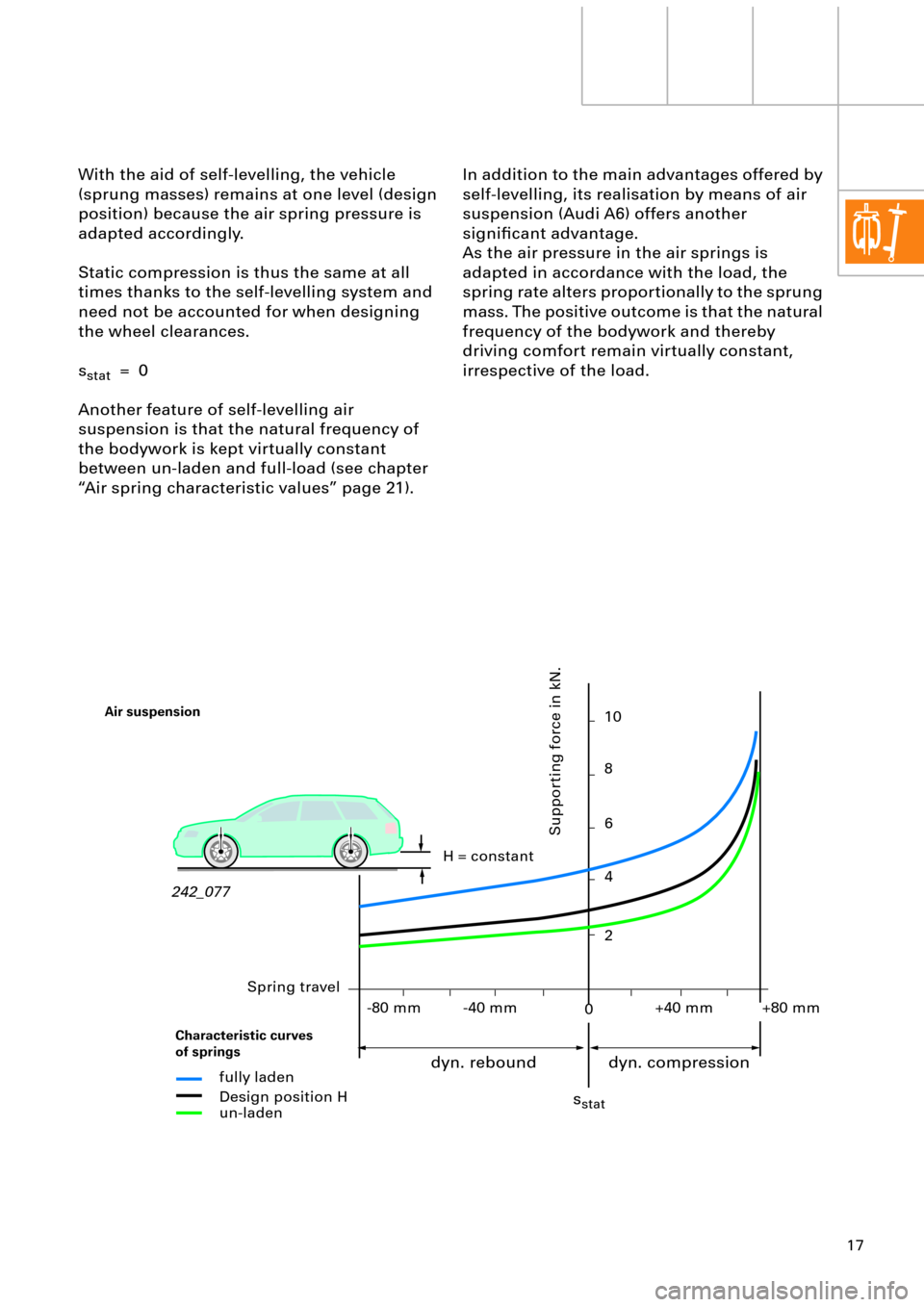
In addition to the main advantages offered by
self-levelling, its realisation by means of air
suspension (Audi A6) offers another
signiÞcant advantage.
As the air pressure in the air springs is
adapted in accordance with the load, the
spring rate alters proportionally to the sprung
mass. The positive outcome is that the natural
frequency of the bodywork and thereby
driving comfort remain virtually constant,
irrespective of the load. With the aid of self-levelling, the vehicle
(sprung masses) remains at one level (design
position) because the air spring pressure is
adapted accordingly.
Static compression is thus the same at all
times thanks to the self-levelling system and
need not be accounted for when designing
the wheel clearances.
s
stat = 0
Another feature of self-levelling air
suspension is that the natural frequency of
the bodywork is kept virtually constant
between un-laden and full-load (see chapter
ÒAir spring characteristic valuesÓ page 21).
242_077H = constant
fully laden
Design position H
un-laden
sstat
0
Supporting force in kN.
10
8
6
+80 mm+40 mm-40 mm -80 mm4
2
Air suspension
dyn. rebound dyn. compression
Spring travel
Characteristic curves
of springs
Page 23 of 64
23
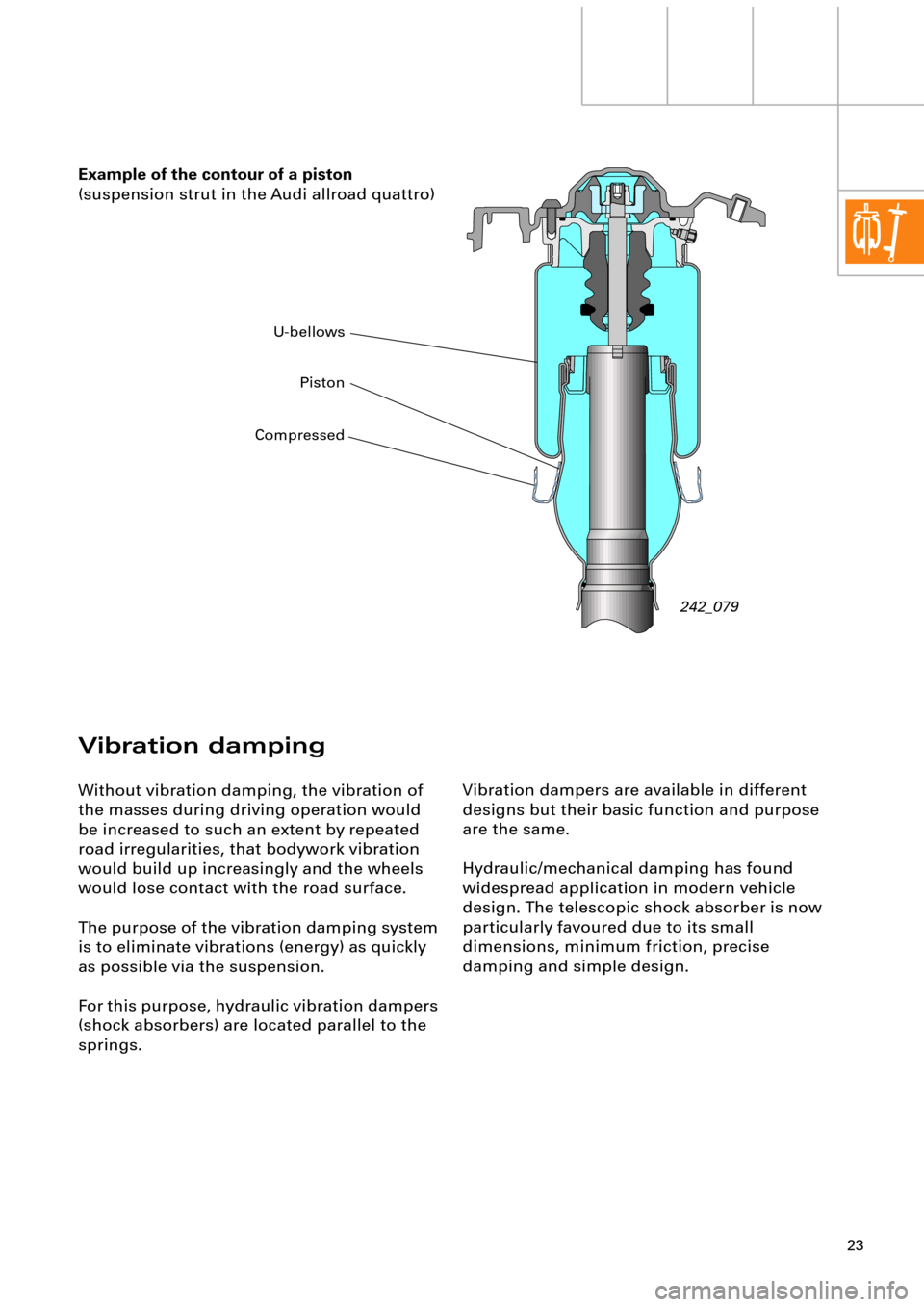
Example of the contour of a piston
(suspension strut in the Audi allroad quattro)
Vibration dampers are available in different
designs but their basic function and purpose
are the same.
Hydraulic/mechanical damping has found
widespread application in modern vehicle
design. The telescopic shock absorber is now
particularly favoured due to its small
dimensions, minimum friction, precise
damping and simple design.
Vibration damping
Without vibration damping, the vibration of
the masses during driving operation would
be increased to such an extent by repeated
road irregularities, that bodywork vibration
would build up increasingly and the wheels
would lose contact with the road surface.
The purpose of the vibration damping system
is to eliminate vibrations (energy) as quickly
as possible via the suspension.
For this purpose, hydraulic vibration dampers
(shock absorbers) are located parallel to the
springs.
242_079
U-bellows
Piston
Compressed
Page 38 of 64
38
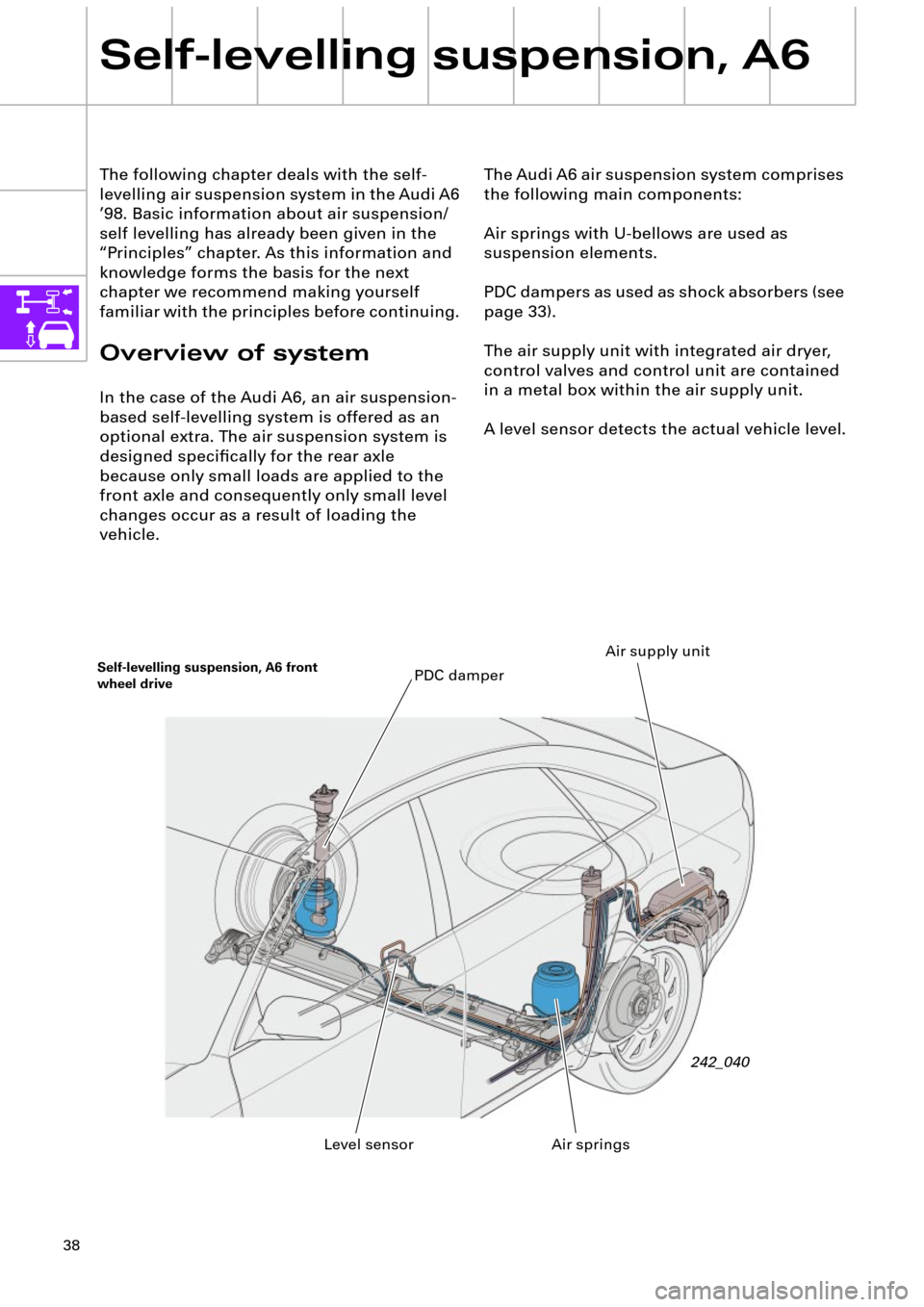
The Audi A6 air suspension system comprises
the following main components:
Air springs with U-bellows are used as
suspension elements.
PDC dampers as used as shock absorbers (see
page 33).
The air supply unit with integrated air dryer,
control valves and control unit are contained
in a metal box within the air supply unit.
A level sensor detects the actual vehicle level. The following chapter deals with the self-
levelling air suspension system in the Audi A6
Õ98. Basic information about air suspension/
self levelling has already been given in the
ÒPrinciplesÓ chapter. As this information and
knowledge forms the basis for the next
chapter we recommend making yourself
familiar with the principles before continuing.
Overview of system
In the case of the Audi A6, an air suspension-
based self-levelling system is offered as an
optional extra. The air suspension system is
designed speciÞcally for the rear axle
because only small loads are applied to the
front axle and consequently only small level
changes occur as a result of loading the
vehicle.
Self-levelling suspension, A6
Self-levelling suspension, A6 front
wheel drive
242_040
Air springs PDC damper
Level sensorAir supply unit