Page 40 of 64
40
The air springs
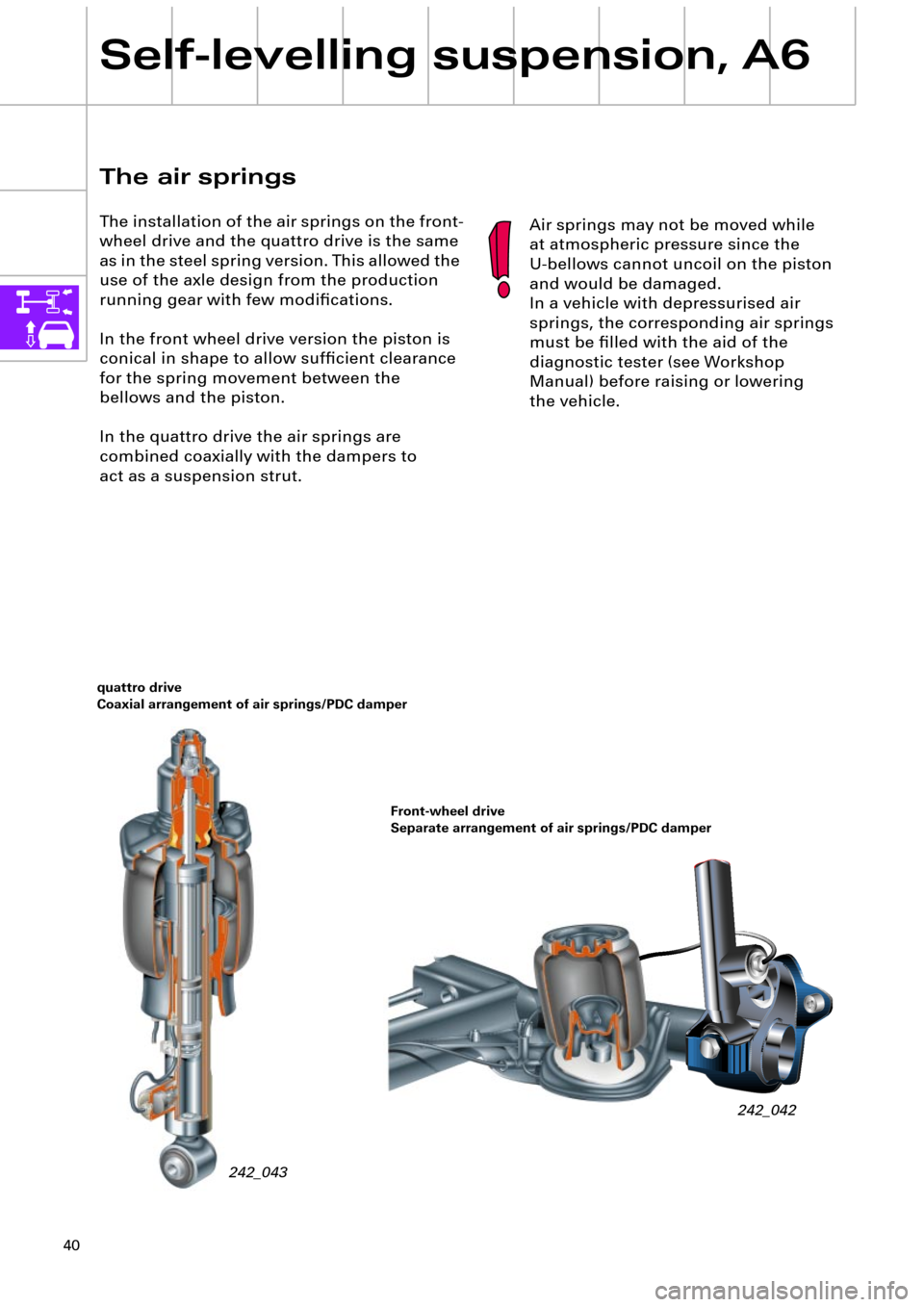
The installation of the air springs on the front-
wheel drive and the quattro drive is the same
as in the steel spring version. This allowed the
use of the axle design from the production
running gear with few modiÞcations.
In the front wheel drive version the piston is
conical in shape to allow sufÞcient clearance
for the spring movement between the
bellows and the piston.
In the quattro drive the air springs are
combined coaxially with the dampers to
act as a suspension strut.
Self-levelling suspension, A6
242_043
quattro drive
Coaxial arrangement of air springs/PDC damper
242_042
Front-wheel drive
Separate arrangement of air springs/PDC damper
Air springs may not be moved while
at atmospheric pressure since the
U-bellows cannot uncoil on the piston
and would be damaged.
In a vehicle with depressurised air
springs, the corresponding air springs
must be Þlled with the aid of the
diagnostic tester (see Workshop
Manual) before raising or lowering
the vehicle.
Page 51 of 64
51
Valve for suspension strut
rear left N150 and rear
right N151
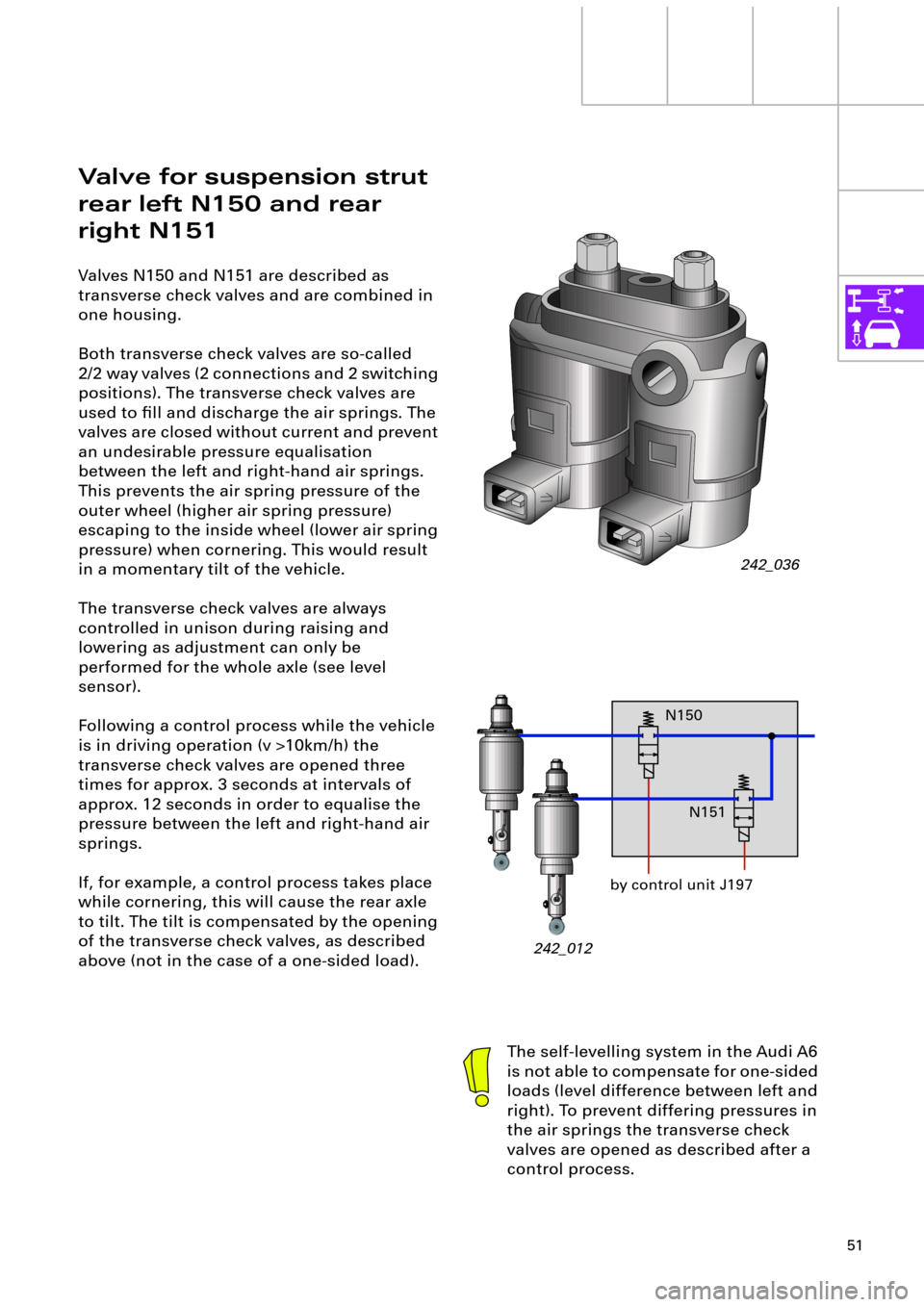
Valves N150 and N151 are described as
transverse check valves and are combined in
one housing.
Both transverse check valves are so-called
2/2 way valves (2 connections and 2 switching
positions). The transverse check valves are
used to Þll and discharge the air springs. The
valves are closed without current and prevent
an undesirable pressure equalisation
between the left and right-hand air springs.
This prevents the air spring pressure of the
outer wheel (higher air spring pressure)
escaping to the inside wheel (lower air spring
pressure) when cornering. This would result
in a momentary tilt of the vehicle.
The transverse check valves are always
controlled in unison during raising and
lowering as adjustment can only be
performed for the whole axle (see level
sensor).
Following a control process while the vehicle
is in driving operation (v >10km/h) the
transverse check valves are opened three
times for approx. 3 seconds at intervals of
approx. 12 seconds in order to equalise the
pressure between the left and right-hand air
springs.
If, for example, a control process takes place
while cornering, this will cause the rear axle
to tilt. The tilt is compensated by the opening
of the transverse check valves, as described
above (not in the case of a one-sided load).
242_036
The self-levelling system in the Audi A6
is not able to compensate for one-sided
loads (level difference between left and
right). To prevent differing pressures in
the air springs the transverse check
valves are opened as described after a
control process.
242_012by control unit J197N150
N151
Page 52 of 64
52
Self-levelling suspension, A6
Self-levelling
suspension sender G84
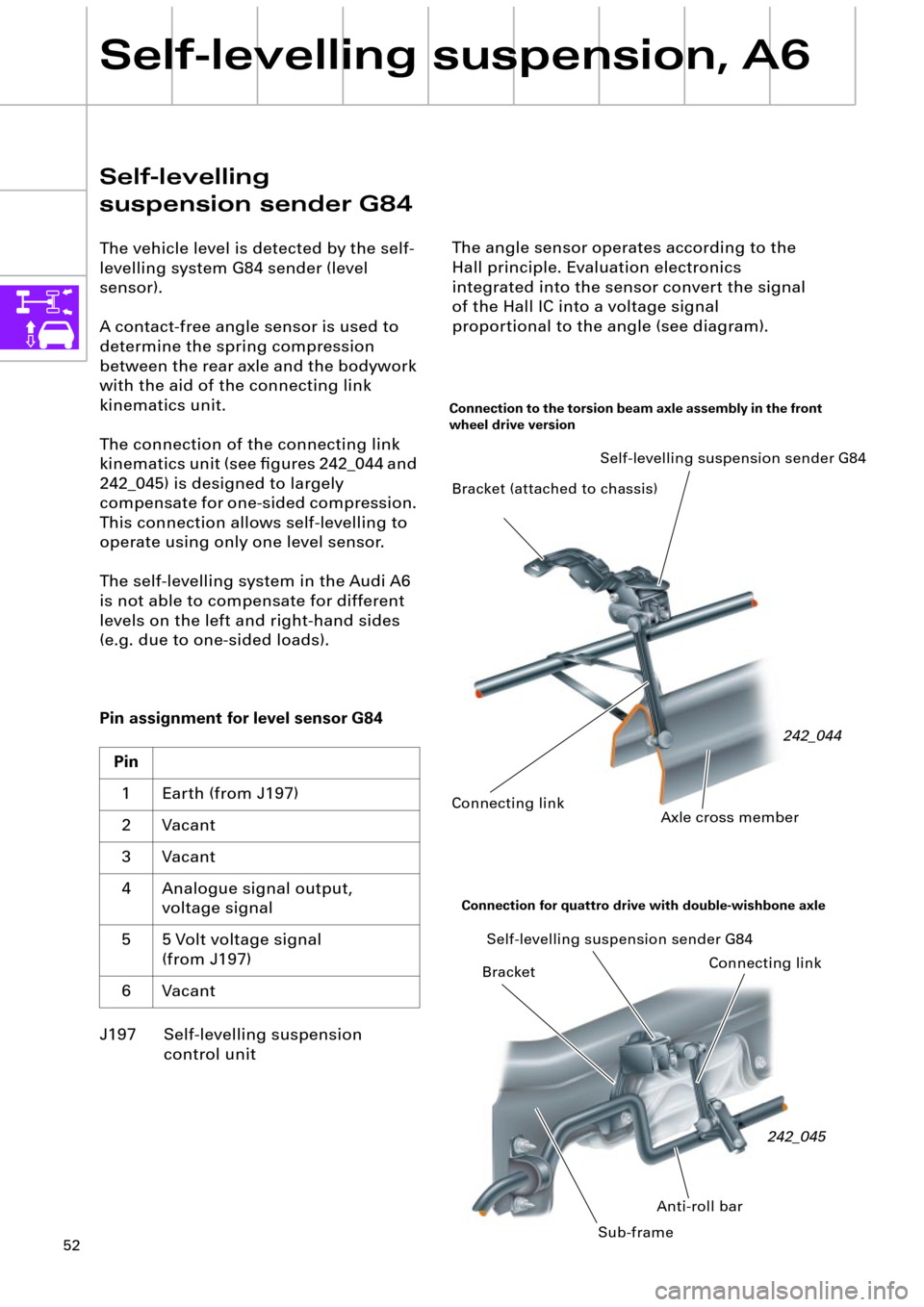
The vehicle level is detected by the self-
levelling system G84 sender (level
sensor).
A contact-free angle sensor is used to
determine the spring compression
between the rear axle and the bodywork
with the aid of the connecting link
kinematics unit.
The connection of the connecting link
kinematics unit (see Þgures 242_044 and
242_045) is designed to largely
compensate for one-sided compression.
This connection allows self-levelling to
operate using only one level sensor.
The self-levelling system in the Audi A6
is not able to compensate for different
levels on the left and right-hand sides
(e.g. due to one-sided loads).
Pin assignment for level sensor G84
J197 Self-levelling suspension
control unit Pin
1 Earth (from J197)
2 Vacant
3 Vacant
4 Analogue signal output,
voltage signal
5 5 Volt voltage signal
(from J197)
6 Vacant
242_044 Self-levelling suspension sender G84
Connecting link
Axle cross member
Connection to the torsion beam axle assembly in the front
wheel drive version
Bracket (attached to chassis)
Connecting link Self-levelling suspension sender G84
Bracket
Anti-roll bar
Connection for quattro drive with double-wishbone axle
242_045
Sub-frame
The angle sensor operates according to the
Hall principle. Evaluation electronics
integrated into the sensor convert the signal
of the Hall IC into a voltage signal
proportional to the angle (see diagram).
Page 57 of 64
57
The interfaces
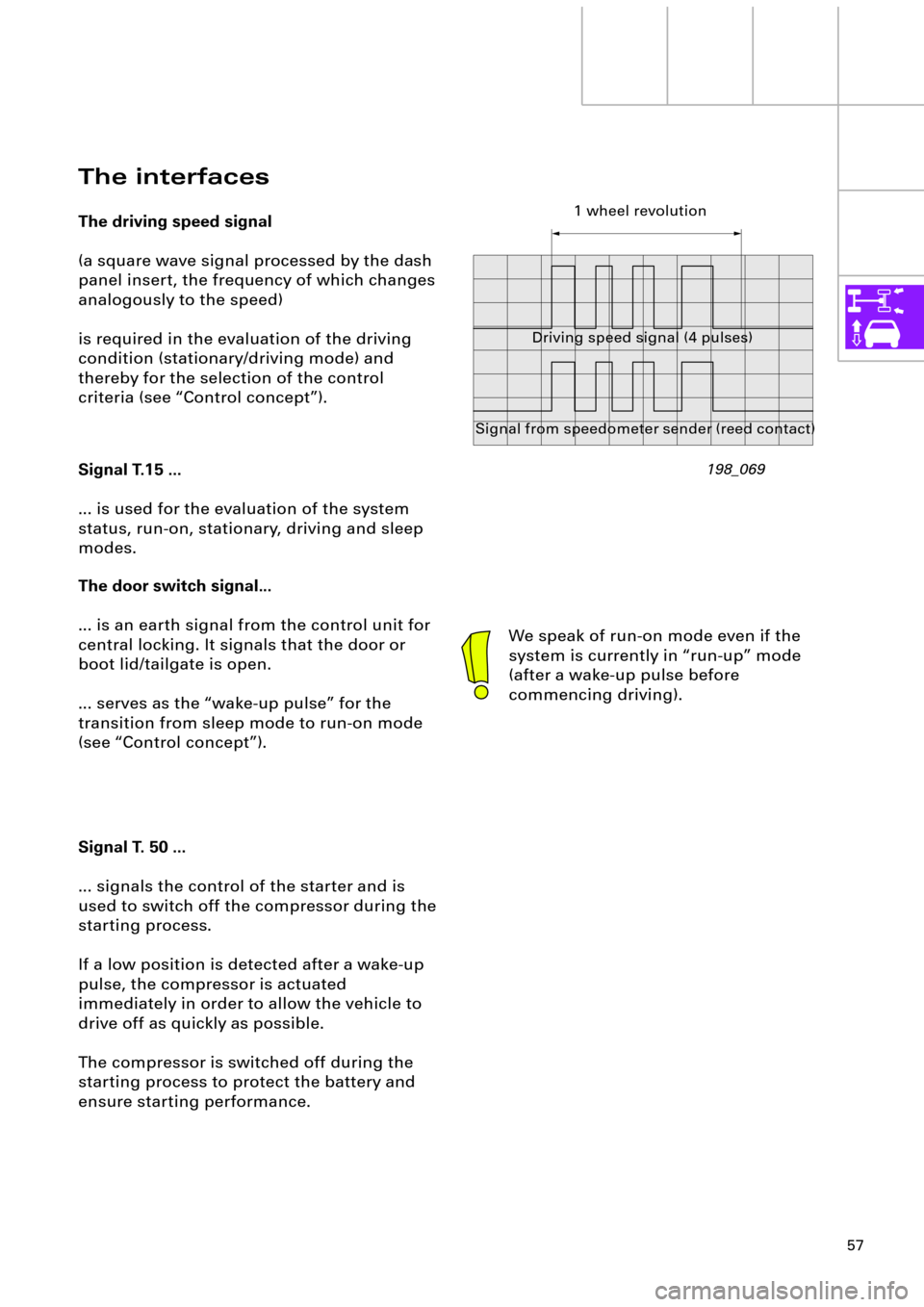
The driving speed signal
(a square wave signal processed by the dash
panel insert, the frequency of which changes
analogously to the speed)
is required in the evaluation of the driving
condition (stationary/driving mode) and
thereby for the selection of the control
criteria (see ÒControl conceptÓ). 1 wheel revolution
Signal T.15 ...
... is used for the evaluation of the system
status, run-on, stationary, driving and sleep
modes.
Signal T. 50 ...
... signals the control of the starter and is
used to switch off the compressor during the
starting process.
If a low position is detected after a wake-up
pulse, the compressor is actuated
immediately in order to allow the vehicle to
drive off as quickly as possible.
The compressor is switched off during the
starting process to protect the battery and
ensure starting performance. The door switch signal...
... is an earth signal from the control unit for
central locking. It signals that the door or
boot lid/tailgate is open.
... serves as the Òwake-up pulseÓ for the
transition from sleep mode to run-on mode
(see ÒControl conceptÓ).
Driving speed signal (4 pulses)
Signal from speedometer sender (reed contact)
We speak of run-on mode even if the
system is currently in Òrun-upÓ mode
(after a wake-up pulse before
commencing driving).
198_069