1998 NISSAN PICK-UP sensor
[x] Cancel search: sensorPage 180 of 1659
VC
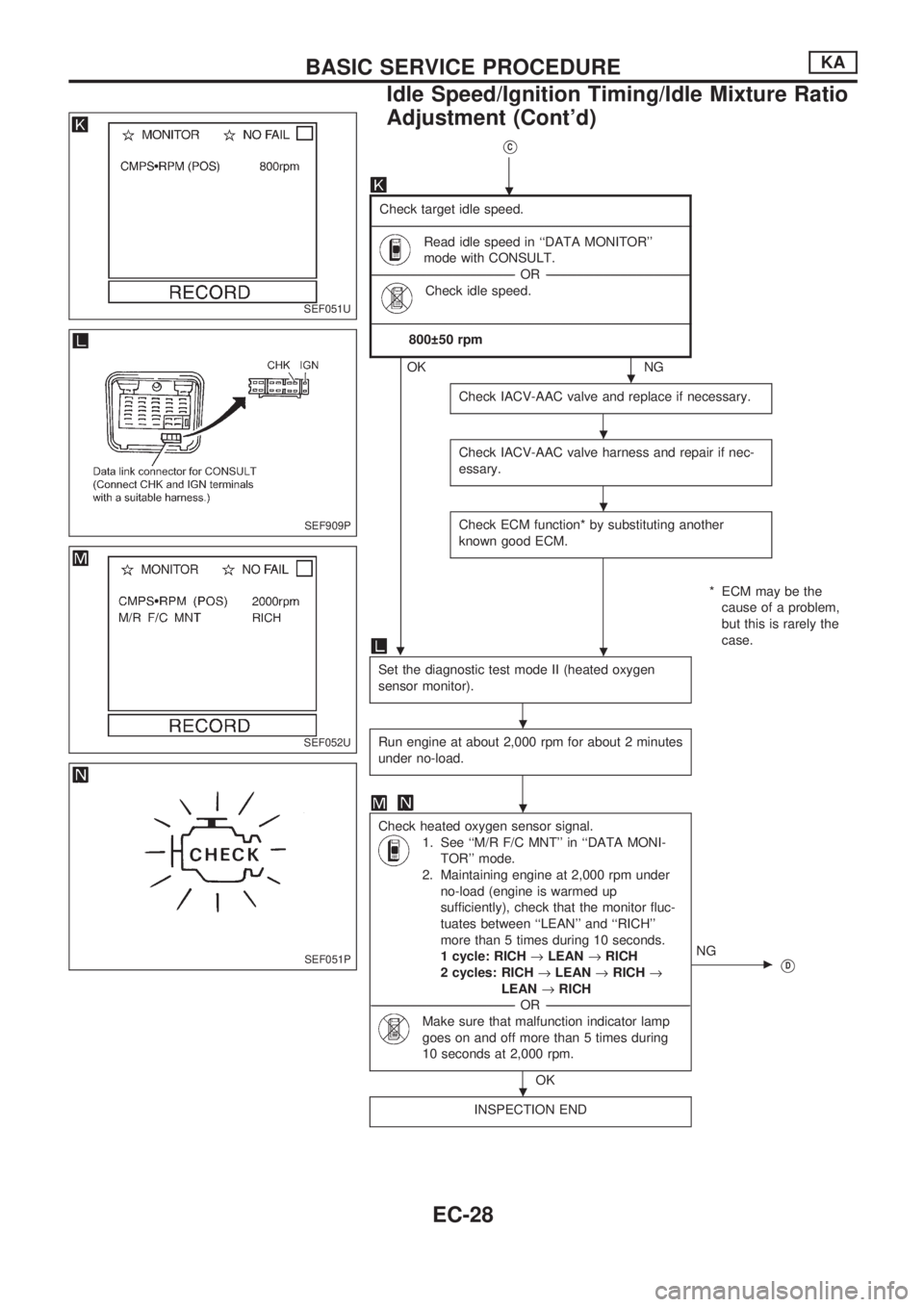
Check target idle speed.
-------------------------------------------------------------------------------------------------------------------------------------------------------------------------------------------------------------------------------------------------------------------------------------------------------------------------------------------------------------------------
Read idle speed in ``DATA MONITOR''
mode with CONSULT.
-----------------------------------------------------------------------------------------------------------------------------------------------------------------OR -----------------------------------------------------------------------------------------------------------------------------------------------------------------
Check idle speed.
-------------------------------------------------------------------------------------------------------------------------------------------------------------------------------------------------------------------------------------------------------------------------------------------------------------------------------------------------------------------------
800 50 rpm
OKNG
Check IACV-AAC valve and replace if necessary.
Check IACV-AAC valve harness and repair if nec-
essary.
Check ECM function* by substituting another
known good ECM.
* ECM may be the
cause of a problem,
but this is rarely the
case.
.
Set the diagnostic test mode II (heated oxygen
sensor monitor).
Run engine at about 2,000 rpm for about 2 minutes
under no-load.
Check heated oxygen sensor signal.
1. See ``M/R F/C MNT'' in ``DATA MONI-
TOR'' mode.
2. Maintaining engine at 2,000 rpm under
no-load (engine is warmed up
sufficiently), check that the monitor fluc-
tuates between ``LEAN'' and ``RICH''
more than 5 times during 10 seconds.
1 cycle: RICH®LEAN®RICH
2 cycles: RICH®LEAN®RICH®
LEAN®RICH
-----------------------------------------------------------------------------------------------------------------------------------------------------------------OR -----------------------------------------------------------------------------------------------------------------------------------------------------------------
Make sure that malfunction indicator lamp
goes on and off more than 5 times during
10 seconds at 2,000 rpm.
OK
cNG
VD
INSPECTION END
SEF051U
SEF909P
SEF052U
SEF051P
.
.
.
.
.
.
.
.
BASIC SERVICE PROCEDUREKA
Idle Speed/Ignition Timing/Idle Mixture Ratio
Adjustment (Cont'd)
EC-28
Page 181 of 1659

VD
Check heated oxygen sensor harness:
1. Turn off engine and disconnect battery ground
cable.
2. Disconnect ECM harness connector from ECM.
3. Disconnect heated oxygen sensor harness con-
nector and connect terminal for heated oxygen
sensor to ground with a jumper wire.
4. Check for continuity between terminal
V19of
ECM harness connector and ground metal on
vehicle body.
----------------------------------------------------------------------------------------------------------------------------------------------------------------------------------------------------------------------------------------------------------------------------------------------------------------------------------------------------------------------------
Continuity exists ... OK
Continuity does not exist ... NG
OK NG
Repair harness.
cVF
Connect ECM harness connector to ECM.
1. Select ``ENG COOLANT TEMP'' in
``ACTIVE TEST'' mode.
2. Set ``COOLANT TEMP'' at 20ÉC (68ÉF).
--------------------------------------------------------------------------------------------------------------------------------------------------------------------OR--------------------------------------------------------------------------------------------------------------------------------------------------------------------
lDisconnect engine coolant temperature
sensor harness connector.
lConnect a resistor (2.5 kW) between ter-
minals of engine coolant temperature sen-
sor harness connector.
Start engine and warm it up until engine coolant
temperature indicator points to the middle of gauge.
(Be careful to start engine after setting ``COOLANT
TEMP'' or installing a 2.5 kWresistor.)
Rev engine two or three times under no-load then
run engine at idle speed.
VE
MEF031DB
SEF053U
.
.
.
.
.
.
.
BASIC SERVICE PROCEDUREKA
Idle Speed/Ignition Timing/Idle Mixture Ratio
Adjustment (Cont'd)
EC-29
Page 182 of 1659
VE
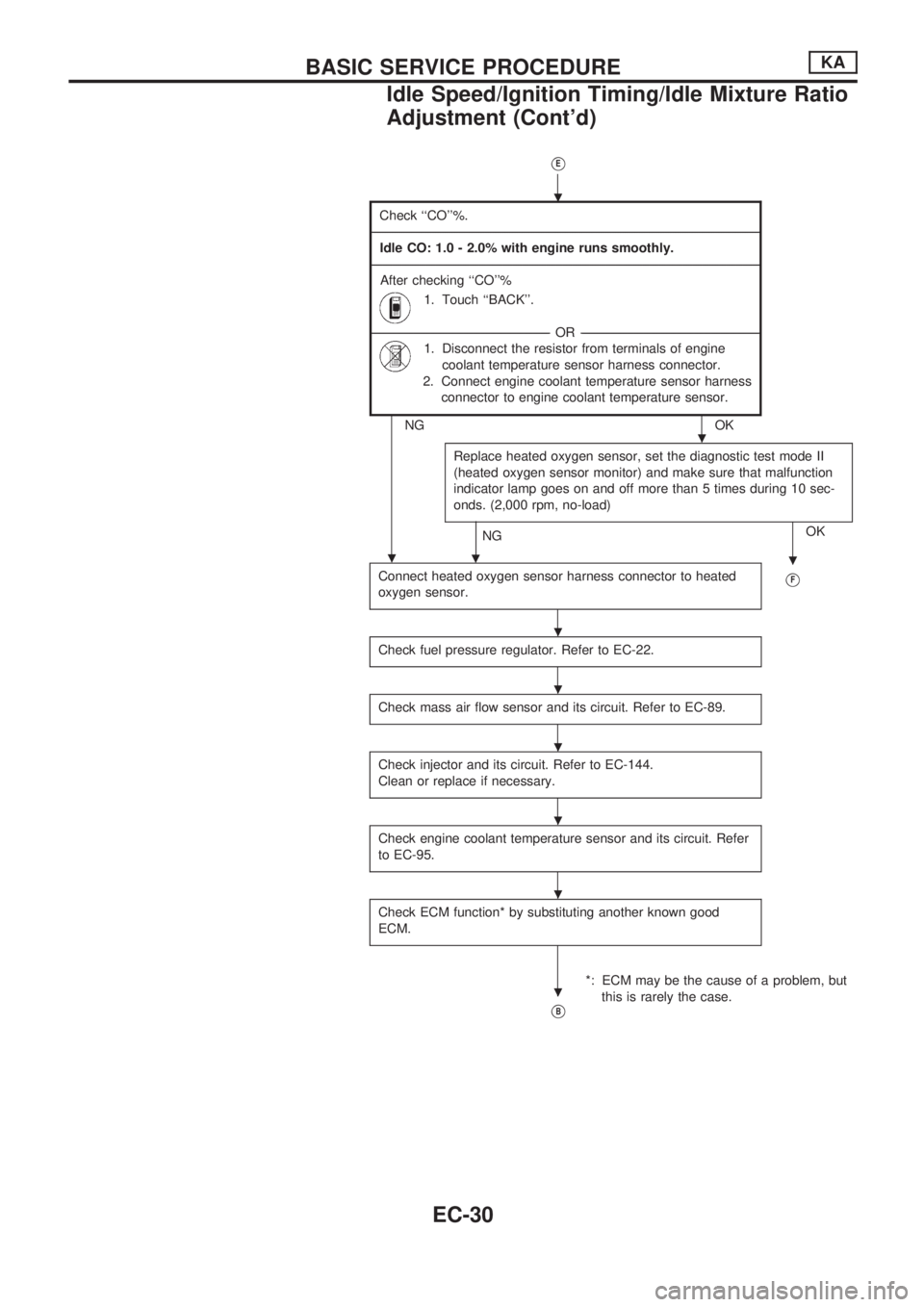
Check ``CO''%.
-------------------------------------------------------------------------------------------------------------------------------------------------------------------------------------------------------------------------------------------------------------------------------------------------------------------------------------------------------------------------------------------------------------------------------------------------------
Idle CO: 1.0 - 2.0% with engine runs smoothly.
-------------------------------------------------------------------------------------------------------------------------------------------------------------------------------------------------------------------------------------------------------------------------------------------------------------------------------------------------------------------------------------------------------------------------------------------------------
After checking ``CO''%
1. Touch ``BACK''.
---------------------------------------------------------------------------------------------------------------------------------------------------------------------------------------------------------OR---------------------------------------------------------------------------------------------------------------------------------------------------------------------------------------------------------
1. Disconnect the resistor from terminals of engine
coolant temperature sensor harness connector.
2. Connect engine coolant temperature sensor harness
connector to engine coolant temperature sensor.
NG OK
Replace heated oxygen sensor, set the diagnostic test mode II
(heated oxygen sensor monitor) and make sure that malfunction
indicator lamp goes on and off more than 5 times during 10 sec-
onds. (2,000 rpm, no-load)
NGOK
.
Connect heated oxygen sensor harness connector to heated
oxygen sensor.VF
Check fuel pressure regulator. Refer to EC-22.
Check mass air flow sensor and its circuit. Refer to EC-89.
Check injector and its circuit. Refer to EC-144.
Clean or replace if necessary.
Check engine coolant temperature sensor and its circuit. Refer
to EC-95.
Check ECM function* by substituting another known good
ECM.
*: ECM may be the cause of a problem, but
this is rarely the case.
VB
.
.
..
.
.
.
.
.
.
BASIC SERVICE PROCEDUREKA
Idle Speed/Ignition Timing/Idle Mixture Ratio
Adjustment (Cont'd)
EC-30
Page 184 of 1659
Checking and adjusting idle speed, ignition timing
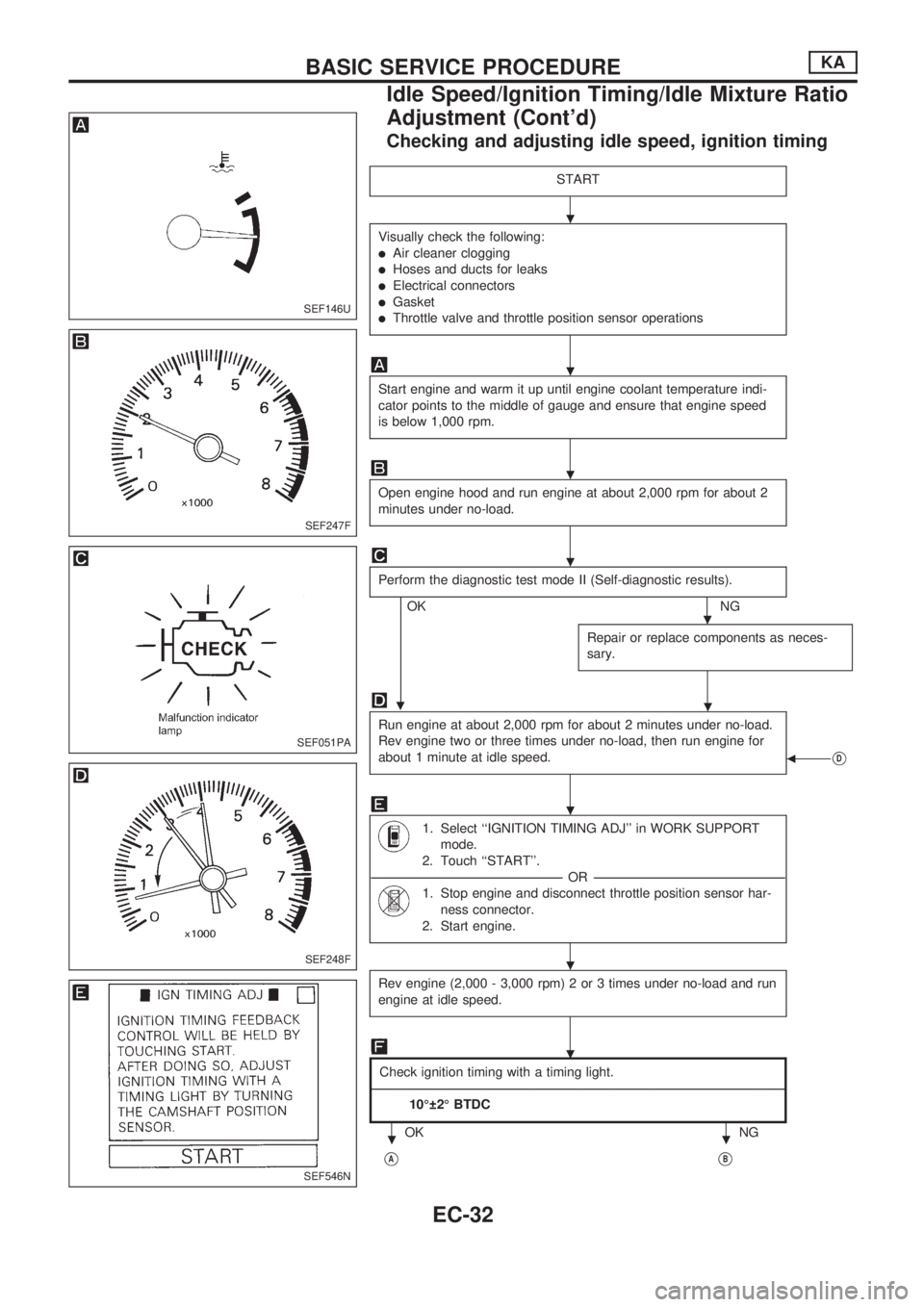
START
Visually check the following:
lAir cleaner clogging
lHoses and ducts for leaks
lElectrical connectors
lGasket
lThrottle valve and throttle position sensor operations
Start engine and warm it up until engine coolant temperature indi-
cator points to the middle of gauge and ensure that engine speed
is below 1,000 rpm.
Open engine hood and run engine at about 2,000 rpm for about 2
minutes under no-load.
Perform the diagnostic test mode II (Self-diagnostic results).
OKNG
Repair or replace components as neces-
sary.
.
Run engine at about 2,000 rpm for about 2 minutes under no-load.
Rev engine two or three times under no-load, then run engine for
about 1 minute at idle speed.
bVD
1. Select ``IGNITION TIMING ADJ'' in WORK SUPPORT
mode.
2. Touch ``START''.
-----------------------------------------------------------------------------------------------------------------------------------------------------------------------------------------------------------------------OR -----------------------------------------------------------------------------------------------------------------------------------------------------------------------------------------------------------------------
1. Stop engine and disconnect throttle position sensor har-
ness connector.
2. Start engine.
Rev engine (2,000 - 3,000 rpm) 2 or 3 times under no-load and run
engine at idle speed.
Check ignition timing with a timing light.
------------------------------------------------------------------------------------------------------------------------------------------------------------------------------------------------------------------------------------------------------------------------------------------------------------------------------------------------------------------------------------------------------------------------------------------------------------------------------------
10É 2É BTDC
OK NG
VAVB
SEF146U
SEF247F
SEF051PA
SEF248F
SEF546N
.
.
.
.
.
.
.
.
.
..
BASIC SERVICE PROCEDUREKA
Idle Speed/Ignition Timing/Idle Mixture Ratio
Adjustment (Cont'd)
EC-32
Page 188 of 1659
Introduction
The ECM (ECCS control module) has an on board diagnostic system, which detects malfunctions related to
engine sensors or actuators. Self-diagnosis items are listed in ``DIAGNOSTIC TROUBLE CODE INDEX'',
EC-1.
The malfunction indicator lamp (MIL) on the instrument panel lights up when a malfunction is detected, or
when the ECM enters fail-safe mode (Refer to EC-61).
Diagnostic Trouble Code (DTC)
HOW TO CONFIRM MALFUNCTION ITEMS
Malfunction items can be confirmed by the following methods.
1. The number of blinks of the malfunction indicator lamp in the Diagnostic Test Mode II (Self- Diag-
nostic Results) indicates the DTC. Examples: 11, 21 etc.
2. CONSULT displays the malfunctioning component or system in ``SELF DIAGNOSTIC RESULTS''
mode.
lOutput of a DTC indicates a malfunction. However, Mode II does not indicate whether the mal-
function is still occurring or has occurred in the past and has returned to normal.
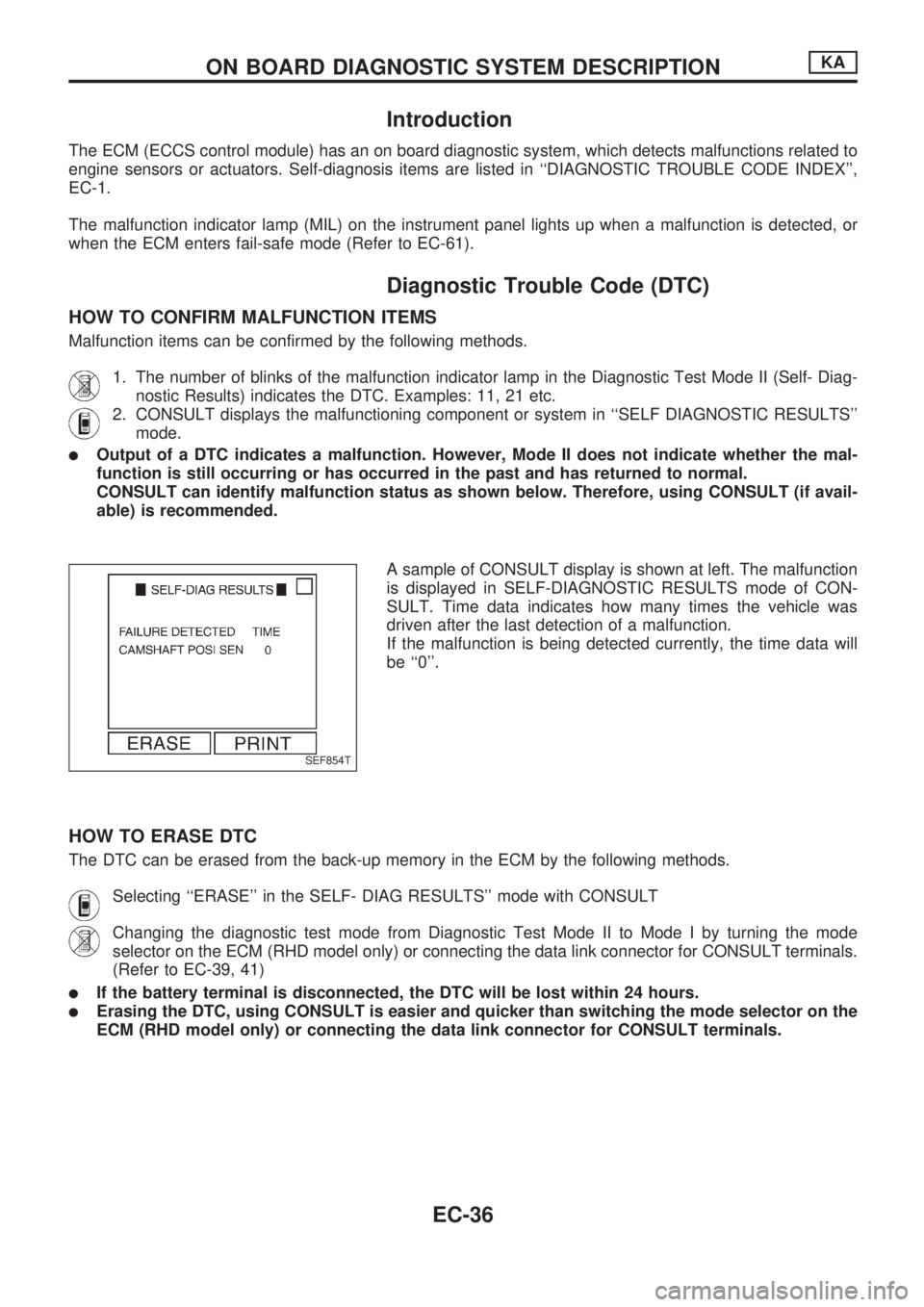
CONSULT can identify malfunction status as shown below. Therefore, using CONSULT (if avail-
able) is recommended.
A sample of CONSULT display is shown at left. The malfunction
is displayed in SELF-DIAGNOSTIC RESULTS mode of CON-
SULT. Time data indicates how many times the vehicle was
driven after the last detection of a malfunction.
If the malfunction is being detected currently, the time data will
be ``0''.
HOW TO ERASE DTC
The DTC can be erased from the back-up memory in the ECM by the following methods.
Selecting ``ERASE'' in the SELF- DIAG RESULTS'' mode with CONSULT
Changing the diagnostic test mode from Diagnostic Test Mode II to Mode I by turning the mode
selector on the ECM (RHD model only) or connecting the data link connector for CONSULT terminals.
(Refer to EC-39, 41)
lIf the battery terminal is disconnected, the DTC will be lost within 24 hours.
lErasing the DTC, using CONSULT is easier and quicker than switching the mode selector on the
ECM (RHD model only) or connecting the data link connector for CONSULT terminals.
SEF854T
ON BOARD DIAGNOSTIC SYSTEM DESCRIPTIONKA
EC-36
Page 190 of 1659
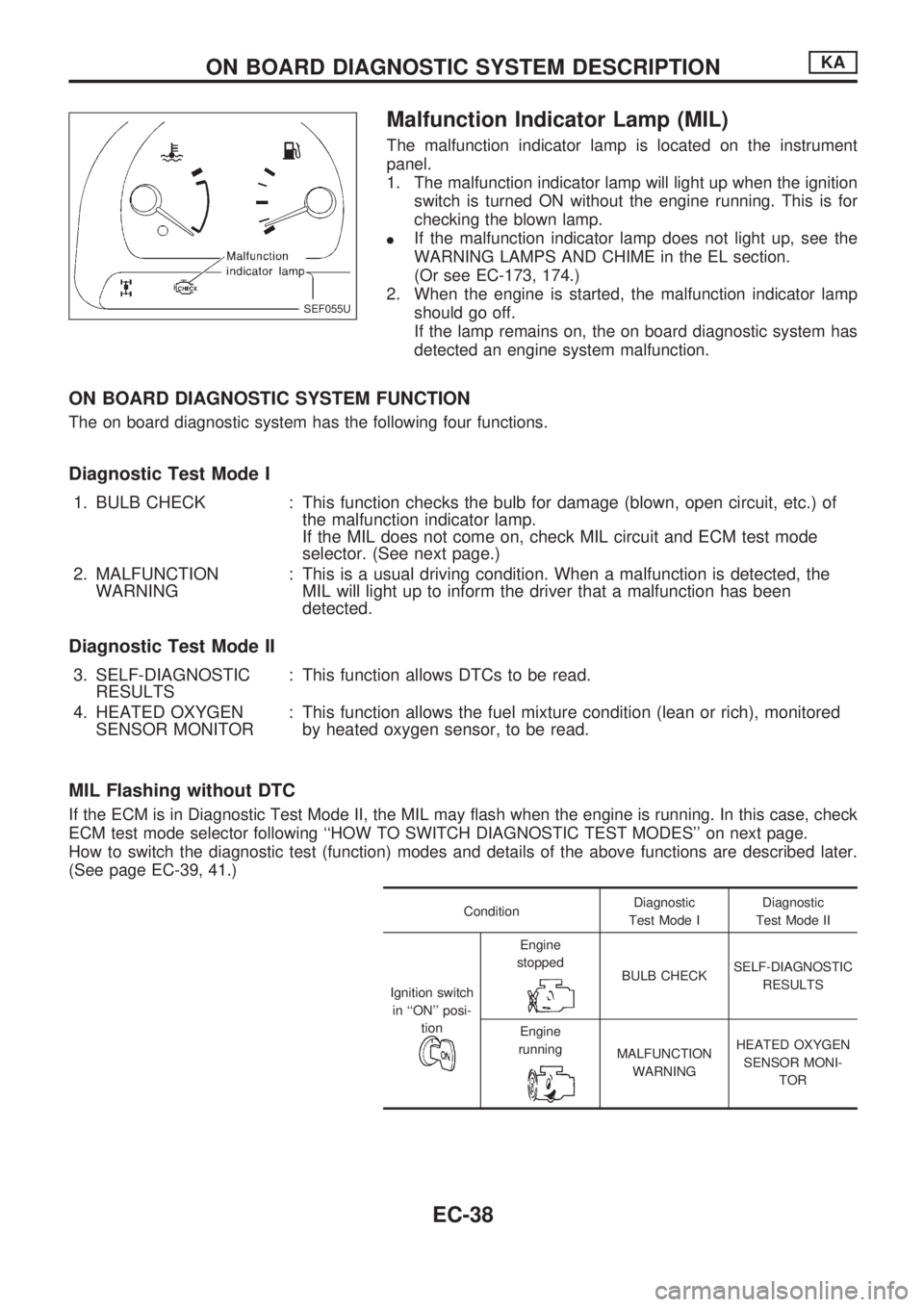
Malfunction Indicator Lamp (MIL)
The malfunction indicator lamp is located on the instrument
panel.
1. The malfunction indicator lamp will light up when the ignition
switch is turned ON without the engine running. This is for
checking the blown lamp.
lIf the malfunction indicator lamp does not light up, see the
WARNING LAMPS AND CHIME in the EL section.
(Or see EC-173, 174.)
2. When the engine is started, the malfunction indicator lamp
should go off.
If the lamp remains on, the on board diagnostic system has
detected an engine system malfunction.
ON BOARD DIAGNOSTIC SYSTEM FUNCTION
The on board diagnostic system has the following four functions.
Diagnostic Test Mode I
1. BULB CHECK : This function checks the bulb for damage (blown, open circuit, etc.) of
the malfunction indicator lamp.
If the MIL does not come on, check MIL circuit and ECM test mode
selector. (See next page.)
2. MALFUNCTION
WARNING: This is a usual driving condition. When a malfunction is detected, the
MIL will light up to inform the driver that a malfunction has been
detected.
Diagnostic Test Mode II
3. SELF-DIAGNOSTIC
RESULTS: This function allows DTCs to be read.
4. HEATED OXYGEN
SENSOR MONITOR: This function allows the fuel mixture condition (lean or rich), monitored
by heated oxygen sensor, to be read.
MIL Flashing without DTC
If the ECM is in Diagnostic Test Mode II, the MIL may flash when the engine is running. In this case, check
ECM test mode selector following ``HOW TO SWITCH DIAGNOSTIC TEST MODES'' on next page.
How to switch the diagnostic test (function) modes and details of the above functions are described later.
(See page EC-39, 41.)
ConditionDiagnostic
Test Mode IDiagnostic
Test Mode II
Ignition switch
in ``ON'' posi-
tion
Engine
stopped
BULB CHECKSELF-DIAGNOSTIC
RESULTS
Engine
running
MALFUNCTION
WARNINGHEATED OXYGEN
SENSOR MONI-
TOR
SEF055U
ON BOARD DIAGNOSTIC SYSTEM DESCRIPTIONKA
EC-38
Page 191 of 1659
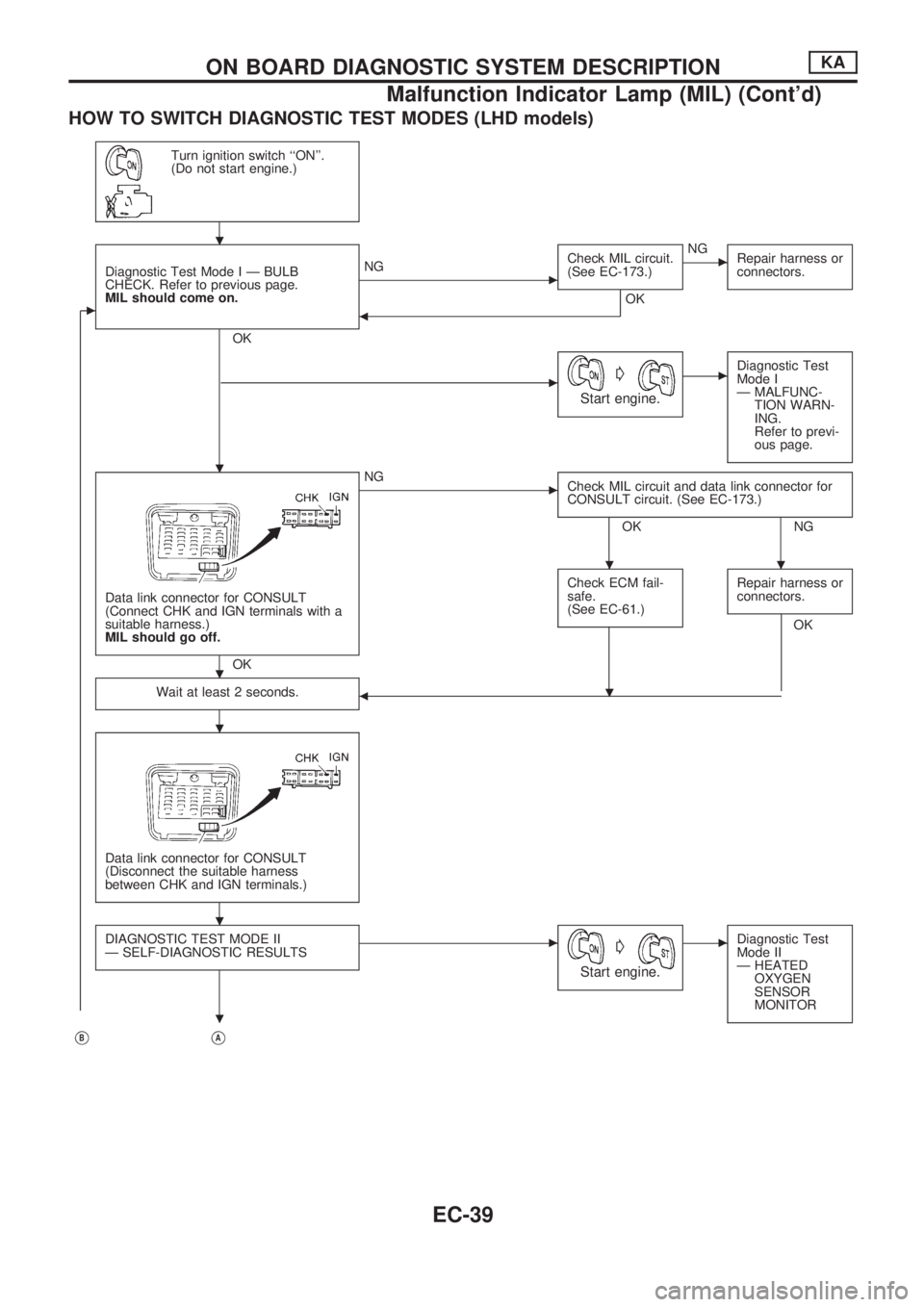
HOW TO SWITCH DIAGNOSTIC TEST MODES (LHD models)
Turn ignition switch ``ON''.
(Do not start engine.)
c
Diagnostic Test Mode I Ð BULB
CHECK. Refer to previous page.
MIL should come on.
OK
cNGCheck MIL circuit.
(See EC-173.)
OK
cNG
Repair harness or
connectors.
b
cG
Start engine.
cDiagnostic Test
Mode I
Ð MALFUNC-
TION WARN-
ING.
Refer to previ-
ous page.
Data link connector for CONSULT
(Connect CHK and IGN terminals with a
suitable harness.)
MIL should go off.
OK
cNG
Check MIL circuit and data link connector for
CONSULT circuit. (See EC-173.)
OK NG
Check ECM fail-
safe.
(See EC-61.)
Repair harness or
connectors.
OK
Wait at least 2 seconds.
b
Data link connector for CONSULT
(Disconnect the suitable harness
between CHK and IGN terminals.)
DIAGNOSTIC TEST MODE II
Ð SELF-DIAGNOSTIC RESULTScG
Start engine.
cDiagnostic Test
Mode II
Ð HEATED
OXYGEN
SENSOR
MONITOR
VBVA
.
.
..
.
.
.
.
.
ON BOARD DIAGNOSTIC SYSTEM DESCRIPTIONKA
Malfunction Indicator Lamp (MIL) (Cont'd)
EC-39
Page 195 of 1659
DIAGNOSTIC TEST MODE IÐBULB CHECK
In this mode, the MALFUNCTION INDICATOR LAMP on the instrument panel should stay ON. If it remains
OFF, check the bulb. (See the WARNING LAMPS AND CHIME in the EL section. Or see EC-173, 174.)
DIAGNOSTIC TEST MODE IÐMALFUNCTION WARNING
MALFUNCTION
INDICATOR LAMPCondition
ON When the malfunction is detected (Refer to EC-1.) or the ECM's CPU is malfunctioning.
OFF No malfunction
lThese Diagnostic Trouble Code Numbers are clarified in Diagnostic Test Mode II (SELF-DIAGNOSTIC
RESULTS).
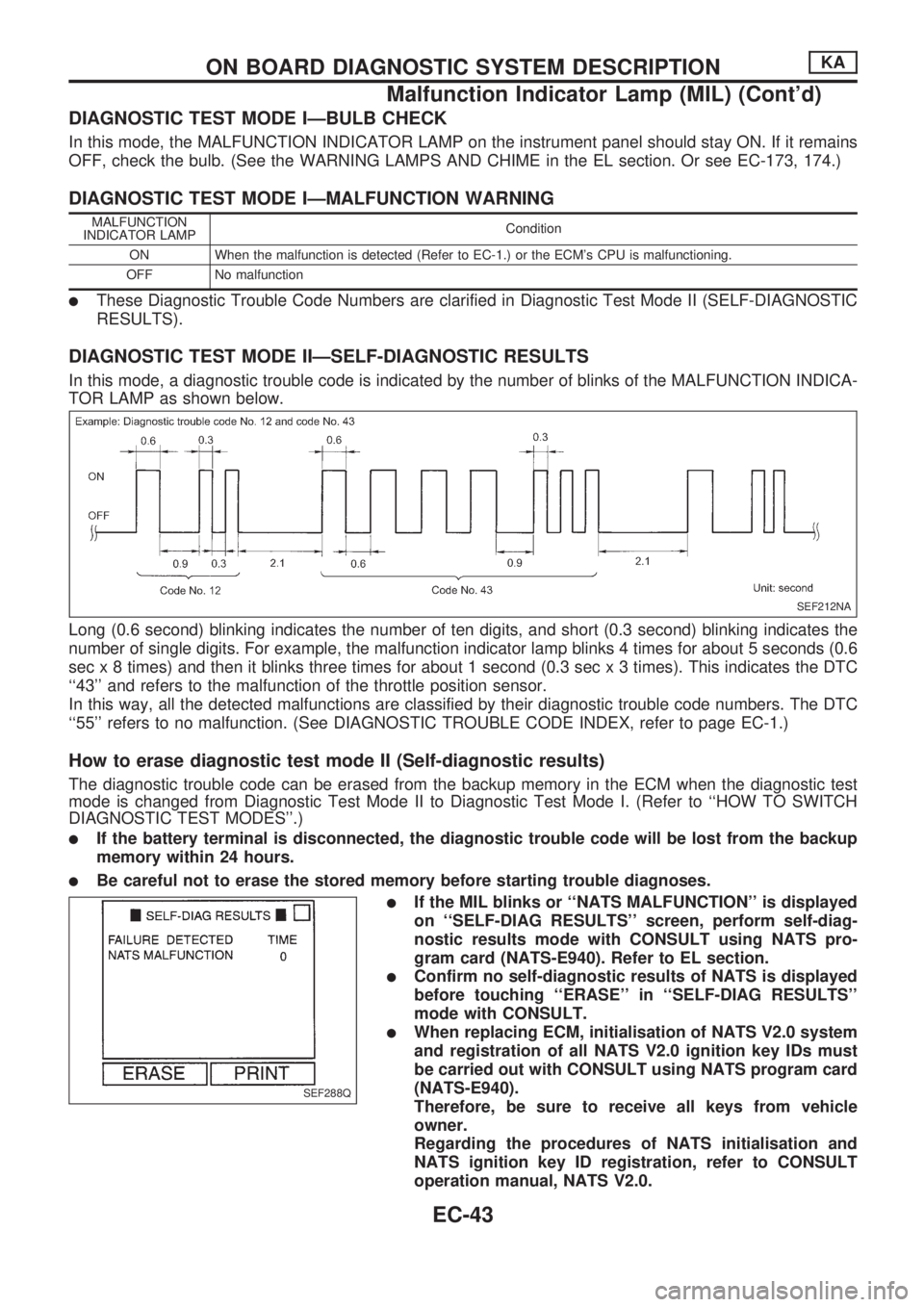
DIAGNOSTIC TEST MODE IIÐSELF-DIAGNOSTIC RESULTS
In this mode, a diagnostic trouble code is indicated by the number of blinks of the MALFUNCTION INDICA-
TOR LAMP as shown below.
Long (0.6 second) blinking indicates the number of ten digits, and short (0.3 second) blinking indicates the
number of single digits. For example, the malfunction indicator lamp blinks 4 times for about 5 seconds (0.6
sec x 8 times) and then it blinks three times for about 1 second (0.3 sec x 3 times). This indicates the DTC
``43'' and refers to the malfunction of the throttle position sensor.
In this way, all the detected malfunctions are classified by their diagnostic trouble code numbers. The DTC
``55'' refers to no malfunction. (See DIAGNOSTIC TROUBLE CODE INDEX, refer to page EC-1.)
How to erase diagnostic test mode II (Self-diagnostic results)
The diagnostic trouble code can be erased from the backup memory in the ECM when the diagnostic test
mode is changed from Diagnostic Test Mode II to Diagnostic Test Mode I. (Refer to ``HOW TO SWITCH
DIAGNOSTIC TEST MODES''.)
lIf the battery terminal is disconnected, the diagnostic trouble code will be lost from the backup
memory within 24 hours.
lBe careful not to erase the stored memory before starting trouble diagnoses.
lIf the MIL blinks or ``NATS MALFUNCTION'' is displayed
on ``SELF-DIAG RESULTS'' screen, perform self-diag-
nostic results mode with CONSULT using NATS pro-
gram card (NATS-E940). Refer to EL section.
lConfirm no self-diagnostic results of NATS is displayed
before touching ``ERASE'' in ``SELF-DIAG RESULTS''
mode with CONSULT.
lWhen replacing ECM, initialisation of NATS V2.0 system
and registration of all NATS V2.0 ignition key IDs must
be carried out with CONSULT using NATS program card
(NATS-E940).
Therefore, be sure to receive all keys from vehicle
owner.
Regarding the procedures of NATS initialisation and
NATS ignition key ID registration, refer to CONSULT
operation manual, NATS V2.0.
SEF212NA
SEF288Q
ON BOARD DIAGNOSTIC SYSTEM DESCRIPTIONKA
Malfunction Indicator Lamp (MIL) (Cont'd)
EC-43