1998 NISSAN PATROL vin
[x] Cancel search: vinPage 3 of 75
Supplemental Restraint System (SRS) ``AIR
BAG'' and ``SEAT BELT PRE-TENSIONER''
The Supplemental Restraint System such as ``AIR BAG'' and ``SEAT BELT PRE-TENSIONER'' used along with
a seat belt, helps to reduce the risk or severity of injury to the driver and front passenger in a frontal collision.
The SRS system composition which is available to NISSAN MODEL Y61 is as follows (The composition var-
ies according to the destination.):
Driver air bag module (located in the center of the steering wheel), front passenger air bag module (located
on the instrument panel on passenger side), seat belt pre-tensioner, a diagnosis sensor unit, warning lamp,
wiring harness and spiral cable.
Information necessary to service the system safely is included in theRS sectionof this Service Manual.
WARNING:
+ To avoid rendering the SRS inoperative, which could increase the risk of personal injury or death
in the event of a collision which would result in air bag in¯ation, all maintenance must be performed
by an authorized NISSAN dealer.
+ Improper maintenance, including incorrect removal and installation of the SRS, can lead to per-
sonal injury caused by unintentional activation of the system. For removal of Spiral Cable and Air
Bag Module, see the RS section.
+ Do not use electrical test equipment on any circuit related to the SRS unless instructed to in this
Service Manual. Spiral Cable and wiring harnesses covered with yellow insulation either just before
the harness connectors or for the complete harness are related to the SRS.
Precautions for Brake System
+Use brake ¯uid ``DOT 3''.
+ Never reuse drained brake ¯uid.
+ Be careful not to splash brake ¯uid on painted areas; it
may cause paint damage. If brake ¯uid is splashed on
painted areas, wash it away with water immediately.
+ To clean master cylinder parts, disc brake caliper parts or
wheel cylinder parts, use clean brake ¯uid.
+ Never use mineral oils such as gasoline or kerosene. They
will ruin rubber parts of hydraulic system.
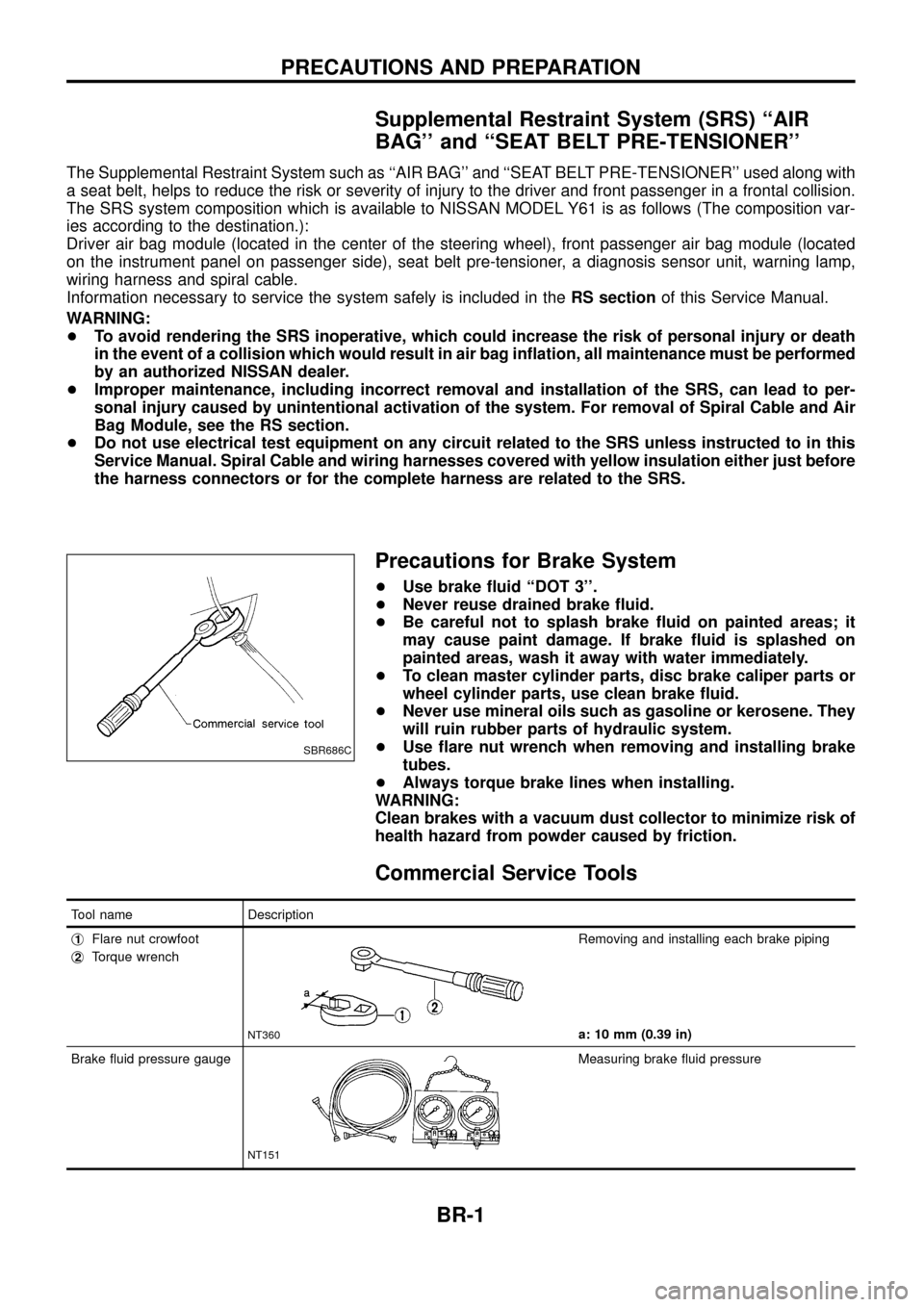
+ Use ¯are nut wrench when removing and installing brake
tubes.
+ Always torque brake lines when installing.
WARNING:
Clean brakes with a vacuum dust collector to minimize risk of
health hazard from powder caused by friction.
Commercial Service Tools
Tool name Description
j
1Flare nut crowfoot
j
2Torque wrench
NT360
Removing and installing each brake piping
a: 10 mm (0.39 in)
Brake ¯uid pressure gauge
NT151
Measuring brake ¯uid pressure
SBR686C
PRECAUTIONS AND PREPARATION
BR-1
Page 5 of 75
Checking Brake Fluid Level
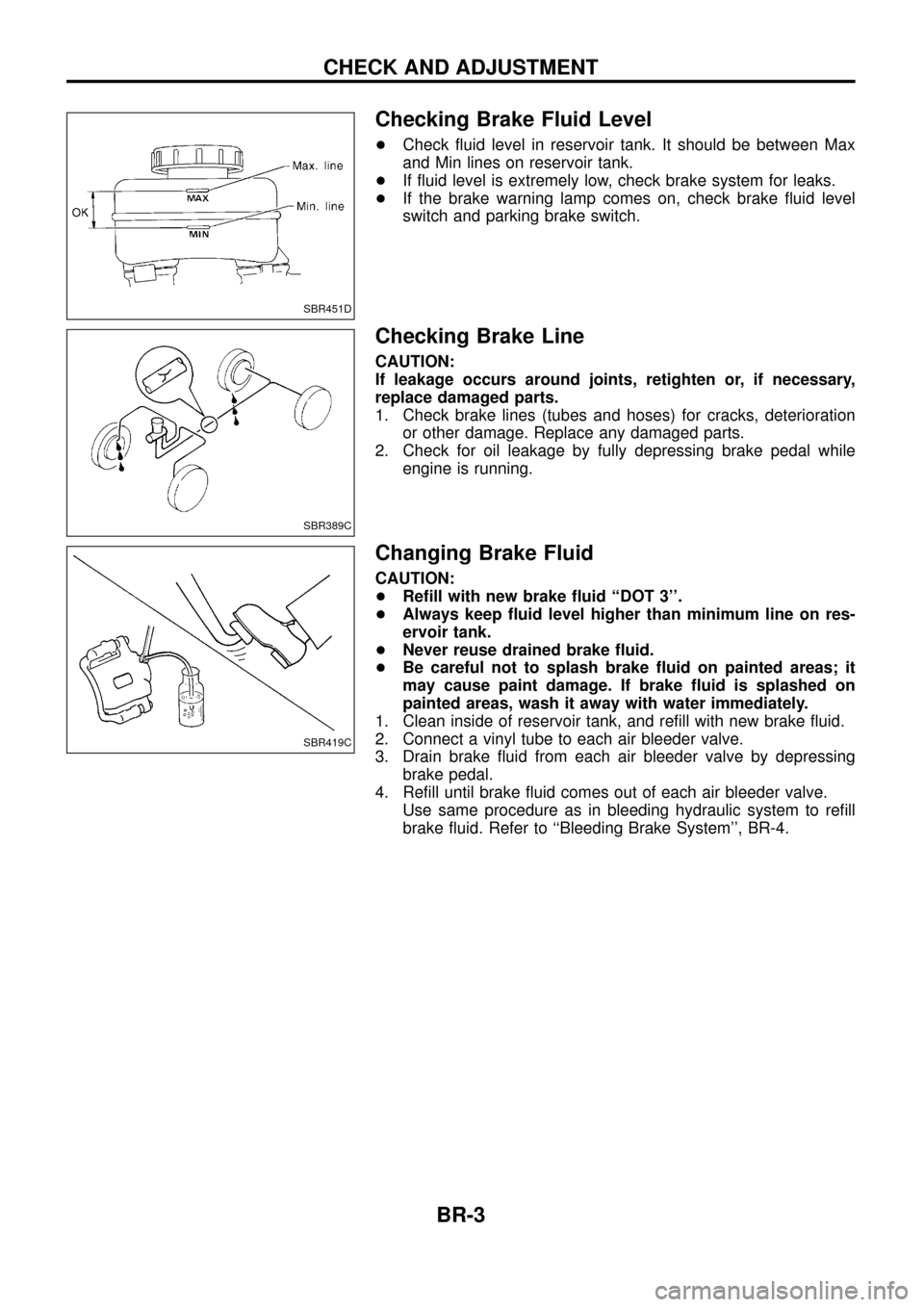
+Check ¯uid level in reservoir tank. It should be between Max
and Min lines on reservoir tank.
+ If ¯uid level is extremely low, check brake system for leaks.
+ If the brake warning lamp comes on, check brake ¯uid level
switch and parking brake switch.
Checking Brake Line
CAUTION:
If leakage occurs around joints, retighten or, if necessary,
replace damaged parts.
1. Check brake lines (tubes and hoses) for cracks, deterioration
or other damage. Replace any damaged parts.
2. Check for oil leakage by fully depressing brake pedal while engine is running.
Changing Brake Fluid
CAUTION:
+Re®ll with new brake ¯uid ``DOT 3''.
+ Always keep ¯uid level higher than minimum line on res-
ervoir tank.
+ Never reuse drained brake ¯uid.
+ Be careful not to splash brake ¯uid on painted areas; it
may cause paint damage. If brake ¯uid is splashed on
painted areas, wash it away with water immediately.
1. Clean inside of reservoir tank, and re®ll with new brake ¯uid.
2. Connect a vinyl tube to each air bleeder valve.
3. Drain brake ¯uid from each air bleeder valve by depressing brake pedal.
4. Re®ll until brake ¯uid comes out of each air bleeder valve. Use same procedure as in bleeding hydraulic system to re®ll
brake ¯uid. Refer to ``Bleeding Brake System'', BR-4.
SBR451D
SBR389C
SBR419C
CHECK AND ADJUSTMENT
BR-3
Page 6 of 75
Bleeding Brake System
CAUTION:
+Carefully monitor brake ¯uid level at master cylinder dur-
ing bleeding operation.
+ If master cylinder is suspected to have air inside, bleed air
from master cylinder ®rst. Refer to ``Installation'', ``MAS-
TER CYLINDER'', BR-14.
+ Fill reservoir with new brake ¯uid ``DOT 3''. Make sure it is
full at all times while bleeding air out of system.
+ Place a container under master cylinder to avoid spillage
of brake ¯uid.
+ For models with ABS, turn ignition switch OFF and discon-
nect ABS actuator connectors or battery ground cable.
+ Bleed air in the following order.
1. LSV air bleeder
2. Left rear brake
3. Right rear brake
4. Left front brake
5. Right front brake
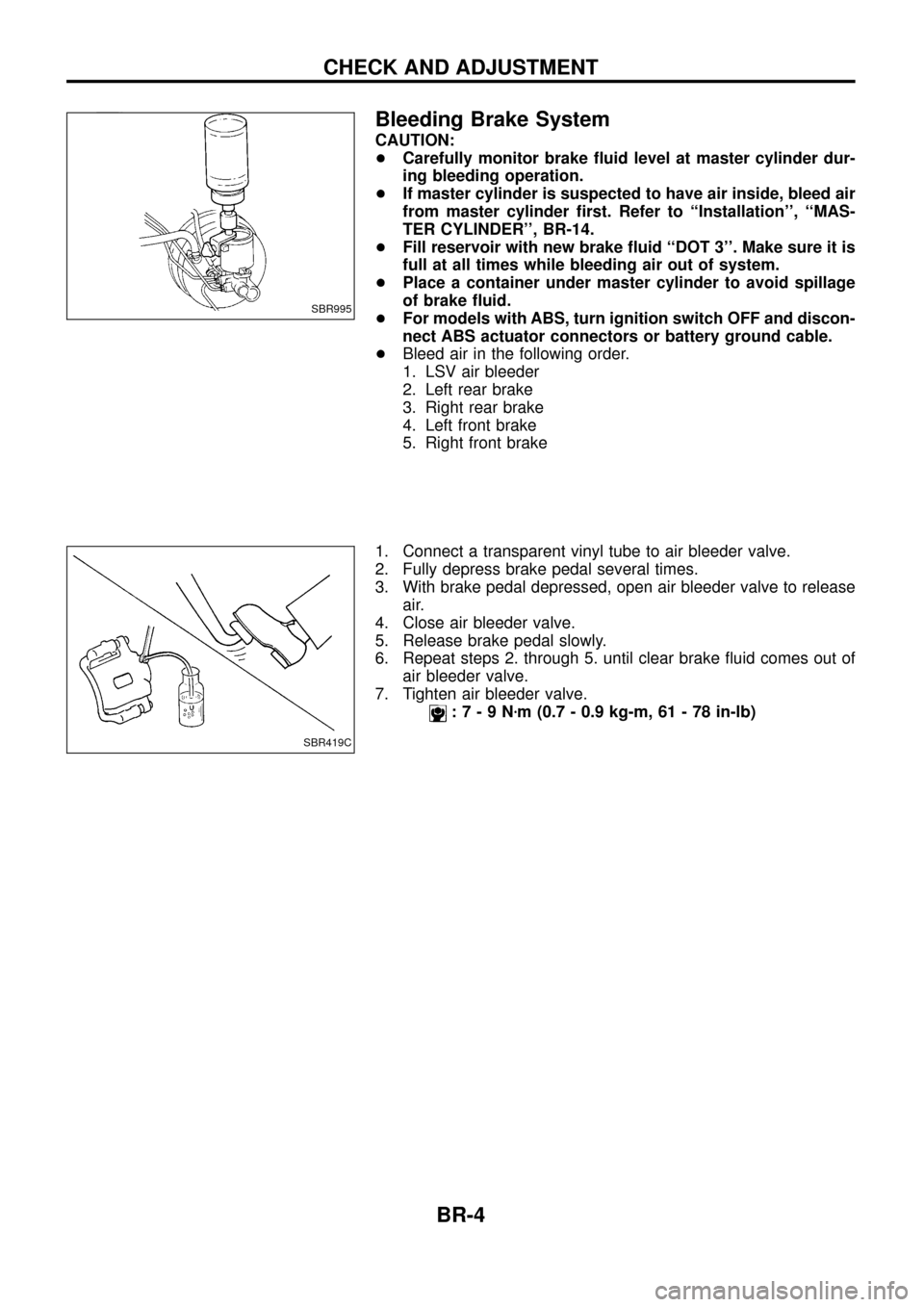
1. Connect a transparent vinyl tube to air bleeder valve.
2. Fully depress brake pedal several times.
3. With brake pedal depressed, open air bleeder valve to release air.
4. Close air bleeder valve.
5. Release brake pedal slowly.
6. Repeat steps 2. through 5. until clear brake ¯uid comes out of air bleeder valve.
7. Tighten air bleeder valve.
:7-9N zm (0.7 - 0.9 kg-m, 61 - 78 in-lb)
SBR995
SBR419C
CHECK AND ADJUSTMENT
BR-4
Page 8 of 75
REMOVAL
CAUTION:
+Be careful not to splash brake ¯uid on painted areas; it
may cause paint damage. If brake ¯uid is splashed on
painted areas, wash it away with water immediately.
+ All hoses must be free from excessive bending, twisting
and pulling.
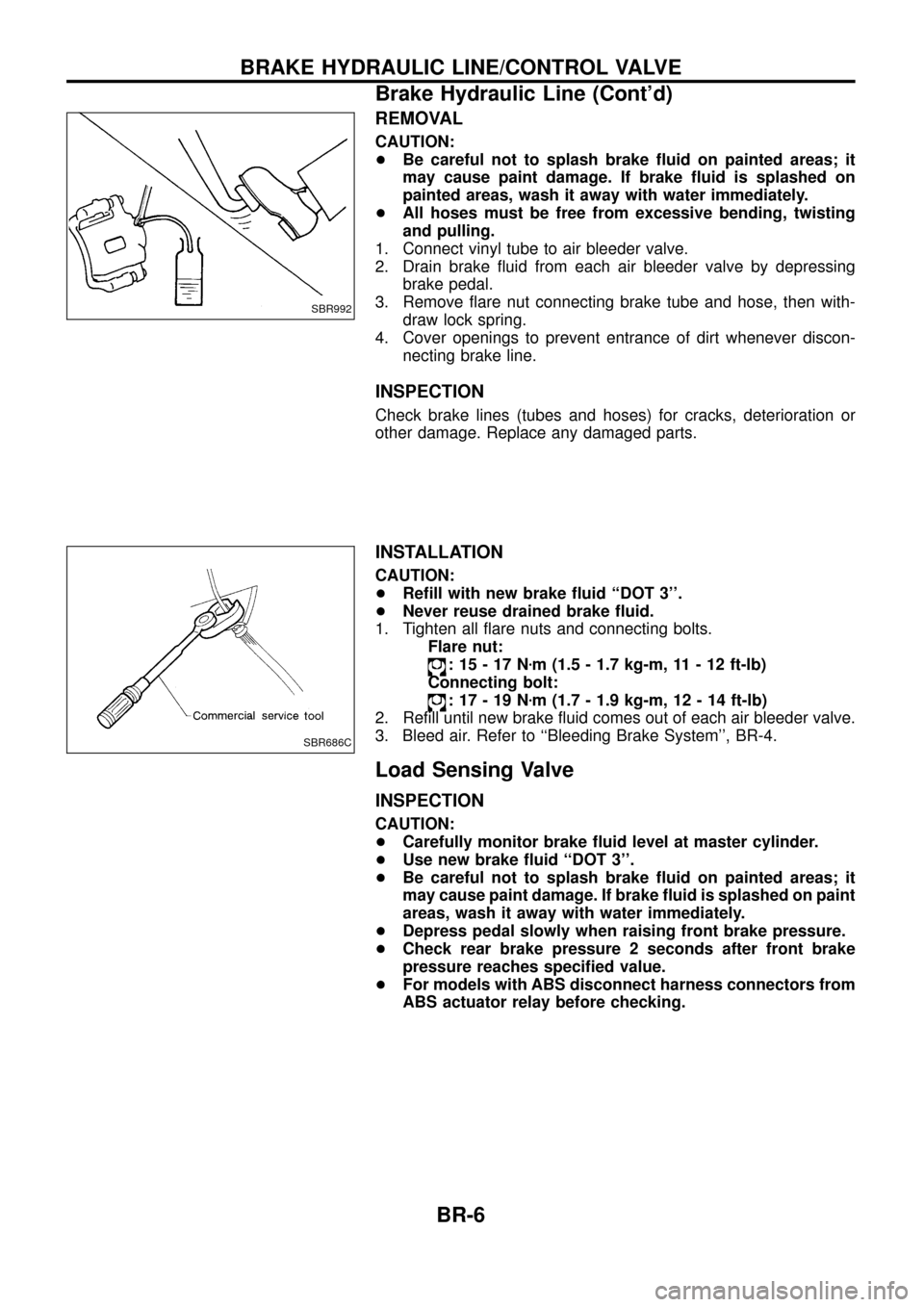
1. Connect vinyl tube to air bleeder valve.
2. Drain brake ¯uid from each air bleeder valve by depressing brake pedal.
3. Remove ¯are nut connecting brake tube and hose, then with- draw lock spring.
4. Cover openings to prevent entrance of dirt whenever discon- necting brake line.
INSPECTION
Check brake lines (tubes and hoses) for cracks, deterioration or
other damage. Replace any damaged parts.
INSTALLATION
CAUTION:
+Re®ll with new brake ¯uid ``DOT 3''.
+ Never reuse drained brake ¯uid.
1. Tighten all ¯are nuts and connecting bolts. Flare nut:
:15-17N zm (1.5 - 1.7 kg-m, 11 - 12 ft-lb)
Connecting bolt:
:17-19N zm (1.7 - 1.9 kg-m, 12 - 14 ft-lb)
2. Re®ll until new brake ¯uid comes out of each air bleeder valve.
3. Bleed air. Refer to ``Bleeding Brake System'', BR-4.
Load Sensing Valve
INSPECTION
CAUTION:
+ Carefully monitor brake ¯uid level at master cylinder.
+ Use new brake ¯uid ``DOT 3''.
+ Be careful not to splash brake ¯uid on painted areas; it
may cause paint damage. If brake ¯uid is splashed on paint
areas, wash it away with water immediately.
+ Depress pedal slowly when raising front brake pressure.
+ Check rear brake pressure 2 seconds after front brake
pressure reaches speci®ed value.
+ For models with ABS disconnect harness connectors from
ABS actuator relay before checking.
SBR992
SBR686C
BRAKE HYDRAULIC LINE/CONTROL VALVE
Brake Hydraulic Line (Cont'd)
BR-6
Page 14 of 75
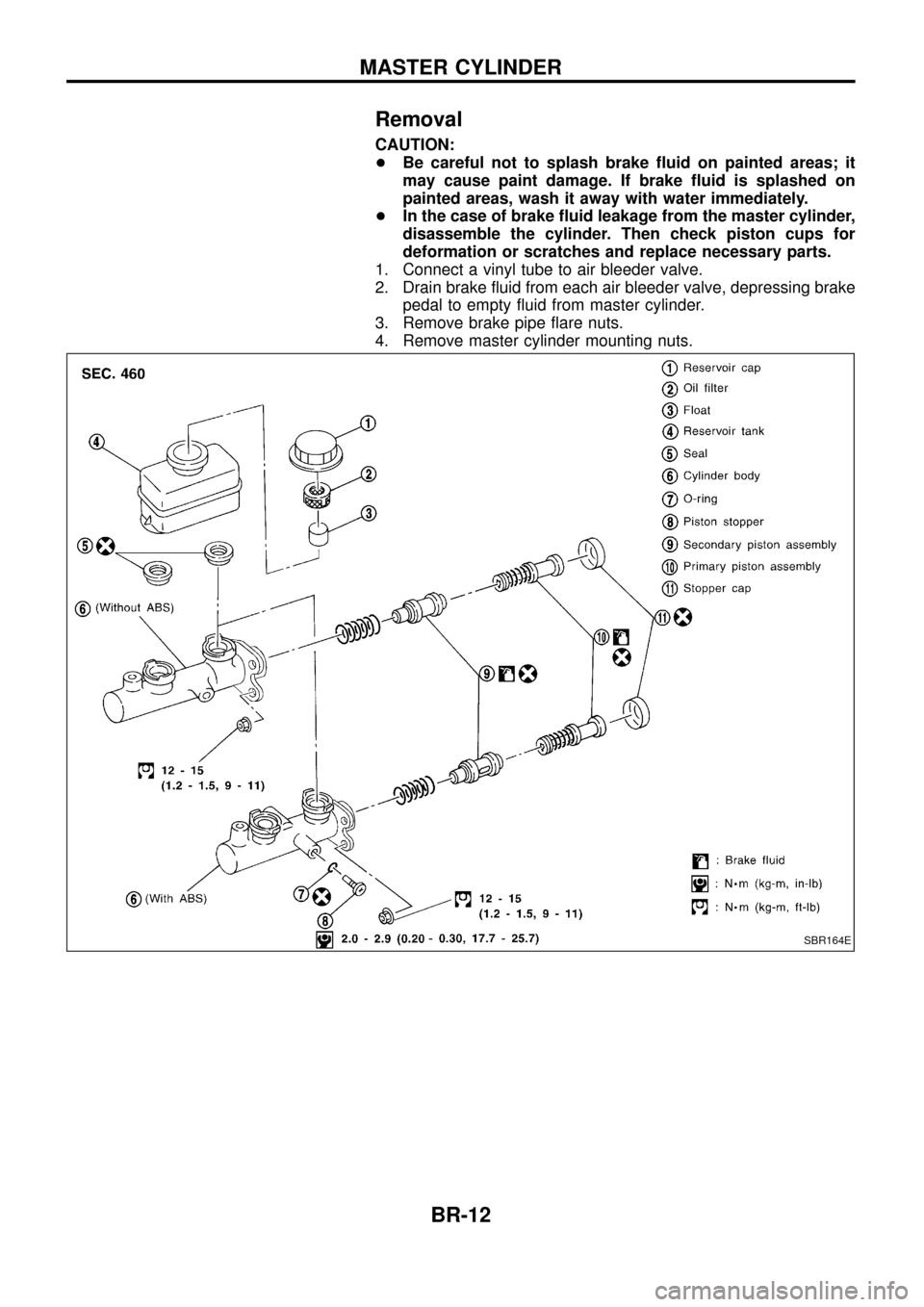
Removal
CAUTION:
+Be careful not to splash brake ¯uid on painted areas; it
may cause paint damage. If brake ¯uid is splashed on
painted areas, wash it away with water immediately.
+ In the case of brake ¯uid leakage from the master cylinder,
disassemble the cylinder. Then check piston cups for
deformation or scratches and replace necessary parts.
1. Connect a vinyl tube to air bleeder valve.
2. Drain brake ¯uid from each air bleeder valve, depressing brake pedal to empty ¯uid from master cylinder.
3. Remove brake pipe ¯are nuts.
4. Remove master cylinder mounting nuts.
SBR164E
MASTER CYLINDER
BR-12
Page 33 of 75
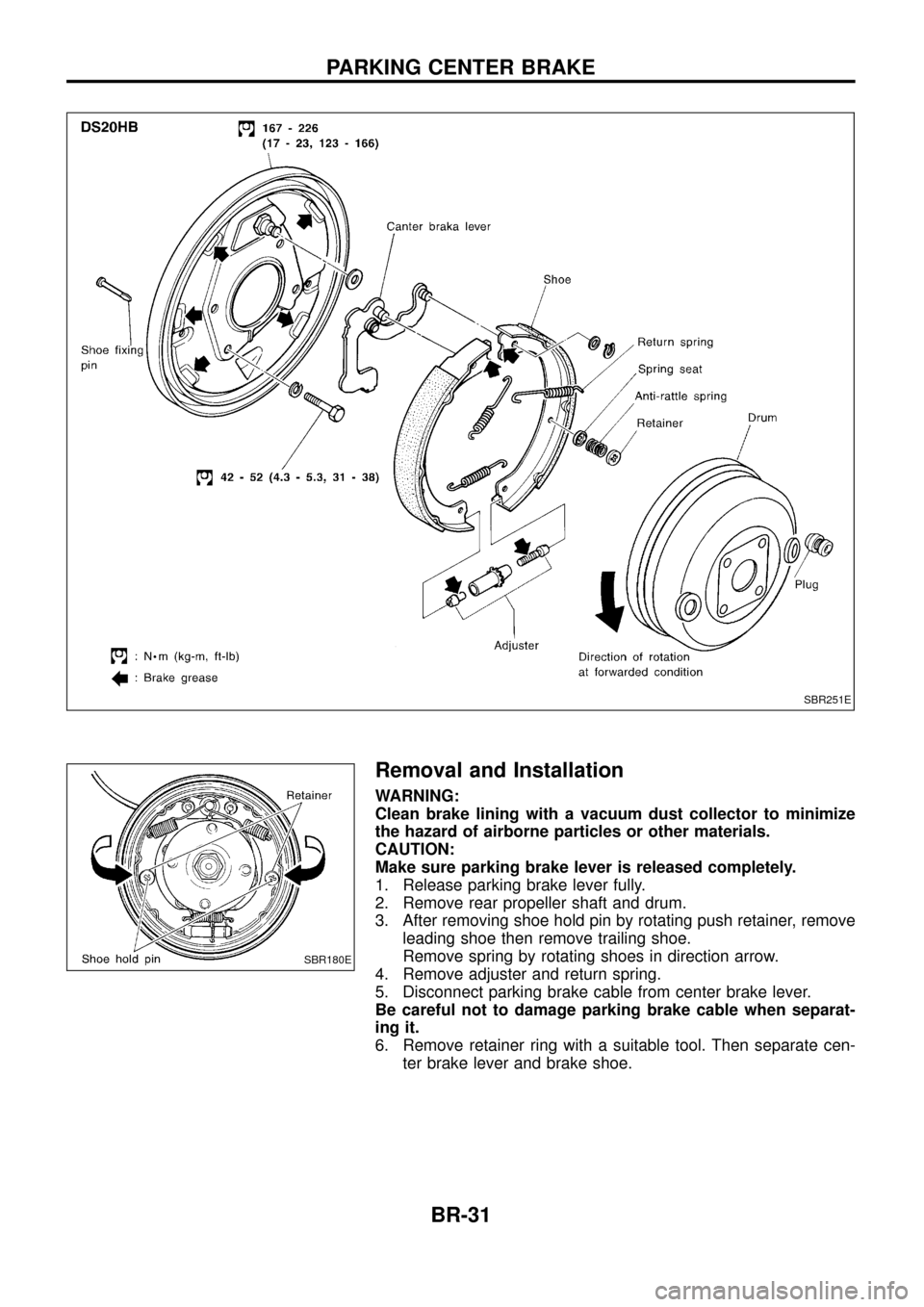
Removal and Installation
WARNING:
Clean brake lining with a vacuum dust collector to minimize
the hazard of airborne particles or other materials.
CAUTION:
Make sure parking brake lever is released completely.
1. Release parking brake lever fully.
2. Remove rear propeller shaft and drum.
3. After removing shoe hold pin by rotating push retainer, removeleading shoe then remove trailing shoe.
Remove spring by rotating shoes in direction arrow.
4. Remove adjuster and return spring.
5. Disconnect parking brake cable from center brake lever.
Be careful not to damage parking brake cable when separat-
ing it.
6. Remove retainer ring with a suitable tool. Then separate cen- ter brake lever and brake shoe.
SBR251E
SBR180E
PARKING CENTER BRAKE
BR-31
Page 35 of 75
Purpose
The Anti-Lock Brake System (ABS) consists of electronic and hydraulic components. It allows for control of
braking force so locking of the wheels can be avoided.
The ABS:
1) Improves proper tracking performance through steering wheel operation.
2) Eases obstacle avoidance through steering wheel operation.
3) Improves vehicle stability.
Operation
+When the vehicle speed is less than 10 km/h (6 MPH) this system does not work.
+ The Anti-Lock Brake System (ABS) has a self-test function. The system turns on the ABS warning lamp
for 1 second each time the ignition switch is turned ``ON''. After the engine is started, the ABS warning
lamp turns off. The system performs a test the ®rst time the vehicle reaches 6 km/h (4 MPH). A mechani-
cal noise may be heard as the ABS performs this self-test. This is a normal part of the self-test feature. If
a malfunction is found during this check, the ABS warning lamp will stay on.
+ While driving, a mechanical noise may be heard during ABS operation. This is a normal condition.
+ While DIFF-LOCK is on, the anti-lock brake warning light ¯ashes. This indicates that anti-lock may not be
fully operated. (ABS only)
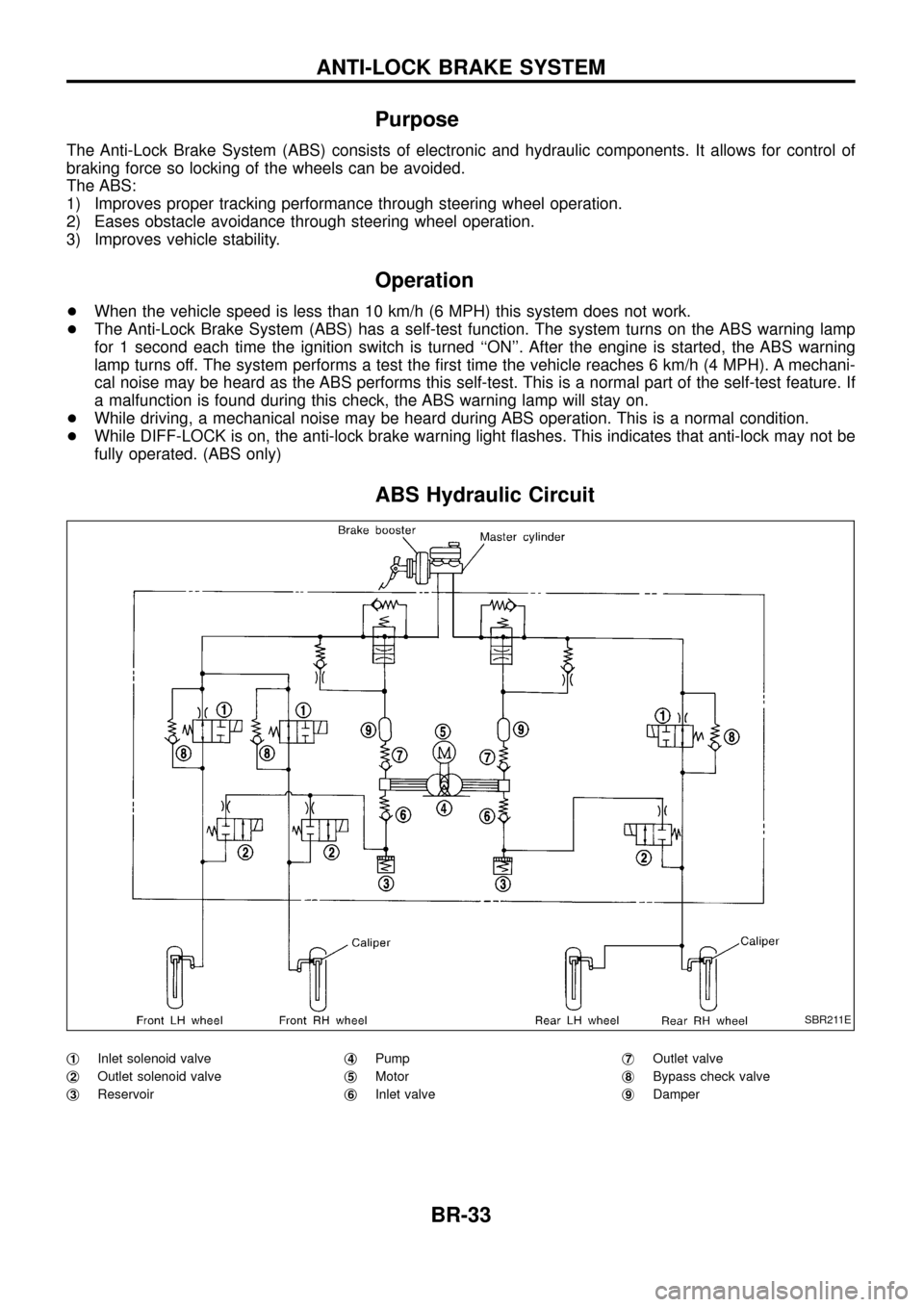
ABS Hydraulic Circuit
j1Inlet solenoid valve
j
2Outlet solenoid valve
j
3Reservoir j
4Pump
j
5Motor
j
6Inlet valve j
7Outlet valve
j
8Bypass check valve
j
9Damper
SBR211E
ANTI-LOCK BRAKE SYSTEM
BR-33
Page 38 of 75
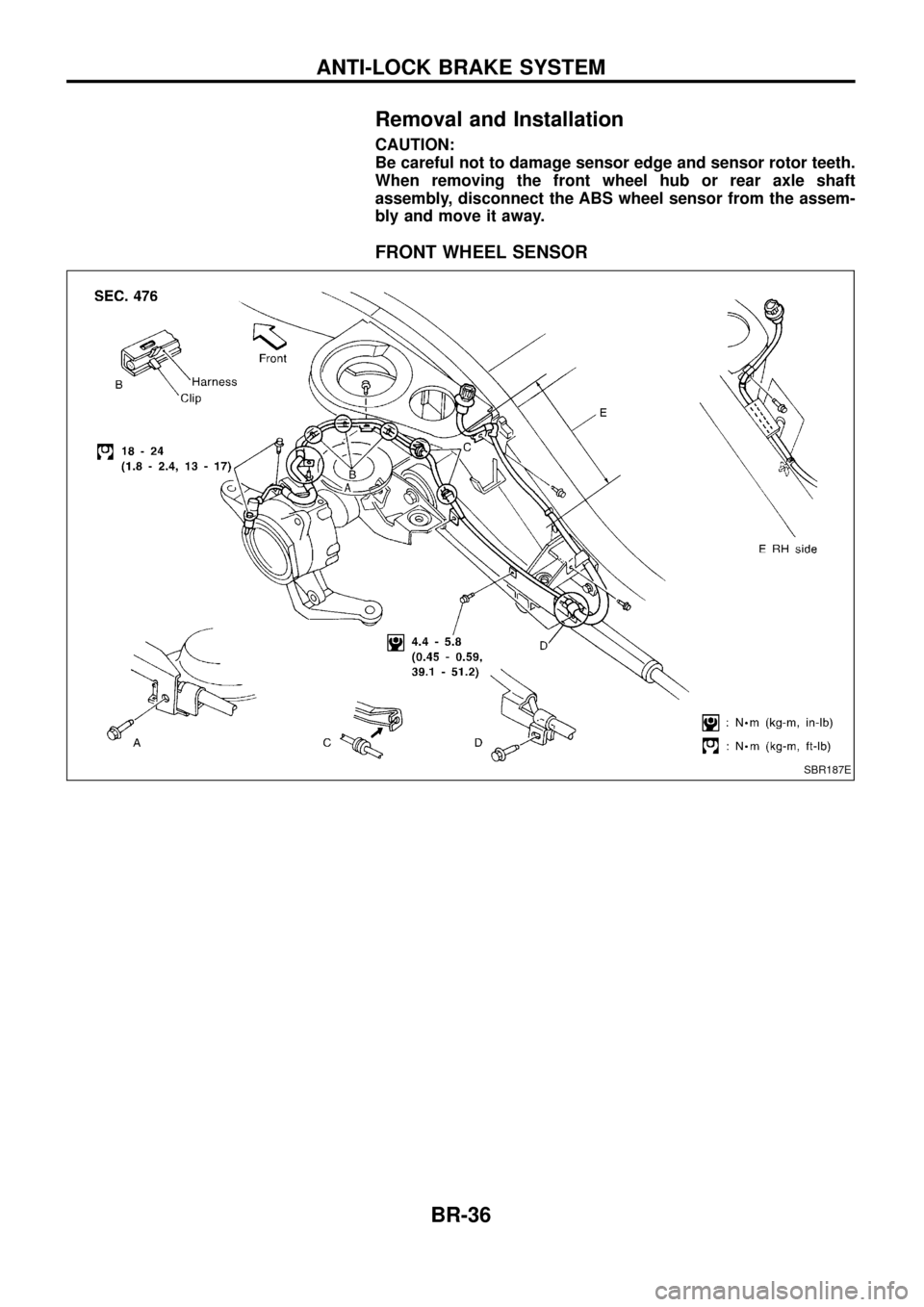
Removal and Installation
CAUTION:
Be careful not to damage sensor edge and sensor rotor teeth.
When removing the front wheel hub or rear axle shaft
assembly, disconnect the ABS wheel sensor from the assem-
bly and move it away.
FRONT WHEEL SENSOR
SBR187E
ANTI-LOCK BRAKE SYSTEM
BR-36