Page 2342 of 2490
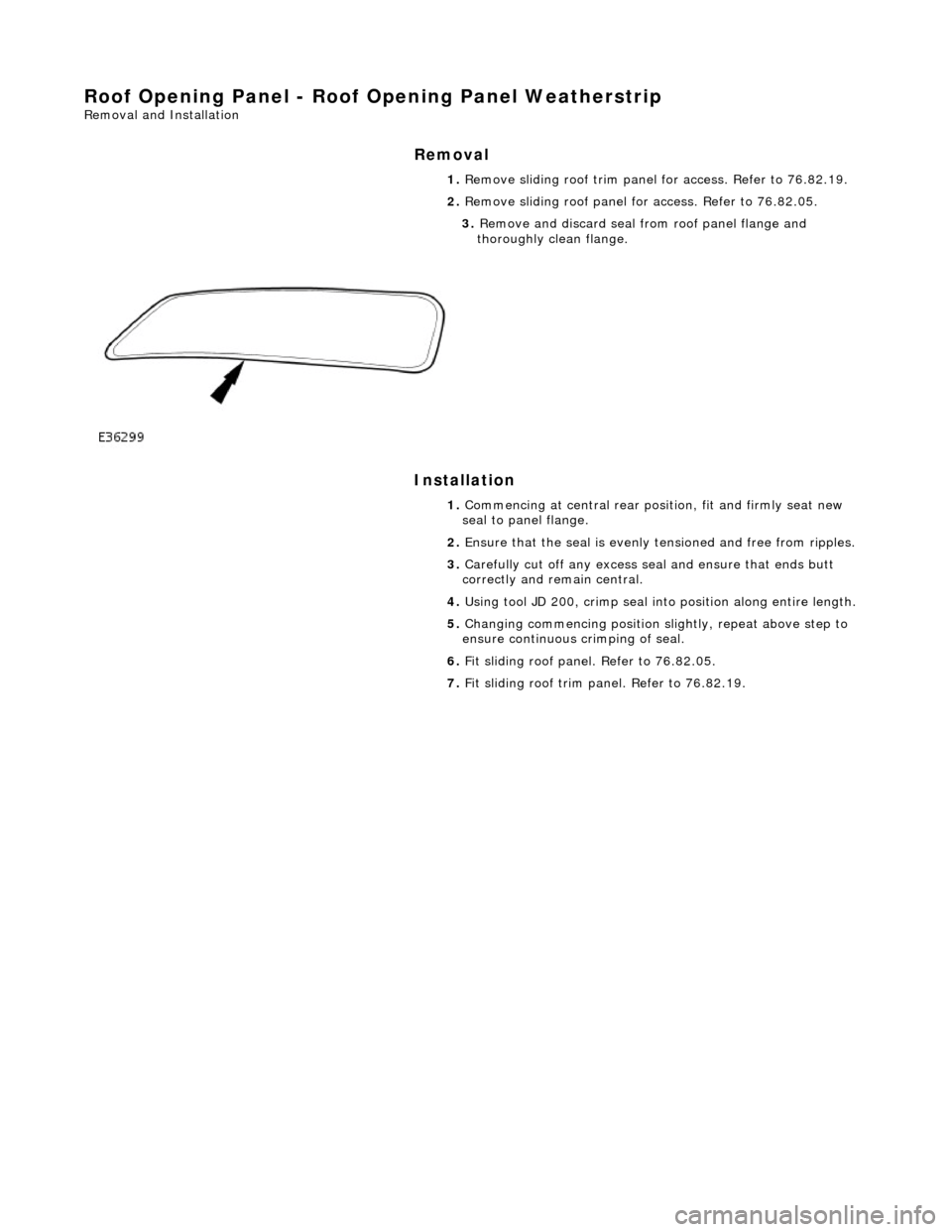
Roof Opening Panel - Roof Opening Panel Weatherstrip
Removal and Installation
Removal
Installation
1.
Remove sliding roof trim panel for access. Refer to 76.82.19.
2. Remove sliding roof panel fo r access. Refer to 76.82.05.
3. Remove and discard seal fro m roof panel flange and
thoroughly clean flange.
1. Commencing at central rear posi tion, fit and firmly seat new
seal to panel flange.
2. Ensure that the seal is evenly tensioned and free from ripples.
3. Carefully cut off any excess seal and ensure that ends butt
correctly and re main central.
4. Using tool JD 200, crimp seal into position along entire length.
5. Changing commencing position sl ightly, repeat above step to
ensure continuous crimping of seal.
6. Fit sliding roof panel. Refer to 76.82.05.
7. Fit sliding roof trim panel. Refer to 76.82.19.
Page 2359 of 2490
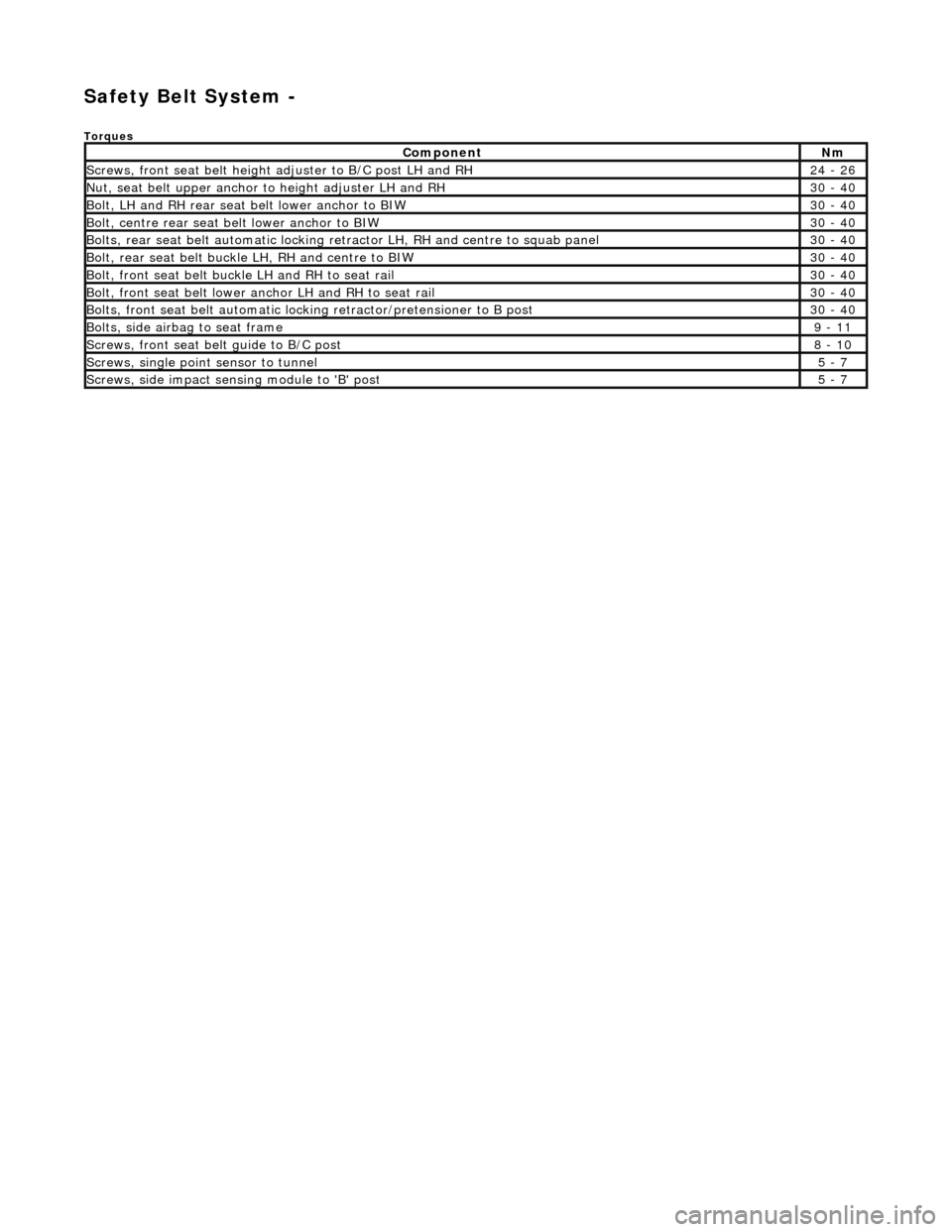
Safety Belt System -
Torques
ComponentNm
Screws, front seat belt height adjuster to B/C post LH and RH24 - 26
Nut, seat belt upper anchor to height adjuster LH and RH30 - 40
Bolt, LH and RH rear seat belt lower anchor to BIW30 - 40
Bolt, centre rear seat belt lower anchor to BIW30 - 40
Bolts, rear seat belt automatic locking re tractor LH, RH and centre to squab panel30 - 40
Bolt, rear seat belt buckle LH, RH and centre to BIW30 - 40
Bolt, front seat belt buckle LH and RH to seat rail30 - 40
Bolt, front seat belt lower an chor LH and RH to seat rail30 - 40
Bolts, front seat belt automatic lock ing retractor/pretensioner to B post30 - 40
Bolts, side airbag to seat frame9 - 11
Screws, front seat belt guide to B/C post8 - 10
Screws, single point sensor to tunnel5 - 7
Screws, side impact sens ing module to 'B' post5 - 7
Page 2360 of 2490
Safety Belt System - Safety Belt System
Description and Operation
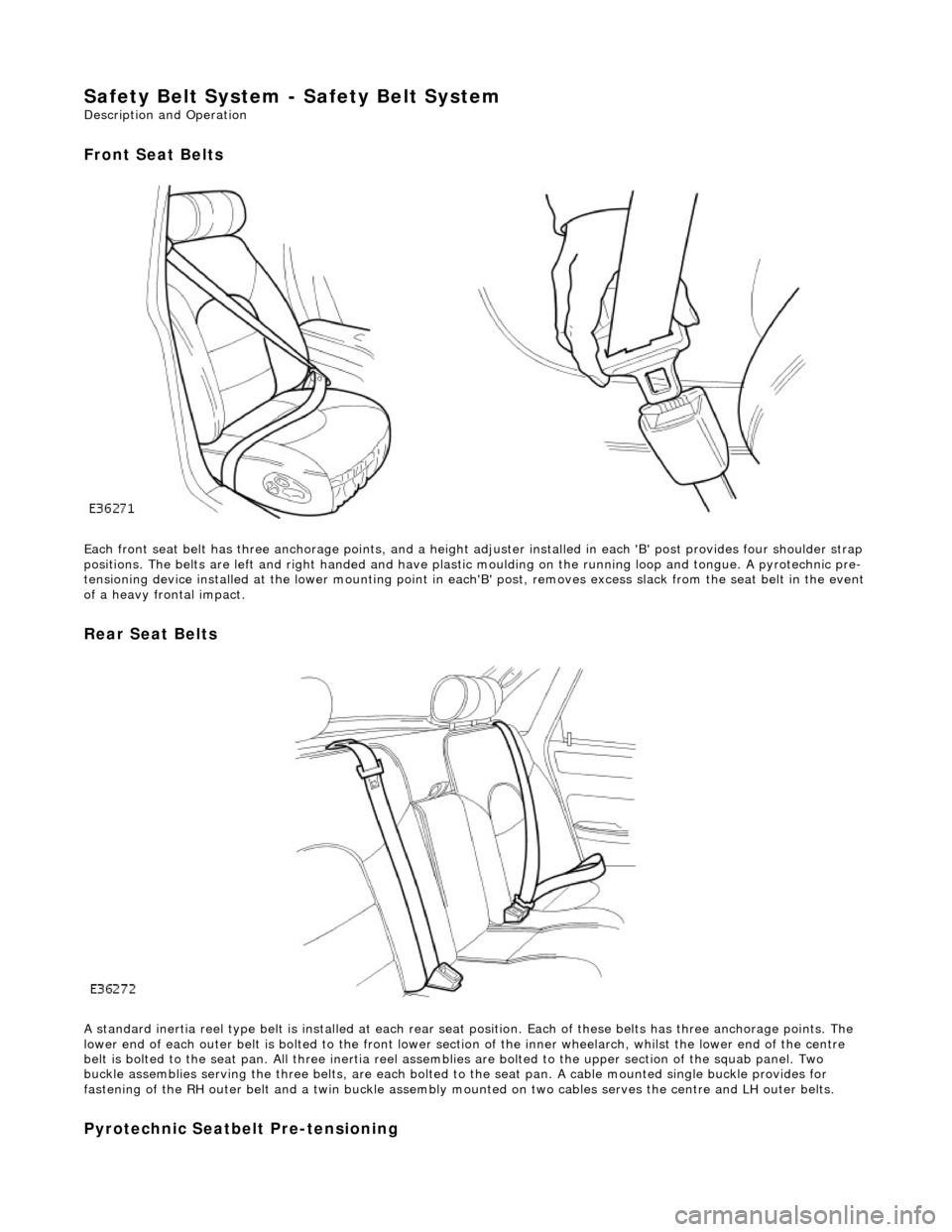
Front Seat Belts
Each front seat belt has three anchorage points, and a height adjuster installed in each 'B' post provides four shoulder strap
positions. The belts are left and right ha nded and have plastic moulding on the r unning loop and tongue. A pyrotechnic pre-
tensioning device installed at the lower mounting point in each 'B' post, removes excess slack from the seat belt in the event
of a heavy frontal impact.
Rear Seat Belts
A standard inertia reel type belt is installed at each rear seat position. Each of these belts has three anchorage points. The
lower end of each outer belt is bolted to the front lower section of the inner wheelarch, whilst the lower end of the centre
belt is bolted to the seat pan. All thr ee inertia reel assemblies are bolted to the upper section of the squab panel. Two
buckle assemblies serving the three belts, are each bolted to the seat pan. A cable mounted single buckle provides for
fastening of the RH outer belt and a twin buckle assembly mounted on two cables serves the centre and LH outer belts.
Pyrotechnic Seatbelt Pre-tensioning
Page 2365 of 2490
Safety Belt System - Rear Safety Belt Retractor
Removal and Installation
Removal
1. Remove rear seat cushion. Refer to 76.70.37.
2. Remove rear headrests.
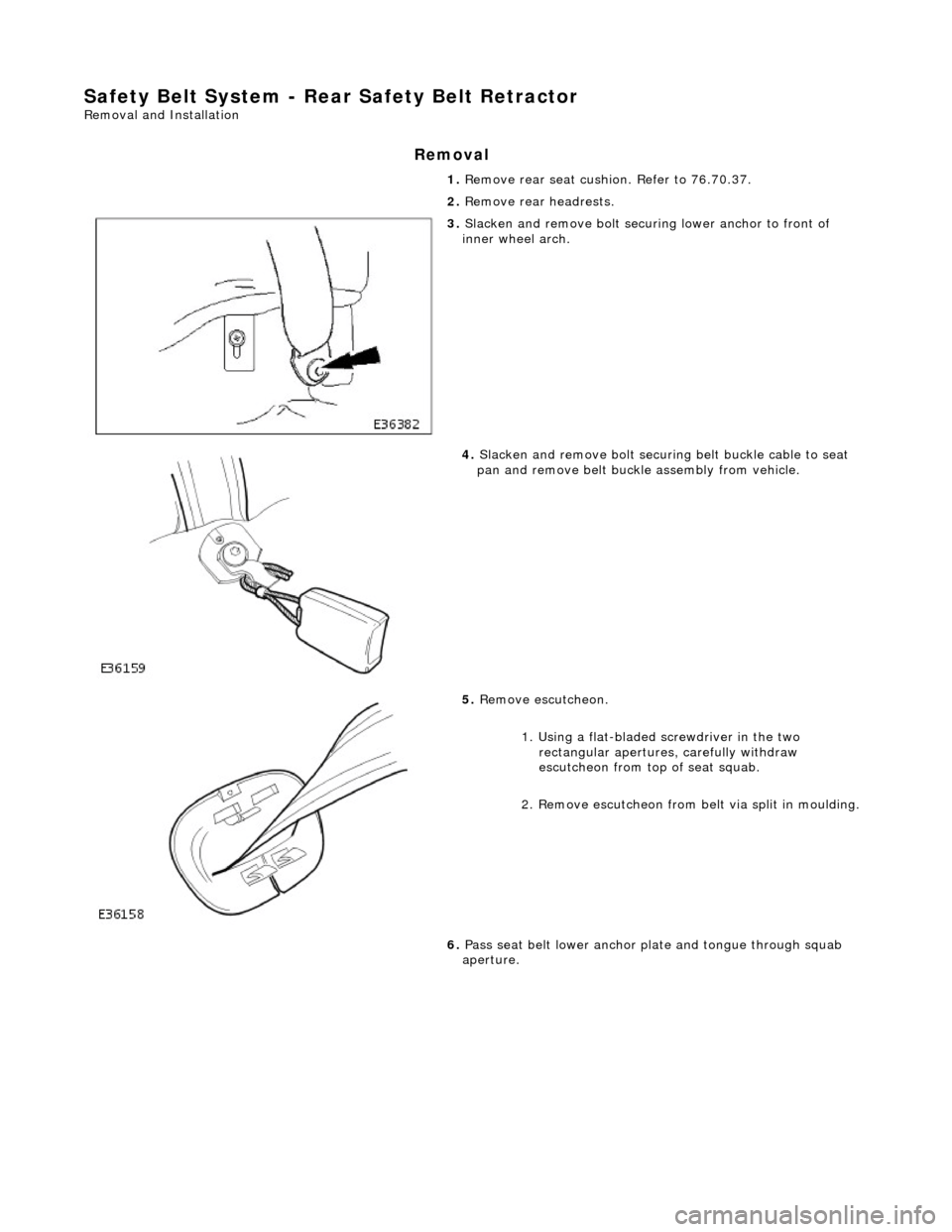
3. Slacken and remove bolt securi ng lower anchor to front of
inner wheel arch.
4. Slacken and remove bolt securing belt buckle cable to seat
pan and remove belt buckle assembly from vehicle.
5. Remove escutcheon.
1. Using a flat-bladed screwdriver in the two rectangular apertures, carefully withdraw
escutcheon from top of seat squab.
2. Remove escutcheon from belt via split in moulding.
6. Pass seat belt lower anchor plate and tongue through squab
aperture.
Page 2366 of 2490
Installation
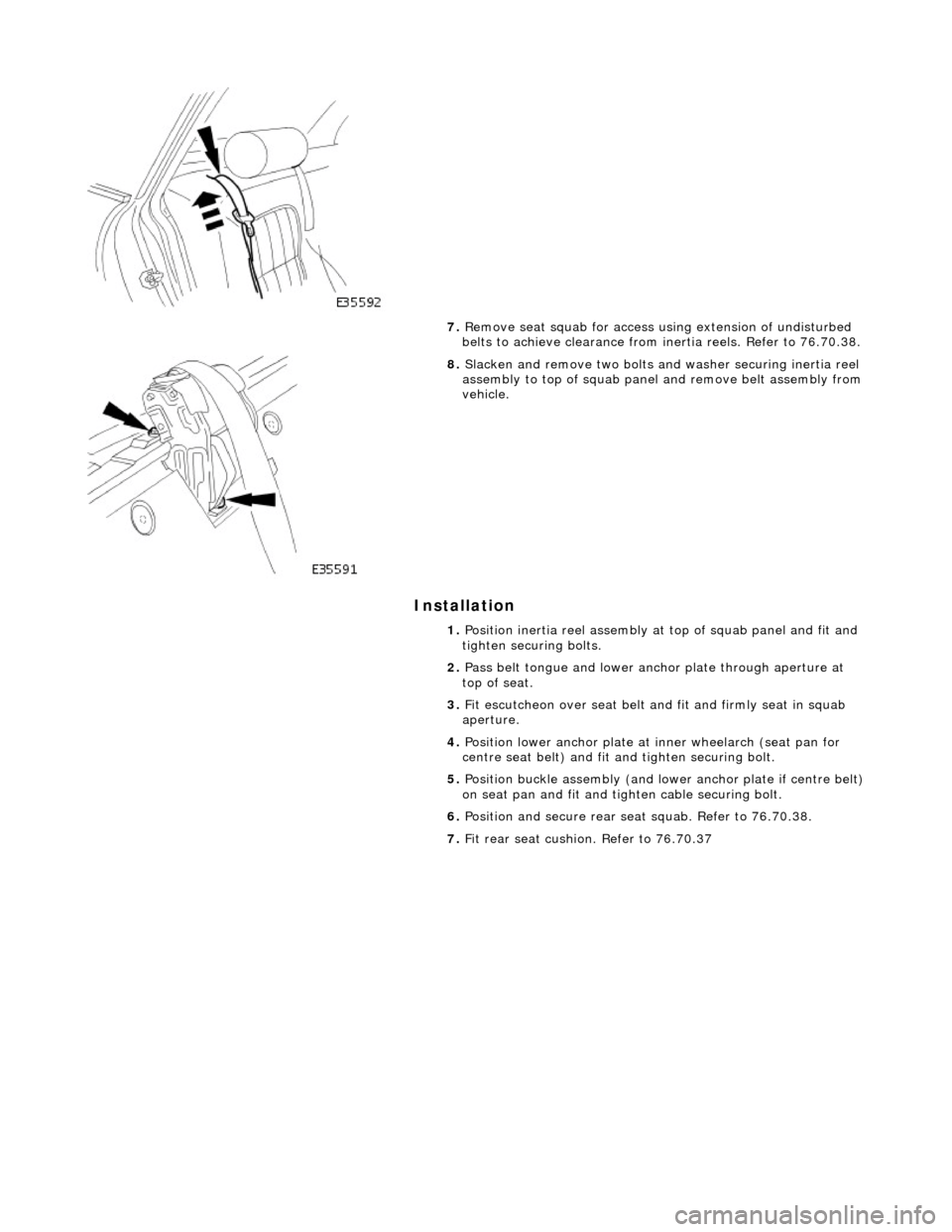
7. Remove seat squab for access using extension of undisturbed
belts to achieve clearance from inertia reels. Refer to 76.70.38.
8. Slacken and remove two bolts and washer securing inertia reel
assembly to top of squab panel and remove belt assembly from
vehicle.
1. Position inertia reel assembly at top of squab panel and fit and
tighten securing bolts.
2. Pass belt tongue and lower anchor plate through aperture at
top of seat.
3. Fit escutcheon over seat belt an d fit and firmly seat in squab
aperture.
4. Position lower anchor plate at inner wheelarch (seat pan for
centre seat belt) and fit and tighte n securing bolt.
5. Position buckle assembly (and lo wer anchor plate if centre belt)
on seat pan and fit and tighten cable securing bolt.
6. Position and secure rear se at squab. Refer to 76.70.38.
7. Fit rear seat cushion. Refer to 76.70.37
Page 2368 of 2490
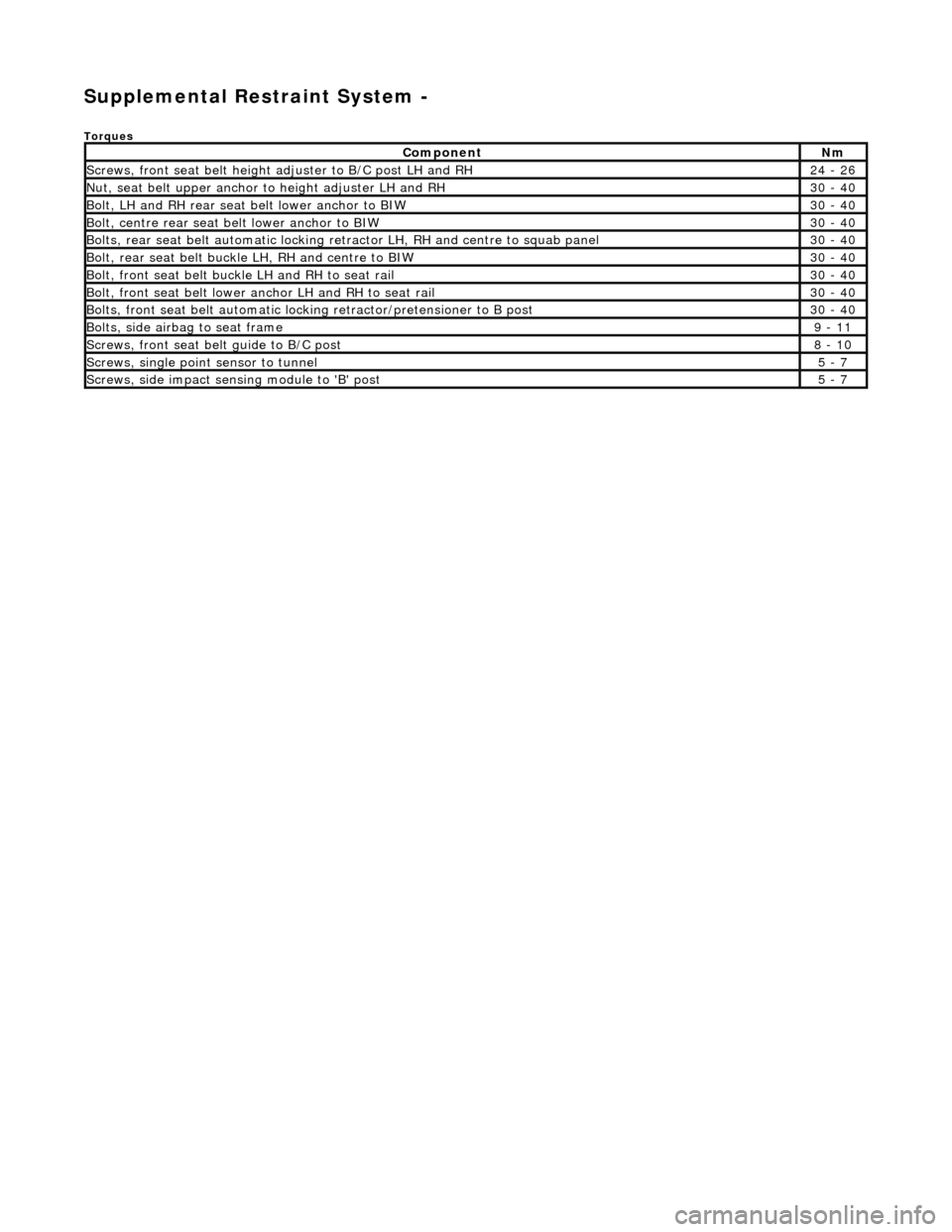
Supplemental Restraint System -
Torques
ComponentNm
Screws, front seat belt height adjuster to B/C post LH and RH24 - 26
Nut, seat belt upper anchor to height adjuster LH and RH30 - 40
Bolt, LH and RH rear seat belt lower anchor to BIW30 - 40
Bolt, centre rear seat belt lower anchor to BIW30 - 40
Bolts, rear seat belt automatic locking re tractor LH, RH and centre to squab panel30 - 40
Bolt, rear seat belt buckle LH, RH and centre to BIW30 - 40
Bolt, front seat belt buckle LH and RH to seat rail30 - 40
Bolt, front seat belt lower an chor LH and RH to seat rail30 - 40
Bolts, front seat belt automatic lock ing retractor/pretensioner to B post30 - 40
Bolts, side airbag to seat frame9 - 11
Screws, front seat belt guide to B/C post8 - 10
Screws, single point sensor to tunnel5 - 7
Screws, side impact sens ing module to 'B' post5 - 7
Page 2386 of 2490
Body Structure
Introduction
The standard wheelbase Jaguar sedan has a unit construction monocoque body structure with bolt-on front fenders and
welded rear fenders. The doors feature lif t-off hinges and welded drop-glass frames.
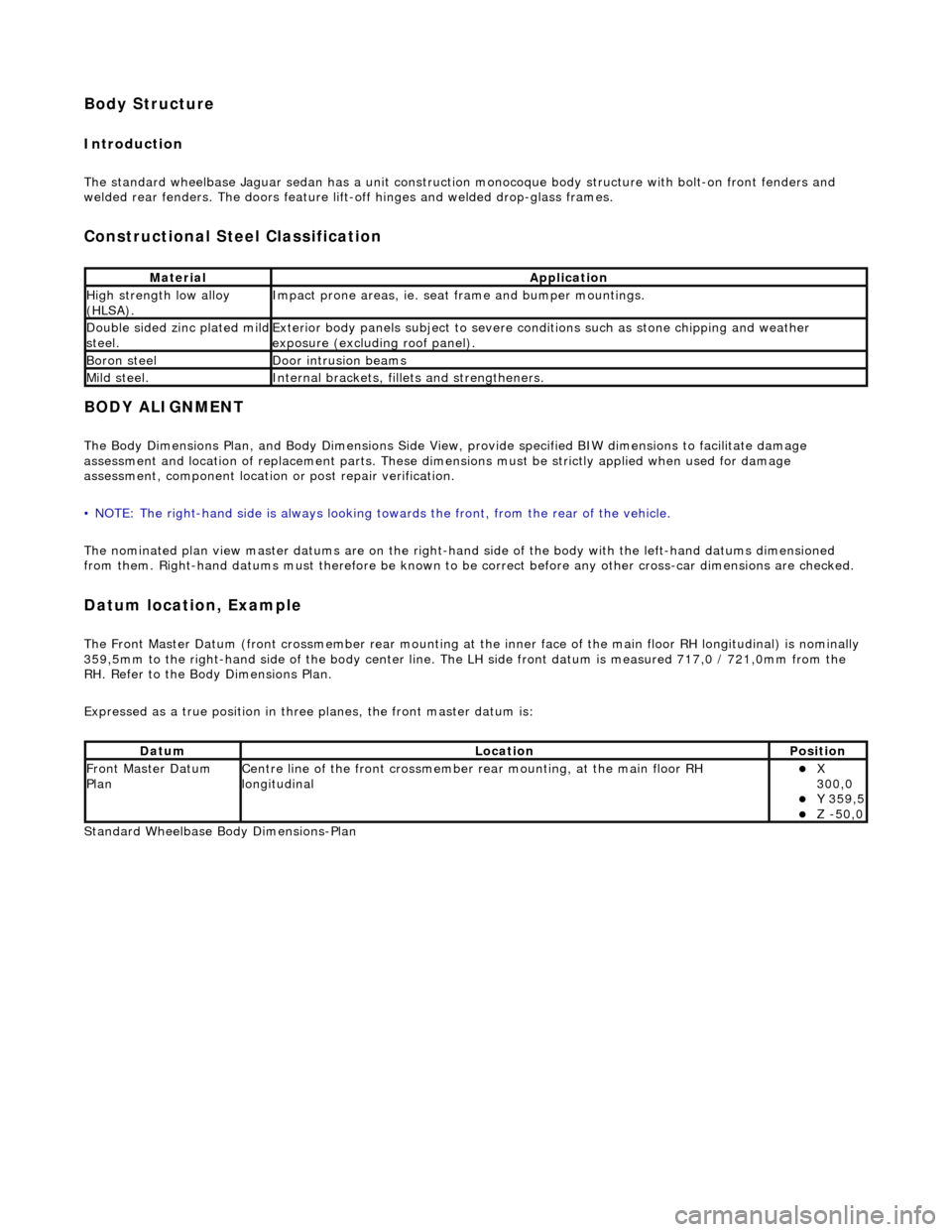
Constructional Steel Classification
BODY ALIGNMENT
The Body Dimensions Plan, and Body Dimensions Side View, provide specified BIW dimensions to facilitate damage
assessment and location of replacemen t parts. These dimensions must be strictly applied when used for damage
assessment, component location or post repair verification.
• NOTE: The right-hand side is always looking towards the front, from the rear of the vehicle.
The nominated plan view master datums are on the right-hand side of the body with the left-hand datums dimensioned
from them. Right-hand datums must therefore be known to be correct before any other cross-car dimensions are checked.
Datum location, Example
The Front Master Datum (front crossmember rear mounting at the inner face of the main floor RH longitudinal) is nominally
359,5mm to the right-hand side of the body center line. The LH side fron t datum is measured 717,0 / 721,0mm from the
RH. Refer to the Body Dimensions Plan.
Expressed as a true posi tion in three planes, the front master datum is:
Standard Wheelbase Bo dy Dimensions-Plan
MaterialApplication
High strength low alloy
(HLSA).Impact prone areas, ie. seat frame and bumper mountings.
Double sided zinc plated mild steel.Exterior body panels subject to severe cond itions such as stone chipping and weather
exposure (excluding roof panel).
Boron steelDoor intrusion beams
Mild steel.Internal brackets, fill ets and strengtheners.
DatumLocationPosition
Front Master Datum
PlanCentre line of the front crossmember rear mounting, at the main floor RH
longitudinalX
300,0
Y 359,5 Z -50,0
Page 2417 of 2490
Panels centered between two adjacent panels must have equal gaps on either side. For exceptions to this, refer to the
appropriate specification. Gaps between ad jacent panels or components must not expose harnesses, labels, brackets or
visually poor joint or assembly conditions.
• NOTE: Sliding roof panel clearances are specified without the edge seal installed.
Areas of particular concern are, fuel filler flap, trunk lid to fenders and saddle panels, hood to fenders, grill and headlamps,
sliding roof to main roof panel, door gaps at fenders, B\C posts, roof drip rail an d rocker panel, and bumper cover to fenders
and cross car assemblies
Alignment
Panels must be correctly profiled to maintain cosmetic appearance, and ensure co rrect seating of seals with minimal wind
noise. Areas of particular concern are hood to fenders, trunk lid to fenders and saddle panels, doors to apertures, doors to
fenders and adjacent doors and relationship of the sliding roof panel leading and trailing edges to the main roof panel.
Exterior Fitments
Bezels, trims and lamps must be concentric with apertu res and have equal clearances with adjacent panels.
Areas of particular concern are headlamp to hood, fender and trim panel, exhaust tailpipe trim to bumper cover cut-out,
rear lamp assembly to trunk lid, fender and bumper cover trim, and side feature lines including body side mouldings, fender
to door and door to door.
Exterior Clearances and Alignments-Front