1998 GMC ENVOY ECU
[x] Cancel search: ECUPage 117 of 386

Training a Garage Opener with a “Rolling
Code” Feature
If you programmed the universal transmitter, but the
garage door will not open, and
if your garage door opener
was manufactured after
1995, your garage door may have
a security feature that changes the “code” of your garage
door opener every time it is opened or closed.
To determine if your garage door opener has this
“rolling code” feature, press the appropriate button on
the universal transmitter that was programmed.
If the
red light flashes rapidly for one to two seconds, then
turns solid, your garage door opener has this feature.
To program a garage door opener with the rolling code
feature, do the following:
1. Program your hand-held transmitter to the universal
transmitter by following the steps provided under
“Programming the Transmitter” earlier in
this section.
2.
3.
4.
5.
6.
Remove the cover panel from the garage door
opener receiver.
It is located near the garage door
opener motor.
Locate the training button on the garage door opener
receiver. The exact location and color will vary
among brands.
Press the training button on the garage door opener
receiver for one to two seconds.
Return to your vehicle and press the programmed
button on the universal transmitter
until the red light
flashes rapidly (about two seconds).
Release the button, then press it again to confirm it
was programmed
to the garage door opener receiver.
You may now use either the universal transmitter or the
hand-held transmitter to open your garage door.
If you
still have difficulty in programming and require
assistance, please call
1-800-355-35 15.
2-56
ProCarManuals.com
Page 131 of 386

I A CAUTION:
Don’t keep driving if the oil pressure is low. If
you do, your engine can become so hot that it
catches fire. You or others could be burned.
Check your oil
as soon as possible and have your
vehicle serviced.
I
I NOTICE:
Damage to your engine from neglected oil
problems can be costly and
is not covered by
your warranty.
Security Warning Light
SECURITY
This light will come on
briefly when you turn the
key toward START. The
light will stay on until the
engine starts.
If the light flashes, the Passlock system has entered a
tamper mode.
If the vehicle fails to start, see “Passlock”
in the Index.
If the light comes on continuously while driving and
stays
on, there may be a problem with the Passlock
system. Your vehicle will not be protected by Passlock,
and you should see your dealer.
This light should also flash as you open
the door (if your
ignition is off).
This is a reminder to activate the
theft-deterrent system. See “Content Theft-Deterrent” in
the Index for more information.
2-70
ProCarManuals.com
Page 155 of 386

1. Write down any three or four-digit number from
000 to 1999 and keep it in a safe place separate from
the vehicle.
2. Turn the ignition to ACCESSORY or RUN.
3. Turn the radio off.
4. Press the 1 and 4 buttons together. Hold them down
until
--- shows on the display. Next you will use the
secret code number which you have written down.
5. Press MN and 000 will appear on the display.
6. Press MN again to make the last two digits agree
7. Press HR to make the first one or two digits agree
with your code.
with your
code.
8. Press AM-FM after you have confirmed that the
code matches the secret code
you have written down.
The display will show REP to let you know that you
need to repeat Steps
5 through 7 to confirm your
secret code.
9. Press AM-FM and this time the display will show
SEC to let you know that your radio is secure. The
indicator by the volume control will begin flashing
when the ignition is turned
off.
Unlocking the Theft-Deterrent Feature After a
Power Loss
Enter your secret code as follows; pause no more than
15 seconds between steps:
1. LOC appears when the ignition is on.
2. Press MN and 000 will appear on the display.
3. Press MN again to make the last two digits agree
with your code.
4. Press HR to make the first one or two digits agree
5. Press AM-FM after you have confirmed that the
with your code.
code matches the secret code
you have written down.
The display will show SEC, indicating the radio is
now operable and secure.
If you enter the wrong code eight times, INOP will
appear on the display.
You will have to wait an hour
with the ignition
on before you can try again. When you
try again,
you will only have three chances to enter the
correct code before INOP appears.
If you lose or forget your code, contact your dealer.
3-22
ProCarManuals.com
Page 156 of 386

Disabling the Theft-Deterrent Feature
Enter your secret code as follows; pause no more than
15 seconds between steps:
1. Turn the ignition to ACCESSORY or RUN.
2. Turn the radio off.
3. Press the 1 and 4 buttons together. Hold them down
until SEC shows on the display.
4. Press MN and 000 will appear on the display.
5. Press MN again to make the last two digits agree
with your code.
6. Press HR to make the first one or two digits agree
with your code.
7. Press AM-FM after you have confirmed that the
code matches the secret code
you have written down.
The display will show
---, indicating that the radio is
no longer secured.
If the code entered is incorrect, SEC will appear
on the
display. The radio will remain secured
until the correct
code
is entered.
When battery power is removed and later applied to
a
secured radio, the radio won’t turn on and LOC will
appear on the display.
To unlock a secured radio, see “Unlocking the
Theft-Deterrent Feature After a Power
Loss” earlier in
this section.
Understanding Radio Reception
AM
The range for most AM stations is greater than for FM,
especially at night. The longer range, however, can
cause stations to interfere with each other. AM can pick
up noise from things like storms and power lines. Try
reducing the treble to reduce this noise
if you ever get it.
FM Stereo
FM stereo will give you the best sound, but FM signals
will reach
only about 10 to 40 miles (1 6 to 65 km). Tall
buildings or hills can interfere with
FM signals, causing
the sound to come and go.
Tips About Your Audio System
Hearing damage from loud noise is almost undetectable
until it is too late. Your hearing can adapt to higher
volumes
of sound. Sound that seems normal can be loud
and harmful to your hearing. Take precautions by
adjusting the volume control on your radio to a safe
sound level before your hearing adapts to
it.
3-23
I
ProCarManuals.com
Page 174 of 386
Off-Road Driving with Your GM
Four-Wheel-Drive Vehicle
Also, see "Anti-Lock Brakes" in the Index.
Off-road driving can be great fun. But
it does have some
definite hazards. The greatest of these is the
terrain itself.
"Off-roading" means you've left the great North
American road system behind. Traffic lanes aren't
marked. Curves aren't banked. There are no road signs.
Surfaces can be slippery, rough,
uphill or downhill. In
short, you've gone right back to nature.
Off-road driving involves some new skills. And that's
why it's very important that
you read this guide. You'll
find many driving tips and suggestions. These will help
make
your off-road driving safer and more enjoyable.
Before You Go Off-Roading
There are some things to do before you go out. For
example, be sure to have all necessary maintenance and
service work done. Check to make sure all underbody
shields
(if so equipped) are properly attached. Be sure
you read all the information about your
four-wheel-drive vehicle
in this manual. Is there enough
fuel? Is the spare tire fully inflated'? Are the fluid levels
up where they should be? What are the local
laws that
apply to off-roading where you'll be driving?
If you
don't know, you should check with
law enforcement
people
in the area. Will you be on someone's private
land'?
If so. be sure to get the necessary permission.
Loading Your Vehicle for Off-Road Driving
There are some important things to remember about
how to load your vehicle.
0 The heaviest things should be on the load floor and
forward of
your rear axle. Put heavier items as far
forward as you can.
Be sure the load is secured properly, so driving on
the off-road terrain doesn't toss things around.
4-15
I
ProCarManuals.com
Page 175 of 386

0
0
0
Cargo on the load floor piled higher than
the seatbacks can be thrown forward
during a sudden stop.
You or your
passengers could be injured. Keep cargo
below the top
of the seatbacks.
Unsecured cargo on the load floor can be
tossed about when driving over rough
terrain. You or your passengers can be
struck by flying objects. Secure the
cargo properly.
Heavy loads on the roof raise the vehicle’s
center of gravity, making it more likely to
roll
over. You can be seriously or fatally
injured
if the vehicle rolls over. Put heavy
loads inside the cargo area, not on the
roof.
Keep cargo in the cargo area as far forward
and low as nossible.
You’ll find other important information in this manual.
See “Vehicle Loading,” “Luggage Carrier” and “Tires”
in the Index.
Environmental Concerns
Off-road driving can provide wholesome and satisfying
recreation. However,
it also raises environmental
concerns.
GM recognizes these concerns and urges
every off-roader to follow these basic rules for
protecting the environment:
0
0
0
0
0
Always use established trails, roads and areas that
have been specially set aside for public off-road
recreational driving; obey all posted regulations.
Avoid any driving practice that could damage me
environment
-- shrubs, flowers, trees, grasses -- or
disturb wildlife (this includes wheel-spinning,
breaking down trees or unnecessary driving througn
streams or over soft ground).
Always carry
a litter bag . . . make sure all refuse is
removed from any campsite before leaving.
Take extreme care with open fires (where permitted),
camp stoves and lanterns.
Never park your vehicle over dry grass or other
combustible materials that could catch fire from the
heat
of the vehicle’s exhaust system.
4-16
ProCarManuals.com
Page 195 of 386
You may see highway signs on mountains that warn
of special problems. Examples are long grades,
passing or no-passing zones,
a falling rocks area
or winding roads. Be alert
to these and take
appropriate action.
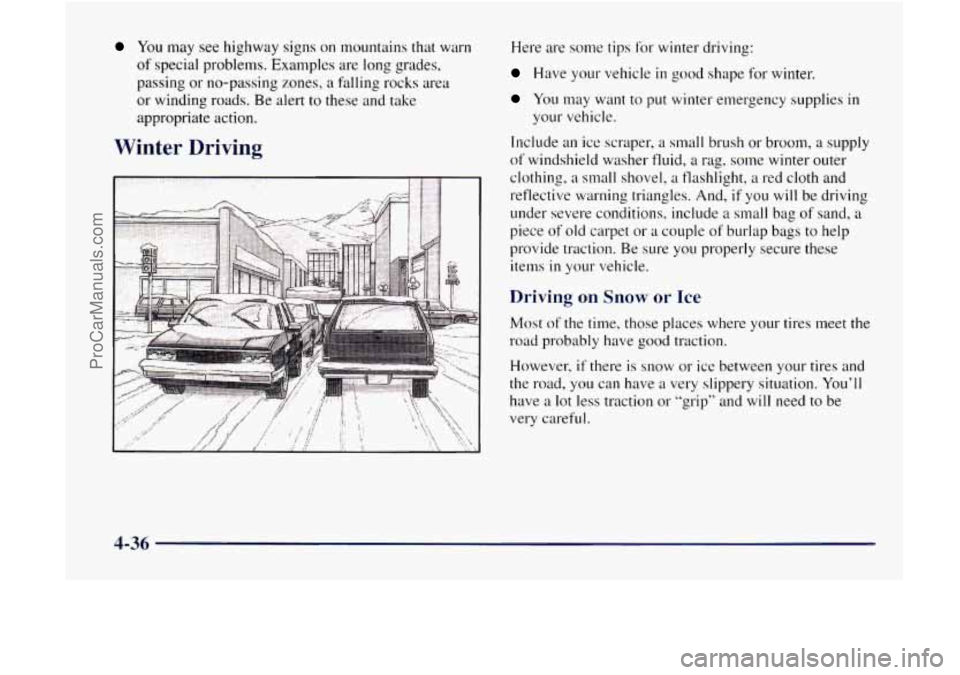
Winter Driving
Here are solne tips for winter driving:
Have your vehicle in good shape for winter.
You may want to put winter emergency supplies in
Tnclude an ice scraper, a small brush or broom, a supply
of windshield washer fluid, a rag, some winter outer
clothing,
a small shovel, a flashlight, a red cloth and
reflective warning triangles.
And, if you will be driving
under severe conditions, include a small bag
of sand, a
piece of old carpet or a couple of burlap bags to help
provide traction. Be sure
you properly secure these
your vehicle.
items
in your vehicle.
Driving on Snow or Ice
Most of the time, those places where your tires
road probably have
good traction.
However,
if there is snow or ice between your t
the road, you can have a very slippery situation meet the
ires and . You’ll
have a lot less traction or “,I-ip” and will need to be
very careful. -- -
4-36
ProCarManuals.com
Page 200 of 386
Using heavier suspension components to get added
durability might not change your weight ratings. Ask
your dealer to help you load your vehicle the right way.
-
NOTICE:
Your warranty does not cover parts or
components that fail because of overloading.
If you put things inside your vehicle -- like suitcases,
tools, packages, or anything else
-- they will go as fast
as the vehicle goes. If you have to stop or turn quickly,
or if there is a crash, they’ll keep going.
A CAUmmdN:
Things you put inside your vehicle can strike and
injure people in a sudden stop or turn, or in
a crash.
0 Put things in the cargo area of your vehicle.
0 Never stack heavier things, like suitcases,
Try to spread the weight evenly.
inside the vehicle
so that some of them are
above the tops of the seats.
0 Don’t leave an unsecured child restraint in
your vehicle.
0 When you carry something inside the
vehicle, secure
it whenever you can.
0 Don’t leave a seat folded down unless you
need to.
There’s also important loading information for off-road
driving in this manual. See “Loading Your Vehicle for
Off-Road Driving” in the Index.
4-41
ProCarManuals.com