1998 GMC ENVOY ECU
[x] Cancel search: ECUPage 70 of 386

Resynchronization Resynchronization may be necessary due to the security
method used by this system. The transmitter does not
send the
same signal twice to the receiver. The receiver
will
not respond to a signal it has been sent previously.
This prevents anyone
from recording and playing back
the signal from the transmitter.
To resynchronize your transmitter, stand close to your
vehicle and press and hold the LOCK and UNLOCK
buttons on the transmitter at the same time for seven
seconds. The door locks should cycle to confirm
synchronization.
If the locks do not cycle. see your
dealer for service.
LiftgateLiftglass
It can be dangerous to drive with the liftgate or
liftglass open because carbon monoxide (CO) gas
can come into your vehicle. You can’t see or smell
CO. It can cause unconsciousness and even death.
If‘ you must drive with the liftgate or liftglass
open or if electrical wiring or other cable
connections must pass through the seal between
the body and the liftgate
or liftglass:
Make sure all windows are shut.
Turn the fan on your heating or cooling
system to its highest speed with the setting
on any airflow selection except
RECIRCULATION. That will force outside
air into your vehicle. See “Comfort
Controls” in the Index.
If you have air outlets on or under the
instrument panel, open them
all the way.
See “Engine Exhaust” in the Index.
2-9
I
ProCarManuals.com
Page 72 of 386

Key in the Ignition
If you leave your vehicle with the keys inside, it’s an
easy target for joy riders or professional thieves
-- so
don’t do it.
When you park your vehicle and open the driver’s door,
you’ll hear a chime reminding
you to remove your key
from the ignition and take
it with you. Always do this.
Your steering wheel will be locked, and
so will your
ignition and transmission. And remember to lock
the doors.
Parking at Night
Park in a lighted spot, close all windows and lock your
vehicle. Remember to keep your valuables out
of sight.
Put them
in a storage area, or take them with you.
Parking Lots
If you park in a lot where someone will be watching
your vehicle, it’s best to lock it up and take your keys.
But what
if you have to leave your ignition key? What if
you have to leave something valuable in your vehicle?
Put your valuables in a storage area, like your
glove box.
Lock all the doors except the driver’s.
Content Theft-Deterrent
Your vehicle is equipped
with
a Content
Theft-Deterrent
SECURITY alarm system.
With this system, the SECURITY light will flash as
you
open the door (if your ignition is off).
This light reminds you to activate the theft-deterrent
system. Here’s how
to do it:
1. Open the door.
2. Lock the door with the power door lock switch or the
remote keyless entry transmitter. The SECURITY
light should come
on and stay on.
3. Close all doors. The SECURITY light should go off
after approximately
30 seconds. The alarm is not
armed until the SECURITY light goes off.
If a door is opened without the key or the remote keyless
entry transmitter, the alarm will go
off. Your vehicle’s
high-beam headlamps will flash
and the horn will sound
for
30 seconds, then will turn off to save the battery power.
2-11
I
ProCarManuals.com
Page 73 of 386

Remember, the theft-deterrent system won‘t activate if
you lock the doors with a key or use the manual door
lock. It activates only if
you use a power door lock
switch with the door open, or with the remote keyless
entry transmitter. You should
also remember that you
can start your vehicle with the correct ignition key
if’ the
alarm has been set
off.
Here’s how to avoid setting off the alarm by accident:
If you don’t want to activate the theft-deterrent
system, the vehicle should be locked
with the door
key
after the doors are closed.
Always unlock a door with a key, or use the remote
keyless entry transmitter. Unlocking
a door any other
way will set off the alarm.
If you set off the alarm by accident, unlock any door
with the key. You can
also turn off the alarm by pressing
UNLOCK on the remote keyless entry transmitter.
The alarm won’t stop if you try to unlock a door any
other way.
Testing the Alarm
The alarm can be tested by following these steps:
I. From inside the vehicle, lower the driver‘s window
and open the driver’s door.
3.
4.
Activate the system by locking the doors with the
power door
lock switch while the door is open, or
with the remote keyless entry transmitter.
Get out
of the vehicle, close the door and wait for the
SECURITY light to
go out.
Then reach
in through the window, unlock the door
with the manual door lock and open the door. This
should set
off the alarm.
If the alarm does not sound when it should but the
vehicle’s high-beam headlamps flash, check
to see if the
horn works. The horn fuse may be blown.
To replace the
f~~se, see “Fuses and Circuit Breakers”
in the Index.
If the alarm does not sound or the vehicle’s high-beam
headlamps do not flash, the vehicle should be serviced
by
an authorized service center.
Passlock’
Your vehicle is equipped with the Passlock
theft-deterrent system.
Passlock is
a passive theft-deterrent system. The system
is armed once the key is removed from the ignition.
Passlock enables fuel
if the ignition lock cylinder is
turned with a valid key. If a correct key is not used, fuel
is disabled.
2-12
ProCarManuals.com
Page 74 of 386

During normal operation, the SECURITY light will go
off after the engine is started.
If the engine stalls and the SECURITY light flashes,
wait about
10 minutes until the light stops flashing
before trying to restart the engine. Remember to release
the key from the
START position as soon as the
engine starts.
If the engine does not start after three (3) tries, the
vehicle needs service.
If you are driving and the SECURITY light comes on,
you will be able to restart the engine if you turn the
engine
off. However, your Passlock system is not
working properly and
must be serviced by your dealer.
Your vehicle is not protected by Passlock at this time.
You may also want to check the fuse (see ”FLIS~S and
Circuit Breakers”
in the Index). See your dealer
for service.
If the SECURITY light comes on while the engine is
running.
a problem has been detected and the system
may need service. See your dealer for service.
In an emergency, call the GMC Roadside Assistance
Center
at 1 -800-GMC-8782 (in Canada, call
1-800-268-6800).
New Vehicle “Break-In”
NOTICE:
~~~ ~ ~
Your vehicle doesn’t need an elaborate
“break-in.” But it will perform better in the long
run if you follow these guidelines:
0
0
0
0
Keep your speed at 55 mph (88 kmh) or
less for the first
500 miles (805 km).
Don’t drive at any one speed
-- fast or
slow -- for the first 500 miles (805 km).
Don’t make full-throttle starts.
Avoid making hard stops for the first
200
miles (322 km) or so. During this time your
new brake linings aren’t yet broken in.
Hard stops with new linings can mean
premature wear and earlier replacement.
Follow this breaking-in guideline every
time you get new brake linings.
Don’t tow a trailer during break-in.
See “Towing a Trailer” in the Index for
more information.
2-13
ProCarManuals.com
Page 108 of 386
Cargo Security Shade
You can use the cargo security shade to cover items in
the cargo area of your vehicle.
Grasp the handle and unroll the cover. Latch the posts
into the sockets on the inside trim panel on the
passenger’s
side of the vehicle to secure it.
An improperly stored cargo cover could be
thrown about the vehicle during a collision or
sudden maneuver. You or others could be
injured.
If you remove the cover, always store it
outside of the vehicle. When you put it back,
always be sure that it is securely reattached. Cargo Tie Downs
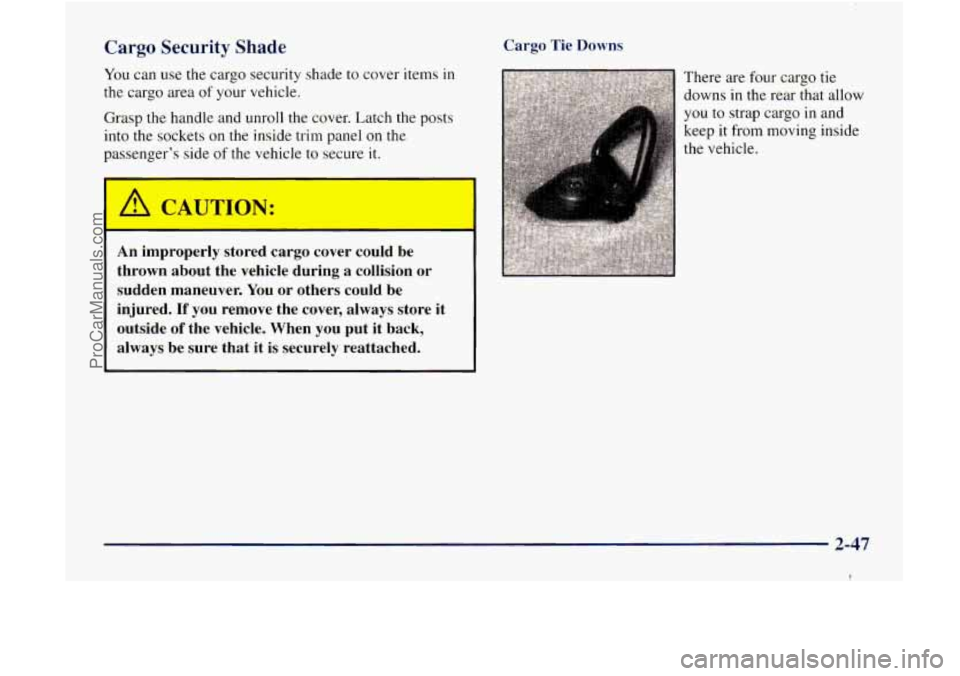
There are four cargo tie
downs in the rear that allow
you to
strap cargo in and
keep it from moving inside
the vehicle.
2-47
I
ProCarManuals.com
Page 109 of 386

If you try to carry something on top of your
vehicle that
is longer or wider than the luggage
carrier
-- like paneling, plywood, a mattress, and
so forth -- the wind can catch it as you drive
along. This can cause you to lose control. What
you are carrying
could be violently torn off, and
this could cause you or other drivers
to have a
collision, and of course damage your vehicle. You
may be able to carry something like this inside.
But, never carry something longer or wider than
the luggage carrier on top
of your vehicle.
Use GM accessory racks that are compatible with your
luggage carrier for transporting sports equipment. These
are available through your
GM dealer.
You can adjust the crossrails to handle loads of various
sizes. Just loosen the slider knobs at each end of the
crossrail and move them to where you want them. Make
sure both sides
of the crossrails are even, then tighten
the slider knobs.
Be sure the cargo is properly loaded. Follow
these guidelines:
Carrying small, heavy loads on the roof is
Tie the load to the tie down (at either end of the
crossrails). When loading cargo directly on the
roof panel, use the crossrails to keep the load
from shifting.
not recommended.
If you need to carry long items, move the crossrails
as far apart as possible. Tie the load to the tie downs
provided. Also tie the load to the bumpers.
Do not tie
the load
so tightly that the crossrails or side rails
are damaged.
The
luggage carrier has slats, side rails and crossrails
attached to the roof to secure cargo. The adjustable tie
downs, at either end of the crossrails, should be used to
secure loads to the luggage carrier.
2-48
ProCarManuals.com
Page 110 of 386

NOTICE:
Loading cargo that weighs more than 200 Ibs.
(91 kg) on the luggage carrier may damage your
vehicle. When you carry large things, never let
them hang over the rear or the sides of your
vehicle. When loading cargo on the roof panel, be
sure it rests on the slats and does not scratch or
damage the vehicle.
Put the cargo against the side rails and fasten it
securely to the luggage carrier. Put the main
weight as
far forward as you can and move the
rear crossrail forward as
far as possible to keep
the load from shifting.
Don’t exceed the maximum vehicle capacity when
loading your vehicle. For more information on vehicle
capacity and loading, see “Loading Your Vehicle“
in
the Index.
To prevent damage or loss of cargo as you’re driving,
check now and then to make sure the luggage carrier and
cargo are still securely fastened.
Ashtrays and Cigarette Lighter
The ashtray is located in the center floor console, in
front
of the shift lever. Flip the cover to expose
the ashtray.
NOTICE:
Don’t put papers and other things that burn into
your ashtray.
If you do, cigarettes or other
smoking materials could set them on fire
causing damage.
To remove the front ashtray, pull the bin upward.
The lighter is located
in the instrument panel below the
climate controls.
To use the lighter, press it in all the
way, and let
go. When it’s ready, it will pop back
by itself.
2-49
I
ProCarManuals.com
Page 114 of 386
Universal Transmitter
Mini Console Full-Size
Console
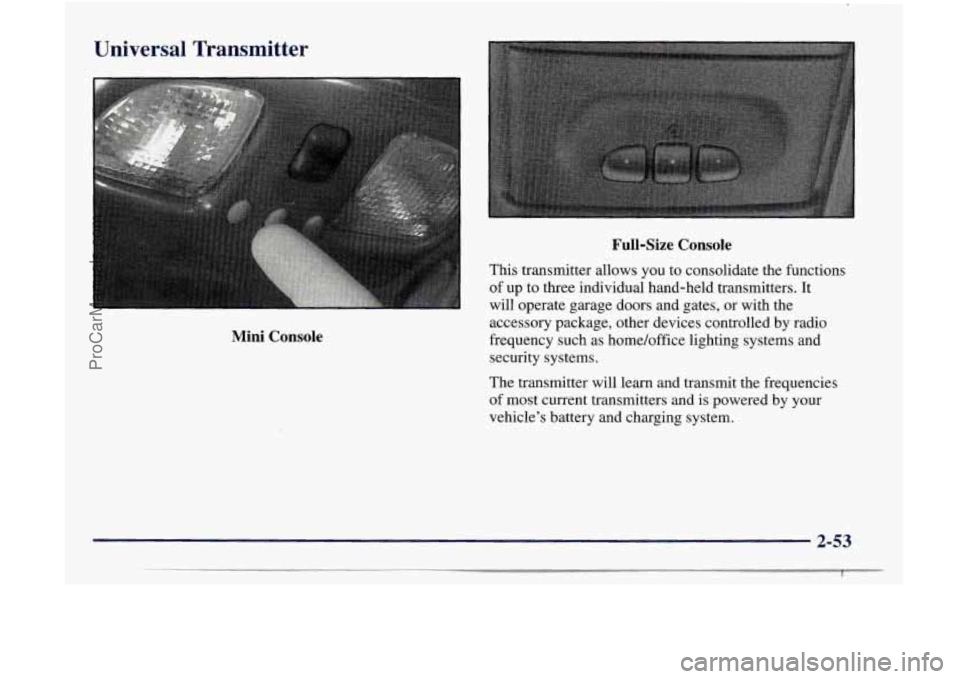
This transmitter allows you to consolidate the functions
of up to three individual hand-held transmitters. It
will operate garage doors and gates, or with the
accessory package, other devices controlled by radio
frequency such as home/office lighting systems and
security systems.
The transmitter will learn and transmit the frequencies
of most current transmitters and is powered by your
vehicle’s battery and charging system.
2-53
I
ProCarManuals.com