1998 GMC ENVOY fuse
[x] Cancel search: fusePage 6 of 386
1
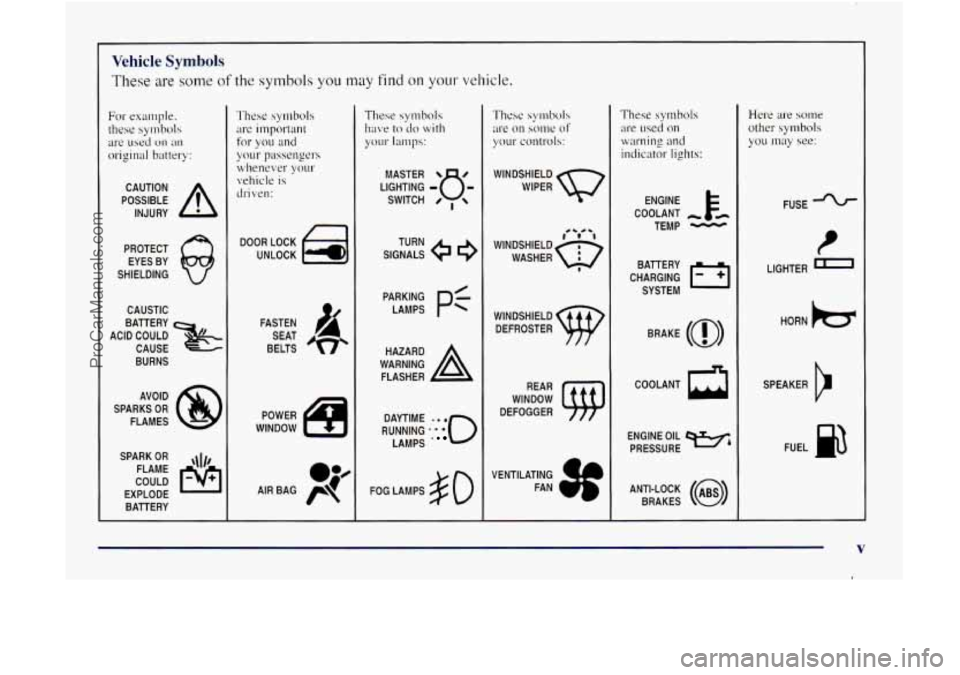
Vehicle Symbols
These are some of the symbols you tnay find on your vehicle.
For example.
these symbols
are used
on an
original battery:
POSSIBLE A
CAUTION
INJURY
PROTECT EYES BY
SHIELDING
CAUSTIC
ACID COULD
BATTERY
CAUSE
BURNS
AVOID
SPARKS
OR
FLAMES
SPARK
OR ,111,
COULD FLAME
EXPLODE BATTERY
These symbols
are important
for you and
your passenpel-s
whenever your vehicle
is
driven:
DOOR LOCK
UNLOCK
FA$TEll SEAT
BELTS SIGNALS
TURN
RUNNING
.':**o
DAYTIME LAMPS
*
FOG LAMPS $0
WINDSHIELD
WIPER
WINDSHIELD DEFROSTER
WINDOW
DEFOGGER
VENTILATING
i F,
FAN COOLANT
-
TEMP -
CHARGING I-1
BATTERY
SYSTEM
BRAKE
(a)
COOLANT a
ENGINE OIL w,
PRESSURE
ANTI-LOCK
(@)
BRAKES
Here are some
other symbols
you may see:
FUSE
P
LIGHTER m
HORN b
SPEAKER
b
FUEL p3
V
1
ProCarManuals.com
Page 73 of 386

Remember, the theft-deterrent system won‘t activate if
you lock the doors with a key or use the manual door
lock. It activates only if
you use a power door lock
switch with the door open, or with the remote keyless
entry transmitter. You should
also remember that you
can start your vehicle with the correct ignition key
if’ the
alarm has been set
off.
Here’s how to avoid setting off the alarm by accident:
If you don’t want to activate the theft-deterrent
system, the vehicle should be locked
with the door
key
after the doors are closed.
Always unlock a door with a key, or use the remote
keyless entry transmitter. Unlocking
a door any other
way will set off the alarm.
If you set off the alarm by accident, unlock any door
with the key. You can
also turn off the alarm by pressing
UNLOCK on the remote keyless entry transmitter.
The alarm won’t stop if you try to unlock a door any
other way.
Testing the Alarm
The alarm can be tested by following these steps:
I. From inside the vehicle, lower the driver‘s window
and open the driver’s door.
3.
4.
Activate the system by locking the doors with the
power door
lock switch while the door is open, or
with the remote keyless entry transmitter.
Get out
of the vehicle, close the door and wait for the
SECURITY light to
go out.
Then reach
in through the window, unlock the door
with the manual door lock and open the door. This
should set
off the alarm.
If the alarm does not sound when it should but the
vehicle’s high-beam headlamps flash, check
to see if the
horn works. The horn fuse may be blown.
To replace the
f~~se, see “Fuses and Circuit Breakers”
in the Index.
If the alarm does not sound or the vehicle’s high-beam
headlamps do not flash, the vehicle should be serviced
by
an authorized service center.
Passlock’
Your vehicle is equipped with the Passlock
theft-deterrent system.
Passlock is
a passive theft-deterrent system. The system
is armed once the key is removed from the ignition.
Passlock enables fuel
if the ignition lock cylinder is
turned with a valid key. If a correct key is not used, fuel
is disabled.
2-12
ProCarManuals.com
Page 74 of 386

During normal operation, the SECURITY light will go
off after the engine is started.
If the engine stalls and the SECURITY light flashes,
wait about
10 minutes until the light stops flashing
before trying to restart the engine. Remember to release
the key from the
START position as soon as the
engine starts.
If the engine does not start after three (3) tries, the
vehicle needs service.
If you are driving and the SECURITY light comes on,
you will be able to restart the engine if you turn the
engine
off. However, your Passlock system is not
working properly and
must be serviced by your dealer.
Your vehicle is not protected by Passlock at this time.
You may also want to check the fuse (see ”FLIS~S and
Circuit Breakers”
in the Index). See your dealer
for service.
If the SECURITY light comes on while the engine is
running.
a problem has been detected and the system
may need service. See your dealer for service.
In an emergency, call the GMC Roadside Assistance
Center
at 1 -800-GMC-8782 (in Canada, call
1-800-268-6800).
New Vehicle “Break-In”
NOTICE:
~~~ ~ ~
Your vehicle doesn’t need an elaborate
“break-in.” But it will perform better in the long
run if you follow these guidelines:
0
0
0
0
Keep your speed at 55 mph (88 kmh) or
less for the first
500 miles (805 km).
Don’t drive at any one speed
-- fast or
slow -- for the first 500 miles (805 km).
Don’t make full-throttle starts.
Avoid making hard stops for the first
200
miles (322 km) or so. During this time your
new brake linings aren’t yet broken in.
Hard stops with new linings can mean
premature wear and earlier replacement.
Follow this breaking-in guideline every
time you get new brake linings.
Don’t tow a trailer during break-in.
See “Towing a Trailer” in the Index for
more information.
2-13
ProCarManuals.com
Page 78 of 386

To Use the Engine Coolant Heater
1. Turn off the engine.
2. Open the hood and unwrap the electrical cord. The
cord is located on the driver’s side of the engine
compartment, behind the underhood fuse block.
3. Plug it into a normal, grounded 110-volt AC outlet.
% CAUTION:
Plugging the cord into an ungrounded outlet
could cause an electrical shock. Also, the wrong
kind
of extension cord could overheat and cause
a fire. You could be seriously injured. Plug the
cord into
a properly grounded three-prong
110-volt
AC outlet. If the cord won’t reach, use a
heavy-duty three-prong extension cord rated for
at least
15 amps.
4. Before starting the engine, be sure to unplug and
store the cord as it was before to keep it away from
moving engine parts. If you don’t, it could
be damaged.
How long should you keep the coolant heater plugged
in? The answer depends on the outside temperature, the
kind
of oil you have, and some other things. Instead of
trying to list everything here, we ask that you contact
your dealer in the area where you’ll be parking your
vehicle. The dealer can give you the best advice for that
particular area.
2-17
ProCarManuals.com
Page 92 of 386

Turn and Lane Change Signals
The turn signal has two upward (for right) and two
downward (for left) positions. These positions allow
you to signal a turn or a lane change.
To signal a turn, move the lever all the way up
or down. When the turn
is finished, the lever
will return automatically.
I 1 I An arrow on the instrument
panel will flash
in the
direction of the turn or
lane change.
To signal a lane change, just raise or lower the lever
until the arrow starts to flash. Hold it there until you
complete your lane change. The lever will return by
itself when you release it.
The signal indicator will flash even if a turn signal bulb
is burned out. Check the front and rear turn signal lamps
regularly
to make sure they are working. If
a bulb is burned out, replace it to help avoid an
accident. If the
arrows don’t go on at all when you
signal a turn, check the fuse (see “Fuses and Circuit
Breakers”
in the Index) and for burned-out bulbs.
Turn Signal On Chime
If your turn signal is left on for more than 3/4 of a mile
(1.2 km), a chime will sound at each flash of the turn
signal.
To turn off the chime, move the turn signal lever
to the off position.
Headlamp High/Low Beam Changer
To change the headlamps from low beam to high or high
to low, pull the multifunction lever all the way toward
you. Then release
it.
When the high beams are
on, this indicator light on
the instrument panel will
also be on.
2-31
ProCarManuals.com
Page 112 of 386

Inflating something too much can make it
explode, and
you or others could be injured. Be
sure to read the inflator instructions, and inflate
any object only to its recommended pressure.
To use your air inflator, attach the appropriate nozzle
adapter, if required, to the end of the hose.
Then attach that end of
the
hose to the object you wish
to inflate. Remove
the
protective cap covering the
outlet. Attach
the other end
of
the hose to the outlet.
Press the
ON switch.
If the air inflator system does not turn on, the fuse may
be blown
or installed incorrectly. See “Fuses and Circuit
Breakers”
in the Index or see your dealer for service.
Your air inflator will automatically shut off after about
10 minutes. To reset, press the ON switch again.
Don’t
run your air inflator for longer than 30 minutes at
one time.
If you do, you may damage the system. After
30 minutes, wait at least 10 minutes before restarting the
air inflator.
To turn off the air inflator, press OFF and detach the
hose, first from the inflated object, then from the outlet.
Replace the protective cap. Place the inflator kit tools
in
the pouch and store it properly.
To replace the cover, line up the tabs at the back of the
cover and put
it in place.
2-51
!
ProCarManuals.com
Page 113 of 386

Accessory Power Outlets
With the accessory power outlets, you can plug in
auxiliary electrical equipment. There are four accessory
power outlets located throughout the vehicle. Two are
near the lower center part
of the instrument panel, one is
located in
the lower rear of the center console and the
other is located in
the rear of the vehicle in the air
inflator compartment. Follow the proper installation
instructions that are included with any electrical
equipment you install.
These circuits are protected by
a fuse and have
maximum current levels.
NOTICE:
When using the accessory power outlets,
maximum electrical load must not exceed
20 amps. Always turn off any electrical
equipment when not in use. Leaving electrical
equipment on for extended periods will drain
your battery.
Sunroof (If Equipped)
Your vehicle may be equipped with a power sliding
sunroof. To open or close your sunroof, the ignition or
RAP needs to be on. See “Retained Accessory Power”
in the Index.
Press and release the rear side
of the button in the mini
console to open the sunroof. You can press the forward
side
of the button to close the sunroof. Once the sunroof
is closed, press the forward side of the button to open
the sunroof to the vent position.
The sunroof
is also equipped with a sunshade which you
can pull forward to block sun rays.
2-52
ProCarManuals.com
Page 175 of 386

0
0
0
Cargo on the load floor piled higher than
the seatbacks can be thrown forward
during a sudden stop.
You or your
passengers could be injured. Keep cargo
below the top
of the seatbacks.
Unsecured cargo on the load floor can be
tossed about when driving over rough
terrain. You or your passengers can be
struck by flying objects. Secure the
cargo properly.
Heavy loads on the roof raise the vehicle’s
center of gravity, making it more likely to
roll
over. You can be seriously or fatally
injured
if the vehicle rolls over. Put heavy
loads inside the cargo area, not on the
roof.
Keep cargo in the cargo area as far forward
and low as nossible.
You’ll find other important information in this manual.
See “Vehicle Loading,” “Luggage Carrier” and “Tires”
in the Index.
Environmental Concerns
Off-road driving can provide wholesome and satisfying
recreation. However,
it also raises environmental
concerns.
GM recognizes these concerns and urges
every off-roader to follow these basic rules for
protecting the environment:
0
0
0
0
0
Always use established trails, roads and areas that
have been specially set aside for public off-road
recreational driving; obey all posted regulations.
Avoid any driving practice that could damage me
environment
-- shrubs, flowers, trees, grasses -- or
disturb wildlife (this includes wheel-spinning,
breaking down trees or unnecessary driving througn
streams or over soft ground).
Always carry
a litter bag . . . make sure all refuse is
removed from any campsite before leaving.
Take extreme care with open fires (where permitted),
camp stoves and lanterns.
Never park your vehicle over dry grass or other
combustible materials that could catch fire from the
heat
of the vehicle’s exhaust system.
4-16
ProCarManuals.com