Page 201 of 386

Payload
The payload capacity is shown on the CertificationRire
label. This is the maximum load capacity that your
vehicle can carry. Be sure to include the weight of the
occupants as part
of your load. If you added any
accessories or equipment after your vehicle left the
factory, remember to subtract the weight
of these things
from the payload.
Your dealer can help you with this.
Electronic Level Control
The rear of the vehicle is automatically kept level as you
load
or unload your vehicle. However, you should still
not exceed the
GVWR or the GAWR.
The ignition has to be on for the level control to work.
The system includes a small electric air compressor and
air-adjustable rear shock absorbers.
You may hear the compressor operating when you load
or unload your vehicle, and periodically
as the system
self-adjusts. This is normal. The compressor should operate for
brief periods
of time
If the sound continues for an extended period of time,
your vehicle needs service.
To keep your battery from
being drained. you may want to remove the
LD LEV
fuse in the fuse control panel until you can get your
vehicle serviced (see “Fuses and Circuit Breakers”
in
the Index).
Using heavier suspension components to get added
durability might not change your weight ratings.
Ask
your dealer to help you load your vehicle the right way.
NOTICE:
Your warranty does not cover parts or
components that fail because
of overloading.
ProCarManuals.com
Page 211 of 386

Trailer Wiring Harness
The heavy-duty trailer wiring is an eight-wire harness
assembly. The harness is stored under the vehicle, on the
driver’s side corner frame rear crossmember. The
heavy-duty trailer wiring has a 30-amp feed wire
with
an in-line fuse located by the junct.ion block. See “Fuses
and Circuit Breakers”
in the Index. The harness does not
have a cannector and should be wired by
a qualified
electrical technician. The technician can use the
following color code chart when connecting the wiring
harness
to your trailer.
0
0
0
0
0
0
0
0
Dark Blue: Use for electric trailer brakes or
auxiliary wiring.
Red: Use for battery charging;
it connects to the
starter solenoid.
Light Green: Back-up lamps.
Brown: Taillamps and parking lamps.
Yellow: Left stoplamp and turn signal.
Dark Green: Right stoplamp
and turn signal.
White (Heavy Gage): Ground wire.
White (Light Gage): Auxiliary stoplamp.
Securely attach the harness to the trailer, then tape or
strap
it to your vehicle’s frame rail. Be sure you leave it
loose enough so the wiring doesn’t bend or break, but
not
so loose that it drags on the ground. Store the
harness
in its original place. Wrap the harness together
and tie
it neatly so it won’t be damaged.
4-52
ProCarManuals.com
Page 250 of 386

You can be injured and your vehicle could be
damaged if you try to do service work on
a
vehicle without knowing enough about it.
0 Be sure you have sufficient knowledge,
experience, the proper replacement parts
and tools before you attempt any vehicle
maintenance task.
0 Be sure to use the proper nuts, bolts and
other fasteners. “English” and “metric”
fasteners can be easily confused.
If you use
the wrong fasteners, parts can later break
or
fall off. You could be hurt.
Adding Equipment to the Outside of
Your Vehicle
Things you might add to the outside of your vehicle can
affect the airflow around
it. This may cause wind noise
and affect windshield washer performance. Check with
your dealer before adding equipment to the outside of
your vehicle.
Fuel
Use regular unleaded gasoline rated at 87 octane or
higher. At a minimum,
it should meet specifications
ASTM D48 14
in the United States and CGSB 3.5-M93
in Canada. Improved gasoline specifications have been
developed by the American Automobile Manufacturers
Association (AAMA) for better vehicle performance
and engine protection. Gasolines meeting the AAMA
specification could provide improved driveability and
emission control system protection compared
to
other gasolines.
Be SUI-e the posted octane is at least 87. If the octane
is
less than 87, you may get a heavy knocking noise when
you drive. If it’s bad enough, it can damage your engine.
If you’re using fuel rated at 87 octane or higher and you
hear heavy knocking, your engine needs service. But
don‘t worry
if you hear a little pinging noise when
you’re accelerating or driving
LIP a hill. That‘s normal,
and you don‘t have
to buy a higher octane fuel to get rid
of pinging. It‘s the heavy, constant knock that means
you have a problem.
6-3
ProCarManuals.com
Page 256 of 386
When you lift the hood, you’ll see these items:
C
A. Battery
B. Coolant Recovery Tank
C. Engine
Oil Dipstick
D. Engine
Oil Fill
E. Transmission Dipstick
E Power Steering Reservoir
G. Brake Master Cylinder
H. Air Cleaner
I. Fuse Block
J. Windshield Washer Fluid
6-9
ProCarManuals.com
Page 302 of 386
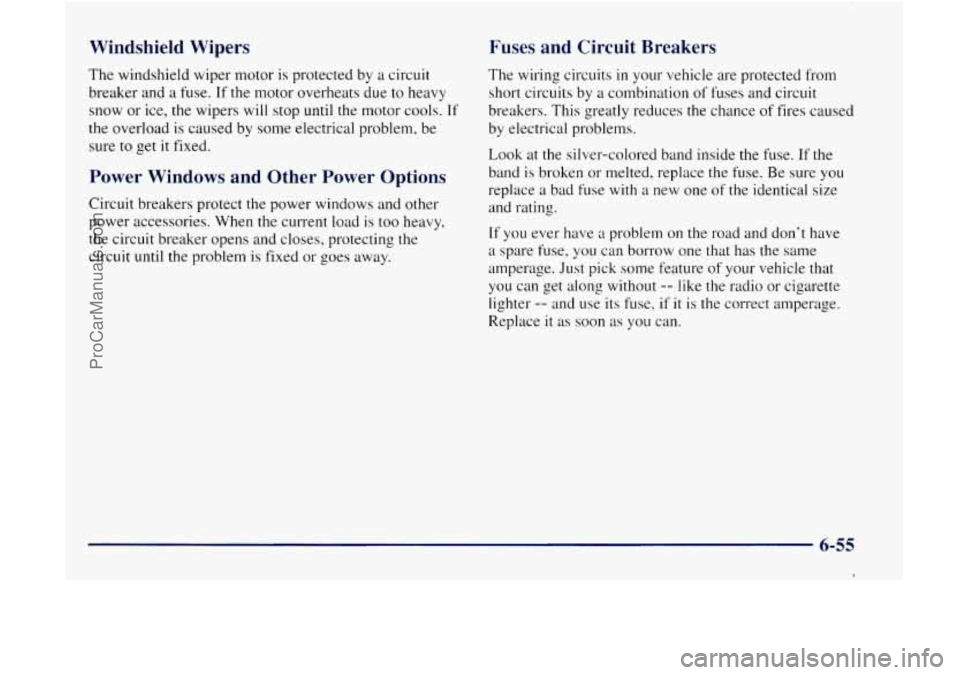
.dshield Wipers
I he windshield wiper motor is protected by a circuit
breaker and
a fuse. If the motor overheats due to heavy
snow or ice, the wipers will stop
until the motor cools. If
the overload is caused by some electrical problem, be
sure to get
it fixed.
Power Windows and Other Power Options
Circuit breakers protect the power windows and other
power accessories. When the current load is too heavy,
the circuit breaker opens and closes, protecting the
circuit
until the problem is fixed or goes away.
Fuses and Circuit Breakers
The wiring circuits in your vehicle are protected from
short circuits by a combination of fuses and circuit
breakers. This greatly reduces the chance
of fires caused
by electrical problems.
Look at the silver-colored band inside the fuse. If the
band
is broken or melted. replace the fuse. Be sure you
replace a bad fuse
with a new one of the identical size
and rating.
If you ever have a problem on the road and don’t have
a spare fuse, you can borrow one that has the same
amperage. Just pick some feature
of your vehicle that
you can get
along without -- like the radio or cigarette
lighter
-- and use its fuse, if it is the correct amperage.
Replace
it as soon as you can.
6-55
I
ProCarManuals.com
Page 303 of 386
Instrument Panel Fuse Block
instrument panel.
Remove the cover by turning the fastener to the left.
Extra fuses and the fuse extractor
are provided in the
cover.
To reinstall the fuse panel cover, push in and turn
the fastener to the right.
Fuse/Circuit
Breaker
A
B
1
Usage
Not Used
Not Used
Headlamp Switch, Body Control
Module, Headlamp Relay
ProCarManuals.com
Page 304 of 386
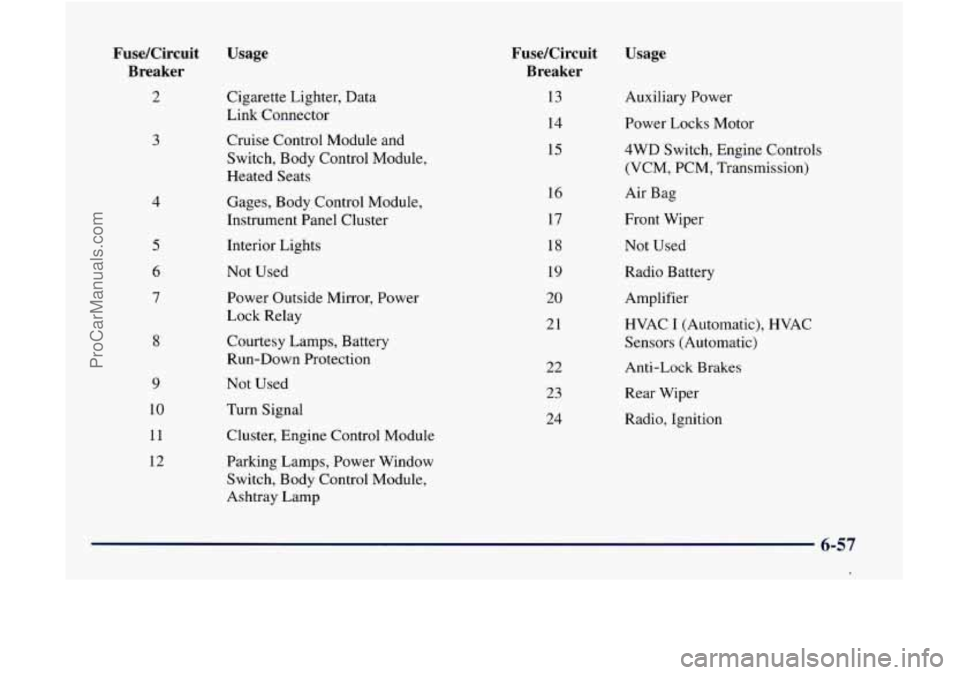
FuseKircuit Usage
Breaker
2
3
4
8
9
10
11
12 Cigarette
Lighter, Data
Link Connector
Cruise Control Module and
Switch, Body Control Module,
Heated Seats
Gages, Body Control Module,
Instrument Panel Cluster
Interior Lights
Not Used
Power Outside Mirror, Power
Lock Relay
Courtesy Lamps, Battery
Run-Down Protection
Not Used
Turn Signal
Cluster, Engine Control Module
Parking Lamps, Power Window
Switch, Body Control Module,
Ashtray Lamp
FuseKircuit
Breaker
13
14
15
16
17
18
19
20
21
22
23
24
Usage
Auxiliary Power
Power Locks Motor
4WD Switch, Engine Controls (VCM, PCM, Transmission)
Air Bag
Front Wiper
Not Used
Radio Battery
Amplifier
HVAC
I (Automatic), HVAC
Sensors (Automatic)
Anti-Lock Brakes
Rear Wiper
Radio, Ignition
6-57
ProCarManuals.com
Page 305 of 386
Engine Compartment Fuse Block
The fuse block is under the hood at the driver’s side of
the engine compartment.
Remove the cover
by turning the fastener to the left. To
reinstall the fuse panel cover, push in and
turn the
fastener to
the right.
TRR TRN RTTRN STARTER
rRL BU
Name
TRL TRN
TRR TRN
TRL
BPU
VEH B/U
RT TURN
LT TURN
LT TRN
Usage
Trailer Left Turn
Trailer Right Turn
Trailer
Back-up Lamps
Vehicle Back-up Lamps
Right Turn Signal Front
Left Turn Signal Front
Left Turn Signal Rear
6-58
ProCarManuals.com