Page 228 of 378
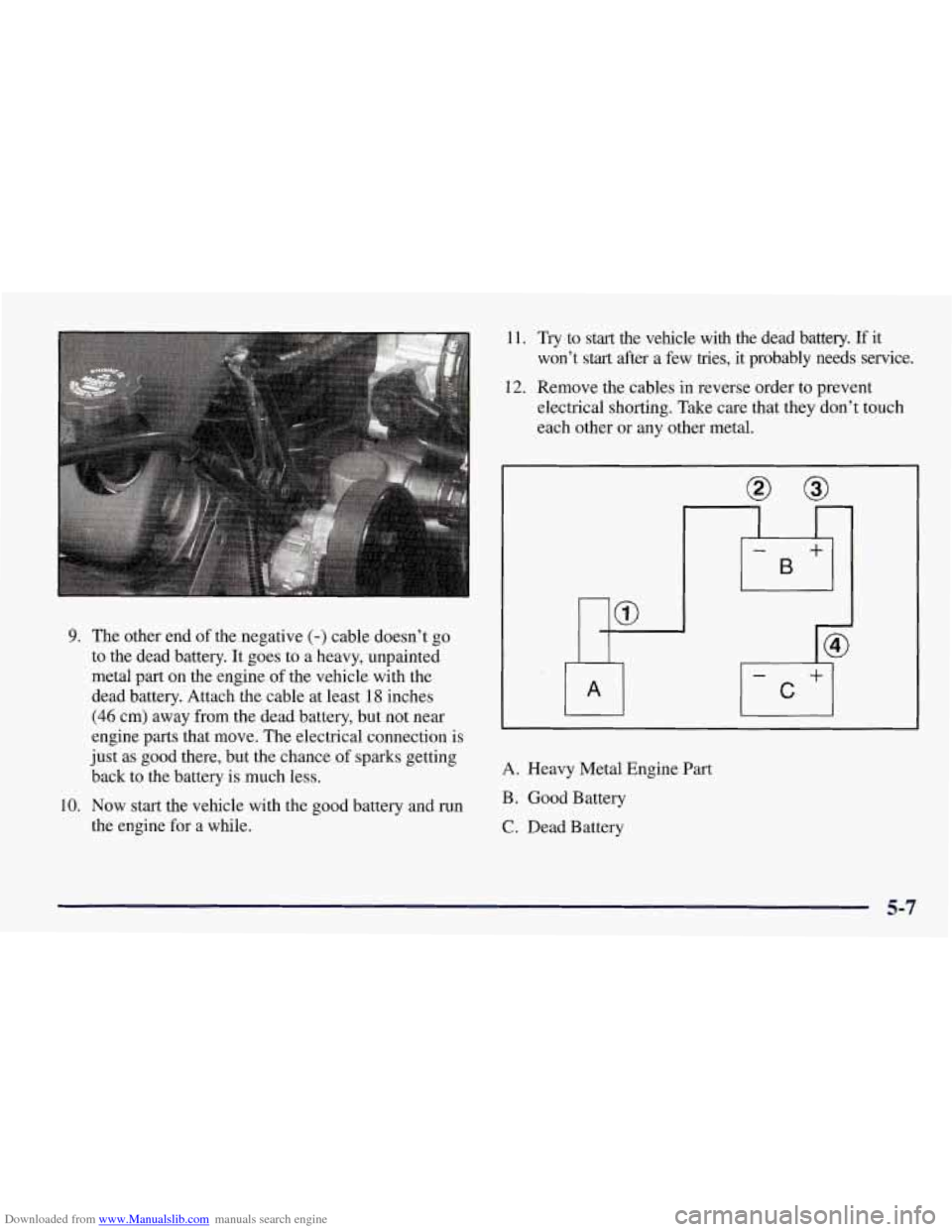
Downloaded from www.Manualslib.com manuals search engine 9. The other end of the negative (-) cable doesn’t go
to the dead battery. It goes to a heavy, unpainted
metal part on the engine
of the vehicle with the
dead battery. Attach the cable at least
18 inches
(46 cm) away from the dead battery, but not near
engine parts that move. The electrical connection is
just as good there, but the chance of sparks getting
back to the battery is much less.
10. Now start the vehicle with the good battery and run
the engine for a while.
11. ‘Try to start the vehicle with the dead battery. If it
won’t start after a few tries, it probably needs service.
12. Remove the cables in reverse order to prevent
electrical shorting. Take care that they don’t touch
each other or any other metal.
A. Heavy Metal Engine Part
B. Good Battery
C. Dead Battery
5-7
Page 229 of 378
Downloaded from www.Manualslib.com manuals search engine Towing Your Vehicle
Try to have a GM dealer or a professional towing service
tow your vehicle. They can provide the right equipment
and know-how to tow your vehicle without damage.
If your vehicle has been changed or modified since it
was factory new by adding aftermarket items like
fog
lamps, aero skirting, or special tires and wheels, these
instructions and illustrations may not be correct.
Before you
do anything, turn on the hazard
warning flashers.
When you call, tell the towing service:
That your vehicle cannot be towed with sling-type equipment.
0 That your vehicle has rear-wheel drive.
The make, model and year of your vehicle.
0 Whether you can still move the shift lever.
If there was an accident, what was damaged.
0 If the vehicle is to be towed from the rear with a
wheel-lift truck, a front dolly will be required.
When the towing service arrives; let the tow operator
know that this manual contains detailed towing
instructions and illustrations. The operator may want
to
see them.
Page 230 of 378
Downloaded from www.Manualslib.com manuals search engine To help avoid injury to you or others:
Never let passengers ride in a vehicle that is
Never tow faster than safe or posted speeds.
Never tow with damaged parts not
0 Never get under your vehicle after it has
Always secure the vehicle on each side with
0 Use only R-hooks. being towed.
fully secured.
been lifted by the tow truck.
separate safety chains when towing it.
A vehicle can fall from a car carrier if it isn’t
adequately secured. This can cause a collision,
serious personal injury and vehicle damage. The
vehicle should be tightly secured with chains or
steel cables before
it is transported.
Don’t use substitutes (ropes, leather straps,
canvas webbing, etc.) that can be cut by sharp
edges underneath the towed vehicle. Always use
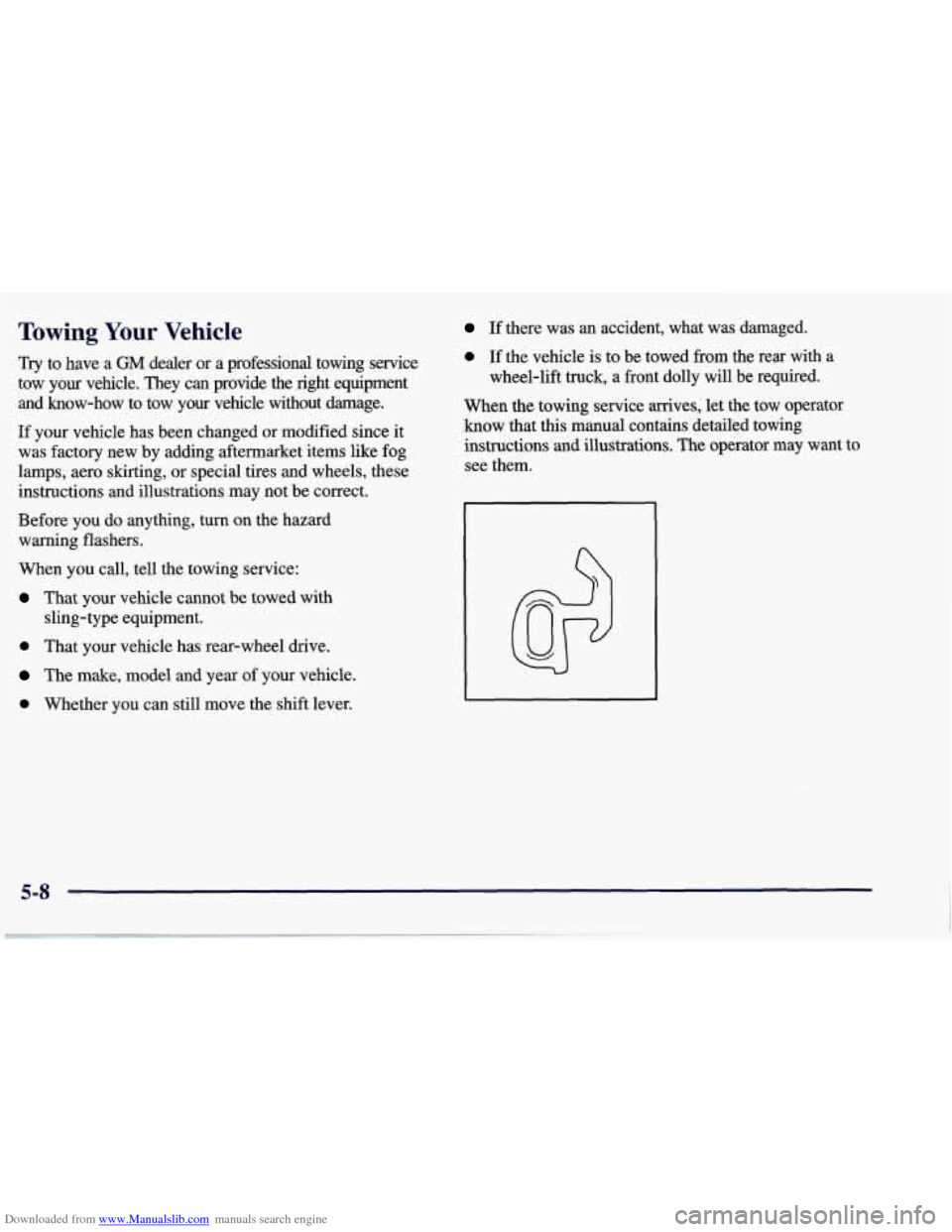
R-hooks inserted in the front and rear R-hook
slots. Never use J-hooks. They will damage
drivetrain and suspension components.
When your vehicle is being towed, have the ignition
key in the
OFF position. The steering wheel should
be clamped in a straight-ahead position, with a
clamping device designed for towing service.
Do not
use the vehicle’s steering column lock for this. The
transmission should be in
NEUTRAL (N) and the
parking brake released.
5-9
Page 236 of 378
Downloaded from www.Manualslib.com manuals search engine NOTICE:
If your engine catches fire because you keep
driving with no coolant, your vehicle can be
badly damaged. The costly repairs would not be
covered by your warranty. See “Overheated
Engine Protection Operating Mode” in the Index.
If No Steam Is Coming From Your Engine
If you get the overheat warning but see or hear no
steam, the problem may not be too serious. Sometimes
the engine can get a little too hot when you:
Climb a long hill on a hot day.
0 Stop after high-speed driving.
Idle for long periods in traffic.
If you get the overheat warning with no sign of steam,
try this for a minute
or so:
1. Turn off your air conditioner.
2.
3.
Turn on your heater to full hot at the highest fan
speed and open the window
as necessary.
If you’re in a traffic
jam, shift to NEUTRAL (N);
otherwise, shift to the highest gear while
driving
-- AUTOMATIC OVERDRIVE (@) or
THIRD (3) for automatic transmissions.
If you no longer have the overheat warning, you can
drive. Just to be safe, drive slower for about
10 minutes.
If the warning doesn’t come back on, you can
drive normally.
If the warning continues, pull over, stop, and park your
vehicle right away.
If there’s still no sign of steam, you can idle the engine
for two or three minutes while you’re parked, to
see if
the warning stops. But then, if you still have the
warning,
turn off the engine and get everyone out of the
vehicle
until it cools down. Also, see “Overheated
Engine Protection Operating Mode” listed previously in
this section.
You may decide not to lift the hood but to get service
help right away.
5-15
Page 238 of 378
Downloaded from www.Manualslib.com manuals search engine The coolant level should be at or above the FULL
COLD mark.
If it isn’t, you may have a leak in the radiator hoses,
heater hoses, radiator, water
pump or somewhere else in
the cooling system.
A CAUTION:
I
Heater and radiator hoses, and other engine
parts, can be very hot. Don’t touch them.
If you
do, you can be burned.
Don’t run the engine
if there is a leak. If you run
the engine, it could lose all coolant. That could
cause an engine
fire, and you could be burned.
Get any leak fixed before you drive the vehicle.
NOTICE:
Engine damage if you keep running your engine
without coolant isn’t covered by your warranty.
See “Overheated Engine Protection Operating
Mode” in the Index.
If there seems to be no leak, with the engine on, check to
see if the electric engine cooling
fans are running. If the
engine is overheating, both
fans should be running. If
they aren’t.
vow vehicle needs service.
5-17
Page 243 of 378
Downloaded from www.Manualslib.com manuals search engine If a Tire Goes Flat
Your Corvette has neither a spare tire nor tire changing
equipment, because it was built with Goodyear
Extended Mobility Tires (EMT). See “Extended
Mobility Tires” in the Index.
A C.* UTION:
If You’re Stuck: In Sand, Mud, Ice
or Snow
What you don’t want to do when your vehicle is stuck is
to
spin your wheels too fast. The method known as
“rocking” can help you get out when you’re stuck, but
you must use caution.
Because your vehicle has no spare tire, no tire
changing equipment, and no provisions to store a
tire
in the vehicle, special tools and procedures
are required if a tire needs to be serviced.
If these
tools and procedures aren’t used, you or others
could be injured and your vehicle could be
damaged. Always be sure the proper tools and
procedures,
as described in the GM Corvette
Service Manual, are used.
To order a service manual, see “Service and Owner
Publications” in the Index.
A CAUTION:
If you let your tires spin at high speed, they can
explode, and you or others could be injured.
And, the transmission or other parts of the
vehicle can overheat. That could cause an engine
compartment fire or other damage. When you’re
stuck, spin the wheels as little as possible. Don’t
spin the wheels above
35 mph (55 km/h) as shown
on the speedometer.
Page 246 of 378
Downloaded from www.Manualslib.com manuals search engine Section 6 Service and Appearance Care
Here you will find information about the care of your vehicle. This section begins with service and fuel information,
and then it shows how to check important fluid and lubricant levels. There is also technical information about your
vehicle, and a part devoted to its appearance care.
6-2
6-3
6-8
6- 12
6- 16
6-18
6- 19
6-20
6-2
1
6-22
6-26
6-26
6-27
6-29
6-32
6-33
6-37
6-40
Service
Fuel
Filling a Portable Fuel Container
Engine Oil
Air Cleaner
Automatic Transmission Fluid
Manual Transmission Fluid
Hydraulic Clutch
Rear Axle
Engine Coolant Surge Tank Pressure Cap
Power Steering Fluid
Windshield Washer Fluid
Brakes
Battery
Bulb Replacement
Windshield Wiper Blade Replacement
Tires 6-52
6-52
6-54
6-54
6-55
6-55
6-56
6-57
6-58
6-58
6-59
6-59
6-61
6-62
6-62
6-62
6-69
6-70 Appearance Care Cleaning the Inside of Your Vehicle
Care of Safety Belts
Cleaning Glass Surfaces
Weatherstrips Cleaning a Removable Roof Panel
Cleaning the Outside of Your Vehicle
Cleaning Your Convertible Top
Cleaning Aluminum Wheels
Cleaning Tires
Finish Damage
Underbody Maintenance
Appearance Care Materials Chart
Vehicle Identification Number (VIN)
Service Parts Identification Label
Electrical System
Replacement Bulbs
Capacities and Specifications
6-1
Page 247 of 378
Downloaded from www.Manualslib.com manuals search engine Service
Your dealer knows your vehicle best and wants you to
be happy with it. We hope you’ll go to your dealer for
all your service needs. You’ll get genuine GM parts and
GM-trained and supported service people.
We hope you’ll want to keep your GM vehicle all GM.
Genuine GM parts have one of these marks:
n
benuine
Doing Your Own Service Work
If you want to do some of your own service work, you’ll
want to use the proper Corvette Service Manual.
It tells
you much more about how to service your vehicle than
this manual can.
To order the proper service manual, see
“Service and Owner Publications” in the Index.
Your vehicle has an air bag system. Before attempting to
do your own service work, see “Servicing Your Air
Bag-Equipped Vehicle’’ in the Index.
You should keep a record with all parts receipts and list
the mileage and the date of any service work you
perform. See “Maintenance Record” in the Index.
I
You can be injured and your vehicle could be
damaged if you try to
do service work on a
vehicle without knowing enough about it.
CAUTION: (Continued)