Page 231 of 378
Downloaded from www.Manualslib.com manuals search engine Front Towing
Tow Limits -- 35 mph (55 kh), 50 miles (80 km)
I NOTICE:
Do not tow with sling-type equipment or bumper,
fog lamps and air dam damage will occur. Use
wheel-lift or car-carrier equipment. Additional
ramping may be required for car-carrier
equipment. Use safety chains and wheel straps.
Use the shipping slots for car-carrier securing.
Don’t have your vehicle towed on the rear wheels
unless you have to.
If the vehicle must be towed
on the rear wheels, don’t exceed the tow limits or
your transmission will be damaged.
NOTICE: (Continued) NOTICE: (Continued)
Towing
a vehicle over rough surfaces could
damage the vehicle. Damage can occur from
vehicle to ground or vehicle to wheel-lift
equipment.
To help avoid damage, install a
towing dolly and raise the vehicle until adequate
clearance is obtained between the ground and/or
wheel-lift equipment.
Do not attach winch cables or
J-hooks to
suspension components when using car-carrier
equipment. Always use R-hooks inserted in the
shipping slots.
I NOTICE:
When using wheel-lift equipment, front tire to
ground clearance distance must be a minimum of
17 inches (43 cm) and a maximum of 22 inches
(56 cm) or damage will occur.
Page 232 of 378
Downloaded from www.Manualslib.com manuals search engine Rear Towing
NOTICE:
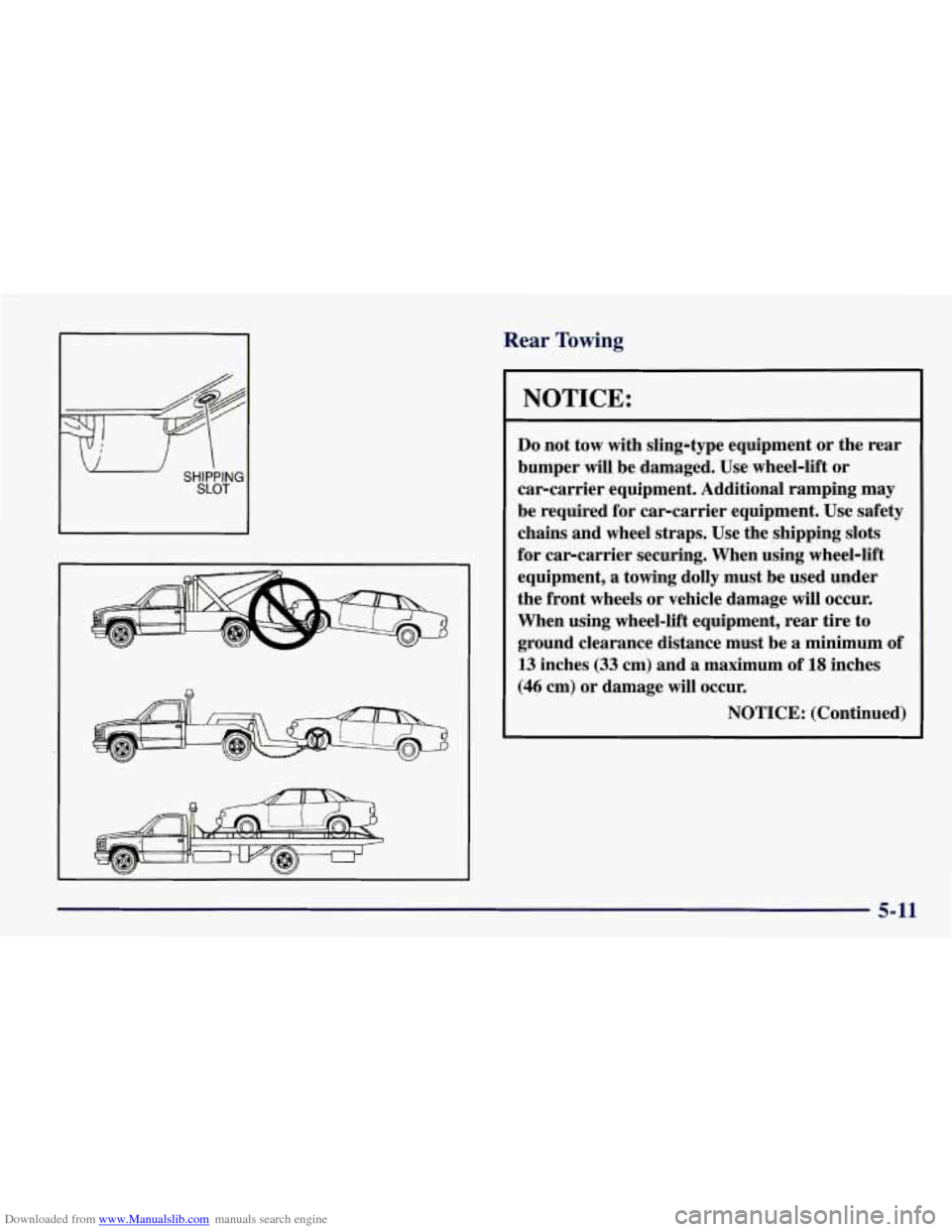
Do not tow with sling-type equipment or the rear
bumper will be damaged. Use wheel-lift or
car-carrier equipment. Additional ramping may
be required for car-carrier equipment. Use safety
chains and wheel straps. Use the shipping slots
for car-carrier securing. When using wheel-lift
equipment, a towing dolly must be used under
the front wheels or vehicle damage will occur.
When using wheel-lift equipment, rear tire to
ground clearance distance must be
a minimum of
13 inches (33 cm) and a maximum of 18 inches
(46 cm) or damage will occur.
NOTICE: (Continued)
5-11
Page 233 of 378
Downloaded from www.Manualslib.com manuals search engine NOTICE: (Continued)
Towing a vehicle over rough surfaces could
damage the vehicle. Damage can occur from
vehicle to ground or vehicle to wheel-lift
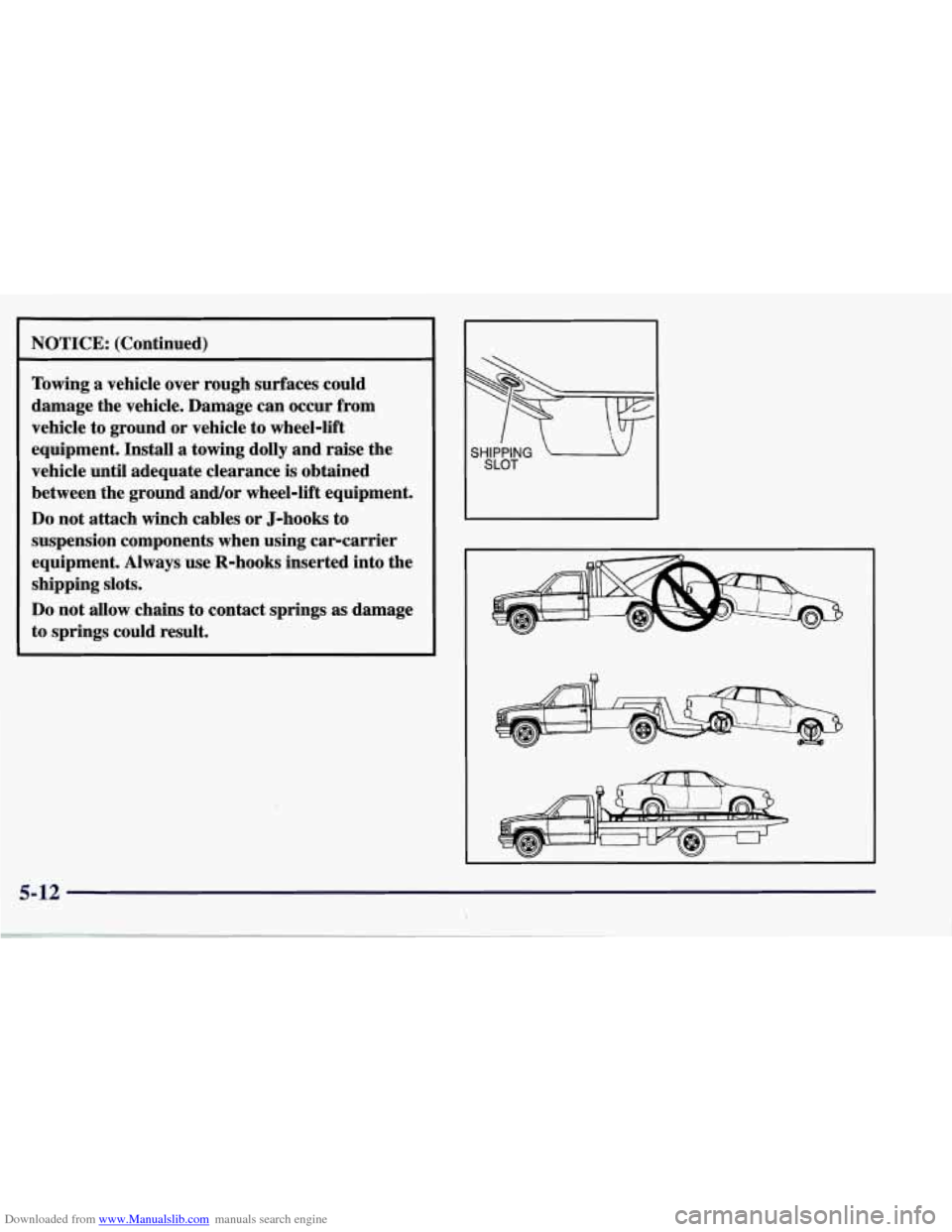
equipment. Install a towing dolly and raise the
vehicle until adequate clearance
is obtained
between the ground and/or wheel-lift equipment.
Do not attach winch cables or J-hooks to
suspension components when using car-carrier
equipment. Always use R-hooks inserted into the
shipping slots.
Do not allow chains to contact springs as damage
to springs could result.
SHIPPING SLOT
"
5-12 ~
Page 294 of 378
Downloaded from www.Manualslib.com manuals search engine A CAUTION:
Using the wrong replacement wheels, wheel bolts
or wheel nuts on your vehicle can be dangerous.
It could affect the braking and handling of your
vehicle, make your tires lose air and make you
lose control. You could have a collision in which
you or others could be injured. Always use the
correct wheel, wheel bolts and wheel nuts
for replacement.
I NOTICE:
The wrong wheel can also cause problems with
bearing life, brake cooling, speedometer or
odometer calibration, headlamp aim, bumper
height, vehicle ground clearance and tire
clearance to the body and chassis.
A CAUTION:
Rust or dirt on the wheel, or on the parts to
which
it is fastened, can make the wheel nuts
become loose after a time. The wheel could come
off and cause an accident. When you change a
wheel, remove any rust or dirt from the places
where the wheel attaches to the vehicle. In an
emergency, you can use a cloth or paper towel to
do this; but be sure to use a scraper or wire brush
later,
if you need to, to get all the rust or dirt off.
I A CAUTION:
I
Never use oil or grease on studs or nuts. If you
do, the nuts might come loose. Your wheel could
fall off, causing a serious accident.
6-49