Page 240 of 378
Downloaded from www.Manualslib.com manuals search engine Adding only plain water to your cooling system
can be dangerous. Plain water, or some other
liquid like alcohol, can boil before the proper
coolant mixture will. Your vehicle’s coolant
warning system is set for the proper coolant
mixture. With plain water or the wrong mixture,
your engine could get too hot but you wouldn’t
get the overheat warning. Your engine could
catch fire and you or others could be burned.
Use a 50/50 mixture of clean water and
DEX-COOL@ coolant.
NOTICE:
In cold weather, water can freeze and crack the
engine, radiator, heater core and other parts.
So
use the recommended coolant.
You can be burned
if you spill coolant on hot
engine parts. Coolant contains ethylene glycol
and it will burn
if the engine parts are hot
enough. Don’t spill coolant on a hot engine.
5-19
Page 243 of 378
Downloaded from www.Manualslib.com manuals search engine If a Tire Goes Flat
Your Corvette has neither a spare tire nor tire changing
equipment, because it was built with Goodyear
Extended Mobility Tires (EMT). See “Extended
Mobility Tires” in the Index.
A C.* UTION:
If You’re Stuck: In Sand, Mud, Ice
or Snow
What you don’t want to do when your vehicle is stuck is
to
spin your wheels too fast. The method known as
“rocking” can help you get out when you’re stuck, but
you must use caution.
Because your vehicle has no spare tire, no tire
changing equipment, and no provisions to store a
tire
in the vehicle, special tools and procedures
are required if a tire needs to be serviced.
If these
tools and procedures aren’t used, you or others
could be injured and your vehicle could be
damaged. Always be sure the proper tools and
procedures,
as described in the GM Corvette
Service Manual, are used.
To order a service manual, see “Service and Owner
Publications” in the Index.
A CAUTION:
If you let your tires spin at high speed, they can
explode, and you or others could be injured.
And, the transmission or other parts of the
vehicle can overheat. That could cause an engine
compartment fire or other damage. When you’re
stuck, spin the wheels as little as possible. Don’t
spin the wheels above
35 mph (55 km/h) as shown
on the speedometer.
Page 267 of 378
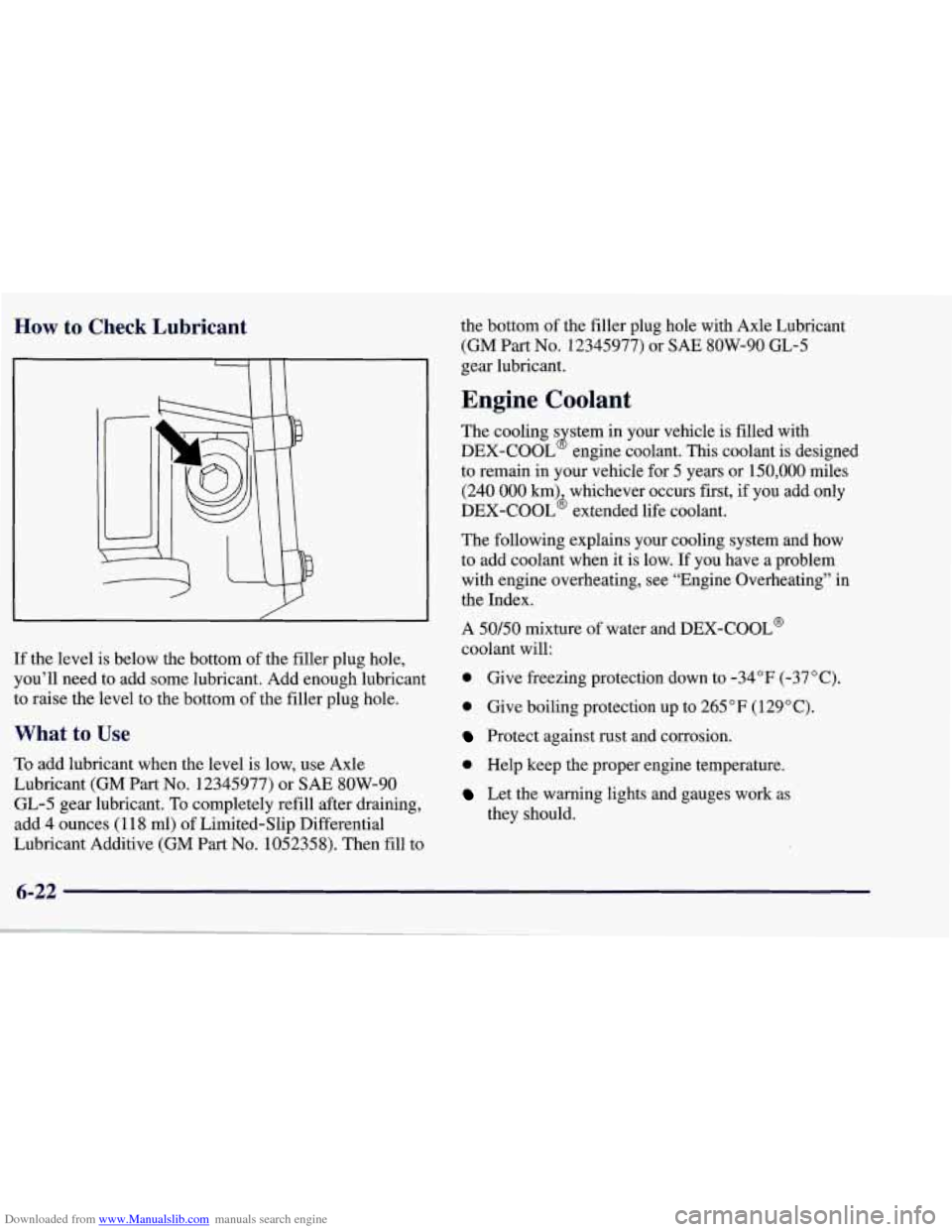
Downloaded from www.Manualslib.com manuals search engine How to Check Lubricant
If the level is below the bottom of the filler plug hole,
you’ll need to add some lubricant. Add enough lubricant
to raise
the level to the bottom of the filler plug hole.
What to Use
To add lubricant when the level is low, use Axle
Lubricant (GM Part
No. 12345977) or SAE 8OW-90
GL-5 gear lubricant. To completely refill after draining,
add
4 ounces (1 18 ml) of Limited-Slip Differential
Lubricant Additive (GM Part
No. 1052358). Then fill to the bottom
of the filler plug hole with Axle Lubricant
(GM Part No. 12345977) or SAE 8OW-90 GL-5
gear lubricant.
Engine Coolant
The cooling s stem in your vehicle is filled with
DEX-COOL engine coolant. This coolant is designed
to remain in your vehicle for
5 years or 150,000 miles
(240 000 km) whichever occurs first, if you add only
DEX-COOL’ extended life coolant.
The following explains your cooling system and how
to add coolant when it is low. If you have a problem
with engine overheating, see “Engine Overheating” in
the Index.
A
50/50 mixture of water and DEX-COOL@
coolant will:
0 Give freezing protection down to -34°F (-37°C).
8
0 Give boiling protection up to 265 “F (129” C).
Protect against rust and corrosion.
0 Help keep the proper engine temperature.
Let the warning lights and gauges work as
they should.
6-22
Page 268 of 378
Downloaded from www.Manualslib.com manuals search engine NOTICE:
When adding coolant, it is important that you use
only
DEX-COOL@ (silicate-free) coolant.
If coolant other than DEX-COOL is added to the
system, premature engine, heater core or
radiator corrosion may result. In addition, the
engine coolant will require change sooner
-- at
30,000 miles (50 000 km) or 24 months,
whichever occurs first. Damage caused by the use
of coolant other than DEX-COOL@ is not
covered by your new vehicle warranty.
What to Use
Use a mixture of one-half clean water (preferably
distilled) and one-half
DEX-COOL@ coolant which
won’t damage aluminum parts.
If you use this mixture,
you don’t need
to add anything else.
I
/II CALTTION:
Adding only plain water to your cooling system
can be dangerous. Plain water, or some other
liquid like alcohol, can boil before the proper
coolant mixture will. Your vehicle’s coolant
warning system
is set for the proper coolant
mixture. With plain water or the wrong mixture,
your engine could get too hot but you wouldn’t
get the overheat warning. Your engine could
catch fire and you or others could be burned.
Use a
50/50 mixture of clean water and
DEX-COOL@ coolant.
6-23
Page 269 of 378
Downloaded from www.Manualslib.com manuals search engine NOTICE:
If you use an improper coolant mixture, your
engine could overheat and be badly damaged.
The repair cost wouldn’t be covered by your
warranty. Too much water in the mixture can
freeze and crack the engine, radiator, heater core
and other parts.
If you have to add coolant more than four times a year,
have your dealer check your cooling system.
NOTICE:
If you use the proper coolant, you don’t have to
add extra inhibitors or additives which claim to
improve the system. These can be harmful.
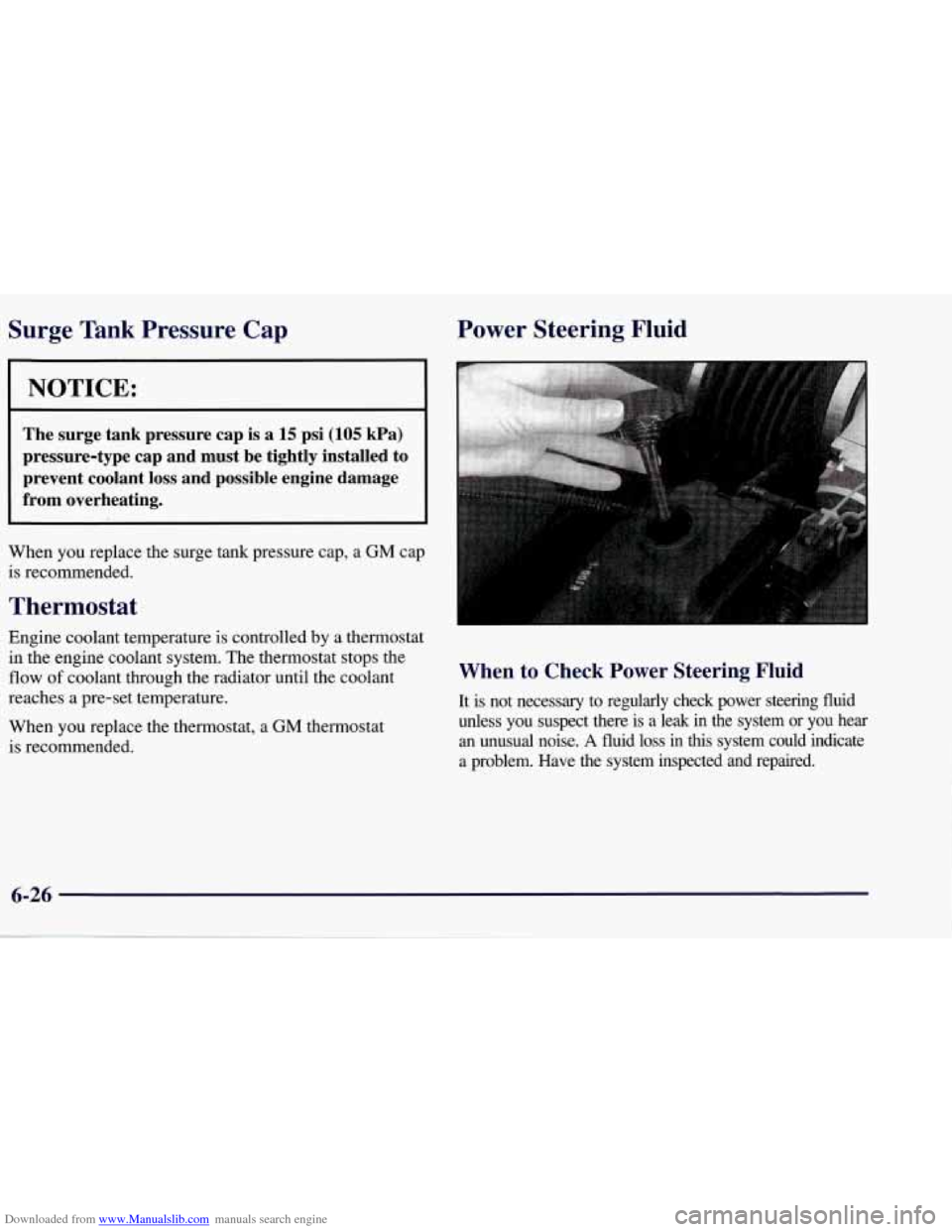
Checking Coolant
The coolant surge tank is in the engine compartment
behind the headlamp.
Page 271 of 378
Downloaded from www.Manualslib.com manuals search engine Surge Tank Pressure Cap
NOTICE:
The surge tank pressure cap is a 15 psi (105 kPa)
pressure-type cap and must be tightly installed to prevent coolant
loss and possible engine damage
from overheating.
When you replace the surge tank pressure cap, a GM cap
is recommended.
Thermostat
Engine coolant temperature is controlled by a thermostat
in the engine coolant system. The thermostat stops the
flow of coolant through the radiator until the coolant
reaches a pre-set temperature.
When you replace the thermostat, a GM thermostat
is recommended.
Power Steering Fluid
When to Check Power Steering Fluid
It is not necessary to regularly check power steering fluid
unless you suspect there is a leak
in the system or you hear
an unusual noise. A fluid loss in this system could indicate
a problem. Have the system inspected
and repaired.
Page 285 of 378
Downloaded from www.Manualslib.com manuals search engine 3. Put the blade assembly pivot in the wiper arm
hook. Pull up until the pivot locking tab locks
in the hook slot.
4. Carefully lower the wiper arm and blade assembly
into the windshield.
Tires
Your new vehicle comes with high-quality tires made by
a leading tire manufacturer. If you ever have questions
about your tire warranty and where to obtain service, see
your Corvette Warranty booklet for details.
A CAUTION:
Poorly maintained and improperly used tires
are dangerous.
0
0
0
Overloading your tires can cause overheating
as a result of too much friction. You could
have an airout and a serious accident.
See
‘Zoading Your Vehicle” in the Index.
Underinflated tires pose the same danger as
overloaded tires. The resulting accident
could cause serious injury. Check all tires
frequently to maintain the recommended
pressure. Tire pressure should be checked
when your tires are cold.
Overinflated tires are more likely to be
cut, punctured or broken by a sudden
impact
-- such as when you hit a pothole.
Keep tires at the recommended pressure.
Worn, old tires can cause accidents.
If your
tread is badly worn, or if your tires have
been damaged, replace them.
Page 309 of 378
Downloaded from www.Manualslib.com manuals search engine Headlamps
The headlamp wiring is protected by a circuit breaker.
An electrical overload will cause the lamps to go on and
off, or in some cases to remain off. If this happens, have
your headlamp wiring checked right away.
Windshield Wipers
The windshield wiper motor is protected by a fuse and
an internal circuit breaker. If the motor overheats due to
heavy snow, etc., the wiper will stop until the motor
cools. If the overload is caused by some electrical
problem and not snow, etc., be sure to get it fixed.
Power Windows and Other Power Options
Circuit breakers protect the power seats and other power
accessories. When the current load is too heavy, the
circuit breaker opens and closes, protecting the circuit
until the problem is fixed or goes away.
Fuses and Circuit Breakers
The wiring circuits in your vehicle are protected from
short circuits by a combination of maxi-fuses,
mini-fuses and circuit breakers. This greatly reduces the
chance of fires caused by electrical problems. replace
a bad fuse with a new one of the identical size
and rating.
If you ever have a problem on the road and don’t have a
spare fuse, you can borrow one that has the same
amperage. Just pick some feature of your vehicle that
you can get along without
-- like the radio or cigarette
lighter
-- and use its fuse, if it is the correct amperage.
Replace it as soon as you can.
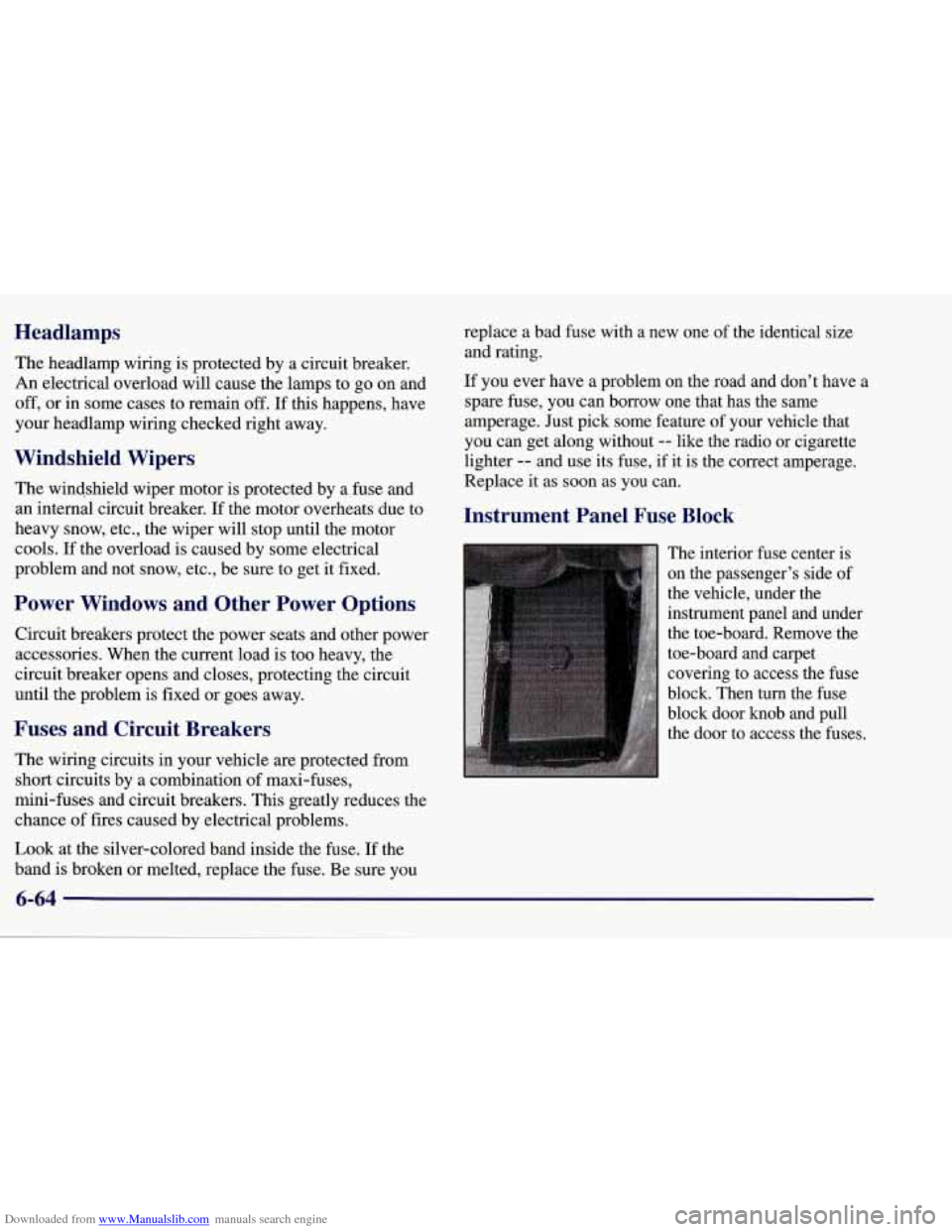
Instrument Panel Fuse Block
The interior fuse center is
on the passenger’s side of
the vehicle, under the
instrument panel and under
the toe-board. Remove the
toe-board and carpet
covering to access the fuse
block. Then turn the fuse
block door knob and pull
the door
to access the fuses.
Look at the silver-colored band inside the fuse. If the
band is broken or melted, replace the fuse. Be sure you