1998 CHEVROLET ASTRO tow
[x] Cancel search: towPage 259 of 414
Downloaded from www.Manualslib.com manuals search engine If You’re Stuck: In Sand, Mud,
Ice
or Snow
What you don’t want to do when your vehicle is stuck is
to spin your wheels too fast. The method known
as
“rocking” can help you get out when you’re stuck, but
you must use caution.
L
A CAUTION: I I
If you let your tires spin at high speed, they can
explode, and you or others could be injured. And,
the transmission or other parts
of the vehicle can
overheat. That could cause an engine
compartment fire or other damage. When you’re
stuck, spin the wheels as little
as possible. Don’t
spin the wheels above
35 mph (55 km/h) as shown
on the speedometer.
NOTICE:
Spinning your wheels can destroy parts of your
vehicle as well as the tires.
If you spin the wheels
too fast while shifting your transmission back
and forth, you can destroy your transmission.
For information about using tire chains on your vehicle,
see “Tire Chains” in the Index.
Rocking Your Vehicle To Get It Out
First, turn your steering wheel left and right. That will
clear the area around your front wheels. Then shift back
and forth between
REVERSE (R) and a forward gear,
spinning the wheels as little as possible. Release the
accelerator pedal while you shift, and press lightly on
the accelerator pedal when the transmission is in gear. If
that doesn’t get you out after a few tries, you may need
to be towed out. If you do need to be towed out, see
“Towing Your Vehicle” in the Index.
5-37
Page 276 of 414

Downloaded from www.Manualslib.com manuals search engine Engine Oil Additives
Don't add anything to your oil, Your dealer is ready to
advise if you think something should be added.
When to Change Engine Oil
If any one of these is true for you, use the short trip/city
maintenance schedule:
0
0
0
e
0
Most trips are less than 5 to 10 miles (8 to 16 km).
This
is particularly important when outside
temperatures are below freezing.
Most trips include extensive idling (such as frequent
driving in stop-and-go traffic).
Most trips are through dusty areas.
You frequently tow a trailer or use a carrier on top of
your vehicle.
The vehicle is used for delivery service, police, taxi
or other commercial apl :ation.
Driving under these conc'"ions c
Ses engine oil to
break down sooner. If any one oi rnese is true for your
vehicle, then you need to change your oil and filter
every
3,000 miles (5 000 km) or 3 months -- whichever
occurs first. If
none
of them is true, use the long trip/highway
maintenance schedule. Change the oil and filter every
7,500 miles (12 500 km) or 12 months -- whichever
occurs first. Driving a vehicle with a fully warmed
engine under highway conditions causes engine oil
to
break down slower.
What to Do with Used Oil
Did you know that used engine oil contains certain
elements that may be unhealthy for your skin and could
even cause cancer? Don't
let used oil stay on your skin
for very long. Clean your skin and nails with soap and
water, or a good hand cleaner. Wash or properly throw
away clothing or rags containing used engine oil. (See
the manufacturer's warnings about the use and disposal
of oil products.)
Used oil can be a real threat to the environment. If you
change your own oil, be sure
to drain all free-flowing oil
from the filter before disposal. Don't ever dispose
of oil
by putting it
in the trash, pouring it on the ground, into
sewers,
or into streams or bodies of water. Instead,
recycle
it by taking it to a place that collects used oil. If
you have a problem properly disposing of your used
oil,
ask your dealer, a service station or a local recycling
center for help.
6-14
Page 282 of 414
Downloaded from www.Manualslib.com manuals search engine Automatic Transmission Fluid
When to Check and Change
How to Check
Because this operation can be a little difficult, you may
choose
to have this done at your GM dealership ~
A good time to check your automatic transmission fluid Service Department.
level is when the engine oil
is changed.
Change both the fluid and filter every
15,000 miles here, or you could get a false reading on the dipstick.\
(25 000 km) if the vehicle is mainly driven under one or If
you do
it yourself, be sure to follow all the instructions
more of these conditions:
0 In heavy city traffic where the outside temperature
0 In hilly or mountainous terrain.
0 When doing frequent trailer towing.
regularly reaches
90°F (32 “C) or
higher.
NOTICE:
Too much or too little fluid can damage your
transmission.
Too much can mean that some of
the fluid could come out and fall on hot engine
Uses such as found in taxi, police or delivery service.
If you do not
use your vehicle under any of
these conditions, change the fluid and filter every
50,000 miles (83 000 km).
parts or exhaust system parts, starting a fire. Be
sure to get an accurate reading if you check your
transmission fluid.
See “Scheduled Maintenance Services’’ in the Index.
6-20
Page 284 of 414
Downloaded from www.Manualslib.com manuals search engine I
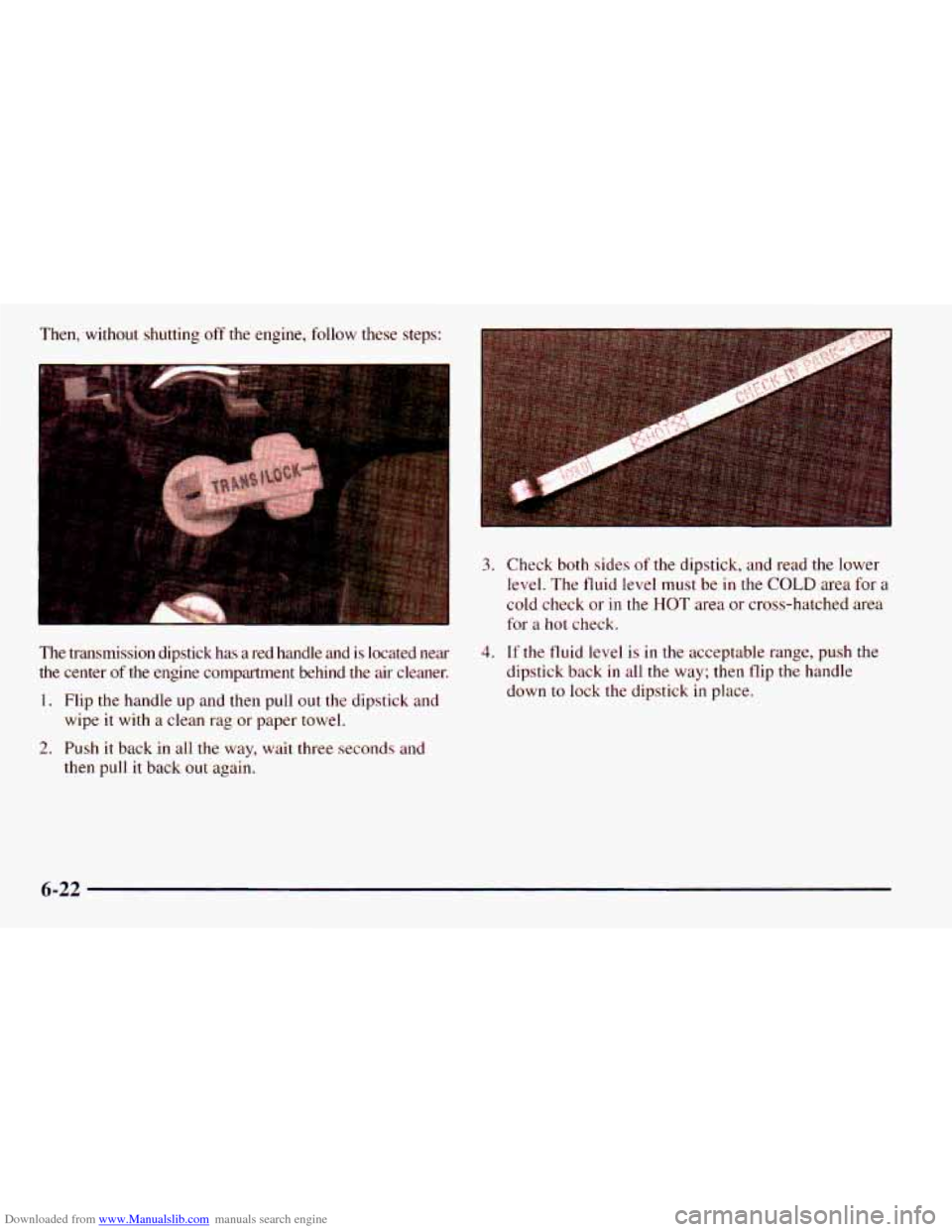
Then, without shutting off the engine, follow these steps:
The transmission dipstick has a red handle and
is located near
the center of the engine compartment behind the air cleaner.
1. Flip the handle up and then pull out the dipstick and
wipe it with a clean rag or paper towel.
then pull it back out again.
2. Push it back in all the way, wait three seconds and
3. Check both sides of the dipstick, and read the lower
level. The fluid level must be in the
COLD area for a
cold check or in the
HOT area or cross-hatched area
for a hot check.
4. If the fluid level is in the acceptable range, push the
dipstick back
in all the way; then flip the handle
down to lock the dipstick in place.
6-22
Page 302 of 414
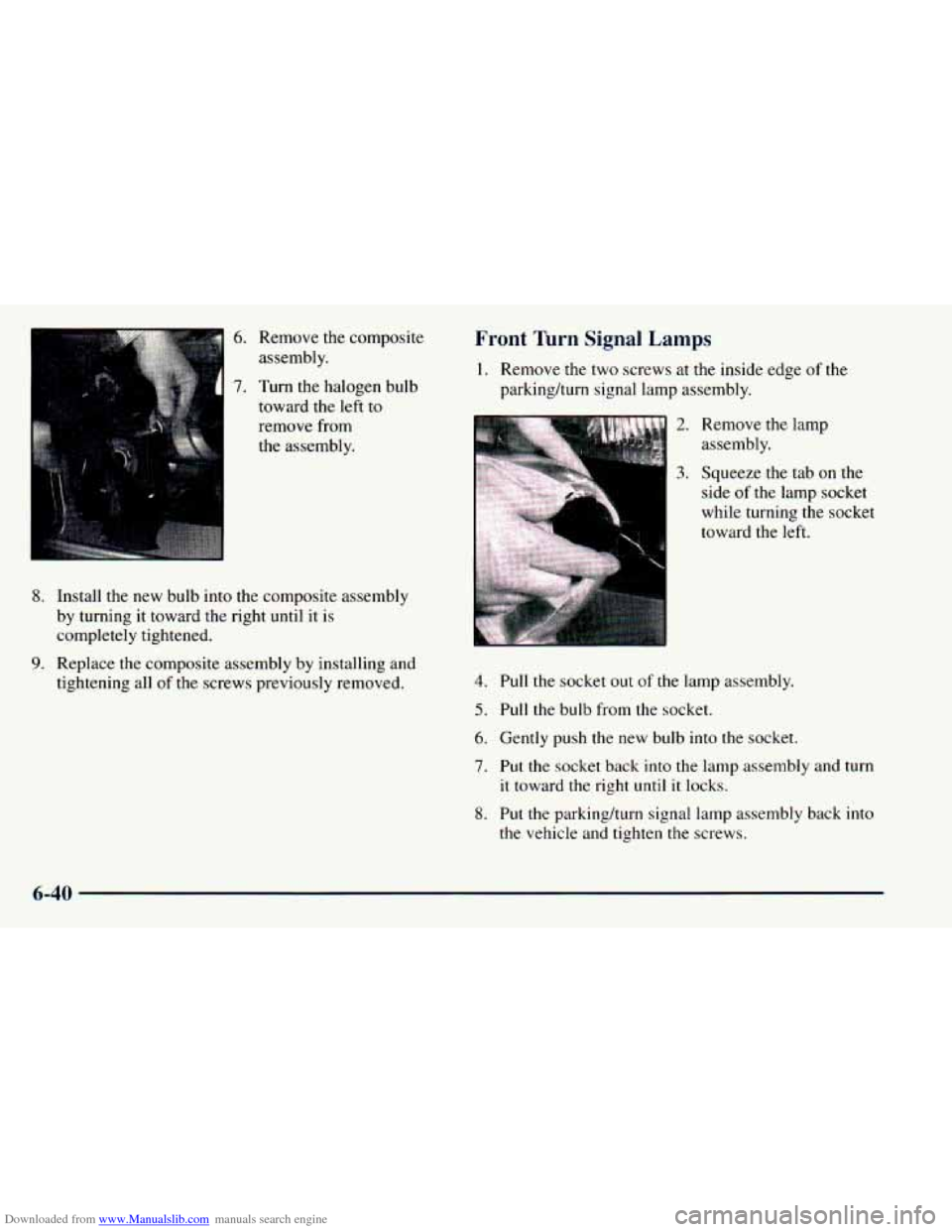
Downloaded from www.Manualslib.com manuals search engine 6. Remove the composite
assembly.
7. Turn the halogen bulb
toward the left
to
remove from
the assembly.
8. Install the new bulb into the composite assembly
by turning it toward the right until it is
completely tightened.
tightening all
of the screws previously removed.
9. Replace the composite assembly by installing and
Front Turn Signal Lamps
1. Remove the two screws at the inside edge of the
parkingkurn signal lamp assembly.
4.
5.
6.
7.
8.
.. .
2.
3.
Remove the lamp
assembly.
Squeeze the tab
on the
side of the lamp socket
while turning the socket
toward
the left.
Pull the socket out
of the lamp assembly.
Pull the bulb from the socket.
Gently push the new bulb into the socket.
Put the socket back into the lamp assembly and turn
it toward the right until it locks.
Put
the parkinghrn signal lamp assembly back into
the vehicle and tighten the screws.
6-40
Page 307 of 414

Downloaded from www.Manualslib.com manuals search engine I
Don’t include the compact spare tire in your
tire rotation.
After the tires have been rotated, adjust the front and
rear inflation pressures as shown on the
Certificationire label. Make certain that all wheel nuts
are properly tightened. See “Wheel Nut Torque” in
the Index.
Rust or dirt on a wheel, or on the parts to which
it
is fastened, can make wheel nuts become loose
after
a time. The wheel could come off and cause
an accident. When you change
a wheel, remove
any rust or dirt from places where the wheel
attaches to the vehicle.
In an emergency, you can
use
a cloth or a paper towel to do this; but be
sure to use
a scraper or wire brush later, if you
need to, to get all the rust or dirt
off. (See
“Changing
a Flat Tire” in the Index.) When
It’s Time for New Tires
One way to tell when it’s
time for new tires is to
check the treadwear
indicators, which will
appear when your tires have
only
1/16 inch (1.6 mm) or
less of tread remaining.
You need a new tire if any of the following statements
are true:
0 You can see the indicators at three or more places
around the tire.
0 YOU can see cord or fabric showing through the
tire’s rubber.
The tread or sidewall is cracked, cut or snagged deep
enough to show cord or fabric.
0 The tire has a bump, bulge or split.
0 The tire has a puncture, cut or other damage that
can’t be repaired well because of the size or location
of the damage.
6-45
Page 314 of 414
Downloaded from www.Manualslib.com manuals search engine Using Multi-Purpose Interior C1f ~ ~ ~ r
on Fabric
I Vacuum and brush the area to remove any loose dirt.
2. Always clean a whole trim panel or section. Mask
3. Mix powdered cleaner following the directions on
surrounding trim along stitch or welt lines.
the container label to form thick suds.
4. Use suds only and apply with a clean sponge. Don't
5. As soon as you've cleaned the section, use a sponge
saturate
the material and
don't rub it roughly.
to remove the suds.
6. Wipe cleaned area with a clean, damp towel or cloth.
7. Wipe with a clean cloth and let dry.
Special Fabric Cleaning Problems
Stains caused by such things as catsup, coffee (black),
egg, fruit, fruit juice, milk, soft drinks, vomit, urine and
blood can be removed as follows:
1. Carefully scrape off excess stain, then sponge the
soiled area with cool water.
2. If a stain remains, follow the multi-purpose interior
cleaner instructions described earlier.
3. If an odor lingers after cleaning vomit or urine, treat
the area with a waterhaking soda solution:
1 teaspoon (5 ml) of baking soda to 1 cup (250 ml)
of lukewarm water.
4. Let dry.
Stains caused by candy, ice cream, mayonnaise, chili
sauce and unknown stains can be removed as follows:
1. Carefully scrape off excess stain.
2. First, clean with cool water and allow to
dry completely.
3. If a stain remains, follow instructions for
Multi-Purpose Interior Cleaner.
Fabric Protection
Your vehicle has upholstery and carpet that has been
treated with Scotchgard" Fabric Protector, a
3M
product. It protects fabrics by repelling oil and water,
which are the carriers
of most stains. Even with this
protection, you still need
to clean your upholstery and
carpet often to keep it looking new.
Further information on cleaning is available by calling
1-800-433-3296
(in Minnesota, 1-800-642-6167).
6-52
Page 317 of 414

Downloaded from www.Manualslib.com manuals search engine Weatherstrips
Silicone grease on weatherstrips will make them last
longer, seal better, and not stick or squeak. Apply
silicone grease with a clean cloth at least every
six months. During very cold, damp weather more
frequent application may be required. (See
“Recommended Fluids and Lubricants” in the Index.)
Cleaning the Outside of Your Vehicle
The paint finish on your vehicle provides beauty, depth
of color, gloss retention and durability.
Washing Your Vehicle
The best way to preserve your vehicle’s finish is to keep \
it
clean by washing it often with lukewarm or cold water.
Don’t wash your vehicle in the direct rays of the sun.
Don’t use strong soaps or chemical detergents. Use
liquid hand, dish or car washing (mild detergent) soaps.
You can get GM-approved cleaning products from your
dealer. (See “Appearance Care and Materials” in the
I Index.) Don’t use cleaning agents that are petroleum
based, or that contain acid or abrasives. All cleaning
1 agents should be flushed promptly and not allowed to dry on the surface, or
they could stain. Dry the finish
with a soft, clean chamois or an all-cotton towel to
avoid surface scratches and water spotting.
High pressure car washes may cause water to enter
your vehicle.
Cleaning Exterior LampsLenses
Use lukewarm or cold water, a soft cloth and a liquid
hand, dish or car washing (mild detergent) soap to clean
exterior lamps and lenses. Follow instructions under
“Washing Your Vehicle.”
Finish Care
Occasional waxing or mild polishing of your vehicle by
hand may be necessary to remove residue from the paint
finish. You can get GM-approved cleaning products
from your dealer. (See “Appearance Care and Materials”
in the Index.)
Your vehicle has a “basecoat/clearcoat” paint finish.
The clearcoat gives more depth and gloss to the colored
basecoat. Always use waxes and polishes that are
non-abrasive and made for a basecoatklearcoat
paint finish.
6-55